Clutch Kit Opel Replacement: OE-Equivalent Sourcing
A clutch kit Opel replacement programme can look simple on a spreadsheet and fail at the workshop. Plate diameter and spline count matter, but so do release geometry, cover stack height, clamp load, bearing type, carton strength, and the accuracy of the application listing. One wrong assumption can turn into drag complaints, noise returns, or stalled bays across a repair network.
For distributors and procurement teams, the sourcing question is practical: will the kit install like the intended reference, behave consistently in service, and arrive undamaged through international logistics?
Driventus manufactures engine and powertrain components in Taizhou, Zhejiang, and supplies B2B customers in more than 60 countries. For clutch kit sourcing, we focus on OE-equivalent dimensional matching, batch traceability, and shipment-ready validation. The sections below turn the sourcing process into checks buyers can actually use: what belongs in the kit, where programmes fail, how to compare samples, which data to specify, and when to separate references instead of forcing interchange.
Driventus is an independent aftermarket manufacturer; brand names are referenced for fitment only.
Start with the kit boundary, not the catalogue line
A passenger-car clutch kit is usually sold as a matched set, but the word “kit” is not precise enough for procurement. Two suppliers may quote the same reference and include different release parts, different accessories, or no installation note. Before price comparison, define the boundary of supply.
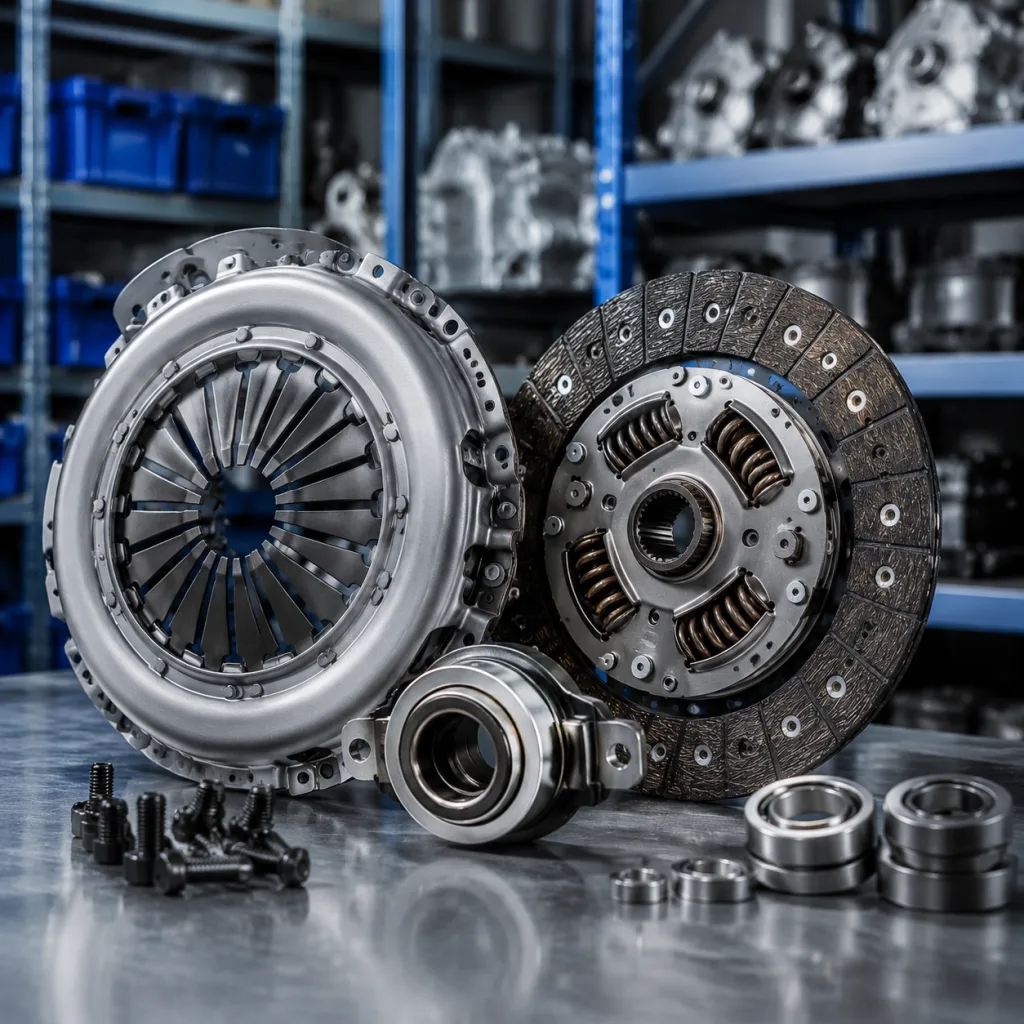
Common kit contents include:
Clutch cover assembly with diaphragm spring
Driven plate with friction facings and torsional damper springs
Release bearing or concentric slave cylinder, where applicable
Alignment tool for selected references, if requested
Installation note, batch label, and application cross-reference sheet
For an Opel replacement range, the design has to match the clutch architecture used on the vehicle platform. The critical variables are not only visible dimensions. Buyers should confirm outer diameter, hub spline, plate offset, cover bolt pattern, release bearing height, and flywheel interface.
A kit can match the vehicle listing and still be wrong. A small release-height difference may cause incomplete disengagement. A pressure plate stack-height deviation can change pedal feel or create slip margin issues. A missing bearing can stop an installation even when the cover and plate are correct.
A useful sourcing file separates three decisions:
1. Vehicle fitment — the application, engine, year, transmission, and regional model naming. 2. Part geometry — the dimensions that determine installation and release movement. 3. Performance evidence — the data showing that the clutch can transmit torque, disengage cleanly, and avoid abnormal noise, drag, or judder.
That separation prevents a common mistake: treating a catalogue match as technical approval.
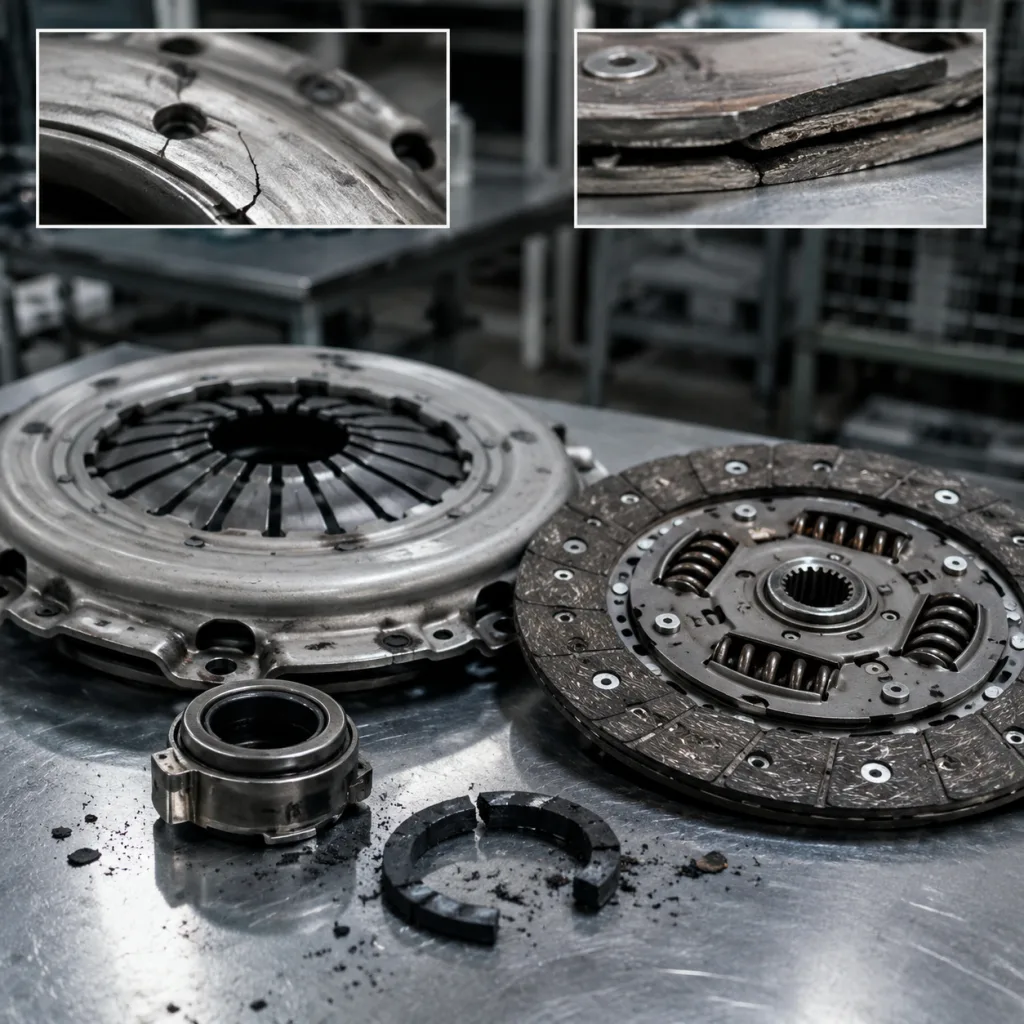
Failure modes that expose weak OE-equivalence claims
OE-equivalence is not a marketing label. It is a verification process. For clutch kits, it means the replacement part matches the original installation envelope and functional requirements closely enough for normal service repair. It does not imply approval or endorsement by any vehicle manufacturer.
The fastest way to evaluate a clutch kit Opel replacement supplier is to ask where the part can fail. Then require evidence against those risks.
Diaphragm spring load curve and working load range
Affects driver perception and service acceptance
Vibration or noise
Balance, damper spring design, rivet setting
Reduces warranty risk
Early wear or facing damage
Friction material and rivet specification
Influences durability and heat behaviour
</tr></thead><tbody> </tbody></table>For OE part-number cross-references, use the buyer’s approved interchange source and keep references generic unless the customer has provided exact data. Where a listing uses an OE-style number, it should be treated as a fitment cross-reference, not as a claim of original manufacturer supply.
Driventus can map customer references against our catalog and provide controlled drawings or sample measurement reports when an application programme needs additional confirmation.
Sample approval: a step-by-step test sequence
Do not test every reference with the same intensity. Use a staged approval route: screen the risk first, then spend deeper validation effort where volume, novelty, or warranty exposure justifies it.
A practical sample approval sequence looks like this:
1. Confirm the application record. Check model, engine, year range, transmission, and market-specific naming. Opel applications can vary by region and platform sharing. 2. Verify kit contents. Confirm whether the quote includes a release bearing, concentric slave cylinder, alignment tool, installation note, or only cover and plate. 3. Measure installation-critical dimensions. Include spline profile, driven plate OD, cover height, bolt pattern, release bearing dimensions, plate offset, and runout. 4. Check functional data. Review static clamp load, working height, torque capacity calculation or rig-test result, and release mechanism behaviour. 5. Inspect material and assembly quality. Look at friction surfaces, rivet setting, spring seating, cover finish, and bearing condition. 6. Review rotating behaviour. Use axial runout and imbalance checks according to the part design and rotating mass. 7. Test packaging as part of the product. Drop and vibration checks matter for export shipments because clutch kits are heavy and damage-sensitive.
Recommended validation items include:
Incoming material verification for steel components, springs, facings, and bearing parts
100% visual inspection of friction surfaces, rivet setting, and cover assembly condition
Dimensional checks for spline profile, cover height, plate runout, and release bearing dimensions
Static clamp load testing for cover assemblies against approved limits
Torque capacity calculation or rig test based on friction coefficient, effective radius, and clamp force
Axial runout and imbalance checks according to the part design and rotating mass
Durability cycling for release mechanism function where programme volume justifies it
Packaging drop and vibration checks for export shipments
For quality governance, production control should align with IATF 16949:2016 and ISO 9001:2015. Environmental and chemical compliance may also be relevant for EU distribution, including REACH (EC) No 1907/2006 for restricted substances in materials and packaging.
High-turnover Opel references and newly introduced SKUs deserve stricter sample approval. Mature low-volume references may be managed through periodic audits and batch inspection, provided the original approval file is sound.
Specification sheet: the data that prevents import surprises
A clutch kit is a technical product and a logistics product at the same time. The pressure plate, friction surfaces, and bearing must survive handling before the workshop ever sees them. If the carton collapses or the bearing is loose in transit, the return will look like a quality issue even when manufacturing was correct.
Build the purchase specification around both dimensions and distribution handling.
Data item
Preferred format
Notes for replacement programmes
Vehicle applications
Make, model, engine, year, transmission
Confirm regional naming differences
Kit contents
Cover, plate, bearing/CSC, accessories
Avoid missing release components
Main dimensions
mm, drawing or inspection sheet
Include spline and stack height
Performance data
Clamp load, torque capacity basis, runout limits
Supports technical approval
Label format
Buyer SKU, barcode, country of origin
Required for warehouse handling
Carton strength
Export-grade corrugated board
Protects pressure plate and bearing
Internal protection
Inserts, separators, anti-rub protection
Reduces transit damage to friction surfaces
Pallet plan
Units per carton, cartons per pallet
Supports landed-cost calculation
Compliance file
REACH declaration, material controls
Important for EU and UK importers
</tr></thead><tbody> </tbody></table>For multi-location repair chains, the installation experience is part of the specification. Technicians expect the correct release part, a clear application note, and no modification. A missing bearing or ambiguous listing can create the same operating cost as a defective part.
Driventus supports application consolidation where one kit can safely cover several references without compromising fit. Where consolidation is not technically safe, we keep references separate rather than forcing an interchange that may increase warranty claims.
When to consolidate, customize, or keep Opel references separate
The sourcing decision is not always “find the cheapest matching kit.” Category managers usually face three scenarios.
Scenario 1: Consolidate references. This works when shared platforms and transmissions use compatible clutch geometry, release travel, torque requirements, and flywheel interfaces. The saving is real: fewer SKUs, simpler stock planning, and higher order volume per reference. But the evidence must be measured compatibility, not catalogue similarity.
Scenario 2: Customize the kit. A distributor may need private-label packaging, a different label format, a specific bearing inclusion, regional application notes, or a non-standard accessory set. Customization is useful when it reduces workshop confusion or aligns with the buyer’s inventory system.
Scenario 3: Keep references separate. This is the correct decision when stack height, release geometry, torque capacity, or flywheel interface differs enough to raise warranty risk. Forced consolidation can save purchasing cost and lose much more through returns.
Driventus is a vertically integrated manufacturer of engine and powertrain components based in Taizhou, Zhejiang. For clutch kit programmes, our B2B support can include:
Application review for Opel passenger-car and light commercial references
Sample production for dimensional and installation verification
Private-label packaging according to distributor requirements
Batch traceability with inspection records
Export documentation for EU, UK, US, Canada, Australia, and Brazil-bound shipments
Engineering review for non-standard kit content or regional fitment differences
Our quality system is structured around IATF 16949:2016 and ISO 9001:2015 principles, including incoming inspection, process control, corrective action, and traceability. For buyers with specific drawings, branding requirements, or kit configurations, our custom manufacturing team can review feasibility, tooling needs, and validation requirements.
When evaluating a clutch kit Opel replacement supplier, ask for samples, installation-critical dimensions, and measured comparison data before placing volume orders. It is a slower start, but it gives category managers better evidence and prevents avoidable returns.
Frequently asked questions
Confirm the vehicle application, kit contents, driven plate diameter, hub spline, pressure plate bolt pattern, release bearing or CSC type, release height, and packaging format. For new references, request samples and inspection data before committing to volume orders.
Sometimes. Shared platforms and transmissions may allow reference consolidation, but buyers should confirm stack height, release geometry, torque capacity, spline data, and flywheel interface. Consolidation should be based on measured compatibility, not only catalogue similarity.
No. OE-equivalent means the replacement part is designed to match the relevant installation and functional requirements. It does not indicate approval, endorsement, or supply status with any vehicle manufacturer.
For application review, sample planning, or landed-cost discussion, send your reference list and target markets to our team. You can [request a quote](/contact.html).