Buying clutch kit Mitsubishi wholesale supply is not a unit-price exercise. A cheap kit becomes expensive when the spline is wrong, the bearing is loose in the box, clamp load varies by batch, or the carton fails before it reaches the installer. The better sourcing question is: can this supplier repeat the same fitment, contents, packaging, and records across the next 12–24 months?
Start the RFQ with measurable facts: kit diameter, spline count, hub offset, release bearing type, cover load target, packaging standard, MOQ by SKU, and annual demand. Do not rely on the vehicle model name alone. This guide is for importers, aftermarket distributors, repair-chain buyers, and sourcing engineers evaluating Mitsubishi-fitment clutch kits from China. It shows where sourcing programmes usually fail, how to structure trial orders, what to inspect before approval, and how to compare quotations on a like-for-like basis.
Driventus manufactures and exports engine and powertrain components from Taizhou, Zhejiang, under IATF 16949:2016 and ISO 9001:2015 quality management systems. Driventus is an independent aftermarket manufacturer; vehicle and brand names are referenced for fitment identification only.
Decision point: define the kit before you discuss price
Two clutch kit offers can use the same application description and still be materially different. One may include a release bearing; another may not. One may use a different hub offset, cover design, or carton standard. Before price comparison, freeze the kit definition.
A wholesale clutch kit programme normally includes some or all of the following:
Clutch cover assembly / pressure plate
Clutch disc with hub and torsion damper springs
Release bearing, or concentric slave cylinder where the application requires it
Pilot bearing or pilot bushing where required by the vehicle design
Alignment tool for selected boxed kits
Installation note, batch label, and traceability code
For Mitsubishi-fitment applications, the high-risk dimensions are driven plate diameter, spline count, spline profile, hub offset, cover clamp load, release travel, and bearing interface. Common aftermarket clutch disc diameters often fall in the 200–260 mm range depending on application, but the number itself is not enough. Confirm spline major and minor diameter, spline count, hub overall height, hub offset, cover mounting PCD, release finger height, and bearing inner/outer diameter against an OE cross-reference, drawing, or controlled sample.
Small errors are not small in service. A slight spline mismatch can block installation. Incorrect finger height can cause release problems. The wrong bearing interface may create noise or premature failure. Variation in friction material or clamp load can show up as judder, difficult gear engagement, pedal vibration, or short lining life.
When launching a new range, provide OE part-number cross-references where available, plus vehicle model, engine code, production year, transmission type, drive configuration, and market region. Avoid a model-name-only RFQ. Regional specifications can differ, and aftermarket catalogues sometimes merge applications that should remain separate. If there are two flywheel designs, two release systems, or a model-year changeover, split the RFQ line until interchangeability is confirmed.
A practical launch is usually 10–30 high-demand SKUs, not a full catalogue. For each SKU, collect local monthly sales, warranty history, competitor price, and stock days. Procurement teams can review our catalog and shortlist applications based on local demand, warranty exposure, competitive coverage, and warehouse turnover.
Order architecture: split A-movers from coverage SKUs
For clutch kit Mitsubishi wholesale projects, order structure matters as much as the quote. Treat fast-moving references and low-volume coverage parts differently. Otherwise, MOQ pressure can turn a profitable range into slow inventory.
Sourcing item
Typical procurement check
Buyer action
MOQ by reference
Confirm MOQ per SKU, not only total order value
Use 50–100 sets/SKU for trial discussion where tooling and parts are existing; expect higher MOQ for new or slow references
Trial order
Agree sample or pilot batch quantity
Approve 2–5 samples first, then run a pilot order before container volume
Standard lead time
Confirm production and packing time after deposit and approvals
Plan 30–45 days for existing references; allow 45–75 days for new private-label or development items
Packaging option
Neutral, private label, or distributor brand
Add 7–15 days for artwork approval and printed carton scheduling if not pre-approved
Mixed-SKU shipment
Confirm carton consolidation and pallet rules
Combine A/B/C movers while protecting carton identity and scan accuracy
Spare components
Check whether bearings, discs, or covers can be supplied separately
Support warranty analysis and service-network replenishment
</tr></thead><tbody> </tbody></table>Lead time depends on tooling status, component availability, friction material selection, bearing configuration, order mix, and packaging approval. Existing references with approved drawings and standard cartons move faster. Private-label projects need artwork approval, barcode checks, sample cartons, and sometimes drop or compression validation.
Use an A/B/C model. A-movers can be ordered every 60–90 days. B-movers may suit quarterly replenishment. C-movers are often better grouped into two or three production windows per year. This keeps range coverage without forcing excessive stock on slow SKUs.
Ask for price breaks at 50, 100, 300, and 500 sets per SKU where applicable. Separate tooling, sample, artwork, inspection, and carton plate charges. A mixed 20-foot or 40-foot container may lower freight per kit, but the saving can disappear if MOQ forces six months of dead stock.
A useful RFQ line should state: part reference, application, disc diameter, spline count, kit content, target first order quantity, annual forecast, packaging type, barcode requirement, Incoterms, inspection requirement, destination port, and required documents. This tells the factory you are sourcing repeat supply, not asking for a one-off price.
Failure modes to eliminate before supplier approval
A low purchase price does not help if the programme generates noise, judder, release complaints, gear engagement problems, or claims from installers. Supplier approval should target the failure modes that create field cost.
Key approval checks include:
Disc outside diameter and lining thickness against drawing limits
Spline count, spline profile, and hub runout
Hub offset and damper spring configuration
Clamp load and release load curve of the cover assembly
Diaphragm spring hardness and heat-treatment control
Flywheel-side and pressure-plate-side marking where required
Friction material batch records and coefficient stability
Release bearing dimensions, rotation smoothness, seal condition, and grease control
Static balance and cover assembly runout
Rivet quality and lining bonding or riveting consistency
Salt spray or corrosion protection checks where specified
Carton compression, label accuracy, and barcode readability
Turn the list into measurable requirements. Check disc OD with a caliper or fixture. Verify splines with GO/NO-GO gauges. Measure hub runout, cover finger height, pressure plate flatness, release bearing ID/OD/height, and bearing rotation noise. For the cover, request a clamp-load curve from a clutch test bench where available.
If the buyer has no drawing, the first approved sample and inspection report should become the frozen reference for future production. Any change in friction material, bearing source, spring design, or cover stamping should require buyer notification.
For repeat wholesale orders, the control plan should define inspection frequency for critical dimensions and functional characteristics. A common structure is 100% visual inspection for obvious damage and marking, plus batch sampling for dimensions and load testing. Buyers can specify AQL final inspection, for example AQL 1.0 for critical defects, 2.5 for major defects, and 4.0 for minor packaging defects, or apply their own standard.
Define critical defects in the purchase order. Examples include wrong fitment, incorrect spline, missing bearing, cracked friction lining, unsafe rivet condition, incorrect kit contents, or unreadable traceability.
Fitment validation should not stop at catalogue matching. Where possible, compare samples against reference parts, drawings, or controlled vehicle applications. This is especially important when the same Mitsubishi model family has different engines, transmissions, flywheel designs, or release systems across regions. For the first shipment, retain one approved golden sample per SKU and compare future deliveries against it for dimensions, labels, bearing type, and kit contents.
Driventus operates under a documented quality system aligned with IATF 16949:2016 and ISO 9001:2015. These standards support process control, traceability, corrective action, supplier management, and continual improvement, but they do not replace part-level validation.
Factory audit: follow one clutch kit lot from parts to pallet
A useful factory audit is not a tour of clean machines. It is a traceability test. Pick one clutch kit reference and follow the material route from incoming components to assembly, testing, packing, finished-goods storage, and shipment release.
Ask these questions on site:
Are incoming steel, springs, friction materials, castings, stampings, and bearings inspected by lot?
Are critical gauges calibrated and recorded under a defined schedule?
Is there a controlled drawing revision process for each reference?
Can the factory trace finished kits back to component batches and production dates?
How are nonconforming covers, discs, bearings, and cartons isolated?
Is clamp load tested by batch or by a defined sampling plan?
Are release bearings checked for dimensional accuracy, rotation noise, and lubrication control?
Are private-label cartons checked against approved artwork before packing?
How are customer complaints analysed, contained, and closed?
Are corrective actions verified after implementation?
Are operators trained for critical assembly and inspection points?
Then test the answers. Request the last three production lots of a selected reference. Compare inspection records with actual lot labels, component batches, and finished-goods quantities. Check gauge calibration dates. Confirm damaged or expired gauges are segregated. Watch how operators identify disc orientation, bearing type, and cover variants to prevent mixed-kit errors.
If friction linings, springs, castings, stampings, or bearings are subcontracted, review supplier approval records and incoming inspection criteria. Outsourced parts are not a problem by themselves; uncontrolled outsourced parts are.
A qualified supplier should show inspection records, gauge calibration status, training records, nonconforming material reports, and complaint-handling examples. The records should be current and used for decisions. A useful corrective action file shows containment, root-cause analysis, process correction, verification results, and prevention of recurrence. A replacement shipment alone is not corrective action.
For importers serving the EU and UK, material declarations may be required to support compliance reviews under REACH (EC) No 1907/2006. Packaging materials may require separate declarations depending on buyer requirements and market rules. Buyers selling into other regions should confirm local labelling, safety, and documentation obligations before shipment.
For non-standard specifications, private-label packaging, or application expansion, Driventus can discuss custom manufacturing based on drawings, samples, and target performance requirements. Driventus is an independent aftermarket manufacturer; brand names are referenced for fitment only.
Packaging spec deep-dive: protect the kit, the label, and the claim trail
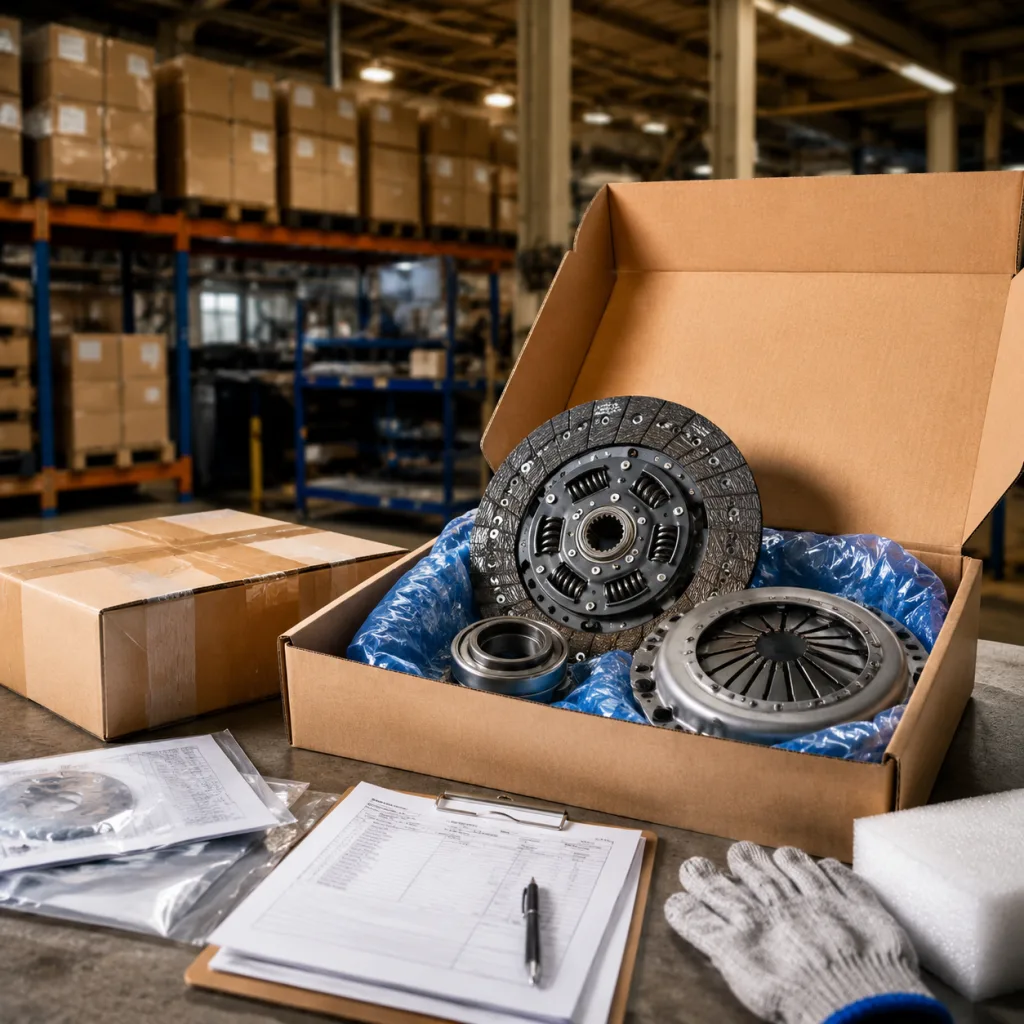
Wholesale clutch kit supply often fails after production. A complete kit is heavy, has machined contact surfaces, and includes parts that should not hit each other inside the carton. Export packaging must protect the pressure plate fingers, disc hub, bearing, and friction surfaces through inland transport, container loading, ocean freight, warehouse handling, and final delivery.
A practical packaging specification should define:
Inner protection for clutch disc friction surfaces
Bearing separation to prevent impact damage
Protection for diaphragm spring fingers and machined surfaces
Anti-corrosion paper, bag, or coating where required
Carton board strength and master carton weight limits
Pallet type, wrapping method, corner protection, and stacking height
SKU label, batch code, barcode, and country-of-origin marking
Private-label artwork approval process
Installation leaflet language and safety notice requirements
Carton marking rules for mixed-SKU shipments
Add numbers wherever possible. Define single-kit carton dimensions or maximum gross weight, master carton limits, pallet height, barcode type, label position, and carton drop-test requirement. For heavier clutch kits, many buyers prefer one kit per inner carton with molded pulp, foam, or corrugated separators so the cover, disc, and bearing cannot contact each other.
If drop testing is required, state the method. For example, define whether cartons must pass a 1-corner, 3-edge, and 6-face drop sequence from a realistic warehouse handling height. For palletized loads, specify whether compression or vibration checks are required.
A label should normally include supplier item number, buyer item number, application reference, kit contents, batch or lot number, quantity, country of origin, barcode, and approved private-label text. For mixed-SKU shipments, require a packing list by pallet and carton sequence so warehouse receiving can scan and reconcile quickly. If the buyer uses EAN-13, UPC, Code 128, or QR traceability, approve the barcode standard and minimum scan grade before mass printing.
Agree documentation before shipment. Common export documents include commercial invoice, packing list, bill of lading, certificate of origin where required, and inspection report. Some buyers also require pre-shipment photos, carton marking confirmation, production batch lists, third-party inspection reports, material declarations, or container loading photos. Put these requirements in the purchase order.
For repair chains, labelling consistency reduces picking errors and incorrect installation attempts. For distributors, carton durability affects resale condition and return rates. A strong clutch kit can still create commercial damage if the box arrives crushed, the bearing is loose, the label is unclear, or the barcode will not scan.
Quote comparison: cheapest FOB is not always lowest cost
When comparing clutch kit Mitsubishi wholesale quotations, normalise the offer before choosing a supplier. A quote that excludes the release bearing, uses weaker cartons, omits batch inspection, or assumes neutral packaging may look cheaper while carrying higher landed cost and warranty exposure.
Compare every quote on the same basis:
Is the kit content identical across suppliers?
Are the same applications, engines, and transmission variants included?
Are drawings, samples, or reference parts used for confirmation?
Does the price include private-label packaging or only neutral cartons?
What is the MOQ per SKU and per shipment?
Is the lead time based on existing stock, scheduled production, or new development?
Which quality records are supplied with each batch?
Are inspection costs, sample costs, and packaging development costs included or separate?
Are warranty terms and claim evidence requirements clearly defined?
Can the supplier support repeat orders for at least 12–24 months?
Is there a clear process for catalogue corrections and superseded references?
Build a landed-cost comparison with unit price, inland freight, export handling, ocean or air freight, insurance, duty, customs broker charges, destination trucking, inspection cost, packaging development cost, and expected warranty allowance. If one supplier is USD 1.00 cheaper per kit but requires 300 sets per slow SKU, the inventory cost may exceed the saving. A lower FOB price can also vanish if cartons fail, claims rise, or the buyer must relabel goods after arrival.
Price the warranty terms as well. Define the claim window, evidence required, compensation method, and whether labour claims are excluded. For clutch kits, suppliers commonly request photos of the failed part, vehicle information, installation date, mileage, batch label, and technician findings. Make sure the batch code remains visible after warehouse handling so claims can be traced to production lots.
The best-value supplier is usually the one that combines stable fitment, repeatable production, reliable packaging, realistic MOQ, predictable lead time, and responsive after-sales handling. Not the lowest initial quote.
For a new programme, use a staged route: confirm applications, approve samples, place a pilot order, review packaging and field feedback, then expand the range. This gives the importer time to validate fitment, carton performance, warehouse handling, and claims response before committing to high-volume container orders. To begin a commercial review, buyers can request a quote with application list, target quantities, and packaging requirements.
Frequently asked questions
Provide vehicle model, engine, year range, transmission type, target OE cross-reference if available, annual volume, first order quantity, destination port, preferred Incoterms, and packaging requirements. Add disc diameter, spline count, hub offset, cover type, bearing configuration, and sample or drawing references where available. Photos, drawings, or physical samples help prevent catalogue mismatch.
Yes. Private-label packaging can be discussed for qualified wholesale orders, including carton artwork, barcode, batch label, packing specification, and installation leaflet requirements. These details should be confirmed before quotation because design approval, printing MOQ, sample carton approval, and packaging validation can affect lead time and unit cost.
No. IATF 16949:2016 and ISO 9001:2015 support process control, but each buyer remains responsible for confirming application fitment, import requirements, labelling, and market-specific compliance. Driventus can provide available quality, inspection, and material documentation for procurement review.
If you are building or reviewing a Mitsubishi clutch kit sourcing programme, send your application list, forecast volume, destination market, first-order quantity, target MOQ, Incoterms, and packaging requirements. Our team can review fitment and commercial options at /contact.html