A clutch kit Citroen wholesale project fails or succeeds on details that are easy to miss in a price-only RFQ. The box may say the right model. The kit may still be wrong: spline mismatch, release bearing height error, weak export carton, unverified friction lining, or a catalogue cross-reference that creates returns across several repair branches. Driventus manufactures and supplies engine and powertrain components from Taizhou, Zhejiang, with export experience across more than 60 countries. For Citroen clutch kit programs, our early discussions focus on the decisions that affect repeat orders: model and engine coverage, gearbox type, clutch diameter, spline count, kit contents, MOQ by reference, private-label packing, sample approval, 45–60 day production planning, and batch traceability. This article is structured as a procurement decision framework rather than a generic checklist. It shows where distributors should spend time before approving samples, cartons, and bulk production. Driventus is an independent aftermarket manufacturer; brand names are used only to identify vehicle fitment.
Start With the Range Strategy, Not the Part Number
A Citroen clutch kit program should begin with a stocking decision: which applications justify warehouse space, catalogue work, and repeat purchasing? One isolated reference can be quoted quickly, but a profitable wholesale range is usually built around fast-moving European passenger car and light commercial applications, grouped by vehicle model, engine code, gearbox family, clutch diameter, release mechanism, and shared components.
The vehicle name alone is not safe. Two vehicles with the same model badge may use different gearbox types, release systems, driven plate hubs, or clutch diameters. In this category, common aftermarket clutch diameters often sit in the 180–240 mm range, but spline count, hub profile, bearing height, and pressure plate mounting details vary by application.
Typical kit structures include:
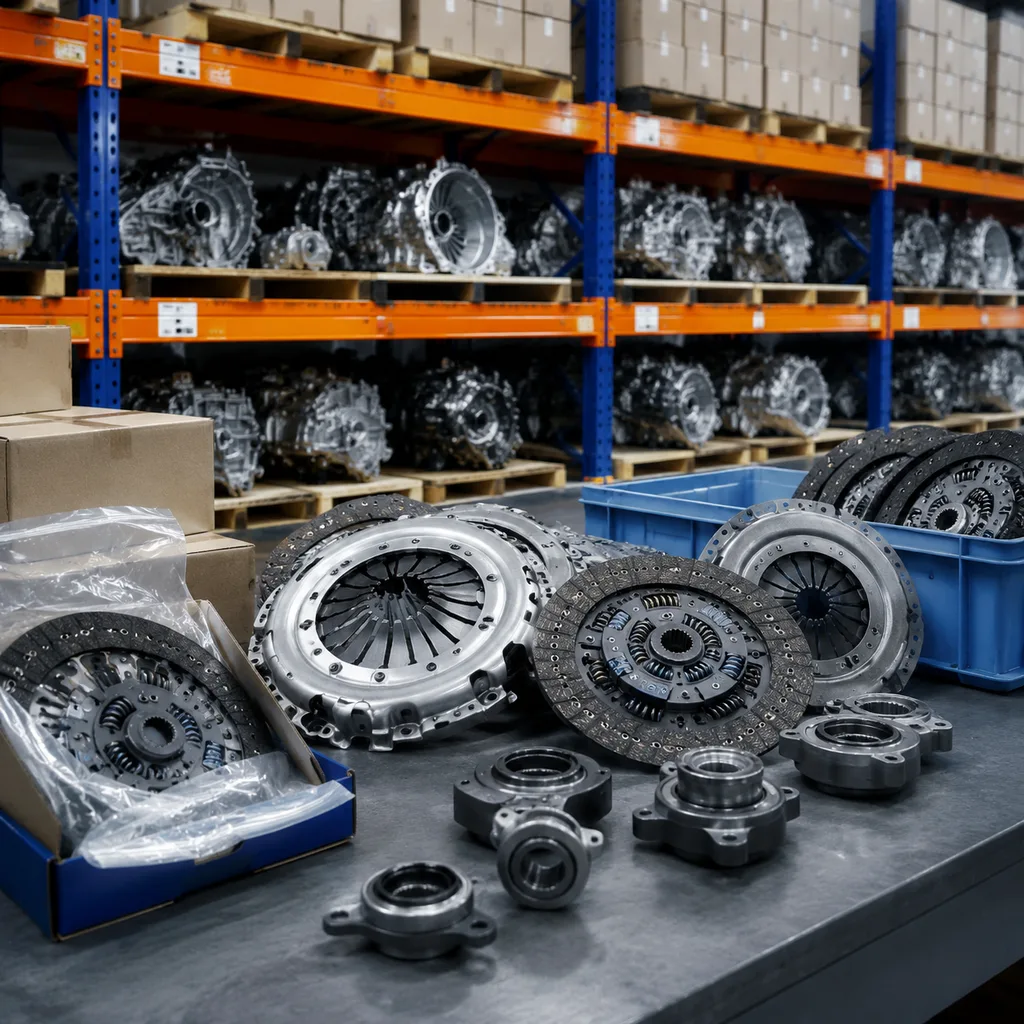
Clutch cover assembly, matched to bolt pattern and clamp-load range
Driven plate, often 180 mm, 200 mm, 215 mm, 228 mm, or 240 mm depending on application
Release bearing or concentric slave cylinder, where required
Alignment tool, if specified by the buyer
Grease sachet and fitting note, if included in the distributor standard
Neutral export box or private-label carton carrying the distributor part number
Driventus can quote from a reference list, physical sample, drawing, or OE part-number cross-reference supplied by the buyer. A partial OE-style number is treated as a fitment clue, not as final engineering approval. Before release, the specification is confirmed through dimensions, application data, kit structure, and agreed inspection criteria.
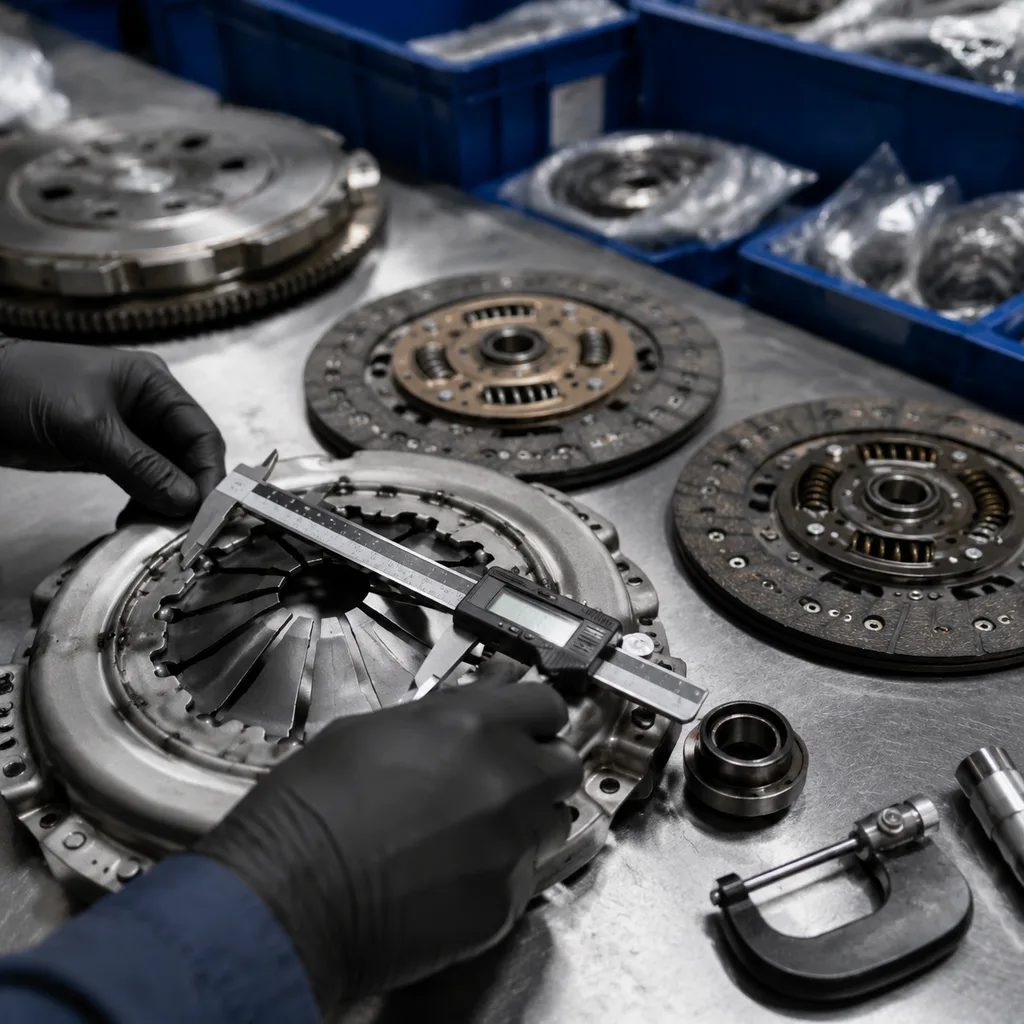
The confirmation points that prevent the most trouble are simple but critical: cover outside diameter, bolt-hole PCD, driven plate outside diameter and thickness, spline count, spline major and minor diameter, release bearing height, bearing interface, and carton label reference.
Procurement teams can review our catalog to understand the wider powertrain range, then send the clutch kit reference list for matching. Brand names, where they appear in sourcing data or catalogues, are used only for application identification; Driventus does not claim vehicle manufacturer approval or endorsement.
Commercial Planning: What MOQ and Lead Time Really Depend On
MOQ is not only a sales policy. It is often a function of component commonality. A 100-set order may be workable when the cover, driven plate, and bearing use common tooling and regular material supply. A low-volume hydraulic CSC kit with special connector geometry may require a higher MOQ, longer sample cycle, or staged approval. Buyers should review MOQ by complete kit, not only by printed box label.
Use the table below as a planning conversation, not as a substitute for a reference-level quotation.
Item
Typical wholesale planning point
Buyer note
MOQ per active reference
100–300 sets
Lower end when cover, disc, and bearing are common
MOQ for private-label carton
Often 300–500 cartons per artwork
Depends on printing method and carton supplier
Trial order
Negotiable mixed references
Useful for fitment checks, catalogue validation, and installer feedback
Mass production lead time
45–60 days after sample/artwork approval
Add time for hydraulic bearings or new packaging
Sample lead time
15–30 days when tooling exists
35–60+ days if new tooling, springs, or CSC sourcing is required
Price logic
Volume, kit contents, bearing type, packing
CSC kits and heavy covers usually increase unit cost and freight weight
Packing
Neutral or private-label cartons
Export master cartons and palletisation available
Documents
Invoice, packing list, COO when required
Batch inspection and test records available on request
</tr></thead><tbody> </tbody></table>Export packing should be specified early, especially for EU, UK, US, Canadian, Australian, and Brazilian importers. A clutch kit is heavy enough to punish weak cartons, but precise enough to be damaged by poor internal support. Pressure plate diaphragms should not carry unsupported stacking loads. Driven plates should not rub or bend in transit. Bearings and hydraulic parts must be protected from contamination and impact.
Driventus generally recommends internal separators, individual polybag or anti-rust protection where suitable, desiccant for humid routes, reinforced 5-layer export cartons for heavy kits, master cartons only where inner-box weight remains manageable, and pallet packing for LCL shipments. Single cartons should stay practical for warehouse handling.
A stronger RFQ reduces revisions. Include annual forecast, target markets, packaging artwork status, preferred Incoterms, mixed-container requirements, barcode rules, carton dimensions if fixed, gross/net weight needs, HS-code documentation expectations, and shipping marks. These details affect the quotation long before the goods reach a port.
Spec Deep-Dive: The Small Measurements That Decide Fitment
A clutch kit is a matched system. A disc that fits the spline can still create judder if damping is wrong. A cover that bolts on can still produce poor release if lift or mounting height is outside the intended range. A bearing that looks similar can still cause noise, preload issues, or incomplete disengagement if height and contact geometry are not controlled.
For that reason, a clutch kit Citroen wholesale order should be approved against technical data, not only against a competitor reference.
Friction lining grade, lining thickness, rivet material, and rivet head clearance
Torsion spring arrangement, pre-damper design where used, and damper travel
Release bearing height, contact face radius, inner diameter, and mounting interface
Concentric slave cylinder connection type, stroke, sealing interface, and bleed-port orientation, where applicable
Cover clamp load and lift characteristics at agreed test positions
Static imbalance limits agreed for the program, commonly controlled in gram-centimetre or equivalent internal criteria
Runout, parallelism, and flatness tolerances for the driven plate and cover contact surfaces
Marking, batch code, date code, and box label requirements
Acceptance methods should be written before sample approval. For many aftermarket programs, buyers request disc OD measurement within an agreed tolerance, spline go/no-go gauge verification, driven plate lateral runout checks on a fixture, cover mounting height checks against a reference surface, and release bearing height measurement with a caliper or height gauge. Exact tolerances must follow the approved drawing or sample. The important point is consistency: first article and mass production should be judged the same way.
One commercial failure mode deserves special attention: catalogue mismatch. A kit can be manufactured correctly and still create returns if the application listing is wrong. That damages installer trust and consumes warehouse time. Driventus uses buyer application data, physical samples, dimensional inspection, and cross-reference review to reduce this risk before mass production. When a distributor sends a broad list, we recommend separating confirmed active references from speculative, obsolete, or slow-moving numbers.
Practical RFQ Data
A complete RFQ should include vehicle model range, engine displacement, fuel type, production year range, gearbox type, target kit contents, expected annual volume, destination market, and packing format. If only a competitor number is available, a physical sample, measured drawing, or detailed specification sheet can support cross-reference validation. Photos should show the cover face, diaphragm spring, bolt pattern, disc hub, spline, bearing face, and any hydraulic connector from multiple angles.
Audit the Process, Not Just the Sample
A good sample is useful. It is not proof of repeatable supply. Clutch kits combine friction, stamped, machined, spring, bearing, and sometimes hydraulic components. The supplier’s process discipline determines whether the tenth shipment matches the first.
A practical audit follows the kit through the factory: incoming material and outsourced bearing receipt, cover assembly, disc assembly, testing, rust prevention, final packing, and carton traceability. Look for evidence, not promises.
Driventus operates under IATF 16949:2016 and ISO 9001:2015 quality management frameworks. Buyers can review our quality system before arranging a supplier audit, remote document review, or first-article approval process.
Typical audit evidence for clutch kit wholesale programs includes:
Incoming material inspection records for steel stampings, friction lining, springs, rivets, bearings, and hydraulic parts
Friction material batch traceability and supplier lot number records
Heat treatment or spring performance records where applicable
Dimensional inspection reports for cover, disc, hub, and release component
Clamp load and lift test records from calibrated clutch test equipment
Driven plate runout, cushion deflection, and spline gauge inspection records
Release bearing rotation, noise, height, and interface inspection records
CSC leakage or pressure-hold checks where hydraulic components are supplied
Packaging drop or transport suitability checks, where specified
Non-conformance and corrective action records with containment action
Final inspection sampling plan, such as AQL-based visual and dimensional checks
Batch identification and carton labelling procedure linking cartons to production lots
Market expectations differ. European distributors may request material declarations and restricted-substance controls related to REACH (EC) No 1907/2006. Repair-chain customers may ask for internal criteria covering noise, vibration, and harshness assessment, even where no dedicated public regulation applies to aftermarket clutch kit performance. Some buyers also require retention samples, batch photos, inspection summaries, calibration certificates, or traceability links between carton labels and production lots.
For first orders, define which reports travel with the goods and which are retained by the factory but available on request. Driventus does not claim approval or endorsement by any vehicle manufacturer. The supply basis is independent aftermarket fitment, confirmed through technical cross-reference, buyer approval, and agreed inspection criteria.
Private Label Decisions That Affect the Warehouse Later
Private label is not only artwork. It affects carton strength, barcode readability, picking accuracy, pallet loading, returns processing, and installer confidence. If packaging is treated as a late-stage cosmetic task, errors appear in the warehouse: wrong label position, missing language data, cartons too weak for stacking, mixed references without clear separation, or shipping marks that do not match import documents.
Wholesale Citroen clutch kit programs often require distributor part numbers, EAN/UPC barcodes, QR codes, regional language labels, and reference tables that warehouse teams can read quickly. The carton must also protect the diaphragm spring, driven disc facing, release bearing, and any hydraulic connection.
Driventus can support:
Neutral packing for stock distributors
Customer brand cartons without vehicle manufacturer logos
Barcode and QR code labels based on buyer data
Consolidated reference tables for warehouse teams
Kit-specific installation notes supplied by the buyer
Carton strength adjustment for long-distance sea freight, including heavier board and internal partitions
Individual component wrapping, anti-rust bags, or moisture-control additions where required
Mixed-model pallet planning with reference separation and outer shipping marks
For buyers needing non-standard kit combinations, friction formulation review, or modified packaging architecture, our custom manufacturing team can evaluate samples, drawings, and target performance requirements. This is useful when a distributor wants to rationalise several low-volume references into a more efficient stocking program. Consolidation is only acceptable when the technical fitment remains valid: clutch diameter, hub offset, spline engagement, cover lift, bearing working height, and pedal/release compatibility must all be verified.
Private-label work also requires clear responsibility for trademarks, artwork ownership, language content, and market-specific warnings. Buyers should provide editable artwork, colour references, barcode data, label position, carton dimensions if fixed by the warehouse system, and pallet requirements such as maximum height or mixed-reference limits. Driventus can manufacture and pack to the buyer’s approved design, but vehicle manufacturer logos or misleading brand references should not be used unless the buyer has the legal right to do so. Brand names in catalogues or RFQs must be limited to application identification.
A Step-by-Step Approval Path Before Bulk Release
The safest bulk order is the one with three approved files before production starts: commercial, technical, and packing. If one of those remains vague, disputes usually appear after shipment, when correction is expensive.
For new distributors, Driventus recommends a staged process that moves from data review to sample testing and then to controlled first production. This matters most when the range covers several engine families or mixes mechanical release bearing kits with concentric slave cylinder kits.
Recommended sourcing sequence:
1. Submit reference list, target market, annual forecast, and packing requirements. 2. Confirm kit contents, dimensions, and fitment scope for each reference. 3. Review commercial terms, MOQ, lead time, payment terms, and Incoterms. 4. Approve samples by dimensional inspection and workshop fitment where possible. 5. Record critical values such as disc OD, spline count, cover height, bearing height, and kit weight. 6. Confirm carton design, labels, palletisation, barcodes, gross/net weight, and shipping marks. 7. Release first production batch with inspection agreement and reporting format. 8. Check pre-shipment inspection photos, carton labels, and batch numbers before loading. 9. Review field feedback before expanding the reference range.
Supplier audits should cover production capacity, calibration records, traceability, warehouse controls, packaging process, and corrective action handling. Buyers importing into regulated markets should confirm documentation before shipment, not after goods arrive at the port. If customer audits are expected, inspection templates and batch records should be discussed during quotation. For high-risk references, especially hydraulic CSC kits, a pilot lot can reduce exposure before a broader annual forecast is committed.
A well-managed clutch kit Citroen wholesale program depends on repeatability. Low unit price matters only if fitment accuracy, friction performance, protective packing, and delivery discipline remain stable across multiple purchase orders. The best RFQ gives the supplier reference data, measurable specifications, packaging rules, and forecast logic from the start, so quotation, sampling, production, and export documentation follow one approved standard.
Frequently asked questions
Send the reference list, vehicle applications, engine and gearbox data, annual forecast, target packing style, destination market, and any OE or competitor cross-reference already used in your database. Samples, drawings, or measured specifications help confirm dimensions such as disc diameter, spline count, cover height, and release bearing interface, reducing approval time.
Yes. Driventus can supply neutral or customer private-label cartons, barcode labels, shipping marks, export master cartons, and palletised packing. Packaging artwork, trademark responsibility, language requirements, carton strength, label position, and pallet limits should be confirmed before production release.
No. Driventus does not claim approval or endorsement by any vehicle manufacturer. Driventus is an independent aftermarket manufacturer, and brand names are referenced only to identify vehicle fitment.
For a reference-by-reference quotation, MOQ review, sample plan, or factory audit discussion, send your application list and packaging requirements to [request a quote](/contact.html).