A clutch kit Buick replacement programme is typically driven by warranty control, SKU consolidation, and reliable coverage for ageing manual-transmission applications. For distributors, importers, and repair-chain buyers, the risk is broader than unit price. Each kit must match the original application envelope, engage predictably, and arrive with documentation that supports customs review, catalogue setup, warehouse control, and field-claim analysis. Buick applications can vary by market and generation, so sourcing teams should confirm engine, gearbox, spline, release system, and flywheel configuration before committing volume. Driventus manufactures clutch kits for independent aftermarket supply, using dimensional inspection, friction material control, and assembly-level checks aligned with B2B purchasing requirements. Driventus is an independent aftermarket manufacturer; brand names are referenced for fitment only.
Replacement scope and fitment control
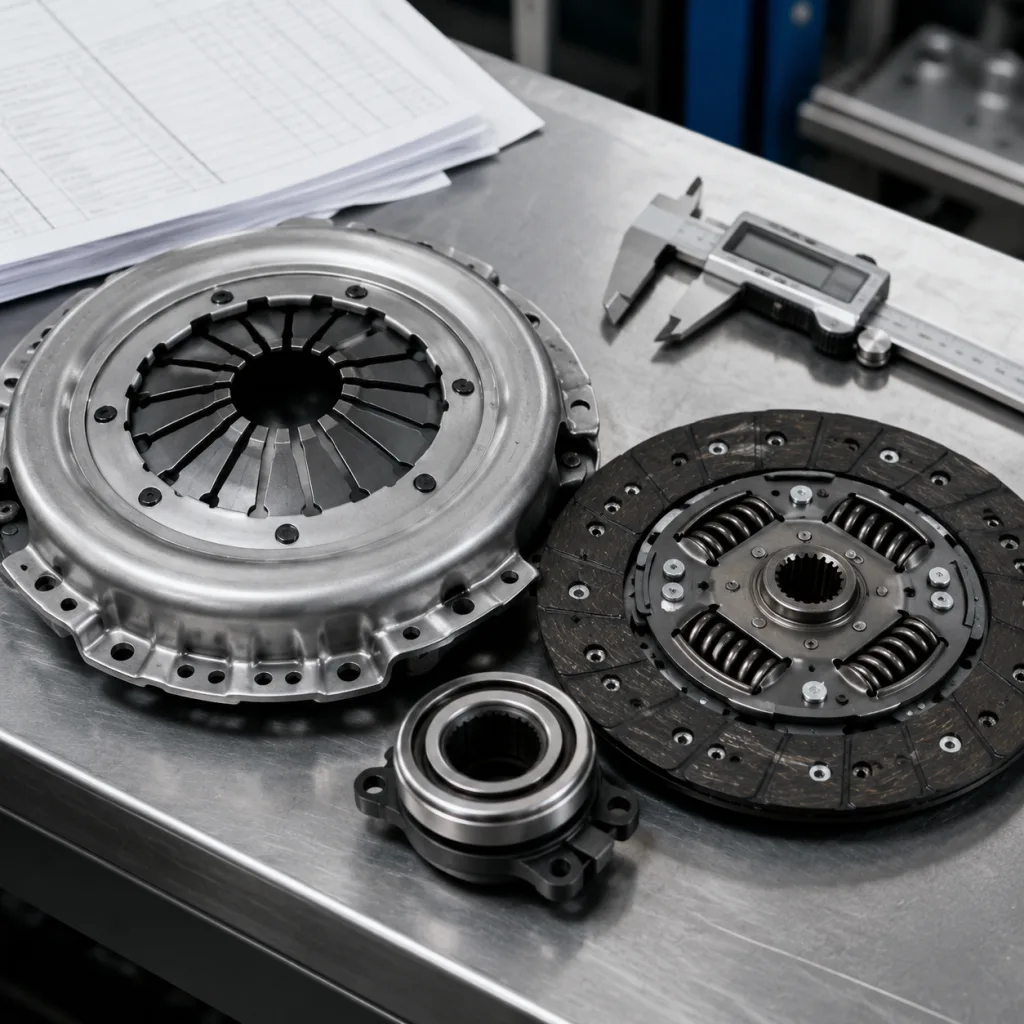
For clutch kit Buick replacement sourcing, fitment definition is the first commercial control point. A kit normally includes the clutch cover assembly, driven disc, release bearing or concentric slave cylinder where applicable, alignment tool, and installation hardware when specified. Some applications may also require a pilot bearing, flywheel bolts, or a dual-mass flywheel compatibility note.
Buyers should not approve a clutch kit by vehicle name alone. Buick badging has been used across North American, Chinese, and export-market platforms, and similar model names can carry different powertrain layouts. Engine displacement, gearbox code, production date, release mechanism, and flywheel design may all change the final kit configuration.
Key fitment data to confirm before sampling:
Vehicle platform, model year range, engine code, and gearbox family
Disc outside diameter and hub spline count
Disc hub offset and torsional damper layout
Clutch cover bolt pattern and pressure plate working height
Release bearing type, guide tube interface, and travel range
Flywheel type: solid, stepped, recessed, or dual-mass
OE part-number cross-reference data, where provided by the buyer
Driventus can map these variables against drawings, physical samples, or buyer-supplied cross-reference files. Buyers reviewing broader powertrain coverage can also compare related lines in our catalog.
OE-equivalent dimensions and functional targets
OE-equivalence does not mean vehicle manufacturer approval. It means the aftermarket kit is engineered to match the intended application envelope and functional requirements, including mounting geometry, clamp load, pedal feel, release travel, friction coefficient range, and thermal behaviour during repeated engagement.
A practical buyer approval file should include measured dimensions, material specifications, and assembly test results. For private-label programmes, drawings should be controlled by revision level so that recurring production remains consistent after the initial PPAP-style review.
Control item
Typical procurement check
Why it matters
Disc outside diameter
Measured against buyer sample or drawing
Prevents housing interference and torque capacity loss
Hub spline count and fit
Go/no-go gauge and mating shaft check
Avoids installation failure and driveline noise
Cover bolt pattern
Coordinate measurement or fixture check
Confirms flywheel mounting compatibility
Clamp load
Bench test across release stroke
Supports torque transfer and pedal consistency
Release bearing interface
Dimensional and travel verification
Reduces disengagement and wear claims
Friction lining thickness
Incoming and finished inspection
Controls engagement height and service life
</tr></thead><tbody> </tbody></table>Common production tolerances depend on the application and approved drawing. For critical mounting features, buyers should expect fixture inspection or gauging rather than visual confirmation alone. If catalogue data conflicts with a physical sample, the sample, gearbox interface, and flywheel geometry should drive the final approval decision.
Validation tests buyers should request
Replacement clutch kits should be validated at both component and assembly level. Buyers do not need every laboratory report with every shipment, but the supplier should maintain a clear control plan and representative validation evidence for each part family.
Recommended validation package:
Static clamp load test: confirms diaphragm spring force across the operating stroke.
Disc burst or overspeed test: checks structural margin above normal engine speed.
Friction performance check: verifies coefficient stability after bedding and temperature cycling.
Release bearing noise and rotation test: screens roughness, seal defects, and lubrication issues.
Rivet retention and lining bond check: reduces separation risk under heat and load.
Fitment trial: confirms cover, disc, release component, and flywheel interface as a system.
For B2B programmes, validation should also cover packaging drop checks and corrosion protection for sea freight. A clutch kit can combine machined steel, cast surfaces, bearing seals, hydraulic parts, and friction materials in one carton. Weak humidity control can create corrosion or bearing concerns before the part reaches the installer.
Driventus production controls are managed under IATF 16949:2016 and ISO 9001:2015. Incoming and outgoing inspection can be structured using ISO 2859-1 sampling principles where agreed in the quality agreement. Material compliance documentation can support REACH (EC) No 1907/2006 requirements for EU importers.
Materials, manufacturing, and traceability
A clutch kit is a system of stamped, machined, riveted, spring-loaded, and friction-lined components. Small variation in one part can create field symptoms that appear unrelated, including clutch drag, judder, slip, high pedal effort, release noise, or premature lining wear.
Driventus controls the main manufacturing stages through supplier qualification, incoming material checks, in-process gauging, and final assembly inspection. Friction facings are selected according to torque requirement, engagement comfort, and thermal durability. Cover assemblies are checked for spring characteristics and pressure plate flatness. Driven discs are inspected for runout, hub spline fit, damper spring installation, and lining security.
Traceability should be useful for distributors, not just available on request. A practical label format includes part number, batch number, production date, quantity, country of origin, and barcode. For repair-chain supply, carton and master-carton labelling should align with the buyer warehouse system to reduce receiving errors and support rapid batch isolation if a claim appears.
Typical documentation available for approved programmes includes:
Dimensional inspection report for critical features
Material or coating declaration where applicable
Batch traceability record
Packaging specification and carton artwork approval
Control plan summary for recurring production
Corrective action report format for warranty returns
Buyers can review the Driventus quality system before supplier onboarding or remote audit scheduling.
Procurement checklist for Buick replacement programmes
A replacement sourcing project should be managed as a fitment and risk-control exercise, not as a simple price comparison. The most common avoidable issue is approving one sample kit and then ordering mixed applications under the same commercial description.
Use this checklist before placing a forecast order:
1. Confirm the target Buick applications by market, model year, engine, and gearbox. 2. Provide OE cross-reference files or existing aftermarket references without claiming brand approval. 3. Define the kit contents: cover, disc, bearing, pilot bearing, bolts, hydraulic parts, and tool. 4. Approve drawings or golden samples for each part number. 5. Request clamp load, spline fit, runout, and release bearing checks. 6. Confirm packaging layout, humidity protection, and palletisation. 7. Agree AQL, inspection documents, and batch traceability requirements. 8. Define warranty return handling and root-cause review expectations.
For distributors, SKU rationalisation may reduce working capital if the technical envelope is truly shared. One clutch kit can sometimes cover several production years, but only when disc hub offset, release travel, spline fit, flywheel design, and cover height remain compatible. For repair chains, clear kit content labels and installation notes can reduce bay-time loss. For OEM or Tier-1 service programmes, Driventus can support custom manufacturing based on drawings, samples, or controlled specifications.
Commercial planning and supply stability
Clutch kit demand is often uneven. Older manual-transmission applications may move slowly for months and then generate urgent replenishment when a distributor runs out of stock. Procurement teams should evaluate supplier stability through tooling ownership, component availability, production scheduling, revision control, and the ability to consolidate mixed SKUs into planned shipments.
For new Buick coverage, a practical sourcing sequence is sample order, dimensional approval, limited pilot order, field feedback review, and then recurring forecast. Lead time depends on kit complexity, hydraulic components, packaging approval, and whether tooling already exists. Buyers should also confirm minimum order quantity by part number and by mixed shipment, because clutch kit cartons are larger than many engine components and freight planning can materially affect landed cost.
Driventus exports engine and powertrain components to more than 60 countries from Taizhou, Zhejiang. For clutch kit programmes, the same commercial discipline applies: stable specifications, controlled revisions, transparent batch records, and clear communication before each production run. Driventus is an independent aftermarket manufacturer; brand names are referenced for fitment only.
Frequently asked questions
Sometimes, but only when the engine, gearbox, flywheel type, disc spline, cover height, and release system match. Buyers should verify each application by technical data or sample, not by model name alone.
Request dimensional inspection data, kit content confirmation, material or compliance declarations where applicable, packaging specification, batch traceability format, and validation evidence for clamp load, runout, spline fit, and release bearing function.
No. Driventus is an independent aftermarket manufacturer; brand names are referenced for fitment only. Replacement parts are supplied for aftermarket compatibility based on specifications, samples, and buyer-approved cross-reference data.
If you are building a clutch kit Buick replacement range, Driventus can review fitment data, samples, MOQ, and documentation needs. To discuss supply options, [request a quote](/contact.html)