Choosing a crankshaft Renault OEM supplier is a high-risk sourcing decision because crankshaft quality affects engine durability, warranty exposure, and repeat-order stability. Procurement teams should look beyond unit price and verify the full manufacturing route: metallurgy, machining control, dimensional inspection, fatigue-related features, packaging discipline, and change management. Driventus manufactures crankshafts and related powertrain components in Taizhou, Zhejiang for aftermarket distributors, OEM programmes, Tier-1 sourcing teams, and multi-location repair chains. This guide explains how to qualify an independent Chinese manufacturer for Renault-fitment crankshafts, including audit evidence, MOQ planning, lead-time assumptions, material control, validation records, and commercial documentation. Driventus is an independent aftermarket manufacturer; Renault and other brand names are referenced for fitment identification only.
What Buyers Should Verify Before Sourcing
A crankshaft is not a commodity casting or a simple catalogue item. Small variations in journal geometry, fillet radius, hardness depth, oil-hole finish, or balance correction can lead to bearing wear, vibration, oil pressure loss, or early fatigue failure. For Renault-fitment applications, buyers should start with a controlled technical review using the customer drawing, engine code, sample part, fitment list, or approved cross-reference database.
Key checks before placing a production order include:
Balance control: dynamic balancing method, correction location, and whether balance records are required for the shipment.
Traceability: heat batch, machining batch, inspection record, operator or line identification, and packaging lot.
For buyers reviewing multiple Renault-compatible part families, our catalog can be used as an initial reference before a technical cross-reference review. Final confirmation should always be based on customer-supplied application data, measured dimensions, and engine details—not vehicle brand name alone.
Factory Capability, MOQ, and Lead-Time Planning
A credible crankshaft Renault OEM supplier should define production limits early in the sourcing process. Buyers need to know annual capacity, minimum order quantity, sample timing, tooling status, and realistic lead time after drawing confirmation. Over-promising during quotation often creates schedule pressure later, especially when distributors combine slow-moving and fast-moving SKUs in one replenishment order.
Typical sourcing parameters for Driventus crankshaft programmes are shown below. Exact values depend on SKU complexity, tooling availability, order mix, packaging requirements, and inspection level.
Sourcing item
Typical planning range
Procurement note
Sample order
5–20 pieces per reference
For dimensional review, assembly checks, and customer approval
MOQ for active references
50–100 pieces
Can often be consolidated with other engine components
New reference development
60–90 days
Covers drawing review, tooling, samples, inspection, and approval feedback
Repeat production lead time
35–55 days
After deposit, technical confirmation, and approved packaging specification
Export packaging
Neutral or customer-specified
Anti-rust protection, carton packing, pallet marking, and batch identification
Documentation
Inspection report, packing list, invoice, CO if required
Additional documents should be agreed before order release
</tr></thead><tbody> </tbody></table>For strategic sourcing programmes, buyers should also assess whether the supplier can manufacture related engine components such as pistons, gaskets, pumps, bearings, and connecting parts. Consolidation can reduce freight cost and simplify vendor management, but it should not dilute product-specific quality controls. A good supplier keeps crankshaft inspection criteria separate from lower-risk engine components and documents each shipment by reference, lot, and inspection status.
Quality System and Audit Evidence
Certification alone does not prove crankshaft capability, but it gives buyers a baseline for process control. Driventus operates under IATF 16949:2016 and ISO 9001:2015 quality management frameworks. These standards support document control, corrective action, process monitoring, internal audit, supplier management, and traceability discipline.
During supplier qualification, procurement and SQE teams should request evidence from the quality system, including:
Process flow diagram for crankshaft manufacturing.
Control plan covering incoming material, machining, heat treatment where applicable, grinding, balancing, cleaning, inspection, and packing.
PPAP-style sample documentation when required by the customer.
Material certificates, chemical composition records, and hardness results.
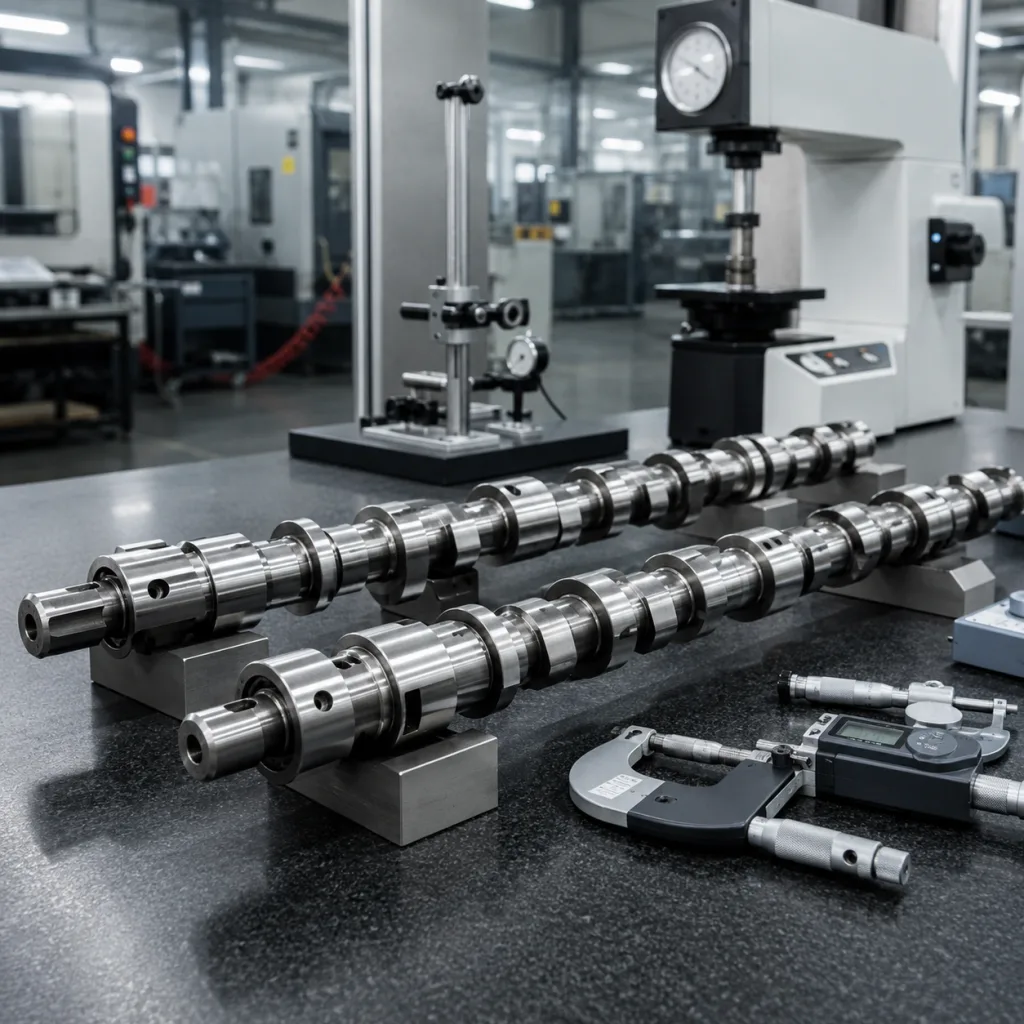
Dimensional inspection reports for critical journals, datum features, flange interfaces, and thread locations.
Gauge calibration records and measurement method descriptions.
Non-conformance handling procedure, containment rules, and corrective action examples.
Change-control process for tooling, material source, machining route, inspection frequency, and packaging.
For EU and UK importers, material and chemical compliance may also require supplier declarations aligned with REACH (EC) No 1907/2006. For engine emission-related service parts, buyers should ensure that replacement component sourcing does not alter regulated engine characteristics. Vehicle-level emissions regulations such as ECE R-83 apply to the vehicle or system approval context; a crankshaft supplier should not imply vehicle manufacturer approval unless that approval is explicitly documented by the customer.
Technical Controls for Renault-Fitment Crankshafts
The most important audit question is whether the factory can hold the same geometry from batch to batch. A first sample can confirm feasibility, but it does not prove stable production. Buyers should review process capability for high-risk features, confirm inspection frequency in the control plan, and check whether non-conforming parts are physically segregated before packing.
A practical specification review should cover:
Journal grinding tolerance: confirmed against drawing; common checks include diameter, taper, ovality, cylindricity, and surface roughness.
Runout control: measured at defined datum points to reduce vibration risk and bearing load concentration.
Fillet radius: checked because excessive reduction or inconsistent transition can reduce fatigue strength.
Oil-hole treatment: deburred, chamfered where specified, and cleaned to reduce abrasive contamination risk.
Hardness and microstructure: verified according to material route, heat-treatment plan, and customer specification.
Dynamic balance: measured and recorded where required for the specific crankshaft design.
Cleanliness: oil passages protected from machining residue, corrosion, and packing debris before shipment.
Sample validation expectations
For new Renault-fitment references, Driventus normally recommends dimensional approval before functional trials. Buyers may also require assembly checks with bearings, seals, timing components, flywheel interfaces, pulley interfaces, and related fasteners. Where the customer has an internal validation protocol, Driventus can align sample inspection records and batch documents through custom manufacturing.
Standards in the audit file should match the component and test purpose. SAE J2527, for example, is commonly referenced for brake dynamometer performance rather than crankshafts, so it should not be used as a crankshaft validation standard. For crankshaft sourcing, stronger evidence usually comes from drawing-based dimensional reports, material and hardness records, balance data, cleanliness checks, and customer-defined assembly or durability validation.
Commercial Terms for Distributors and OEM Buyers
Commercial clarity reduces sourcing friction and prevents avoidable disputes after samples or production shipments. For aftermarket distributors, the main issues are consistent cross-reference data, packaging, reorder stability, claim handling, and landed cost. For OEM and Tier-1 buyers, the focus is usually drawing control, process approval, traceability, change management, and documentation discipline.
When comparing suppliers, buyers should request quotations in a format that separates tooling, sample cost, unit price, packaging, inspection documentation, and freight terms. A low unit price can be offset by poor packing density, high claim rate, weak documentation, unstable lead time, or repeated engineering changes that are not formally approved.
Useful quotation inputs include:
Target engine family and application market.
Customer drawing, OE benchmark, sample part, or approved dimensional reference.
Annual volume estimate, first order quantity, and expected reorder frequency.
Required Incoterms, destination port, shipment mode, and packaging rules.
Labelling requirements, including neutral brand, customer brand, private label, or batch-only marking.
Inspection level and documentation required with each shipment.
Any restricted substances, customs, market compliance, or certificate-of-origin requirements.
Driventus can support mixed engine-component shipments where the buyer sources crankshafts together with bearings, gaskets, pistons, pumps, or related powertrain parts. If the purchasing team is building a new Renault-compatible programme, the next step is to request a quote with target references, quantities, drawings, benchmark samples, and any packaging or compliance requirements.
Frequently asked questions
Yes. Driventus manufactures aftermarket crankshafts for Renault-fitment applications based on customer-supplied drawings, samples, or cross-reference data. Fitment should be confirmed by engine code, dimensions, interfaces, and application details before production approval.
Buyers should review IATF 16949:2016 and ISO 9001:2015 certification, then verify process-level evidence such as control plans, inspection records, material certificates, calibration records, traceability data, and corrective action procedures.
Send the target reference list, engine applications, estimated annual volume, first order quantity, packaging requirements, destination, required documentation, and any drawings or benchmark samples. This allows a realistic quotation for MOQ, lead time, inspection scope, and commercial terms.
If you are qualifying a crankshaft Renault OEM supplier for distributor or OEM programmes, Driventus can review your reference list, drawings, samples, and packaging requirements to confirm feasibility. Send your sourcing details through /contact.html