Clutch Kit Alfa Romeo Supplier for B2B Sourcing
Choosing a clutch kit Alfa Romeo supplier is not a catalogue exercise. A kit can match the visible dimensions and still fail in the field if clamp load drifts, release geometry is wrong, the bearing grade is weak, or the carton cannot survive export handling. For B2B buyers, the real task is to protect fitment accuracy, warranty rate, launch timing, and repeat supply across multiple SKUs.
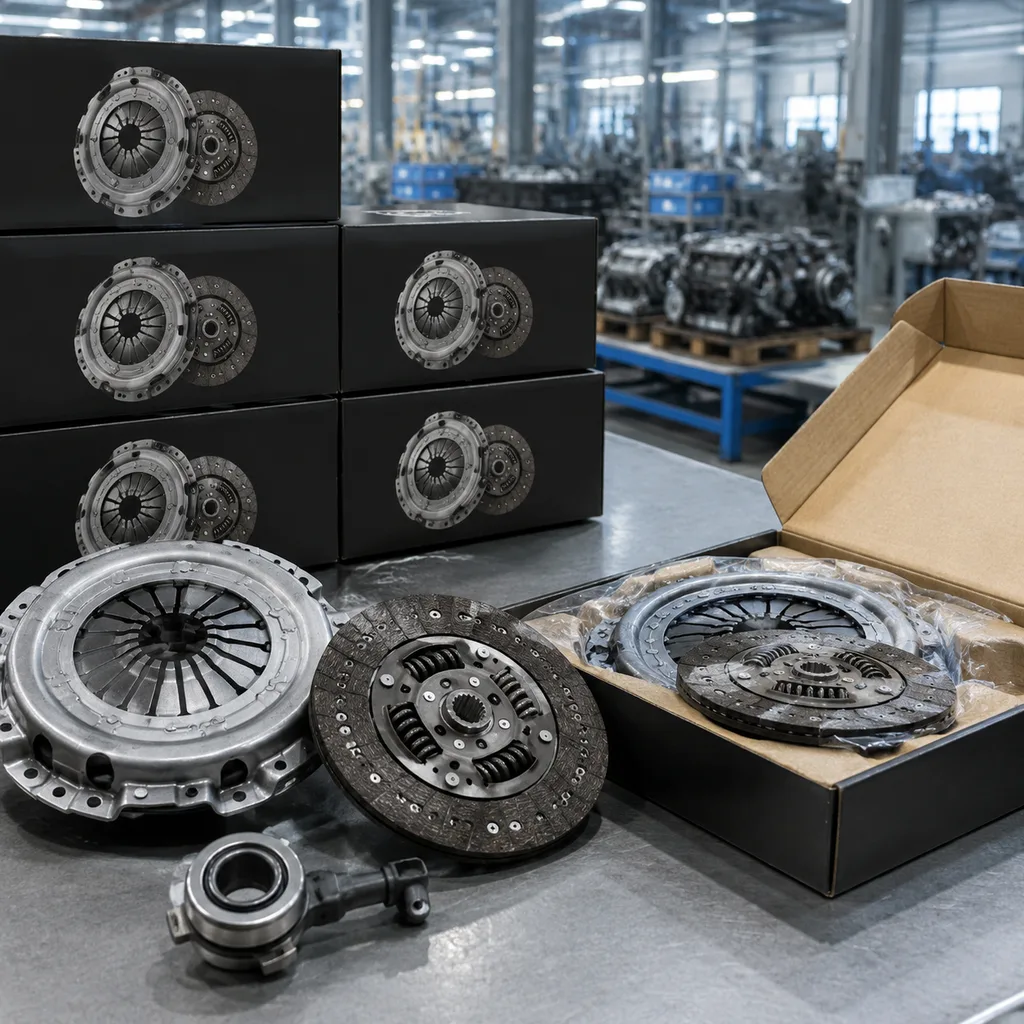
Driventus supplies Alfa Romeo clutch kits for wholesalers, importers, regional distributors, workshop networks, private-label programmes, and repair-chain supply. Typical kits include a clutch cover assembly, driven plate, release bearing or concentric slave cylinder where applicable, alignment tool, and application-specific hardware. Common passenger-car ranges include 200–240 mm disc diameters, 20–23 spline hubs, cover runout control at final assembly, and release systems matched to the specified gearbox and actuation type.
Production is managed under IATF 16949:2016 and ISO 9001:2015 systems, with batch traceability from incoming steel and friction materials through final inspection. Driventus is an independent aftermarket manufacturer; vehicle brand names are used only for fitment identification. The sections below give procurement teams a practical way to qualify a supplier, compare offers, control technical risk, and build a stable sourcing programme.
Decision Framework: Approve the Supplier Before You Approve the Price
The first buying decision is not price. It is whether the supplier can prove fitment accuracy and production repeatability before an order moves into commercial negotiation. A clutch kit is a drivability- and safety-critical assembly, and many failures are invisible in product photos: incorrect diaphragm spring load, unstable friction coefficient, poor release bearing life, wrong locating diameter, unsuitable damper tuning, or weak export packaging.
For Alfa Romeo applications, request the data in a controlled technical sheet rather than relying on catalogue screenshots. The file should let your technical, purchasing, warranty, and warehouse teams review the same facts.
Confirm these points before supplier approval:
- Application list by model, engine, transmission code, model year range, and regional market; check left-hand/right-hand drive differences where hydraulic routing or CSC format changes
- OE-style cross-reference format where available, used only for application identification, with supersession notes and clear “do not fit” exceptions
- Disc outside diameter, spline count, hub profile, spline major/minor diameter, offset direction, damper spring arrangement, and facing thickness; common light-vehicle discs are often 200, 215, 228, or 240 mm depending on engine and gearbox
- Cover assembly dimensions, bolt circle, dowel or locating diameter, installed height, clamp load range, and release load curve; values should be checked at working height, not free height only
- Friction material type, facing thickness tolerance, rivet specification, burst-speed requirement, and heat-resistance target; many programmes use facing thickness tolerance around ±0.15 mm and disc lateral runout around 0.50–0.80 mm, subject to application
- Release bearing or concentric slave cylinder type, grease specification, seal material, axial clearance limit, noise check method, and operating temperature range, commonly around -40°C to 120°C for bearing grease environments
- MOQ by part number, mixed-SKU order, and private-label programme; slow-moving references may need to be grouped under one production window
- Standard lead time for production, sample preparation, artwork approval, printed carton proofing, and pre-shipment inspection booking
- Export carton dimensions, gross/net weight, palletisation plan, pallet height limit, and estimated 20GP/40HQ loading quantity
A capable clutch kit Alfa Romeo supplier should provide this information early. If technical data arrives only after deposit payment, risk has already shifted to the buyer. Buyers can review related part families in our catalog and confirm whether clutch kit coverage matches the target vehicle parc, sales region, and warranty policy.
Supply Model Comparison: Trial Orders, Regular Replenishment, and Private Label
Not every order should be structured the same way. A launch order needs learning speed. A replenishment order needs cost stability and predictable availability. A private-label order adds artwork, carton strength, barcode control, and market-specific wording. Treating all three as the same purchase often creates avoidable delays.
Driventus supports standard export packaging, neutral packaging, and customer-labelled programmes after artwork approval. MOQ is influenced by friction material batch planning, cover stamping availability, pressure plate preparation, release bearing sourcing, carton printing, and the need to keep matched assemblies inside a controlled production lot.
| Sourcing item | Typical B2B expectation | Procurement note |
|---|---|---|
| Trial order MOQ | 50–100 sets per fast-moving reference | Used for fitment validation, catalogue confirmation, installer feedback, and market testing |
| Regular order MOQ | 100–300 sets per reference | Lower unit cost is usually possible when grouped with mixed clutch SKUs and shared materials |
| Slow-moving reference MOQ | 30–80 sets when grouped by family | Depends on available covers, discs, bearings, and whether the reference uses standard packaging |
| Private-label packaging | Usually from 300 sets per reference | Artwork, carton strength, barcode data, label layout, and country-of-origin wording must be approved |
| Standard production lead time | 35–55 days after deposit and artwork confirmation | Timing may vary by bearing type, friction material, heat treatment, plating, and order mix |
| Sample lead time | 10–20 days for available references | Longer if tooling, special validation, CSC sourcing, or non-standard kit content is required |
| Indicative price logic | Based on kit content, bearing/CSC type, order quantity, and packaging | A kit with CSC, bolts, or reinforced private-label cartons will not price like a basic three-piece kit |
| Documentation pack | Invoice, packing list, certificate of origin where applicable | Additional market documents, declarations, or inspection certificates should be agreed before release |
| Evaluation area | Question to ask | Why it matters |
|---|---|---|
| Fitment data | Is the model, engine, gearbox, year range, and market confirmed? | Reduces catalogue errors and customer returns |
| Kit contents | Are cover, disc, bearing, tool, bolts, hydraulic parts, and instructions listed clearly? | Prevents hidden cost differences between quotations |
| Technical specs | Are disc diameter, spline count, cover height, clamp load, release type, and runout limits stated? | Confirms that the quoted kit is technically comparable |
| Test records | Can clamp load, release load, dimensional, bearing, and final inspection reports be supplied? | Supports supplier approval and claim analysis |
| MOQ | Is MOQ calculated per SKU, per packaging type, per printed carton, or per mixed order? | Affects inventory exposure and launch planning |
| Price basis | Is the price EXW, FOB, CFR, or CIF, and does it include private-label packaging or documentation? | Prevents false comparison between suppliers and shipment terms |
| Packaging | Is carton strength suitable for export pallets, humidity, container stacking, and warehouse handling? | Reduces freight damage and repacking cost |
| Lead time | Is it based on current material availability, bearing stock, and approved artwork? | Prevents launch delays and stock gaps |
| Claims process | Are photos, mileage, installation evidence, return samples, and credit rules defined? | Speeds up technical review and credit decisions |
| Documentation | Are invoice, packing list, origin documents, compliance statements, and inspection records agreed? | Supports customs clearance and customer audits |