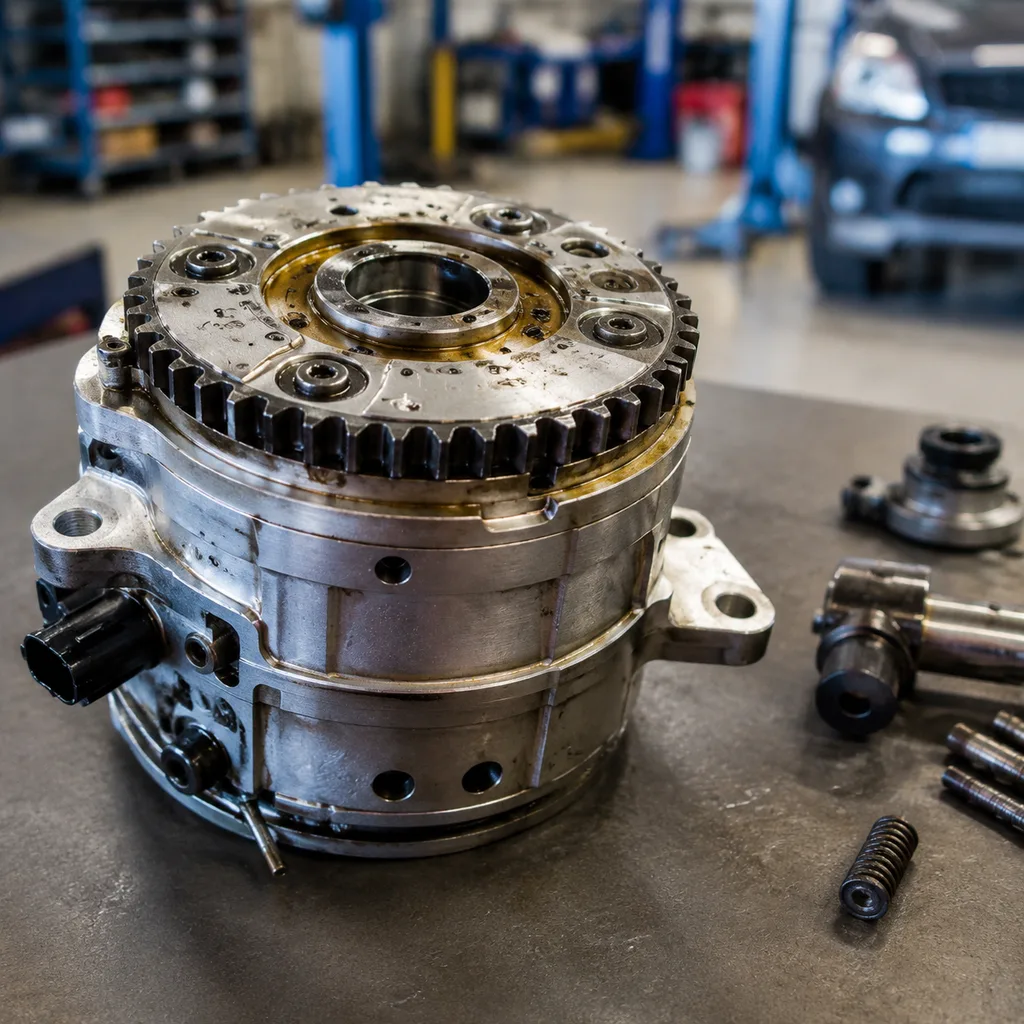
Choosing a camshaft phaser Acura supplier is not a catalogue tick-box exercise. The part has to bolt on, yes—but it also has to meter oil correctly, release and lock at the right pressure, return cleanly, hold timing response across batches, and arrive without packaging damage or traceability gaps.
That is where many sourcing problems start. A sample looks acceptable. The first shipment passes a visual check. Then one lot produces start-up noise, another has oil-port burrs, and a third arrives with mixed intake and exhaust references. The cost is no longer the unit price. It becomes warranty handling, repacking, quarantine, delayed catalogue launch, and customer confidence.
Driventus Auto Parts manufactures engine and powertrain components in Taizhou, Zhejiang, under IATF 16949:2016 and ISO 9001:2015 certified processes. We supply B2B customers in more than 60 countries, including importers and distributors in the EU, UK, US, Canada, Australia, and Brazil. Driventus is an independent aftermarket manufacturer; Acura and other brand names are referenced only to identify fitment and application coverage.
For buyers evaluating an Acura-fitment VVT programme, the useful question is simple: can the supplier prove control before the first bulk order? Evidence should include confirmed dimensions, drawings or benchmark comparisons, control plans, gauge lists, functional oil-pressure test records, batch traceability, packaging specifications, and export documents aligned with the destination market.
Start with the decision tree, not the part number
A camshaft phaser Acura sourcing project should begin with fitment logic. Model names are not enough. The same buying list may contain intake-side and exhaust-side phasers, bank-specific parts, different chain interfaces, and region-specific catalogue references. If those distinctions are not locked at the RFQ stage, mixed inventory follows.
Use this sequence before asking for price:
1. Identify the engine family and market region. Confirm production year range, engine code where available, and whether the application differs by North America, EU, Japan, or other market coverage. 2. Define the phaser position. Intake, exhaust, left bank, right bank, or shared application must be clear in the catalogue structure. 3. Confirm the mechanical interface. Check chain pitch, tooth count, sprocket outside diameter, mounting bore, bolt pattern, bolt seating depth, mounting face runout, face parallelism, and trigger feature location. 4. Map the hydraulic interface. Oil feed paths, gallery position, vane geometry, cover plate thickness, seal design, locking angle, lock-pin release pressure, and return behaviour should match the approved reference. 5. Agree inspection limits. Do not rely on “OE replacement” wording. Use a drawing, benchmark sample, or agreed tolerance list for critical dimensions and functions. 6. Connect the part to traceability. The buyer should be able to link raw material heat, machining lot, assembly lot, functional test record, carton label, and shipment documents.
A complete supplier file normally includes:
Application matrix by engine family, model-year range, market region, intake/exhaust position, and bank position where applicable
OE-style cross-reference fields, such as OE 14310… or OE 14210… formats where relevant, without implying vehicle manufacturer approval
Critical dimensions for bore, PCD, chain interface, oil channels, timing-reference features, cover seating surfaces, and trigger alignment
Material and heat-treatment records for hub, rotor, stator, cover plate, spring, seals, fasteners, return spring, and locking pin
Functional test plan covering advance/retard response, internal leak rate, return position, lock release, lock engagement, abnormal noise, and post-test inspection
Cleanliness rules for washing, drying, oil-passage protection, plugging or bagging, and particle-control targets agreed by buyer and supplier
Packaging specification for unit boxes, VCI or moisture protection if required, export cartons, palletisation, barcode labels, batch coding, and private label requirements
Also ask whether the supplier manufactures the relevant VVT components in-house or trades finished goods. This matters when a buyer needs dimensional adjustment, failure analysis, catalogue expansion, or standard inspection limits across multiple part numbers.
MOQ and lead time: what changes between stock, pilot, and new development
MOQ is not just a sales rule. For camshaft phasers, it reflects fixture status, machining load, material procurement, functional test time, packaging format, and whether the reference is already validated. A stock item, a repeat production part, and a new Acura-fitment reference should not be planned the same way.
Sourcing item
Typical procurement requirement
Driventus supply approach
Existing-reference MOQ
Often 100–300 pcs per part number for regular packaging; lower only when stock exists
MOQ confirmed by part number, finish, packaging, forecast, and current production plan
New-reference MOQ
Commonly 300–1,000 pcs when fixtures, gauges, or validation work are needed
Pilot quantity and mass-production MOQ quoted after drawing/sample review
Sample lead time
Usually 7–20 working days for available references; 30–60 days for new development
Pre-production samples with dimensional report when drawings and benchmarks are confirmed
Mass production lead time
Commonly 30–45 days for repeat references and 45–75 days for new or custom references
Planned by order volume, machining load, test scope, packaging artwork, and destination documents
Unit price logic
Driven by machining time, internal parts, heat treatment, test time, scrap allowance, packaging, and quantity
Price breaks normally improve at 300, 500, 1,000, and scheduled annual volumes, subject to reference
Packaging
Neutral, private label, distributor brand, or service packaging
Unit box, inner protection, export carton, pallet label, carton mark, and traceable batch coding
Audit support
Remote review or on-site supplier audit
Process flow, PFMEA/control plan, inspection records, certification review, and corrective-action evidence
Documentation
Needed for customs clearance and internal PPAP-style review
Commercial invoice, packing list, COO where applicable, certificate copies, material declaration, and test summaries by agreement
</tr></thead><tbody> </tbody></table>A practical launch plan separates three stages:
First articles: used to verify dimensions, oil passages, timing references, lock function, surface finish, and packaging concept.
Pilot lot: produced through the intended production route, not hand-finished, with inspection and functional records.
Routine replenishment: released only after drawings, packaging, labels, test limits, and traceability rules are stable.
Lead time can be lost outside the factory floor. Artwork approval, barcode format, carton strength, pallet height, country-of-origin wording, fumigation or non-wood declaration, COO request, and destination compliance declarations can all delay shipment readiness. The efficient RFQ combines technical review, sample plan, packaging review, Incoterms, and document requirements at the beginning.
Driventus can also support custom manufacturing when a buyer provides drawings, benchmark samples, performance targets, or technical requirements for a specific camshaft timing application.
Failure modes that expose weak VVT phaser control
A camshaft phaser can pass a quick fitment check and still fail in service. The risk is hydraulic and mechanical, not only dimensional. A credible camshaft phaser Acura supplier must control how the assembly behaves with oil pressure, temperature, contamination risk, and repeated movement.
Common failure modes include:
Start-up rattle: often linked to lock-pin engagement, return position, spring force, internal clearance, or oil retention issues.
Slow timing response: may result from oil-gallery mismatch, burrs, leakage, vane sealing variation, or excessive internal friction.
Diagnostic trouble codes: can appear when timing response is delayed, unstable, or outside the expected operating window.
Oil-pressure instability: may be caused by internal leakage, poor surface finish, sealing inconsistency, or cover seating problems.
Sticking or incomplete return: can come from contamination, burrs, inadequate washing, spring force drift, or dimensional interference.
Abnormal noise after installation: may point to sprocket tooth profile variation, chain interface burrs, stop-angle error, or internal looseness.
Batch-to-batch inconsistency: usually indicates weak process control, unverified supplier changes, poor gauge discipline, or incomplete reaction plans.
Driventus manufacturing controls are managed through our quality system, aligned with IATF 16949:2016 and ISO 9001:2015. These standards apply to quality management, process control, traceability, corrective action, risk-based thinking, and continual improvement. They do not mean any product is approved by a vehicle manufacturer.
Key control points include:
Incoming material verification for steel, alloy, powder metallurgy, spring material, seals, and fasteners using supplier certificates, hardness checks, and lot identification
CNC machining control for bore concentricity, face parallelism, face runout, sealing surfaces, oil-channel position, bolt-hole location, and cover seating surfaces
Gear or sprocket profile inspection according to approved drawings, including tooth count, chain pitch interface, tooth form, pitch runout, and burr control on chain-contact areas
Deburring, ultrasonic or spray washing, drying, and cleanliness controls to reduce contamination in oil passages and moving interfaces
Heat-treatment verification where hardness, wear resistance, and dimensional stability are specified, with lot-based hardness and deformation checks
Spring force, return torque, locking-pin engagement depth, lock release confirmation, and free movement after lubrication
Oil-pressure functional testing under defined conditions for response, leakage, return behaviour, lock release, and abnormal noise
Assembly verification for fasteners, cover plate seating, seals, trigger features, timing marks, rotational stop angle, and rotational smoothness
First-piece approval at setup, patrol inspection during machining, 100% functional test for critical launch lots where agreed, and AQL or buyer-specific final inspection before packing
Batch traceability from raw material and machining lot through assembly, final test, packaging label, carton mark, and shipment invoice
Ask the supplier what happens when leakage, sticking, abnormal noise, delayed lock release, oil-port blockage, or dimensional drift is found. The answer should include containment, lot identification, reinspection, root-cause analysis, corrective action, and documented verification—not only replacement stock.
Where the destination market requires material declarations, Driventus can support buyer-specific compliance documentation related to REACH (EC) No 1907/2006. Exact documentation scope, test report format, substance declaration responsibility, and third-party testing requirements should be agreed before order placement.
Audit the production route, then approve the sample
A supplier audit for VVT phasers should follow the part through the factory. Certificates are useful, but they do not show whether the oil-test bench is controlled, whether gauges are calibrated, or whether quarantine stock can be separated from released inventory.
Production-route audit questions
Does the factory have in-house machining for critical rotor, stator, hub, cover, sprocket, or sealing features?
Are special characteristics and key dimensions identified in a control plan with inspection frequency, gauge type, tolerance, and reaction plan?
Are gauges calibrated, labelled, and traceable to a documented schedule, including micrometers, bore gauges, CMM fixtures, runout fixtures, torque tools, and oil-test gauges?
Are machining fixtures, assembly tools, washing equipment, leak-test benches, and functional test equipment maintained under controlled procedures?
Does the process include first-piece inspection after tool change, setup change, material lot change, and long stoppage?
Is there a defined reaction plan for leakage, locking failure, abnormal noise, sticking, delayed response, oil-port blockage, burrs, or dimensional drift?
Can the supplier separate engineering samples, pilot batches, first-article lots, routine mass production, reworked parts, and quarantined stock?
Are inspection and functional test records retained by lot number, with retention time defined in the quality system or buyer agreement?
Can packaging material, barcode label, carton mark, and pallet label data be traced to the same production lot as the component?
Does the export team understand destination requirements for labelling, HS code review, certificates, COO, wood packaging rules, and customs documents?
Can the supplier provide 8D or equivalent corrective-action reports when field returns, audit findings, or receiving-inspection failures occur?
Sample approval sequence
1. Confirm the sample source. Samples should come from the intended production route, not a one-off hand-polished prototype. 2. Inspect the interfaces. Review mounting bore, bolt holes, timing marks, trigger feature, sprocket profile, oil-feed alignment, cover seating, and chain-contact areas. 3. Check movement and lock function. Verify internal movement, lock engagement, release behaviour, rotational stop positions, return behaviour, and visible burrs at oil passages. 4. Compare against a benchmark. If benchmark samples are supplied, document photographs, measured dimensions, weight data, material notes, hardness results where relevant, and functional test results. 5. Approve packaging with the part. Packaging should not be postponed until after production.
Packaging approval deserves attention. Unit boxes, foam or separators, rust prevention, polybags, carton wall strength, barcode placement, pallet height, stretch film, edge protection, and moisture protection affect damage rates during long-distance shipping. For private label programmes, approve artwork, barcode symbology, country-of-origin wording, warning text, and carton marks before pilot production. Otherwise the first mass shipment can become a repacking project.
Build the RFQ around landed cost, not FOB price
The cheapest FOB quote may be the most expensive supply decision if it excludes test records, packaging strength, documentation, or realistic MOQ. For camshaft phaser programmes, cost is shaped by machining time, internal component count, material specification, heat treatment, washing and cleanliness process, functional testing, order quantity, packaging format, forecast stability, and documentation scope.
Air freight can make sense for samples, warranty replacement stock, or urgent replenishment. Sea freight is usually more economical for regular distributor inventory. Either way, compare landed cost and launch risk—not only unit price.
Recommended RFQ information:
Target application, engine family, model-year range, market region, intake/exhaust position, and bank position where relevant
OE-style reference format, if used, such as OE 14310… or other buyer catalogue numbers
Annual forecast, first order quantity, target MOQ, expected reorder rhythm, and whether blanket orders or call-off shipments are preferred
Destination country, discharge port or warehouse location, preferred Incoterms, and whether shipment is by air, sea LCL, sea FCL, or courier sample service
Packaging type: neutral, private label, distributor brand, or bulk service packaging, including unit-box dimensions if the buyer has shelf standards
Required documents: inspection report, functional test summary, material declaration, REACH declaration if required, certificate copies, COO where applicable, and customs documents
Sample quantity, sample approval criteria, required dimensional report, benchmark comparison method, and deadline for catalogue launch
Warranty handling, return analysis, chargeback rules, quarantine process, or field claim reporting expectations
Labelling rules, barcode format, carton marks, pallet requirements, maximum carton weight, and pallet height limit
A 100-piece first order with private label packaging and extra reports will not price like a 1,000-piece repeat order using standard export packaging. Extra functional testing, additional dimensions, special rust prevention, upgraded cartons, and buyer-specific declarations all affect cost or lead time. Put those requirements in the RFQ, not after quotation.
Driventus works with aftermarket distributors, wholesalers, OEM/Tier-1 purchasing teams, and multi-location repair chains. For catalogue expansion, buyers can send a reference list, target markets, annual volume estimate, and current pain points: supply gaps, high return rates, excessive MOQ, delayed replenishment, or inconsistent packaging. For development work, drawings, benchmark samples, photographs, failed-part analysis, or oil-pressure response targets help shorten the technical review.
Clear commercial inputs allow the supplier to quote realistic MOQ, sample charges if any, tooling or fixture charges if any, unit price, lead time, and validity period. They also reduce relabelling, repacking, and documentation delays before shipment.
Long-term supply scenario: what to lock before scaling volume
Scenario: the first shipment performs well, the distributor adds more Acura-fitment references, and monthly demand grows. This is the point where weak controls often appear. A supplier changes a subcomponent. Packaging artwork is revised. A freight route changes. A new operator runs the assembly line. None of those changes is automatically a problem—unless there is no change-control process.
Before scaling volume, lock the operating standard:
Approved drawing, benchmark sample, inspection limits, oil-test method, packaging specification, label layout, and barcode format
Batch codes on the product where feasible, unit boxes, cartons, pallets, packing lists, and invoices
Critical dimensions, functional test frequency, AQL level, and buyer-specific receiving inspection criteria
Golden samples at both buyer and supplier locations, with revision, approval date, and responsible approver recorded
Defect reporting by failure mode, such as leakage, start-up rattle, lock failure, slow response, oil-port blockage, damaged packaging, wrong label, or fitment mismatch
Demand review before peak buying seasons, Chinese New Year, summer shutdowns, and year-end freight congestion
Formal change notification for material, process, fixture, supplier, test method, packaging, label, or artwork changes
Defined process for containment, replacement, credit, root-cause analysis, corrective action, and verification if problems occur
Packaging revalidation when carton size, pallet pattern, freight route, private label artwork, unit box, or moisture protection changes
Tracking of lead-time performance, on-time shipment, receiving inspection results, and warranty trends by part number
The aim is not paperwork for its own sake. It is speed when something goes wrong. If a workshop claim comes in, the buyer should be able to identify the lot, shipment, test record, packaging batch, and related stock quickly. Then the supplier can contain suspect inventory, analyse the failure mode, and verify corrective action.
For regulated and brand-sensitive markets, claims must stay factual. Driventus does not claim approval, authorisation, or endorsement by any vehicle manufacturer. Fitment references are used to help professional buyers identify application coverage. Driventus is an independent aftermarket manufacturer; brand names are referenced for fitment only.
If your team is assessing a camshaft phaser Acura supplier for a new range, send target references, forecast volume, desired MOQ, packaging expectations, sample deadline, destination documents, and inspection or test requirements. Technical and commercial review can then run in parallel, reducing avoidable delays before sample approval and first shipment.
Frequently asked questions
Yes. Driventus can support neutral or private label packaging for approved references, subject to MOQ, artwork files, carton specification, barcode format, country-of-origin wording, and destination labelling requirements. Packaging details should be confirmed before sample approval.
Driventus operates certified processes aligned with IATF 16949:2016 and ISO 9001:2015. These certifications relate to quality management systems, traceability, and process control; they do not represent vehicle manufacturer approval or endorsement.
Please provide target application, engine family, OE-style reference if available, annual forecast, first order quantity, packaging requirements, destination country, preferred Incoterms, documentation needs, and whether samples, drawings, or benchmark parts are available for review.
For sourcing review, sample planning, or distributor range development, send your reference list, target quantities, packaging requirements, and destination market to [request a quote](/contact.html).