Clutch Kit Acura OEM Supplier: Sourcing Guide for Buyers
Procurement teams sourcing a clutch kit Acura OEM supplier need more than a fitment claim. They need measurable dimensions, defined tolerance bands, documented material control, export packaging, and a factory that can repeat the approved sample without process drift. Driventus supplies clutch kit programmes for passenger car applications with a focus on OE-equivalent geometry, stable friction characteristics, and batch traceability. Driventus is an independent aftermarket manufacturer; brand names are referenced for fitment only. For buyers in the EU, UK, US, Canada, Australia, and Brazil, the practical questions are consistent: which OE reference is being matched, what disc diameter and spline specification apply, what clamp-load window is validated, how MOQ affects price, and how fast the supplier can scale from samples to repeat pallet or container shipments. The sections below set out sourcing checks, process controls, validation logic, and RFQ details that matter before you issue a purchase order or schedule a factory audit.
What buyers should verify before requesting samples
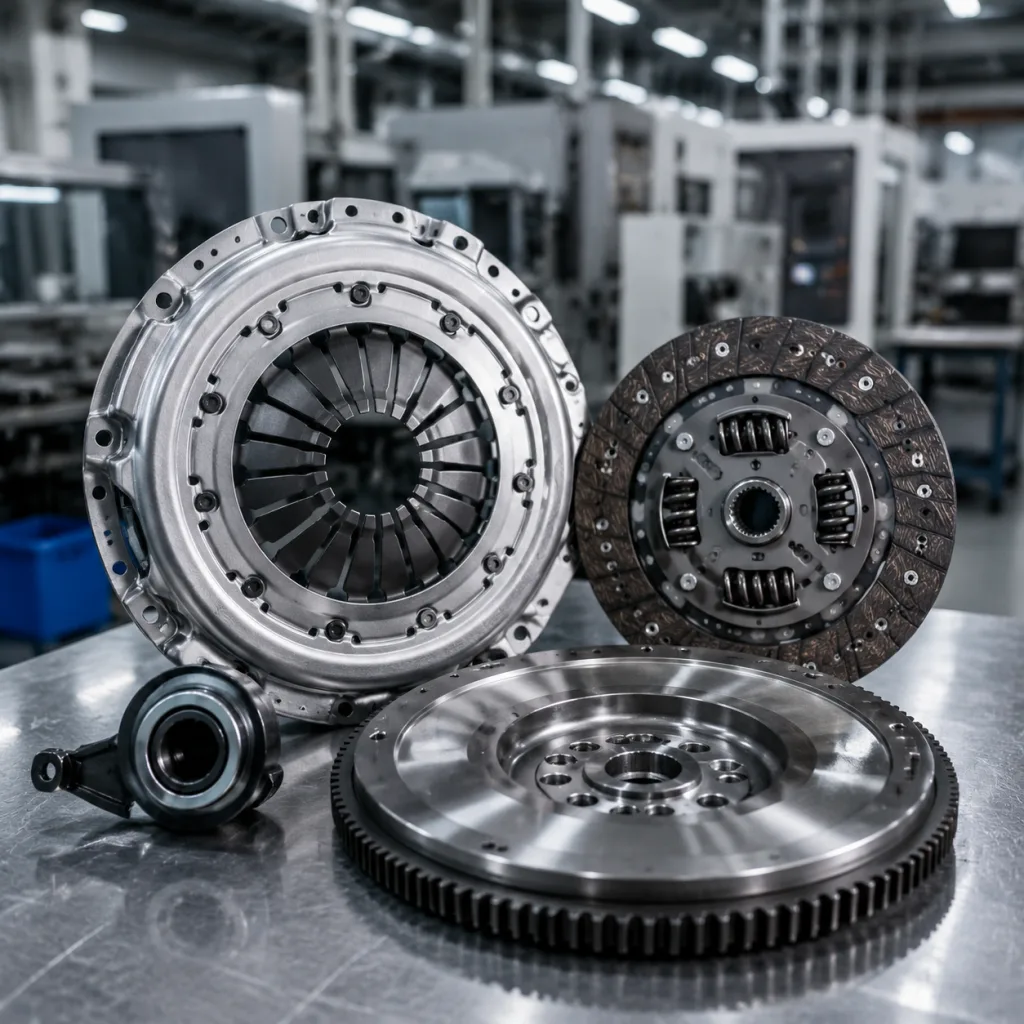
A clutch kit is normally evaluated as a matched system, not as isolated parts. For Acura applications, buyers usually check the cover assembly, clutch disc, release bearing, alignment tool, and packaging against the target OE reference, transmission type, and vehicle build range. Do not approve a sample from a catalogue photo alone; request the inspection points and acceptance limits before courier shipment.
Minimum sourcing checks
OE cross-reference from the customer or parts catalogue; provide the complete OE number and any supersession history rather than a shortened reference
Vehicle model, model year, engine code, displacement, and transmission code
Disc outside diameter, typical tolerance ±0.30 mm unless the drawing specifies tighter control
Spline count, spline OD/ID, pressure angle where available, and hub offset; confirm free sliding on a matching input shaft gauge
Cover bolt pattern, dowel position, locating diameter, and installed height
Clamp load target, commonly controlled within ±8–10% of approved sample value for aftermarket production
Disc thickness, parallelism, facing rivet height, and total indicated runout; buyers often require disc runout at or below 0.50 mm
Friction material type, copper/heavy-metal restrictions, thermal stability window, and intended duty cycle
Carton marking, EAN/UPC or customer barcode, inner bag, rust inhibitor, and pallet configuration
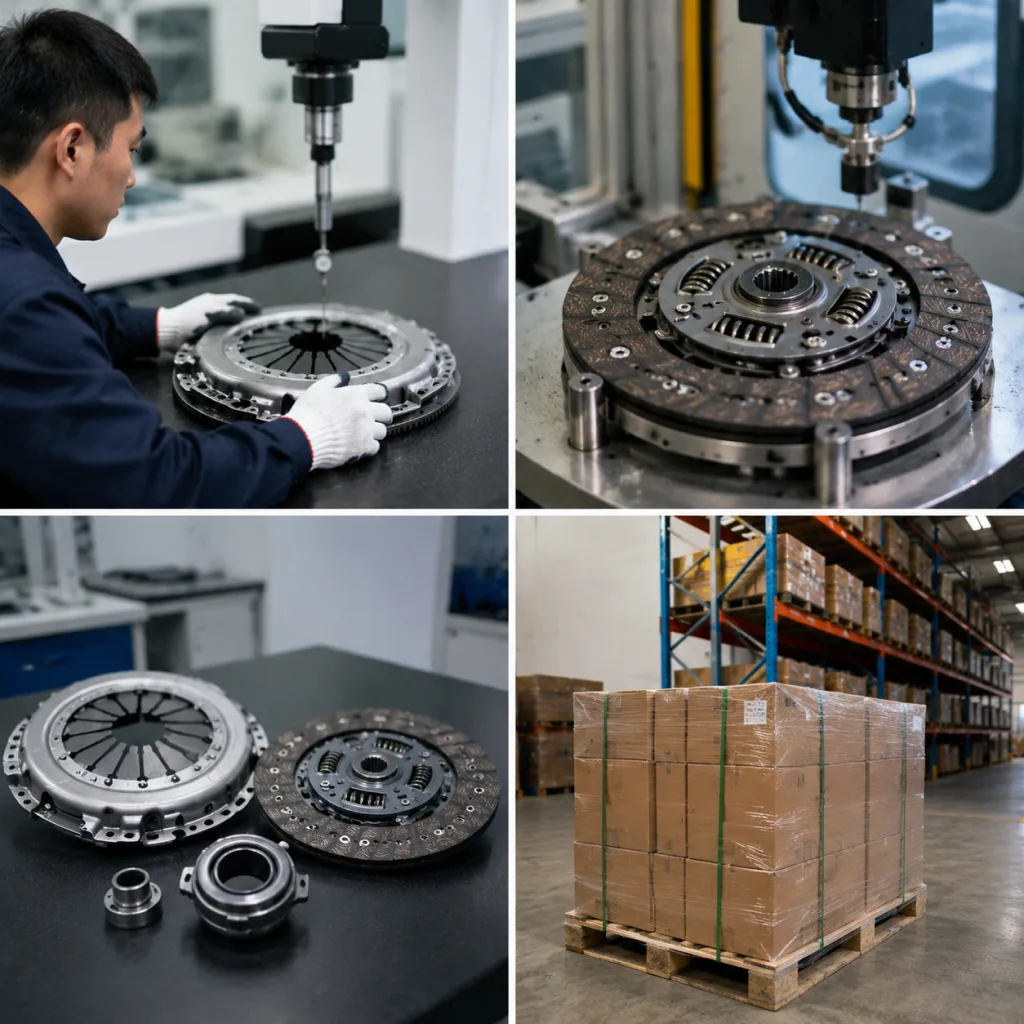
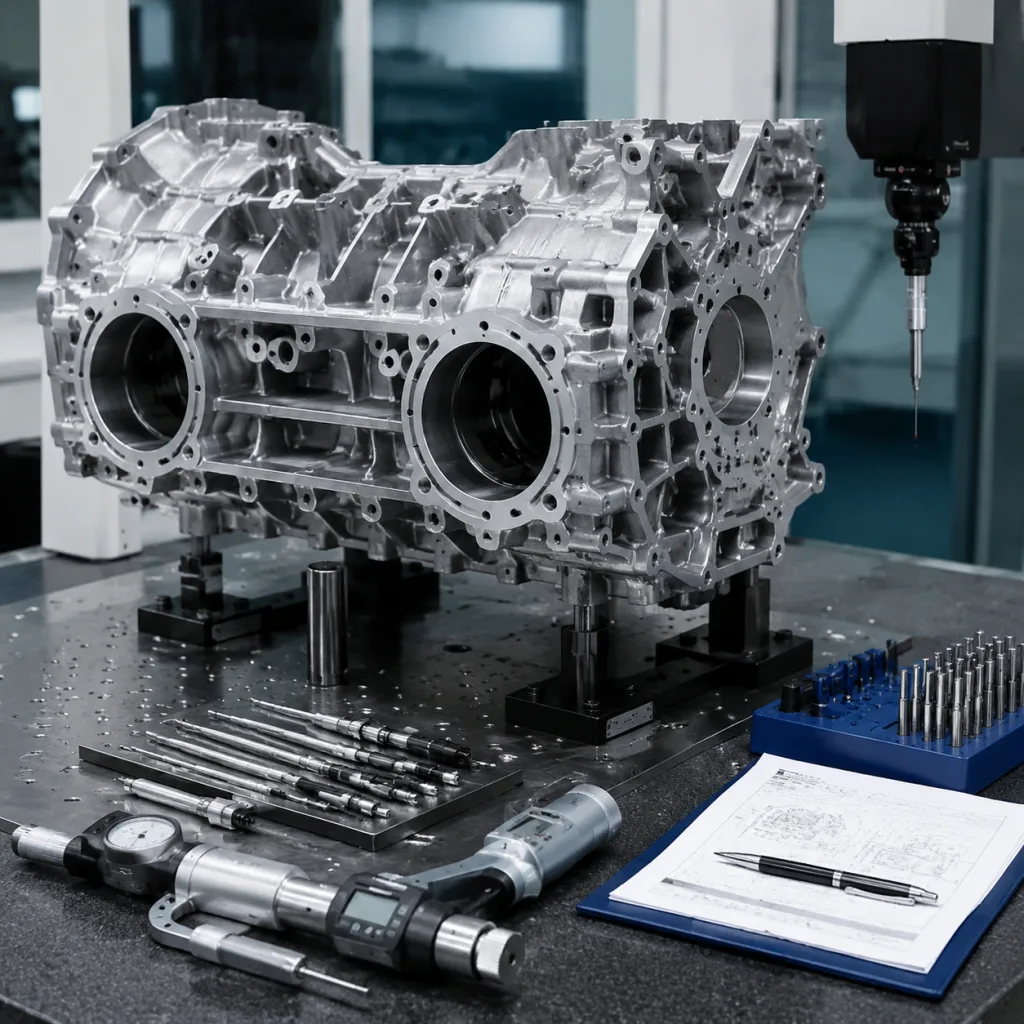
For procurement teams, the first gate is dimensional match. The second gate is functional validation. Ask the supplier to state which gauges are used: vernier calipers for general dimensions, micrometers for thickness, spline go/no-go gauges for hub fit, height gauges for cover geometry, a clamp-load test bench for pressure plate performance, and a dial indicator fixture for runout. A buyer-ready sample report should include measured values, not only “OK” marks.
Supplier qualification and factory controls
A credible supplier should be able to show process control, not only final inspection. Driventus operates under IATF 16949:2016 and ISO 9001:2015, with incoming material inspection, in-process checks, and finished-goods verification tied to batch traceability. For a clutch kit Acura OEM supplier programme, the buyer should review how the factory controls variation from stamping, machining, heat treatment, riveting, balancing, assembly, and packing.
Qualification item
What buyers should ask for
Quality management
Valid IATF 16949:2016 and ISO 9001:2015 certificates, scope, expiry date, and issuing body
Traceability
Lot number on friction disc, cover, bearing pack, master carton, and inspection record
Material records
Steel grade, diaphragm spring material, friction mix declaration, bearing steel, rubber seal or polymer component traceability
Incoming inspection
Coil or plate thickness, hardness, bearing rotation check, friction lining thickness, and supplier CoC review
In-process checks
Rivet setting height, diaphragm spring height, pressure plate flatness, cover concentricity, and spline gauge confirmation
VCI bag or rust-proof paper, desiccant where required, carton compression strength, pallet wrap, and drop-test method
Change control
Written notification for tooling, friction formula, bearing sub-supplier, heat-treatment process, or packaging change
</tr></thead><tbody> </tbody></table>Useful numeric controls for audit discussion include pressure plate flatness within 0.05–0.10 mm depending on design, disc facing thickness variation within 0.10 mm, and balancing verification where the customer specification requires it. Record retention should normally cover at least the warranty period plus one year, or the customer’s documented requirement.
If your programme requires supplier approval, review the quality system before opening commercial negotiation. Buyers should also confirm whether the factory can support a dock audit, remote video inspection, or PPAP-style document review with process flow, control plan, FMEA summary, dimensional report, material certificate, and packaging specification.
OE-equivalence targets for Acura clutch kits
For replacement and aftermarket supply, OE-equivalence means matching the functional and dimensional envelope of the reference part. It does not mean making any claim of vehicle manufacturer approval. The goal is that the kit installs without modification, releases cleanly, resists judder within normal use, and maintains clamp performance over the expected service interval.
Key technical points
Clutch disc diameter: must match the transmission family and flywheel interface; common passenger-car kits are often in the 200–240 mm range, but the exact value must come from the OE reference or approved sample
Spline count and centre bore: must engage without binding or excessive backlash; buyers should request spline gauge evidence or mating-shaft fit confirmation
Hub offset and damper travel: must clear the flywheel bolts and pressure plate fingers; incorrect offset can cause noise or non-release even when diameter is correct
Friction lining: coefficient should remain stable after heat cycling; request the supplier’s friction grade, intended temperature range, and wear limit criteria
Cover assembly: clamp load should remain consistent across the operating range; specify nominal clamp load, release load, and allowable deviation in the RFQ
Diaphragm spring: free height, finger height variation, and heat-treatment consistency affect pedal feel and release point
Release bearing: low noise, correct seal performance, acceptable axial play, and grease suitable for regional temperature conditions
Hardware: bolt thread form, torque requirement, washer type, corrosion protection, and whether bolts are included or excluded from the kit
Published standards that may be relevant to buyer audits include REACH (EC) No 1907/2006 for SVHC control in the EU and, where a friction or durability test programme is specified, SAE J2527 as a recognised durability reference for related validation environments. For corrosion resistance, many buyers request neutral salt spray targets such as 48–96 hours on coated external parts, depending on destination market and packaging. If your customer specification references emission, safety, or vehicle compliance items, confirm the exact document set before issuing a purchase order.
MOQ, lead time, and commercial terms for B2B buyers
Sourcing managers usually compare suppliers on landed cost, but supply continuity matters more on recurring programmes. For clutch kits, MOQ is driven by tooling status, box configuration, kit complexity, bearing sourcing, and how many references share the same friction disc, cover, or release bearing.
Typical commercial questions
What is the MOQ per reference and per shipment?
Is tooling already open, or is a new cover, hub, or bearing variant required?
Can multiple Acura fitments be consolidated into one mixed pallet or container?
What is the sample lead time versus mass-production lead time?
Are private-label cartons, barcode labels, and instruction sheets available?
What is the replenishment plan for fast-moving SKUs and slow-moving long-tail references?
As a practical starting point, stocked or tooled references may support trial orders of 50–100 kits per SKU, while private-label production commonly starts around 200–500 kits per SKU depending on carton artwork and component availability. New-tooling or low-volume references may require a higher MOQ because stamping, diaphragm spring, hub, or facing procurement must be batched. Sample lead time is often 7–15 working days when components are available and 25–45 days when tooling or bearing confirmation is needed. Mass production is commonly 30–60 days after deposit, artwork approval, and sample sign-off; add time for peak season, customer-specific testing, or third-party inspection.
Price should be quoted against clear assumptions: EXW, FOB, CIF, or DDP term; annual volume; order batch size; packaging type; warranty expectation; required certificates; and payment terms. A small MOQ may carry a higher unit price because setup, inspection, and carton printing costs are spread over fewer kits. Container or scheduled quarterly orders usually reduce the per-kit cost and improve bearing and friction-material purchasing stability.
Driventus supports B2B buyers through our catalog, custom manufacturing for programme-specific requirements, and export documentation for repeat orders. For buyers planning a range launch, a pilot order is usually the fastest way to confirm fitment, packaging, warehouse handling, and market demand before booking container volume.
Validation testing and release process
A buyer should not release a clutch kit programme without documented test data. At minimum, the supplier should present the validation logic used to approve the sample and the first production batch. The most useful reports compare the OE sample, the approved pre-production sample, and the mass-production result in the same table.
Common release checks
Dimensional inspection against drawing, OE sample, or customer-approved master sample
Disc OD, ID, spline count, hub offset, total thickness, and rivet height measurement
Static clamp load and release load verification at defined installed height
Disc parallelism, axial runout, and hub alignment measurement
Cover finger height variation and pressure plate flatness check
Bearing noise check, rotation smoothness, seal condition, and axial play measurement
Thermal cycle or repeated engagement test with written cycle count and pass/fail criteria
Corrosion review after storage or salt spray where the destination market requires it
Packaging transit review for crush, rust, label scuffing, and component movement inside the carton
A practical release sequence is: RFQ data review, OE sample or drawing confirmation, feasibility check, prototype build, dimensional report, functional bench test, buyer sample approval, pilot batch, pre-shipment inspection, and mass-production release. For pilot lots, many buyers request AQL inspection such as 0 critical defects, AQL 1.0 for major defects, and AQL 2.5 for minor cosmetic or packaging defects, although the exact plan should match the customer’s quality agreement.
If the programme is for harsh duty cycles, mountainous regions, taxi fleets, or mixed-market distribution, ask for test conditions, cycle count, temperature range, and acceptance criteria in writing. This is especially important when one part number is sold across multiple regions with different driving habits and warranty expectations. For buyers needing a broader engine and drivetrain range, see our catalog and engine components.
How Driventus supports procurement teams
Driventus is based in Taizhou, Zhejiang, with vertically integrated manufacturing for engine and powertrain components. That structure helps control tooling, process flow, and batch consistency across recurring export orders. For a clutch kit Acura OEM supplier project, the objective is to turn an OE number or sample into a controlled sourcing package with fitment, inspection, packing, lead time, and commercial assumptions defined before production.
What procurement teams typically receive:
Fitment review against the requested OE reference, vehicle application, engine code, and transmission code
Technical confirmation of disc diameter, spline count, hub offset, cover pattern, bearing type, and kit contents
Sample supply for dimensional and functional confirmation, with measured data where requested
Production traceability by lot, including component batch and final inspection references
Export packing suitable for distributor, e-commerce, or warehouse handling, including inner protection and master carton labelling
Commercial support for private label, neutral packaging, barcodes, customer part numbers, or programme-specific packaging
Shipment support for mixed SKUs, pallet loading plans, and standard export documents such as invoice, packing list, certificate of origin where applicable, and bill of lading or airway bill
For a faster RFQ, send the OE reference, photos of the original kit if available, target annual volume, first-order quantity, destination port or country, preferred Incoterm, packaging requirement, and any mandatory test or compliance format. If the buyer already has a warranty return profile from the market, share the main failure modes so the validation focus can be adjusted.
For buyers who require a formal sourcing step, use the request a quote channel to send OE reference, annual volume, destination market, and any required test report format. If your requirement is a catalogue comparison first, start with our catalog and then narrow the shortlist by fitment, MOQ, and delivery window.
Driventus is an independent aftermarket manufacturer; brand names are referenced for fitment only.
Frequently asked questions
Yes, when the customer provides the OE reference, transmission code, vehicle application, and target market. The part is matched for aftermarket supply only, and brand names are used for compatibility identification.
Typical documents include IATF 16949:2016 and ISO 9001:2015 certificates, dimensional inspection records, material or component traceability, packaging specification, and batch inspection data. Additional test documents can be discussed during RFQ review.
Yes. Packaging, carton marking, barcode requirements, instruction sheets, and pallet configuration can be aligned to distributor or regional warehouse needs through custom manufacturing and commercial review.
If you are sourcing by OE reference, volume target, or market region, send your clutch kit requirements and we will confirm fitment, MOQ, lead time, and commercial terms. Start here: /contact.html