Camshaft vs INA Alternative: B2B Sourcing Comparison
A camshaft sourcing decision can look simple on a spreadsheet. It is not. Buyers comparing a camshaft vs INA alternative have to judge fitment confidence, metallurgy, lobe accuracy, heat treatment, packaging durability, and claim traceability before margin gains are real. The wrong part may install, run, and still create noise, tappet wear, timing complaints, or early returns.
This guide is written for category buyers, import managers, sourcing engineers, distributors, repair chains, and private-label teams evaluating aftermarket camshafts. Driventus manufactures engine and powertrain components in Taizhou, Zhejiang, and exports to more than 60 countries. We operate under IATF 16949:2016 and ISO 9001:2015 controls. Driventus is an independent aftermarket manufacturer; brand names are referenced for fitment only.
Start With the Sourcing Decision, Not the Brand Name
The useful comparison is not “brand versus no brand.” It is a decision about risk control.
INA is widely associated with valvetrain and bearing-related components. In procurement, however, the camshaft must be judged against the engine application, OE reference geometry, installation environment, expected service life, and the buyer’s warranty exposure. A catalogue match is helpful. It is not a complete approval.
For a camshaft, the functional questions are specific:
Does the lobe profile preserve valve timing and lift?
Are the journals aligned and finished for the intended bearing interface?
Is hardness high enough for wear resistance but controlled enough to avoid brittleness?
Are oil holes, thrust faces, keyways, sensor features, and drive interfaces in the correct positions?
Will the part work with the tappets, followers, lubrication quality, and service habits in the target market?
A lower landed cost only matters if those questions are answered. A practical camshaft vs INA alternative review should therefore be built from samples, drawings, dimensional reports, material data, packaging requirements, and traceability records. Where available, buyers may provide OE part-number cross-references in generic form, such as OE 06A… or OE 11251…, for fitment discussion. Driventus does not claim approval or endorsement by any vehicle manufacturer.
Comparison Matrix: Where Each Route Wins
The table below shows the normal sourcing trade-offs. Results still depend on part number, volume, drawing availability, approval scope, packaging, and target market.
Evaluation point
Established branded route
Driventus independent alternative
Fitment basis
Brand catalogue and application data
OE cross-reference, sample reverse engineering, and drawing confirmation
Landed cost
Usually higher unit cost
Program-based pricing for distributor, repair-chain, and private-label demand
MOQ flexibility
Often fixed by channel policy
Negotiable by part family, packaging, and forecast stability
Engineering visibility
Limited for standard distribution purchases
Dimensional reports, material data, and process controls available for review
Packaging control
Standard branded packaging
Neutral, customer-label, or market-specific packaging by agreement
Traceability
Batch-level or channel-dependent
Lot traceability tied to production and inspection records
</tr></thead><tbody> </tbody></table>A branded source can reduce customer hesitation and simplify catalogue purchasing. An independent manufacturer can improve margin, label control, and supply flexibility, but only when the technical review is disciplined.
Use a branded route when the contract requires it, demand is too small for efficient production, or the buyer cannot validate the part. Use an independent route when the application is mature, volumes repeat, and the approval process can be documented.
Spec Deep-Dive: Measurements That Decide Approval
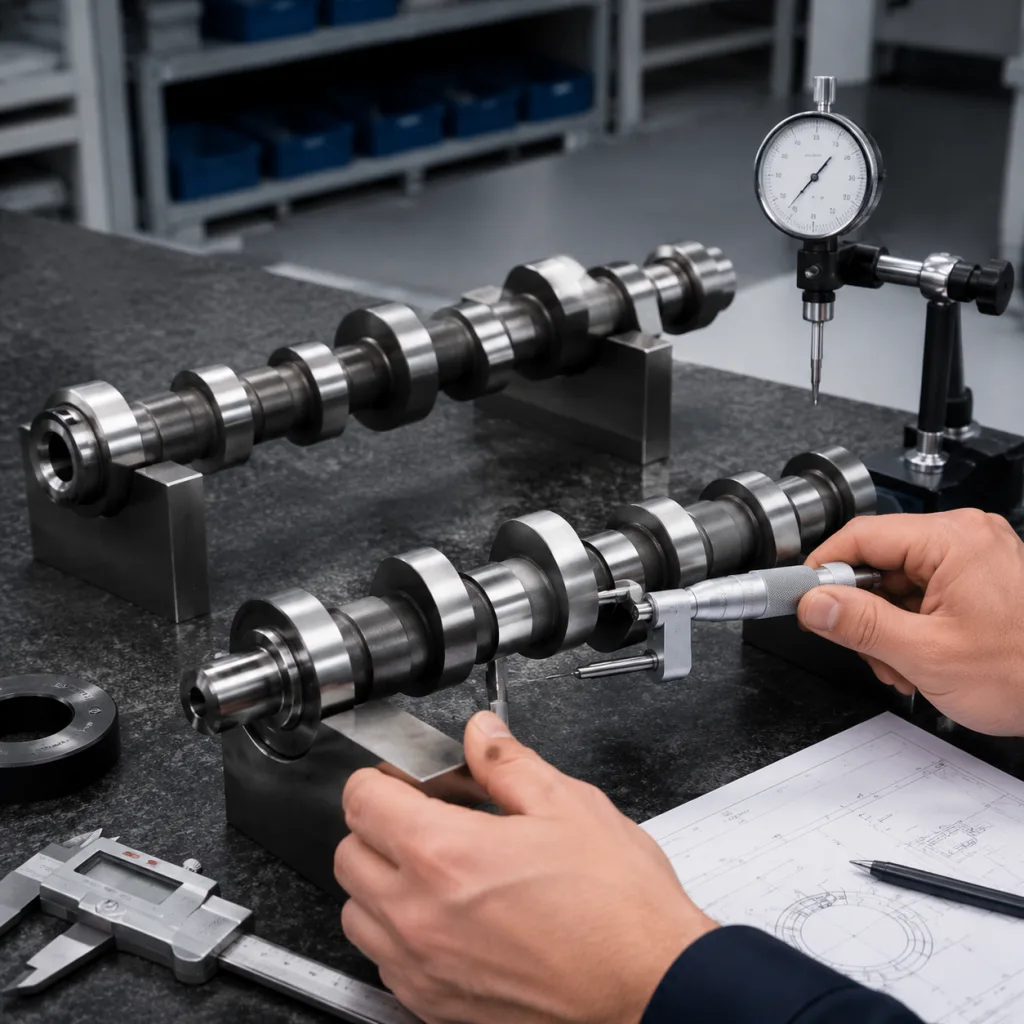
A camshaft is not a generic machined shaft. Small errors in profile, straightness, oil-hole position, or surface finish can change engine behavior. Ask for measurable evidence, not broad claims of interchangeability.
For quoting and approval, build the spec sheet around these control points:
Application and engine family, including fuel type, displacement, valve count, and emissions market.
OE cross-reference format, such as OE 06A… or OE 11251…, plus photo confirmation of sensor, gear, thrust, and drive features.
Material, such as chilled cast iron, ductile iron, or forged steel, depending on design.
Lobe lift tolerance, usually controlled to drawing with a buyer-agreed target band often in the ±0.03 to ±0.05 mm range for repeatable aftermarket production.
Journal diameter tolerance, commonly around ±0.01 to ±0.02 mm, with roundness and cylindricity defined separately.
Journal-to-journal concentricity, lobe phasing, and index position against the master sample or CAD reference.
Overall straightness after heat treatment and grinding, often limited to 0.03 to 0.05 mm TIR unless the drawing is tighter.
Surface hardness range and case depth where induction hardening or nitriding is used, commonly specified as HRC 50–60 on working surfaces or by effective case depth in millimeters.
Surface roughness on bearing journals and lobes, typically Ra 0.2–0.8 μm depending on interface and lubrication scheme.
Oil-hole location, chamfer condition, burr-control criteria, and cleaning standard, with no loose chips permitted in finished bores or galleries.
Keyway, sprocket, sensor, thrust-face, and drive-interface dimensions with allowance for assembly fit.
Dynamic balance requirement, if the application has tighter NVH targets or high-speed operation.
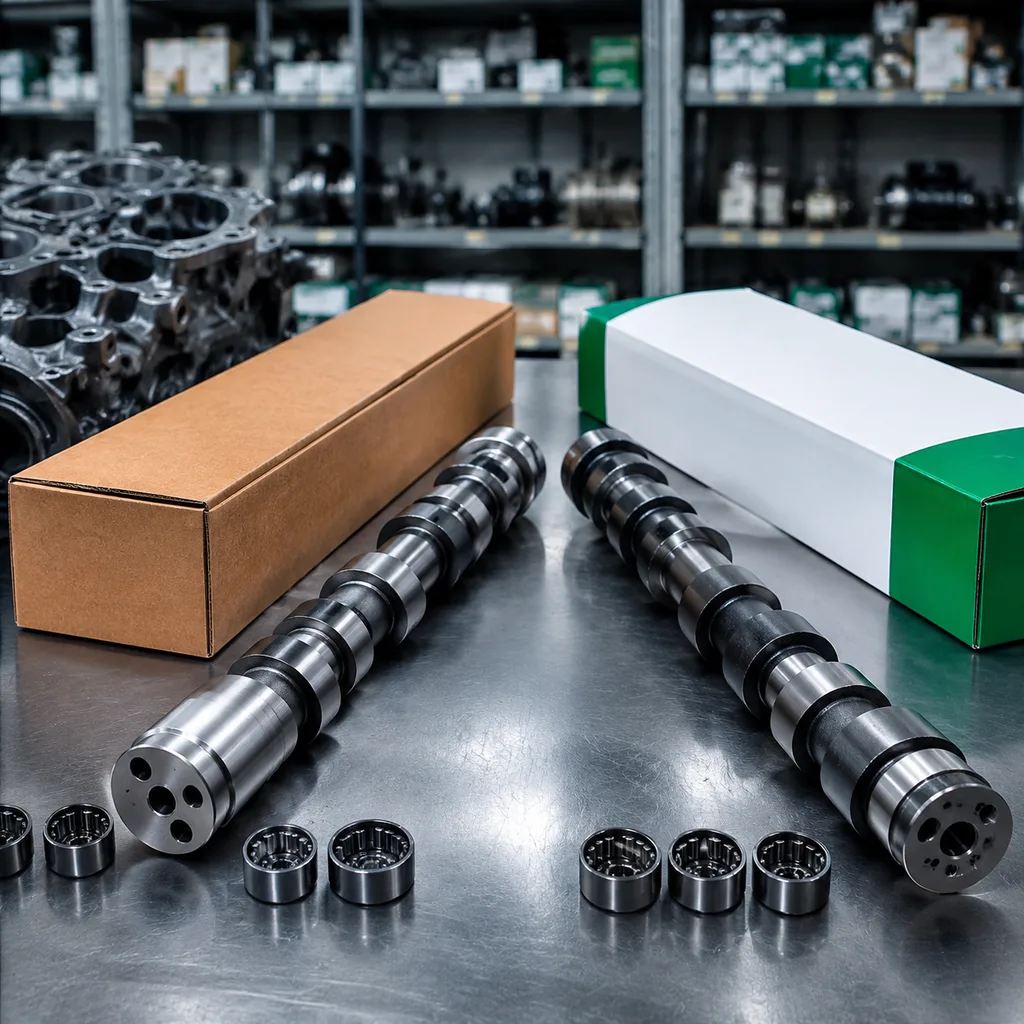
Packaging specification for sea freight, warehouse handling, mixed-SKU consolidation, and private-label presentation.
For MOQ and price planning, many independent camshaft programs start at 100–300 pcs for one part number. Unit price usually improves once releases reach 500–1,000 pcs. Buyers should compare ex-works price, ocean freight, duty, inspection cost, and expected warranty reserve to estimate the true landed cost.
Repeat orders commonly run 30–45 days after sample approval. First orders can take 45–75 days when tooling, reverse engineering, fixture work, or special packaging is required.
IATF 16949:2016 and ISO 9001:2015 do not define camshaft dimensions. They do support process control, document control, corrective action, internal audit, and traceability. For EU supply chains, environmental and chemical compliance may also need review under REACH (EC) No 1907/2006.
Failure Modes to Eliminate Before Release
Most sourcing mistakes are visible before mass production if the buyer asks for the right checks. A visual match is not enough.
Production controls
Driventus uses controlled production routing for camshaft programs, including material verification, machining inspection, heat-treatment monitoring, grinding checks, cleaning, corrosion protection, and final packing inspection. The exact control plan depends on part family, annual volume, drawing status, and customer approval requirements.
Typical checkpoints include incoming chemistry review, microstructure checks, rough machining allowance, pre-heat-treatment geometry, post-heat-treatment hardness, finish-grind dimensions, final visual inspection, and cleanliness review. For tighter programs, buyers can request SPC on key-to-quality dimensions such as journal diameter, lobe height, and runout. Acceptance can be based on agreed AQL sampling or 100% inspection for critical characteristics.
The main defects to screen out are lobe-height drift, incorrect phasing, journal runout, poor surface roughness, incomplete burr removal, blocked oil holes, under-hardening, over-hardening, corrosion, and packaging damage. Each one can become a field complaint.
Approval evidence
For higher-volume programs, buyers may request a sample approval package with dimensional inspection reports, material certificates, hardness results, surface-finish data, and packaging validation. Where a customer requires a formal automotive submission, the discussion can reference AIAG Production Part Approval Process practices without implying vehicle manufacturer approval.
A practical approval set usually includes 5–10 pilot samples, one retained master sample, a dimensional report against all agreed characteristics, and photos of packaging and anti-corrosion treatment. If the part has a long service interval, add bench rotation checks, wear pattern review after short-run testing, or field trial feedback before distribution release.
Our quality system is structured around IATF 16949:2016 and ISO 9001:2015. These frameworks improve repeatability, but the buyer still needs to define inspection characteristics, test scope, and acceptance criteria for each camshaft program.
Commercial Scenario: Distributor or Repair Chain Launch
Consider a distributor launching a private-label camshaft line for mature engine applications. The margin target is attractive, but the launch only works if technical, packaging, and claims rules are locked before the first purchase order.
Start with the commercial model:
Landed cost: compare unit price, duty, freight, packaging, inspection cost, financing cost, and warranty reserve.
Availability: confirm production lead time, current capacity, tooling status, and whether master samples are required.
MOQ and price breaks: request tiered pricing by 100, 300, 500, and 1,000 pcs so reorder economics are visible.
Assortment depth: check whether the supplier can support adjacent engine components such as tappets, timing kits, gaskets, pistons, and water pumps through our catalog.
Private label: define carton strength, label format, barcode rules, language requirements, and country-specific documents.
Claims handling: agree evidence requirements, response time, containment method, and credit policy before launch.
Forecasting: provide 6- or 12-month demand estimates to reduce stockout, rush freight, and overproduction risk.
Payment and supply terms should be settled early. First orders often use 30% deposit with balance before shipment; larger programs may use LC at sight. Net terms can be discussed after performance is proven.
For multi-location repair chains, consistency may matter more than the lowest unit price. Clear labels, stable fitment references, clean packaging, installation identification, and batch traceability reduce installer uncertainty and make claim review faster.
Q&A: When Is the Independent Route the Right Move?
When does an independent camshaft source make sense?
Use it when the buyer can define the target application, provide a sample or OE-style reference, approve pilot parts, and forecast repeat demand. It is especially useful for mature engine families where margin improvement, private-label control, or supply consolidation matters.
When should the buyer stay with a branded distribution route?
Stay with a branded route when customer contracts require a named brand, demand is too small for efficient production, or technical data is missing. If the procurement team cannot provide a sample, drawing, OE-style reference, engine application data, or failure history, approval risk rises sharply.
Can both routes be used together?
Yes. Many buyers use branded stock for low-volume or contract-sensitive applications and independent production for high-running part families. That split protects availability while improving margin where demand is predictable.
What should Driventus review first?
Send target applications, annual volumes, OE-style references, photos, sample availability, packaging requirements, inspection expectations, and known failure history from the current product. For controlled aftermarket programs, Driventus can review samples, drawings, and fitment references through custom manufacturing.
Driventus is an independent aftermarket manufacturer; brand names are referenced for fitment only.
Frequently asked questions
No. An independent aftermarket camshaft is manufactured for fitment and functional equivalence against defined applications or references. It should be validated through dimensions, material, hardness, surface condition, and performance-related checks. It is not an OE-approved part unless that approval is separately documented by the vehicle manufacturer.
Include application, engine code if available, OE-style reference such as OE 06A… or OE 11251…, annual volume, packaging needs, target market, sample availability, compliance requirements, and required inspection documents. Add target tolerances, required hardness range, surface finish, lead-time target, MOQ expectation, and whether you need private-label or neutral packaging. Photos alone are not enough for reliable sourcing.
Yes, subject to part family, MOQ, packaging specification, and compliance review. Private-label projects normally require approved artwork, carton testing expectations, traceability rules, market documentation, and a sample approval process before mass production. Buyers should also define release quantities, label rules, and forecast commitments so pricing and lead time can be quoted accurately.
If you are comparing camshaft sourcing options, send the target applications, volumes, and sample requirements. Our team can review fitment, inspection scope, and program feasibility when you [request a quote](/contact.html).