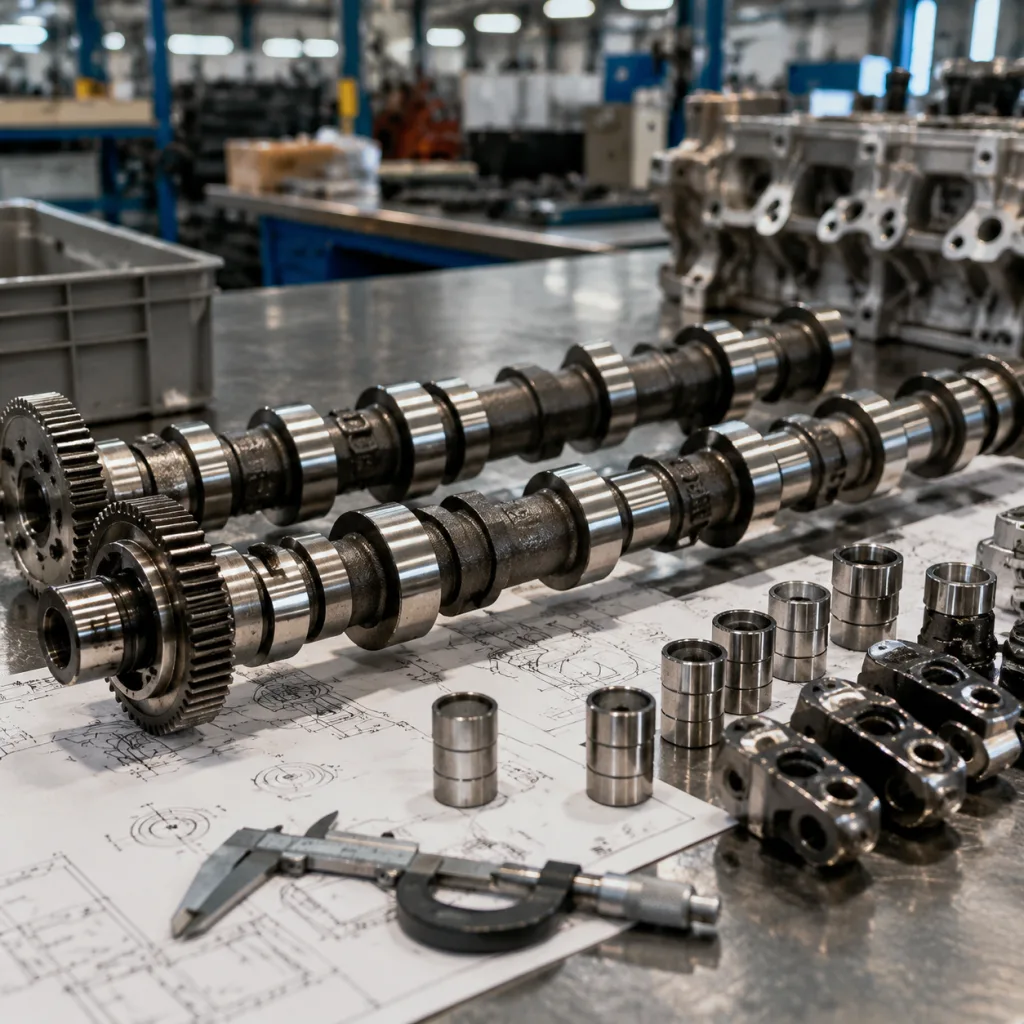
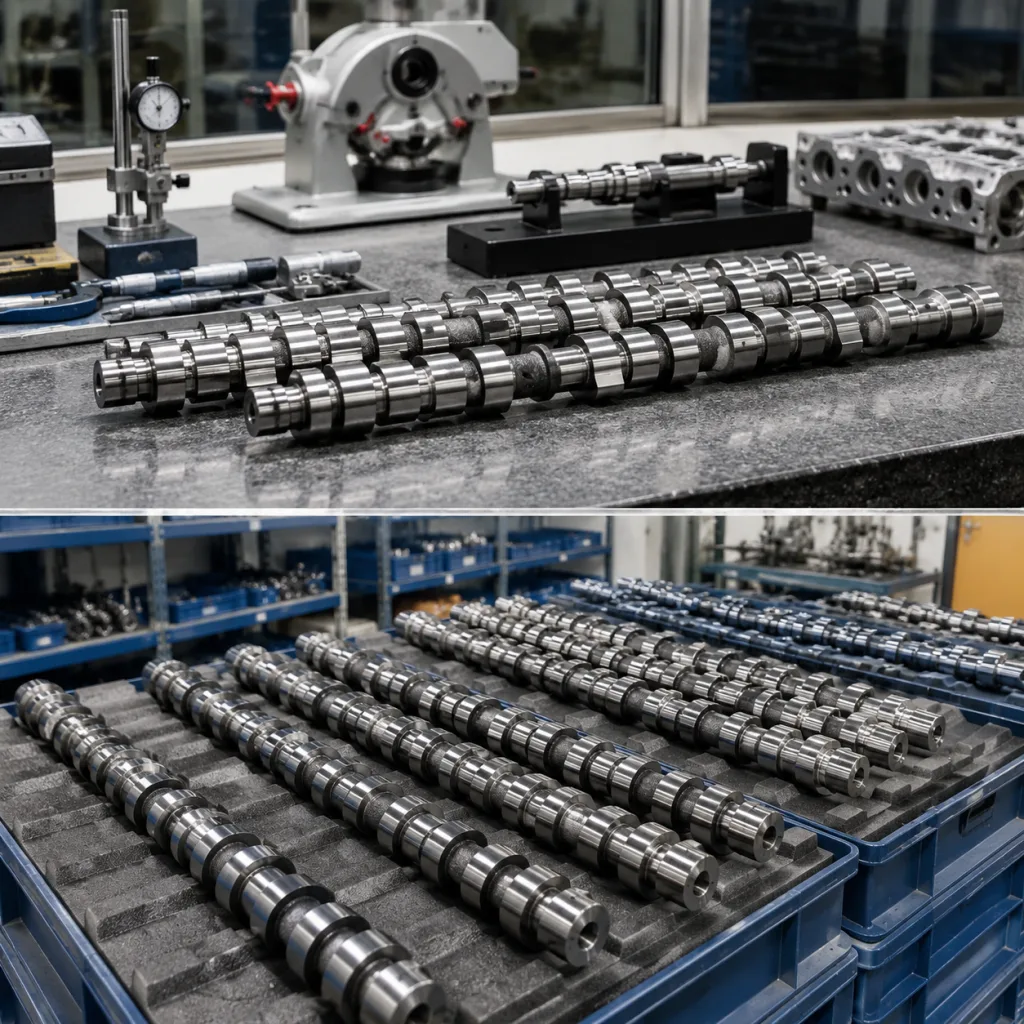
A camshaft Toyota OE equivalent program fails or succeeds on details that are easy to miss in a catalogue: lobe profile, journal geometry, oil-feed alignment, thrust position, trigger features and drive-interface fit. For distributors, importers and repair-chain buyers, “fits Toyota application” is not enough. The part must restore valve timing, oil-film stability and service durability across the exact engine family being sold.
Small deviations matter. A 0.02–0.05 mm error in journal size, lobe lift or thrust location can change oil clearance, idle quality, emissions-related performance and warranty risk.
This guide gives procurement teams a practical way to define OE-equivalent camshafts, challenge supplier claims, and release production with measurable controls. It focuses on replacement-market sourcing, not vehicle-brand approval. Driventus manufactures engine and powertrain components in Taizhou, Zhejiang, under IATF 16949:2016 and ISO 9001:2015 quality systems, supplying B2B customers in more than 60 countries. Driventus is an independent aftermarket manufacturer; brand names are referenced for fitment only.
Decision Rule: Define OE Equivalence by Function, Not Catalogue Text
For a replacement camshaft, OE equivalence means the part is engineered to match the functional characteristics of the original equipment component for a defined application range. It does not mean approval, endorsement or supply by the vehicle manufacturer.
The buying decision should start with one question: what must this camshaft do in the engine to be considered interchangeable? For Toyota engine applications, the answer should be written as measurable characteristics, not as a loose cross-reference. The specification should identify the reference part, target engine codes, production range, intake/exhaust position and controlled dimensions before any production commitment.
Control these items first:
Overall length and end-face reference dimensions, typically controlled within ±0.05–0.10 mm unless the drawing requires tighter limits
Journal diameter, roundness and surface finish, with bearing journals commonly held within ±0.005–0.015 mm depending on engine design
Cam lobe lift, base circle, flank geometry and phase relationship, checked at multiple angular points rather than only peak lift
Intake or exhaust position, where applicable, because VVT oil galleries and trigger features may differ even when the casting appears similar
Drive-end interface, including sprocket, gear, actuator or timing component fit, with bolt-hole PCD, dowel position and keyway geometry confirmed
Oil-feed holes, grooves, plugs and gallery alignment, including hole diameter and clocking relative to datum journals
Thrust face width, finish and axial location, usually verified against a datum end face or center journal
Material grade, hardness depth and surface treatment, with heat-treatment route locked before mass production
OE part-number cross-references may help with fitment mapping, but they are not engineering proof. Verify them against engine code, production year, valve-train layout, regional emissions specification and supersession history before release. For high-risk references, ask whether the match is based on an OE sample scan, buyer drawing, reverse-engineered data or prior production approval.
Treat a camshaft Toyota OE equivalent as a controlled functional component, not a generic machined shaft. A practical release file connects catalogue references to dimensional evidence, material records, inspection criteria and batch-release rules. It should include the frozen application list, approved sample report, CTQ dimension list, control plan, packaging approval and agreed AQL level before the first production order.
Spec Deep-Dive: The Dimensions and Materials That Carry the Risk
A buying specification should combine drawing-level dimensions with functional tolerances. If the supplier only provides an application list, the buyer has limited control over noise, timing stability, oil-pressure complaints and bearing wear. Use the supplier’s drawing where available, but define minimum measurable requirements in the purchase specification so inspection teams can approve or reject parts consistently.
Parameter
Typical procurement requirement
Why it matters
Journal diameter
Commonly ±0.005–0.015 mm against drawing; buyer should confirm bearing clearance target
Maintains oil film and bearing clearance
Journal roundness
Often ≤0.005–0.008 mm on critical journals
Reduces localised wear and low oil-pressure complaints
Journal roughness
Ra 0.2–0.4 μm typical after grinding/polishing
Supports oil film stability and bearing life
Lobe lift
Usually within ±0.03–0.05 mm of approved profile unless OE data requires tighter
Controls valve opening and engine breathing
Lobe profile
Lift-curve deviation checked every 1–2° or at agreed angular points
Protects timing, duration and idle quality
Lobe hardness
Often 50–60 HRC for hardened steel or equivalent material-specific range
Reduces scuffing during break-in and service
Case depth
Specify effective depth, commonly 1.0–2.5 mm where induction or carburising applies
Prevents early surface fatigue
Runout
Typically ≤0.03–0.05 mm across datum journals after finish machining
Prevents timing variation and abnormal bearing load
Oil-hole position
Hole diameter and angular position confirmed to drawing or golden sample
Ensures lubrication to journals and actuator areas
Thrust face finish
Ra 0.4–0.8 μm typical, with width and location controlled
Limits axial wear and noise
</tr></thead><tbody> </tbody></table>Common manufacturing routes include chilled cast iron, ductile iron, forged steel and assembled camshaft construction. Do not substitute one route for another without validation. Material, hardening method and contact stress behaviour are linked. Surface treatment may include induction hardening, carburising, nitriding or chill-hardening, depending on the material and OE design. A chilled-cast profile may rely on local chill hardness; a steel camshaft may require controlled induction depth and tempering records.
The specification also needs a datum strategy, measurement method and sample size. A lobe profile report is useful only when it states the measuring equipment, angular resolution, reference datum and acceptable profile deviation. A hardness report should identify test scale, test location and acceptance range rather than listing a single average value.
For pilot approval, buyers often inspect 5–10 pieces from the first lot at full dimensional level, then move to a control-plan frequency such as first-off, patrol inspection and final sampling. Driventus aligns production controls with its quality system, including incoming material inspection, in-process checks and final dimensional verification. For buyer-owned specifications, CTQ items such as journal diameter, lobe lift, phase angle, runout, oil-hole clocking and thrust-face width should be marked separately from general dimensions.
Proof Package: What Evidence Separates a Valid Claim from a Sales Claim
A credible camshaft Toyota OE equivalent claim needs test evidence. The exact validation plan depends on application volume, warranty risk, change history and whether the program is aftermarket-only or supplied into an OEM/Tier-1 channel. For a first sourcing project, buyers should allow time for sample review, lab reports, fitment checks and pilot-lot inspection before committing to container-level purchasing.
A practical validation package may include:
Material certificate with chemical composition, heat-number traceability and material grade confirmation
Hardness report for lobes and journals, including test method, location and minimum/maximum acceptance range
Case-depth or hardened-layer confirmation where relevant to the design, with microstructure photos for higher-risk applications
Surface roughness report for journals, lobes, seal areas and thrust faces, reported in Ra and measured after final polishing
Profile measurement report comparing the lobe lift curve with reference data at agreed angular intervals, not only maximum lift
Phase-angle report showing lobe centerline and relationship to dowel, keyway, gear, trigger or actuator datum
Runout and straightness report after heat treatment and final machining, with datum journals identified
Magnetic particle inspection or other crack-detection record where applicable, especially after heat treatment
Bench fitment check for sprocket, sensor trigger, actuator, seal and thrust interface using reference mating parts where possible
Cleaning and residual-contamination control for oil passages, including air blow, flushing or particle check where applicable
Packaging vibration, corrosion or handling assessment for export shipments, especially sea freight above 30 days
For quality management, IATF 16949:2016 and ISO 9001:2015 are relevant published standards for automotive manufacturing systems. Environmental and substance compliance may be requested under REACH (EC) No 1907/2006 for EU-market importers, especially where coatings, packaging materials or preservative oils are involved. If the buyer sells into regulated distribution channels, request IMDS-style material data or supplier declarations early; compliance documents can take longer than ordinary inspection reports.
Emissions standards such as ECE R-83 apply at vehicle level, not to a camshaft as a standalone component. Still, cam profile accuracy can affect valve timing, combustion stability and emissions-related performance after installation. Replacement buyers should control lobe geometry, phase angle and actuator-interface fit as primary characteristics.
Where possible, compare supplier data with a retained OE sample or an approved golden sample. Approve 2–3 golden samples: seal one at the supplier, retain one at the buyer’s inspection location and keep one for dispute resolution. All should carry the same drawing revision, lot number and approval date.
Failure Modes: Where Application Mapping Usually Breaks
Camshafts are often visually similar across engine families. Some differences are almost invisible without measurement. A wrong match can cause immediate installation issues, fault codes, abnormal noise or delayed failures after several thousand kilometres. Procurement teams should separate fitment data from engineering approval data and avoid adding applications based only on name similarity.
Before placing a purchase order, verify:
Engine code, displacement and valve-train layout
Production date range and market region
Intake versus exhaust camshaft position
Variable valve timing actuator compatibility, including oil-control path and actuator mounting face
Sensor trigger wheel, reluctor or cam-position signal configuration
Number of journals and lobe arrangement
Seal diameter, front-end drive interface, dowel position and bolt pattern
Oil-feed layout, plug position, groove width and gallery direction
Relevant OE cross-reference format, if provided in the buyer’s data
Supersession note showing whether the change is dimensional, functional or catalogue-only
Catalogue control needs a formal revision process. When an OE reference is superseded, the supplier should confirm whether the replacement part is dimensionally unchanged, functionally interchangeable or restricted to a later engine variant. A short replacement note is not enough when the change affects trigger geometry, oil feed, thrust location or actuator fit. Require a dated revision record stating the affected SKU, old and new cross-reference, engineering reason and inventory disposition.
Regional distributors face another trap: the same engine family name may appear in multiple catalogues with different emissions equipment or production cut-in dates. Use engine codes, VIN breakpoints where available, and sample confirmation for high-risk applications. Keep the approved application list locked during production. Uncontrolled catalogue additions are a common source of returns.
A good operating rule is simple: sales catalogue expansion must trigger engineering review when it adds a new engine code, production date range, market region or VVT configuration.
Driventus can support distributors with structured fitment tables, buyer-specific labels and carton data for aftermarket warehouse systems. Buyers can review related engine products through our catalog or the engine-components section at /products/engine-components.html. For private-label programs, confirm label fields such as SKU, OE reference, engine code, production lot, quantity, country of origin, barcode format and carton gross weight before artwork approval.
Factory Comparison: What Repeatable Suppliers Control Batch After Batch
For importers and multi-location repair chains, the first approved sample is only the starting point. The real sourcing challenge is repeatability. Camshaft production includes several stages where variation can enter: casting or forging, rough machining, heat treatment, straightening, grinding, polishing, cleaning and anti-rust packaging. Each stage needs a recorded control point, not only a final visual check.
A supplier audit should compare these controls:
Lot traceability from raw material to finished carton, including heat number, work order and final batch code
Gauge calibration records for profile, runout and journal measurement, with valid calibration dates
Heat-treatment process parameters and load records, including temperature, holding time, quenching medium and tempering cycle where applicable
Grinding-wheel control, dressing frequency and surface-finish checks for journals and lobes
First-off, patrol and final inspection frequency, with CTQ dimensions measured more often than general dimensions
Straightening process control after heat treatment, including maximum correction limit and recheck method
Segregation and disposition of nonconforming material, with rework approval and scrap records
Cleaning process for oil holes, grooves and machined passages, including compressed-air, flushing or brush-cleaning method
Preservation oil and corrosion-prevention method, normally suitable for 6–12 months of warehouse storage when cartons remain sealed
Export packaging strength for sea freight and warehouse handling, including separators to prevent lobe-to-lobe contact
For higher-volume programs, buyers may request PPAP-style documentation where applicable to the commercial relationship. Do not assume that a catalogue item and a production-approved item carry the same documentation level. Write the requirement into the sourcing agreement, including what is submitted before mass production and what remains available for audit. Typical pre-production submissions include dimensional report, material certificate, hardness report, process flow, control plan, FMEA summary where available, packaging approval and sample warrant.
Batch release should link inspection records to carton labels, lot codes and shipment documents. This traceability allows faster containment if a field complaint appears, and it helps separate installation issues from manufacturing variation. A startup-noise complaint, for example, can be checked against journal diameter, oil-hole position, surface roughness, packaging damage and installation batch instead of turning into an open-ended supplier dispute.
Driventus manufactures camshafts and related engine components under controlled inspection plans. For non-standard applications, private-label ranges or engineering changes, custom manufacturing can be assessed against drawings, samples and target annual volume. Buyers should state expected annual demand, release quantity, preferred documentation level and packaging standard at RFQ stage so the factory can quote the correct process rather than a generic catalogue supply.
Step-by-Step Release: From RFQ to First Shipment
A structured release process reduces warranty disputes, prevents mixed inventory and gives both buyer and supplier a shared basis for approval. Use the sequence below when launching a replacement camshaft line or comparing quotations that appear similar on price but differ in inspection, packaging and documentation.
1. Confirm the target engine family, market region, production years and intake/exhaust position. 2. Freeze the OE-equivalent reference list and block uncontrolled additions after quotation. 3. Request drawings or a full dimensional inspection report against samples, with CTQ tolerances identified. 4. Confirm material, heat treatment, hardness, case depth and surface finish requirements. 5. Review lobe profile comparison data, not only lift at maximum height. 6. Validate drive-end, sensor, actuator, seal and oil-feed interfaces by bench fitment. 7. Approve packaging, anti-corrosion method, label format, barcode data and carton traceability. 8. Define AQL, inspection frequency and batch traceability expectations before mass production. 9. Agree documentation requirements, including what ships with goods and what remains on factory file. 10. Retain golden samples for incoming inspection and dispute resolution.
Commercial terms should reflect engineering risk. Common catalogue camshafts may support lower MOQs when tooling, fixtures and inspection programs already exist. A new camshaft Toyota OE equivalent program that requires samples, scanning, fixtures or packaging development may need a higher MOQ or staged release. A practical RFQ should request three price points: 100–300 pieces for pilot order, 500–1,000 pieces for replenishment and annual volume pricing above 2,000–5,000 pieces where demand supports it.
Separate lead time by phase. Sample development commonly takes 30–60 days when drawings or OE samples are clear. First mass production may require 45–75 days after sample approval, depending on material availability, heat-treatment capacity and packaging requirements. Repeat orders for stocked or established references are usually faster, but buyers should still allow time for final inspection, export packing and sea freight booking.
Price comparisons should specify Incoterms, inspection level, packaging type, documentation package and whether anti-rust protection is suitable for the destination climate.
This discipline matters most when sourcing a camshaft Toyota OE equivalent for multiple regional catalogues. The same engine name may not guarantee the same camshaft geometry across all markets. A reliable supplier should be able to explain where the part is identical to the OE function, where aftermarket manufacturing methods differ, and how those differences are validated. Unsupported interchange claims should be treated as commercial claims, not engineering evidence.
Frequently asked questions
Yes. OE-equivalent means the replacement part is designed and validated to match the original component’s fit and function for specified applications. It does not mean approval, endorsement or supply by the vehicle manufacturer. Documentation should support dimensional match, material suitability, lobe profile accuracy, oil-feed alignment and functional compatibility.
Request an application list, OE cross-reference data, material certificate, hardness report, case-depth data where relevant, lobe profile inspection, journal measurement, runout report, surface roughness data, phase-angle report and packaging specification. For higher-volume programs, ask for control plans, batch traceability records and release inspection aligned with IATF 16949:2016 or ISO 9001:2015 systems.
Driventus can review samples, drawings, target annual volumes, MOQ requirements, packaging needs and catalogue data for private-label or distributor programs. The scope may include dimensional verification, controlled production, export packaging and documentation agreed before order release. Driventus is an independent aftermarket manufacturer; brand names are referenced for fitment only.
If you are evaluating a camshaft Toyota OE equivalent program, share the engine codes, target references, target annual volume, pilot-order quantity and packaging requirements with our team. You can [request a quote](/contact.html) or contact Driventus directly at /contact.html.