diagnostics · 2026-06-17

Warped Cylinder Head Causes and Fixes for Buyers

A warped cylinder head is rarely a “bad gasket” story by itself. The usual pattern is heat, uneven clamp load, or poor sealing control changing the relationship between the head, gasket, and block. Once that happens, the repair decision affects more than one bay job. It changes warranty exposure, supplier qualification, incoming inspection, and stocking plans for head gaskets, head bolts, water pumps, thermostats, coolant, pressure caps, and complete cylinder head assemblies.

This guide reviews warped cylinder head causes and fixes from a B2B sourcing angle. It does not treat every case as the same repair. Instead, it separates symptoms from proof, root cause from failed part, machining from replacement, and low unit price from successful repair cost.

Driventus supplies engine and powertrain components for aftermarket distributors, OEM/Tier-1 suppliers, and multi-location repair chains. Driventus is an independent aftermarket manufacturer; brand names are referenced for fitment identification only.

Start With the Symptom, But Do Not Buy From It

Cylinder head distortion changes the flatness of the sealing face. When the head is no longer flat enough for the gasket design, the gasket may lose control of combustion pressure, oil, and coolant passages. The first field complaint is often simple: overheating, coolant loss, misfire, or another head gasket failure after a recent repair.

Common symptoms include:

  • Coolant loss with no visible external leak, often 0.5–2.0 L over a few hundred kilometres
  • White exhaust smoke after warm-up, especially after overnight cold soak
  • Combustion gas detected in the cooling system by block-test fluid or gas analyser
  • Oil and coolant cross-contamination, including milky oil or oil film in the expansion tank
  • Low compression on adjacent cylinders, commonly with a 15–25% spread against the best cylinder
  • Repeat head gasket failure within 5,000–20,000 km after a recent head-off repair
  • Localised overheating near one cylinder bank, end cylinder, exhaust bridge, or injector area

Those signs justify inspection. They do not prove the head is warped. The same complaints can come from a cracked head, porous casting, incorrect gasket selection, poor bolt torque, blocked radiator, failed water pump, sticking thermostat, cooling-fan fault, weak pressure cap, incorrect coolant mix, or damaged block deck.

For buyers, that difference changes the stock decision. The correct answer may be a gasket kit, bolt set, cooling component, remanufactured head, complete cylinder head assembly, or full repair bundle. Buying only the gasket because the complaint sounds like a gasket failure creates repeat claims.

For warranty triage, require the installer to record coolant pressure-test result, compression or leak-down values, overheating evidence, and head flatness readings before approving a parts-quality claim. A pass/fail note is too weak to separate gasket defect, installation error, cooling failure, and head distortion.

Driventus lists related engine sealing and cooling components in our catalog, including gaskets, water pumps, and engine components used in head repair programs.

Failure Modes Behind Warped Cylinder Head Causes

Most cylinder head warpage starts with thermal stress. Aluminium heads are especially sensitive because aluminium expands about twice as much as cast iron under the same temperature change. When an engine overheats and then cools unevenly, the head can bow along its length, twist across the deck, or distort around high-temperature areas such as exhaust valve bridges.

</tr></thead><tbody> </tbody></table>The common purchasing error is premature blame. A repeat head gasket failure is often treated as a gasket-quality issue before anyone confirms head flatness, block flatness, cooling performance, surface finish, and bolt condition. Warranty returns should request photographs, flatness readings in millimetres, compression or leak-down data, cooling-system pressure-test results, thermostat opening temperature, bolt replacement status, and installation details before assigning cause.

Heat history matters. Aluminium heads that have seen severe overheating may be softened even if they can be machined flat. Buyers should ask machine shops or reman suppliers how they screen for cracks, hardness loss, minimum thickness, cam-bore alignment, valve-seat movement, and pressure leakage. A head that passes flatness but fails pressure testing or hardness control should not return to a repair-chain program.

Manufacturing controls also influence repair outcomes. Driventus operates under IATF 16949:2016 and ISO 9001:2015 frameworks, with process control for machined surfaces, material traceability, and inspection records described in our quality system.

Inspection Workflow: Evidence Before Authorisation

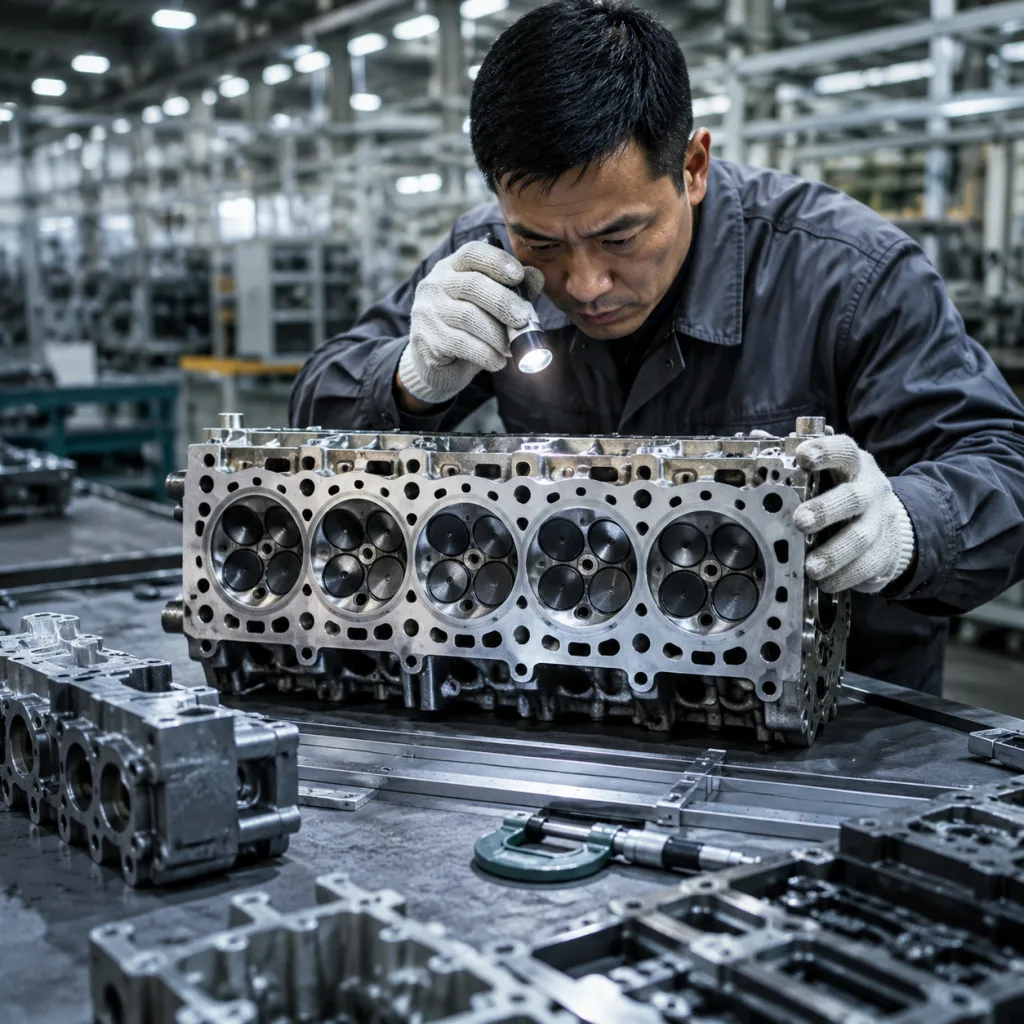
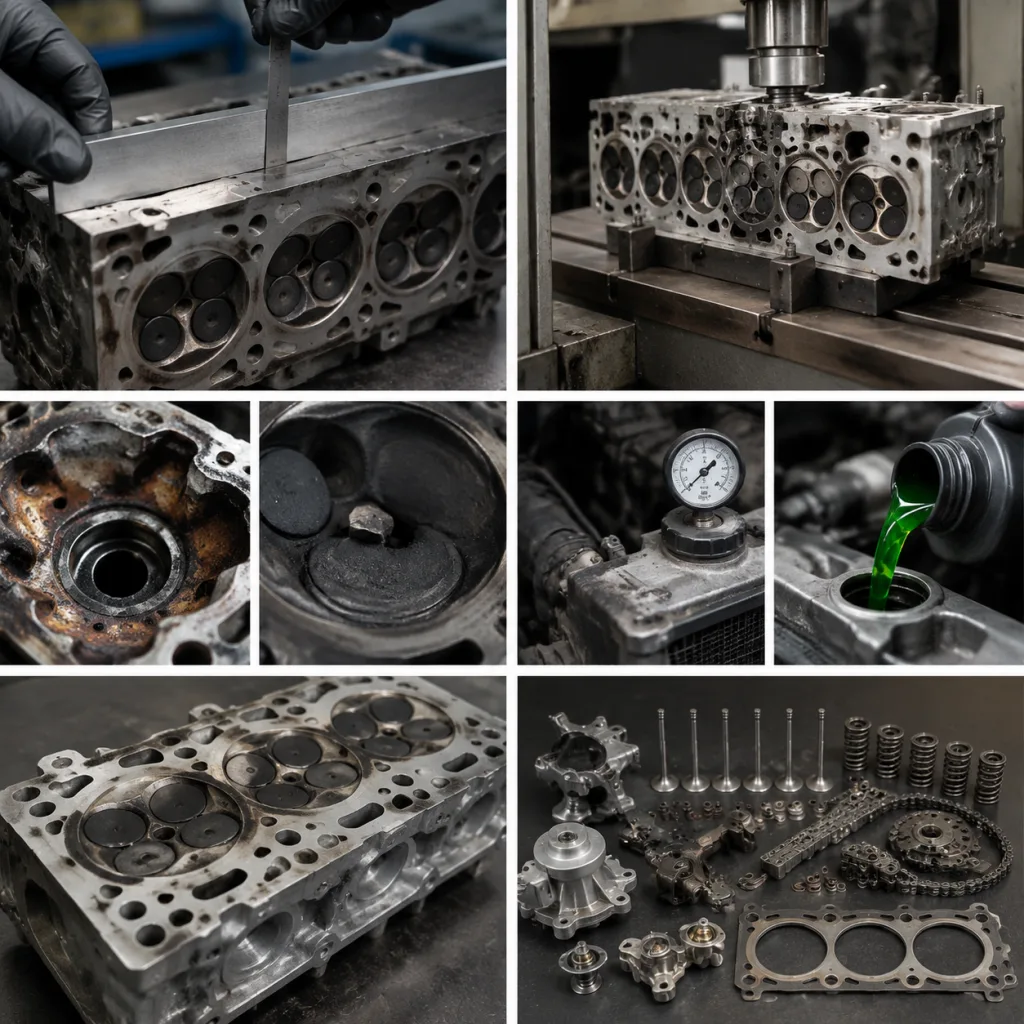
Reliable diagnosis needs measured evidence. Visual inspection can show overheating marks, gasket blow-by tracks, corrosion, coolant staining, and damaged fire rings. It cannot confirm whether the cylinder head remains within serviceable flatness limits.

Use a fixed inspection order:

  • Record the customer complaint, mileage, engine code, VIN range where available, and repair history.
  • Pressure-test the cooling system and pressure cap before disassembly, commonly at the cap rating for 10–15 minutes.
  • Check for combustion gas in the coolant using an approved chemical tester or exhaust-gas analyser.
  • Measure compression and perform leak-down testing where practical; record cylinder-by-cylinder values.
  • Remove the head according to the engine maker’s loosening sequence to avoid adding distortion.
  • Clean the deck surface without removing base metal or rounding sealing edges.
  • Measure flatness with a precision straightedge and feeler gauges, or a calibrated surface plate.
  • Take readings lengthwise, crosswise, diagonally, and across narrow bridge areas between cylinders.
  • Inspect for cracks, especially between valve seats and around injector, pre-combustion, and coolant-passage areas.
  • Check surface roughness when a multi-layer steel gasket will be installed.
  • Confirm block deck condition before approving a gasket-only repair.

Flatness limits vary by engine family, head material, and gasket design. Do not impose one universal number across all applications. As a practical screening range, many aluminium passenger-car heads require total deck warpage to be around 0.05–0.10 mm or less, while some longer diesel heads and composite-gasket designs may allow different values. The service manual wins. If it states 0.03 mm across a short span and 0.05 mm overall, those figures override a generic purchasing checklist.

Surface finish is just as important. Multi-layer steel gaskets often require a smoother, more controlled finish than composite gaskets; many programs specify roughly Ra 0.4–1.2 µm, or an equivalent Rz/Ra target from the gasket supplier. A resurfaced head that is flat but too rough can abrade gasket coatings. A surface that is too polished may reduce coating grip. Procurement documents should state the measuring method, not just the word “smooth.”

For incoming inspection at distributor or repair-chain level, the return form should capture measured warpage, gasket type, bolt replacement status, surface-preparation method, coolant condition, overheating evidence, and pressure-test result. That structure reduces disputes and helps category managers see whether failures cluster around one engine platform, one installer process, one cooling-system fault, or one component batch.

Inspection Workflow: Evidence Before Authorisation

Repair Decision Matrix: Cut, Replace, or Stop the Job

The correct fix depends on measured distortion, crack status, remaining head thickness, surface-finish requirements, hardness, pressure-test result, and the reason the engine overheated. Machining a head without correcting the cooling, combustion, or clamping issue often produces the next warranty claim.

When resurfacing makes sense

Resurfacing may be acceptable when distortion is within the engine manufacturer’s allowable machining range and the head is free from cracks. The machine shop must hold the required finish for the gasket type, especially where multi-layer steel gaskets are used. Excessive material removal can change compression ratio, cam timing geometry, valve-to-piston clearance, injector protrusion, combustion-chamber volume, and manifold alignment on some engines.

A practical buyer rule is to request five numbers: pre-machining flatness, material removed, final head thickness, surface-finish value, and pressure-test result. If the head has already been resurfaced once, do not approve another cut without confirming minimum thickness and cam-bore alignment. For chain-driven engines, small geometry changes can affect timing set-up. For diesel engines, injector protrusion and piston clearance may matter more than the machining cost.

When replacement is safer

Replacement is normally preferred when the head is cracked, softened by severe overheating, below minimum thickness, repeatedly resurfaced, pressure-test failed, or distorted beyond the machining allowance. A replacement program should also define companion parts such as the head gasket, valve stem seals, head bolts, thermostat, coolant, pressure cap, and, in many cases, the water pump.

Practical fix matrix:

Cause Typical mechanism Procurement implication
Severe overheatingCoolant loss, blocked radiator, failed fan, weak pressure cap, or failed thermostat creates uneven expansionStock cooling-system parts with gasket kits, not gaskets alone
Water pump failureReduced coolant flow creates local hot spots around exhaust valve bridges and end cylindersVerify impeller material, bearing life, flow performance, and 100% seal testing
Incorrect bolt tighteningUneven clamping load bends the head or overloads gasket fire ringsSupply the specified tightening sequence and torque-to-yield bolt sets where required
Reusing stretched boltsClamp load falls below design requirement after heat cyclesBundle head bolts with gasket repair kits when the service procedure calls for replacement
Poor surface preparationOld gasket material, corrosion, or rough machining prevents uniform sealingInclude scraper, abrasive, and surface-finish guidance for repair-chain customers
Detonation or abnormal combustionHigh cylinder pressure and temperature increase local head and gasket stressReview ignition, fueling, boost, EGR, and cooling diagnostics before repeat repair

</tr></thead><tbody> </tbody></table>For purchasing decisions, compare total repair risk rather than machining price alone. Resurfacing can work when demand is local and machine-shop quality is controlled. A complete head assembly can reduce bay time, installer variability, and warranty debate for high-volume repair chains. For export distributors, complete assemblies also simplify training because every branch receives the same baseline condition and packing protection.

Driventus can support custom manufacturing for engine component programs where buyers require defined material, machining, packaging, or inspection documentation. We do not claim vehicle manufacturer approval or endorsement.

Build the Sourcing Spec Around the Repair Scenario

For distributors and multi-location repair chains, warped cylinder head causes and fixes should be converted into a sourcing specification. The aim is not to buy more parts. It is to reduce repeat repairs, keep installation consistent, and make warranty decisions less subjective across locations.

Suggested procurement specification:

  • Application coverage by engine code, fuel type, displacement, valve count, and model-year range
  • OE part-number cross-reference format where applicable, such as OE 06A… or OE 11251… for fitment identification only
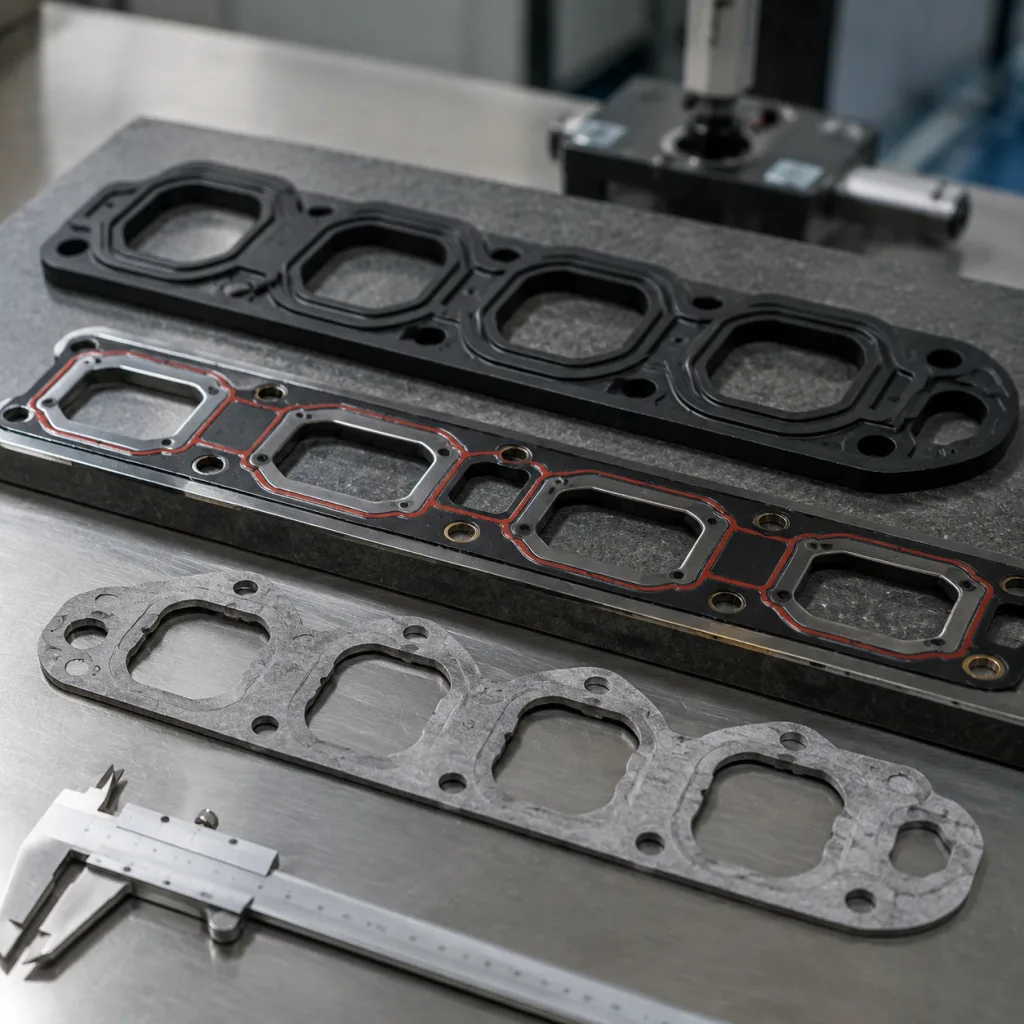
  • Head gasket bore size, thickness, layer count, fire-ring design, and coating type
  • Head bolt type: reusable or torque-to-yield, with tightening sequence and angle stages supplied separately
  • Water pump impeller material, shaft bearing specification, flow validation, and seal test record
  • Thermostat temperature rating, opening tolerance, jiggle-valve orientation, and pressure-cap compatibility where relevant
  • Machined-surface flatness and roughness inspection records where applicable
  • Cylinder head pressure-test method and minimum holding time for supplied heads or reman programs
  • Material declarations aligned with REACH (EC) No 1907/2006 for EU supply chains
  • Production quality controls aligned with IATF 16949:2016 and ISO 9001:2015
  • Packaging that protects machined faces during sea freight, inland transport, and warehouse handling
  • Batch traceability for warranty analysis and corrective action

MOQ and price logic should follow kit complexity. Fast-moving gasket kits and bolt sets usually support lower MOQs than machined cylinder heads because tooling, machining fixtures, pressure testing, and packaging space differ. As a working model, buyers can separate demand into A/B/C applications: A-items may justify 300–1,000 sets per SKU per order for gasket or bolt kits, while slower head assemblies may need mixed-SKU consolidation, forecast commitments, or scheduled releases.

Price comparisons should include the gasket set, bolts, thermostat, water pump, coolant-related parts, packing, inspection documents, inland freight, sea freight, duties, and expected warranty reserve. A low gasket price is not low cost if the program keeps buying claims.

Lead-time planning should also be tiered. Standard sealing and cooling SKUs may fit normal production windows. New or low-volume head assemblies can require extra time for sample approval, machining fixture confirmation, pressure-test validation, packing drop checks, and first-article inspection. For program launches, request quotation in three lines: unit price at MOQ, price at annual volume, and price with bundled companion parts. This makes it easier to compare a gasket-only SKU, repair kit, and complete head-off repair bundle on landed cost per successful repair.

Avoid pairing low-cost gasket sets with unverified bolts or cooling parts on engines known for thermal sensitivity. A kit strategy often performs better: gasket set, bolt set, thermostat, and water pump selected as a matched repair group. It also simplifies installer instructions. For engine component sourcing, see our engine components range.

Published emissions standards such as ECE R-83 may apply to vehicle-level type approval, not to a replacement cylinder head or gasket as a stand-alone part. Procurement documents should cite only relevant component, material, packaging, traceability, and quality-management requirements.

Build the Sourcing Spec Around the Repair Scenario

Q&A for Diagnostic-Based Supply With Driventus

What does Driventus supply for warped-head repair programs? Driventus manufactures engine and powertrain components in Taizhou, Zhejiang, and exports to more than 60 countries. Relevant supply scope includes head gaskets, gasket kits, water pumps, pistons, crankshafts, and related engine components used during head-off repairs.

What documentation can buyers request? For machined or sealing products, buyers can request drawings, inspection plans, packaging requirements, and agreed sampling methods before production. Typical documentation can include material specification, key-dimension report, surface-finish requirement, flatness record, pressure-test method where applicable, packaging drawing, carton label format, and batch traceability plan.

How can a repair chain avoid forcing every branch into one repair choice? Structure bundles around the diagnostic path: symptom, root cause, inspection result, replacement decision, and system correction. One bundle may cover gasket-only repairs. Another may cover head-off cooling correction. A third may support complete head replacement. Each bundle can carry a different MOQ, inspection level, and lead-time plan.

What should buyers share before quotation? Send the engine families, annual demand, target markets, expected MOQ range, target landed cost, packaging requirements, and inspection requirements. Driventus can then check coverage, manufacturing feasibility, documentation needs, and practical quote structure before you request a quote.

Driventus is an independent aftermarket manufacturer; brand names are referenced for fitment identification only. Cross-references are used to identify application compatibility and do not imply approval, endorsement, or supply relationship with any vehicle manufacturer.

Frequently asked questions

No. Resurfacing depends on measured distortion, crack status, minimum head thickness, hardness, pressure-test result, and gasket surface-finish requirements. If the head is cracked, softened by overheating, below the machining allowance, or already cut too far, replacement is normally the safer repair route.

Many engines use torque-to-yield bolts that should not be reused. Buyers should confirm the engine service specification and consider bundling bolt sets with gasket kits to reduce installer error, low clamp load, and repeat failures.

Check the water pump, thermostat, radiator, fan control, coolant condition, pressure cap, head gasket, head bolts, block deck flatness, cylinder head flatness, and surface finish. Replacing only the gasket may not correct the root cause.

If you are building a diagnostic-based engine repair program, Driventus can review application coverage, kit structure, MOQ logic, lead-time planning, and quality documentation. Send your requirements through /contact.html

Request a Quote
Inspection result Recommended action Parts to review
Minor warpage, no cracks, sufficient thicknessControlled resurfacing with documented finishHead gasket, bolts, coolant
Warpage beyond service limitReplace cylinder headComplete head assembly, gasket set, bolts
Cracks between valves or coolant portsReplace head or use a validated castingHead assembly, pressure-tested components
Repeat gasket failureDiagnose system root cause before releaseWater pump, thermostat, radiator, fan control
Corrosion around coolant passagesReview coolant maintenance and material compatibilityGasket coating, coolant, sealing surfaces
Poor surface finish after previous repairRe-machine if within limits or replaceGasket type, machine-shop process, head thickness