Camshaft Subaru OEM Supplier Sourcing Checklist
A camshaft Subaru OEM supplier decision can fail long before the first container ships. The usual cause is not the headline price. It is a vague application match, an uncontrolled lobe profile, weak heat-treatment evidence, missing traceability, or packaging that lets finished parts arrive with corrosion or impact damage.
Subaru-fit engine coverage is not a single sourcing category. Buyers may be dealing with different engine families, intake and exhaust positions, naturally aspirated and turbocharged applications, sensor trigger designs, cam phaser interfaces, emissions markets, and year-to-year production changes. A catalogue name alone leaves too much interpretation.
This article reframes the sourcing process as a decision system: define the part precisely, test the supplier’s manufacturing controls, plan MOQ and lead time by programme type, audit for repeatability, validate before bulk release, and compare commercial offers using risk-adjusted evidence. Driventus manufactures engine and powertrain components in Taizhou, Zhejiang, under IATF 16949:2016 and ISO 9001:2015 quality systems. Driventus is an independent aftermarket manufacturer; brand names are used only to identify fitment and application requirements.
Start with a Fitment Decision Tree, Not a Price Request
A useful RFQ answers one question first: exactly which camshaft is being sourced? Until that is clear, price comparisons are noise.
For Subaru-fit applications, a buyer should narrow the requirement by engine family, displacement, market, model year range, aspiration type, intake or exhaust position, and timing interface. If variable valve timing, a cam phaser, sensor trigger, dowel, keyway, sprocket interface, or thrust feature is involved, those details belong in the first RFQ—not in a later clarification email after samples have already been made.
Vehicle model names are not enough. The same model line may carry different engines, calibration changes, or market-specific hardware. OE part-number cross-references can help where legally and commercially available, but they should be backed by drawings, controlled samples, or buyer-approved technical data when the programme requires precision.
Use this decision sequence before asking for quotation:
1. Confirm the engine and market. Identify engine family, displacement, model year range, and export region. 2. Confirm camshaft position. Intake and exhaust versions may look similar but carry different timing, lobes, or end features. 3. Confirm timing and sensing features. Check phaser interface, trigger wheel, keyway, dowel, sprocket, and sensor-related geometry. 4. Confirm the evidence route. Decide whether the supplier will work from an existing item, a buyer-controlled drawing, or a physical sample. 5. Confirm the commercial format. Define first order quantity, annual forecast, packaging, labelling, and documentation needs.
A complete RFQ should include:
- Engine family, displacement, and application range
- Intake or exhaust camshaft position
- Naturally aspirated or turbocharged application
- Variable valve timing or cam phaser interface details, if applicable
- Sprocket, trigger, keyway, dowel, or sensor-related features
- Target market: EU, UK, US, Canada, Australia, Brazil, or mixed export
- Annual forecast and first purchase quantity
- Sample route: reverse engineering, drawing confirmation, or buyer-controlled drawing
- Packaging requirement: bulk, individual box, neutral carton, customer label, or private label
- Required certificates, inspection reports, and traceability documents
Procurement teams can review baseline coverage through our catalog. For obsolete references, customer-specific variants, or parts without stable catalogue data, custom manufacturing is usually safer than forcing a near-match item into the bill of materials.
Where Camshaft Supply Programmes Usually Fail
Camshafts are unforgiving parts. A small deviation in lobe lift, base circle, phase angle, journal concentricity, surface hardness, or surface finish can become a timing fault, wear claim, oil-film problem, idle complaint, or emissions-related failure.
The strongest supplier review therefore looks for failure modes, not marketing language. Does the plant control the process at each stage? Are gauges calibrated? Is heat treatment tied to a batch? Can the supplier prove that a finished camshaft in a carton can be traced back to material and production records?
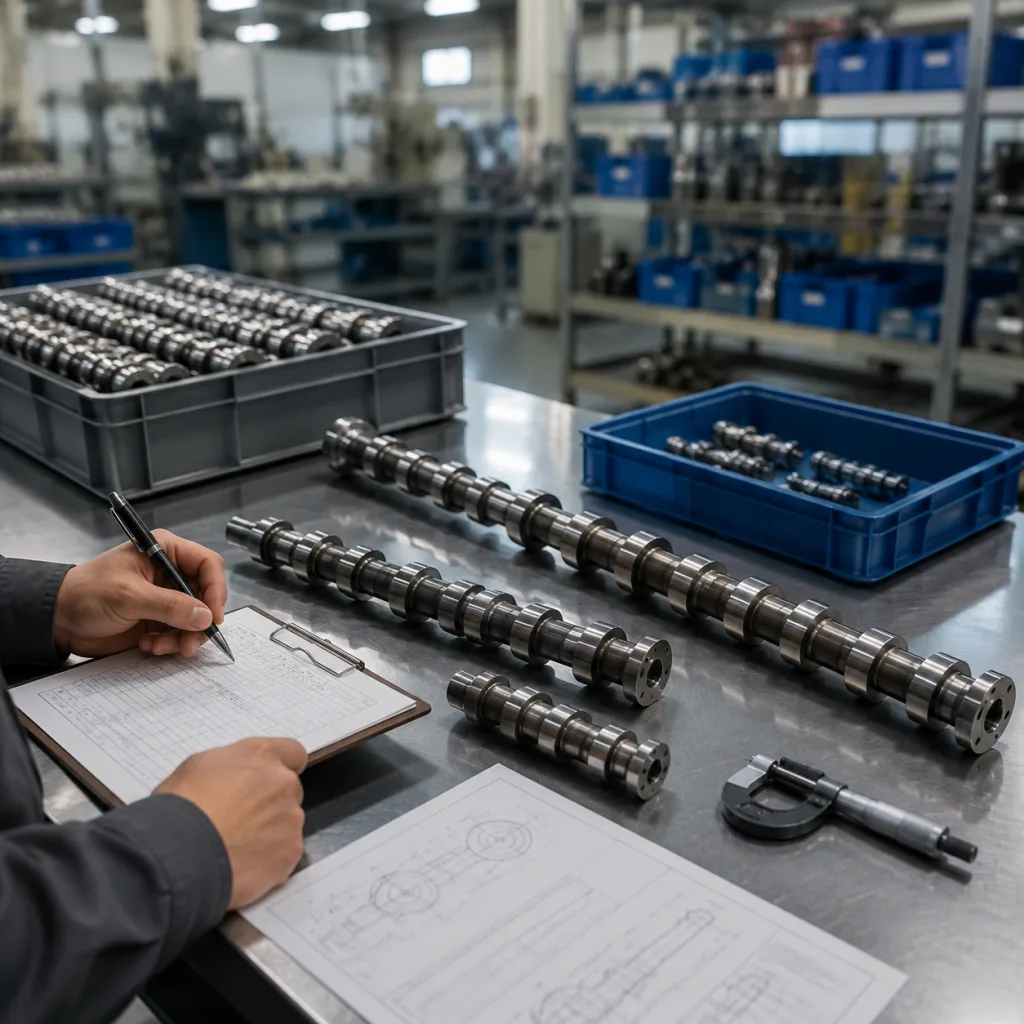
Common manufacturing control points include casting or forging verification, CNC rough machining, heat treatment, straightening, finish grinding, surface treatment where specified, final washing, preservation, and protective packing. Each step needs an acceptance standard and a record.
| Failure mode | Why it matters | Supplier evidence to request |
|---|---|---|
| Incorrect material grade | Reduces wear resistance or causes machining instability | Material certificate and incoming inspection record |
| Lobe profile drift | Changes valve events and engine behaviour | Profile measurement report or CMM data |
| Journal diameter variation | Affects oil film, bearing fit, and seizure risk | Micrometer, air-gauge, or CMM inspection record |
| Excessive runout | Creates noise, vibration, seal wear, and timing inaccuracy | Runout report by specified datum location |
| Weak or inconsistent hardness | Accelerates lobe and journal wear | Heat-treatment batch report and hardness test data |
| Poor surface roughness | Increases wear and lubrication risk | Roughness inspection report for lobes and journals |
| Residual contamination | Introduces debris into the engine oil system | Washing process record and final packing inspection |
| Inadequate packing | Causes corrosion, dents, or transit damage | Packing specification and preservation check |