Camshaft Subaru Manufacturer China: Sourcing Guide
Sourcing Subaru-fit camshafts is not a simple unit-price exercise. Buyers need confidence in metallurgy, lobe profile repeatability, journal finish, timing-feature accuracy, cleanliness, packaging, documentation, and supplier responsiveness before moving from sample approval to regular shipments. Driventus manufactures camshafts and other engine components in Taizhou, Zhejiang for aftermarket distributors, wholesalers, repair-chain supply programmes, and OEM or Tier-1 sourcing projects. This guide explains how to evaluate a camshaft Subaru manufacturer China option using practical procurement criteria: certification, process control, validation, MOQ, lead time, audit readiness, and import documentation. It is written for import managers, category buyers, and sourcing engineers who need stable supply, controlled specifications, and clear technical evidence. Driventus is an independent aftermarket manufacturer; brand names are referenced for fitment only.
What Buyers Should Verify Before RFQ
For Subaru-fit camshafts, the RFQ should identify the engine family, intake or exhaust position, variable valve timing features, target material, surface treatment, annual forecast, and packaging requirements. A vehicle model name alone is not enough for an accurate quotation because the same model range may use different engines, timing systems, and regional specifications.
Useful RFQ inputs include:
- Application scope: Subaru-fit engine family, model years, intake or exhaust camshaft, and market region.
- Cross-reference format: generic OE-style references already used in the buyer’s project data, without treating them as manufacturer approval.
- Material requirement: chilled cast iron, ductile iron, or forged steel depending on load, wear target, and cost position.
- Process requirement: casting or forging, CNC turning, cam grinding, induction hardening where applicable, oil-hole processing, cleaning, and final straightening.
- Order plan: trial order quantity, annual volume, safety-stock target, and shipment cadence.
- Compliance documents: IATF 16949:2016, ISO 9001:2015, and REACH (EC) No 1907/2006 declaration where relevant to the importing market.
A capable supplier should confirm whether the camshaft can be produced from existing tooling or needs new development. Existing references can shorten quotation and sample lead time because fixtures, gauges, and process parameters may already be available. New cam profiles require controlled sample approval, dimensional reporting, and functional validation before shipment.
Factory Capability and Quality System
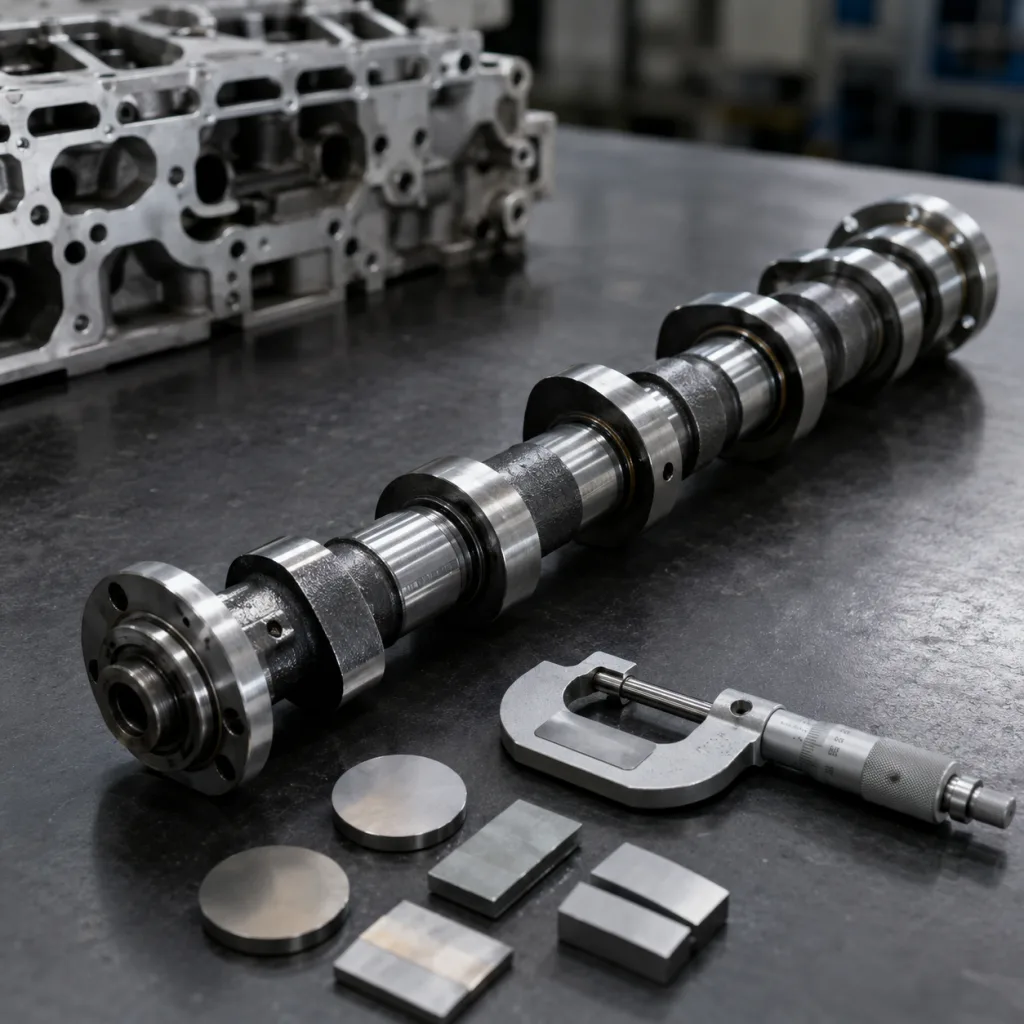
A camshaft plant should demonstrate control over every feature that affects valve timing, bearing performance, and durability. For Subaru-fit applications, procurement teams should review lobe geometry, journal diameter, thrust face width, keyway or timing slot position, VVT-related interfaces, oil-hole cleanliness, runout, and surface hardness.
Driventus operates under IATF 16949:2016 and ISO 9001:2015, with production and inspection records managed through its documented quality system. These certifications do not replace part-level validation, but they show that the factory works with defined procedures for process change, nonconforming product handling, traceability, corrective action, and continual improvement.
Typical audit checkpoints include:
- Incoming material certificates and heat-number traceability.
- CNC, grinding, and inspection-equipment calibration records.
- In-process checks for journal runout, lobe lift, base circle, and timing angle.
- Hardness testing after heat treatment, induction hardening, or chilling where applicable.
- Surface roughness checks on bearing journals and cam lobes.
- Oil-hole deburring, washing, and air-cleaning verification.
- Final inspection reports linked to batch numbers and carton labels.
- Packaging drop-resistance or transport-simulation checks for export cartons or pallets.
Buyers should also review how the supplier manages engineering change requests. A small adjustment to lobe taper, oil-hole chamfer, timing-slot location, or thrust-face grinding can affect assembly fit, lubrication behaviour, noise, and warranty exposure.
Typical Camshaft Specification Points
Exact values depend on the engine family, sample condition, and approved drawing requirements, but the following table shows specification areas normally requested by professional buyers during supplier qualification.
| Specification area | Common sourcing requirement | Procurement note |
|---|---|---|
| Material | Chilled cast iron, ductile iron, or steel | Confirm grade by drawing, load, and wear target |
| Journal diameter | Drawing-controlled | Require CMM or gauge report by batch |
| Lobe lift | Drawing-controlled | Check intake and exhaust profiles separately |
| Runout | Project-specific tolerance | Measure after grinding and final straightening |
| Surface roughness | Journal and lobe controlled | Define Ra requirement in the RFQ |
| Hardness | Surface and core values by design | Specify test method, location, and acceptance range |
| Timing feature | Slot, pin, gear interface, or VVT feature | Verify angular position against the master drawing |
| Cleanliness | Oil holes free from burrs and debris | Include visual, washing, and air-cleaning checks |
| Evaluation item | Low-risk supplier evidence | Risk if missing |
|---|---|---|
| Certification | IATF 16949:2016 and ISO 9001:2015 certificates | Weak process control and inconsistent records |
| Technical review | Drawing, sample, or reverse-engineering confirmation | Incorrect fitment or timing-feature mismatch |
| Inspection capability | CMM, hardness tester, roughness tester, runout gauge | Undetected dimensional variation |
| Traceability | Batch records from material receipt to shipment | Difficult warranty investigation |
| Export packaging | Oil protection, separators, reinforced cartons | Rust, lobe damage, mixed part numbers |
| Communication | Clear RFQ, sample, and corrective-action response | Delayed launches and unresolved quality issues |