camshaft · 2026-06-18

Camshaft for Skoda Octavia Replacement Sourcing

A camshaft for Skoda Octavia replacement programme fails or succeeds before the first batch is machined. The decisive work is reference control: which engine code, which camshaft position, which timing interface, which material route, and which inspection file will both sides treat as the master.

For B2B buyers, “fits Skoda Octavia” is not enough. Octavia generations have used multiple petrol and diesel engine families, and small changes in lobe profile, sensor trigger, journal size, or heat treatment can create real warranty exposure. The buying task is to separate true interchangeability from catalogue convenience.

Driventus manufactures engine and powertrain components in Taizhou, Zhejiang, and supplies B2B customers in more than 60 countries. For camshaft sourcing, our technical discussions usually cover engine-code coverage, buyer-confirmed OE 06A… cross-reference structures where applicable, cast or forged blank routes, CNC grinding controls, induction hardening or nitriding routes, export packaging, and batch traceability. This article gives import managers, category buyers, and sourcing engineers a practical way to approve a replacement camshaft line without turning the project into a generic catalogue exercise.

Start With the SKU Decision, Not the Model Name

Treat every engine code plus camshaft position as its own commercial SKU until interchangeability is proven. That one rule prevents many avoidable returns.

Skoda Octavia vehicles span several petrol and diesel engine families across different generations. Two listings may share displacement and still need different intake or exhaust camshafts because of timing adjuster design, sensor trigger layout, follower type, emission stage, or production-year changes. A casting that looks similar is not proof of fit.

Build each part record around:

  • Vehicle model and generation coverage, such as Octavia I, II, or III where applicable
  • Engine displacement and fuel type, including turbo petrol or diesel distinction
  • Buyer-confirmed engine code from catalogue, sample, VIN research, or repair data
  • Intake, exhaust, or unit-specific camshaft position
  • Valve count and valvetrain type, such as 8V, 16V, bucket tappet, roller follower, or hydraulic follower where relevant
  • Sensor trigger pattern, tooth count, and datum orientation where applicable
  • Timing gear, sprocket, slot, keyway, or phaser interface details
  • OE part-number cross-reference format, such as OE 06A…, only when supported by verified buyer data

Before quotation, Driventus normally asks for an application file showing engine code, year range, reference number, expected annual demand, and packing preference: neutral, private label, or bulk service pack. If the buyer cannot confirm the reference, a sample or verified drawing should become the starting point.

This is not admin work. It protects the distributor from catalogue ambiguity and separates manufacturing defects from fitment mistakes during warranty review.

Driventus is an independent aftermarket manufacturer; brand names are used for fitment reference only.

Buyers can review adjacent engine lines in our catalog and the engine category page at engine components. For private-label or non-catalogue demand, custom manufacturing can be evaluated after drawings, samples, or verified reference parts are available.

Geometry Deep-Dive: Where a Camshaft Goes Wrong

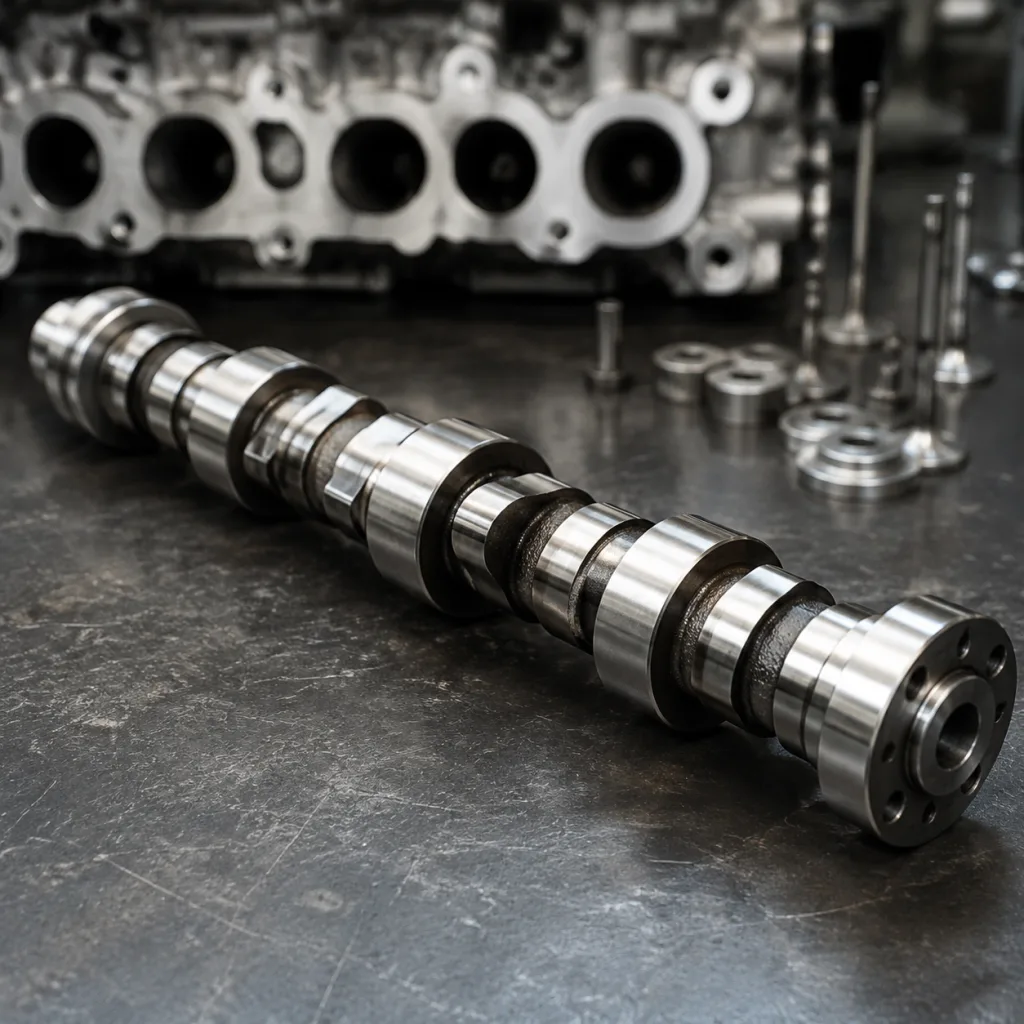
A camshaft is a timing component with bearing surfaces, not a simple rotating shaft. Very small errors can change valve timing, oil-film stability, compression, emissions behaviour, noise, and follower life.

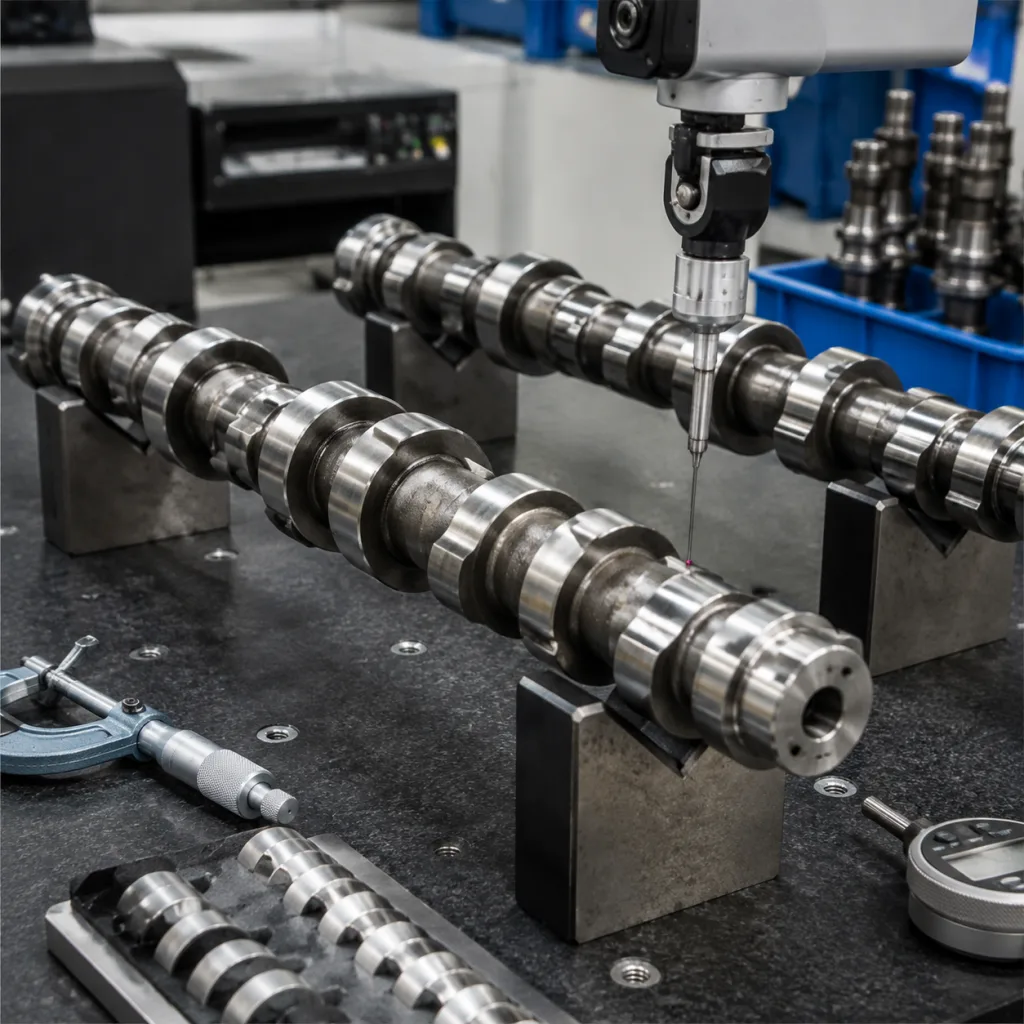
The inspection discussion should focus on critical-to-function points: journal diameters, lobe base circle, lobe lift, lobe separation angle, total length, thrust face width, oil-hole alignment, keyway or slot position, dowel-hole position, gear seat diameter, and sensor reference geometry. These should be checked against approved drawings, buyer samples, or mutually confirmed reference parts before mass production.

Typical buyer-controlled tolerances depend on the drawing, but the table below reflects common approval discussions for replacement camshafts:

</tr></thead><tbody> </tbody></table>For distributor programmes, Driventus recommends a first-article inspection report before mass shipment and a retained sample for every approved part number. A practical approval file includes at least 5 first-article pieces for a new reference or 3 pieces for an established repeat reference, with all critical-to-function dimensions recorded.

That retained sample matters later. If a future claim involves noise, timing deviation, or early wear, both buyer and supplier can compare the returned part with the approved baseline instead of debating catalogue assumptions.

Material Choice: Cast, Forged, Hardened, or Nitrided?

The production route should be fixed before quotation. It affects blank cost, machining sequence, surface treatment, lead time, inspection method, and validation scope.

Replacement camshafts are commonly produced from cast iron or forged steel. The correct route depends on engine family, loading conditions, follower design, and customer specification. Do not treat material as a late-stage purchasing variable.

A complete technical file should define:

  • Material grade or mutually approved equivalent, such as alloy cast iron, chilled cast iron, or forged steel where specified
  • Blank production route: casting, forging, or machined billet where specified
  • Heat-treatment method, such as induction hardening, chilling, carburising, or nitriding depending on design
  • Target surface hardness range, commonly around 50–60 HRC for hardened lobe contact areas when specified by design
  • Core hardness range where required, often checked separately from lobe surface hardness
  • Case depth or hardened layer requirement, commonly 1.0–3.0 mm for induction-hardened lobes or 0.2–0.6 mm for nitrided surfaces where applicable
  • Lobe and journal surface finish requirements after grinding and polishing
  • Straightness and runout limits after final machining
  • Magnetic particle inspection or crack detection plan, when required
  • Batch traceability from raw material heat number to final packing label

Hardness is a balancing act. Too hard, and follower wear can increase. Too soft, and the lobe may pit, scuff, or lose profile under mixed lubrication. Buyers should request lobe and journal hardness records, dimensional data, and process capability evidence for critical characteristics. For higher-volume programmes, Cpk targets of 1.33 or higher on journal diameter, lobe lift, and runout are reasonable when the dimension is stable and measurable in serial production.

Surface integrity deserves the same attention. Burrs around oil holes, rough journal finishes, weak lobe polishing, residual grinding burn, or unremoved shot-blast media can shorten service life even when headline dimensions look correct. For higher-risk references, buyers may add metallographic review, magnetic particle inspection, nital etch for grinding burn, or expanded sampling to the control plan.

Driventus aligns production controls with IATF 16949:2016 and ISO 9001:2015 management requirements. Material and chemical compliance can be reviewed against REACH (EC) No 1907/2006 requirements when the importing market requires supplier declarations.

Material Choice: Cast, Forged, Hardened, or Nitrided?

Release Testing by Failure Mode

Aftermarket replacement camshafts do not need vehicle-maker endorsement, but they do need disciplined validation against the approved specification and intended duty cycle. The release plan should match the buyer’s risk: annual volume, warranty exposure, market sensitivity, and whether the item is an established reference or a new development.

Start with the failure mode. An oil-starvation complaint points to different controls than a timing-interface mismatch, incorrect catalogue listing, weak heat treatment, or transport damage.

For a new camshaft for Skoda Octavia replacement line, validation may include dimensional inspection, material verification, hardness testing, runout measurement, surface roughness checks, torque interface checks, and bench or engine durability validation where justified.

A common validation package includes:

  • First-article inspection report for all critical dimensions, normally 3–5 pieces per new part number
  • Material certificate and incoming raw-material traceability by heat or batch number
  • Hardness report by lobe and journal sampling plan, with test locations defined on the drawing
  • Surface roughness report for bearing and contact surfaces
  • Dynamic or static runout measurement between centres
  • Metallographic review when heat-treatment depth is specified
  • Magnetic particle or crack detection for forged or highly loaded references where required
  • Timing interface torque or fit check against sprocket, phaser, slot, or gear datum
  • Installation trial against a reference cylinder head or checking fixture
  • Packaging drop or vibration checks for export cartons, especially for mixed-SKU pallets

For mass production, agree the outgoing quality level before shipment. A typical control plan may use 100% visual checks for machined surfaces and oil-hole burrs, 100% final identification and packing-label verification, and sampling inspection for dimensions, hardness, roughness, and runout. Critical dimensions are often checked at every setup, first and last piece of each batch, and at defined intervals during grinding.

Where buyers can share field warranty data, Driventus can use it to refine inspection priorities and corrective-action triggers.

Our quality system supports PPAP-style documentation when required by OEM or Tier-1 customers, subject to agreed scope.

Importer Economics: MOQ, Lead Time, and Packaging Trade-Offs

A camshaft can pass every technical check and still fail as a sourcing item if the commercial rules are vague. Catalogue data, MOQ logic, replenishment timing, packaging, and warranty evidence should be agreed before tooling, sampling, or private-label artwork release.

Feature Procurement check Typical control target Risk if uncontrolled
Journal diameterMicrometer or air-gauge check by journal±0.010–0.020 mmOil pressure loss, seizure, bearing noise
Journal roundnessRoundness tester or V-block comparison≤0.005–0.010 mmBearing hot spots, unstable oil film
Lobe liftProfile measurement against master data±0.030–0.050 mmLow power, misfire, emissions deviation
Base circleMicrometer/profile check±0.020–0.030 mmIncorrect valve lash or hydraulic compensation range
RunoutBetween-centres dial indicator check≤0.030–0.050 mm TIRTiming instability, bearing wear
Thrust face positionWidth and axial location inspection±0.030–0.050 mmEnd-float noise, timing instability
Timing interfaceSlot, keyway, gear, or phaser datum checkDrawing datum ±0.25°–0.50°Incorrect valve timing
Oil-feed holesDiameter, position, and deburring checkBurr-free, drawing positionLubrication failure
Surface finishRa inspection on journals and lobesJournals Ra 0.2–0.4 µm; lobes Ra 0.3–0.8 µmAccelerated follower wear

</tr></thead><tbody> </tbody></table>Separate the cost buckets early: sample cost, tooling or fixture cost, unit price, inspection cost, packaging cost, and freight impact. MOQ is usually driven by blank production, heat-treatment batch size, grinding setup time, and carton artwork. For established references, a practical MOQ may start around 100–300 pieces per part number for repeatable production. For new cast or forged references, MOQ may be higher when a dedicated blank or tooling batch is required.

Mixed-SKU orders can reduce inventory pressure, but only when parts share compatible packaging, production windows, and shipment timing.

Lead time should be quoted by sourcing stage, not as one vague number. Established references with confirmed drawings and neutral packing may move from sample approval to mass production in about 30–45 days. New development with reverse engineering, blank confirmation, heat-treatment trials, and validation can require 60–120 days depending on tooling, testing, and buyer feedback speed. Private-label cartons or market-specific labels should be approved before mass production because late artwork changes can delay shipment even when parts are ready.

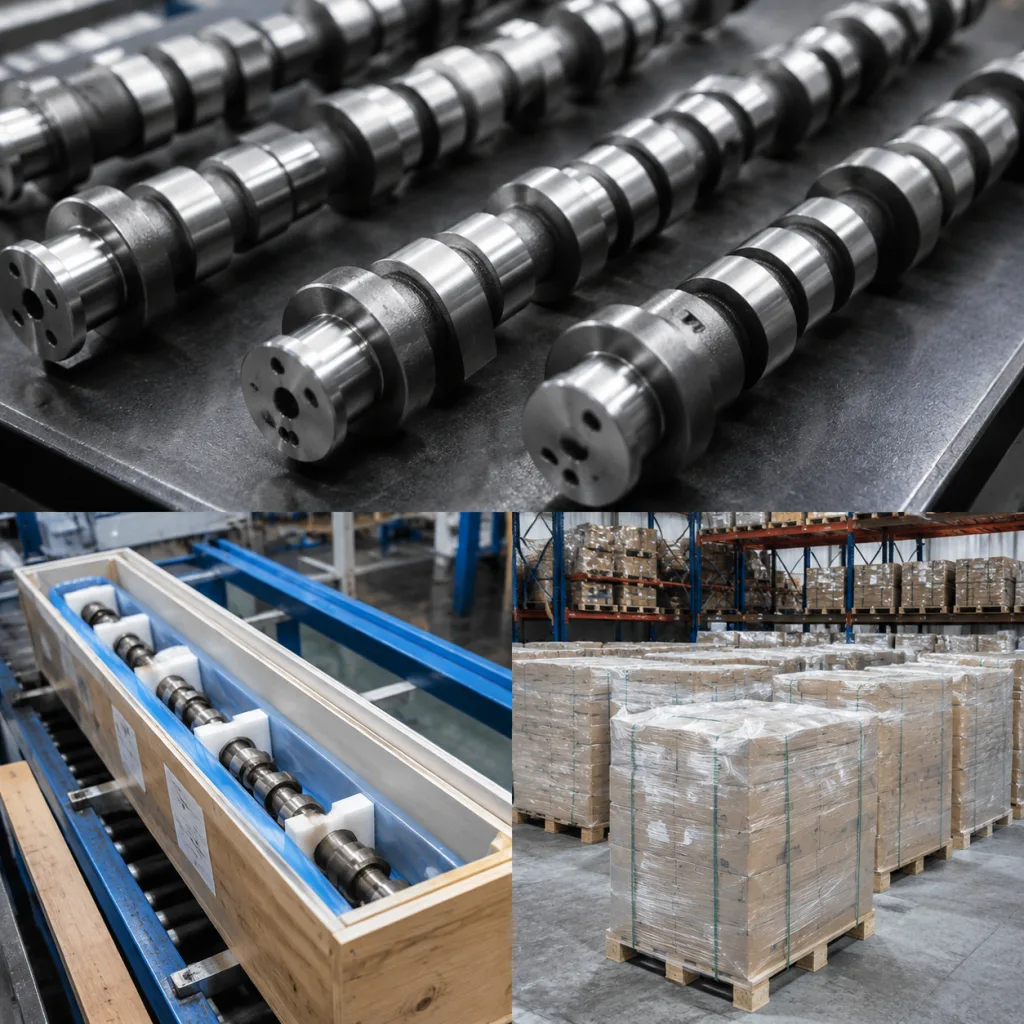
Packaging is part of quality control. Camshafts are long, precision-machined components with vulnerable journals, lobes, and timing interfaces. A typical export pack uses anti-rust oil or VCI protection, individual sleeve or foam separation, rigid inner supports, desiccant where needed, clear part-number labels, and reinforced outer cartons. Heavy cartons should stay within buyer warehouse handling limits, often 15–20 kg per carton unless another pallet rule is agreed.

Driventus exports to the EU, UK, US, Canada, Australia, Brazil, and other markets. Import documentation, carton labels, private-label requirements, and market-specific compliance declarations should be confirmed before mass production to avoid relabelling, customs delays, or sales-channel rejection.

Importer Economics: MOQ, Lead Time, and Packaging Trade-Offs

Approval Sequence: From Reference File to First Shipment

Use a staged approval sequence instead of a loose checklist. Each stage should answer one question: are we approving the right part, made the right way, packed for the right market?

1. Confirm engine code coverage, vehicle year range, fuel type, valve count, and installation position. 2. Verify cross-reference data and avoid unsupported OE claims. 3. Approve drawing, sample, or reference part baseline, including revision number and date. 4. Freeze critical dimensions, tolerances, hardness range, surface finish, and runout limits. 5. Review material route and heat-treatment specification. 6. Confirm MOQ, price tier, sample cost, tooling responsibility, Incoterms, and payment terms. 7. Check first-article dimensional report against the approved drawing or master sample. 8. Confirm hardness, runout, surface finish, crack detection, and traceability records. 9. Conduct installation trial or fixture verification for timing interface and sensor reference. 10. Approve packaging, anti-rust method, carton strength, labels, barcode rules, and palletisation. 11. Define warranty evidence requirements before shipment, including photos, mileage, installation notes, oil condition, and failed-part return rules. 12. Retain approved samples at buyer and supplier locations, with batch number and approval date recorded.

This sequence is especially important when one distributor listing covers several vehicle years or engine variants. A single catalogue error can trigger returns, installer complaints, and warranty claims even when the camshaft was manufactured correctly.

For current range checks or new development enquiries, buyers can request a quote with engine codes, annual volume, target market, target MOQ, desired lead time, packaging requirements, and any available reference samples.

Frequently asked questions

Provide engine code, model year range, fuel type, intake or exhaust position, valve count, timing interface details, reference sample or drawing, and any verified OE 06A… style cross-reference. Annual volume, target MOQ, packaging rules, target market, documentation requirements, and desired lead time also help define validation scope and quotation accuracy.

Yes. Driventus can support neutral packing or buyer-brand packing after artwork, label rules, barcode format, carton specification, pallet rules, and market requirements are confirmed. Private-label supply is for independent aftermarket distribution and does not imply approval or endorsement by any vehicle manufacturer.

Depending on the agreed scope, documents may include dimensional inspection reports, material certificates, hardness results, surface roughness checks, runout records, heat-treatment traceability, crack-detection reports, packaging checks, and PPAP-style files. Production is managed under IATF 16949:2016 and ISO 9001:2015 systems.

Send engine codes, target annual volume, target MOQ, target price range, target market, desired lead time, packaging rules, and any available drawings or samples for a controlled quotation review. Contact Driventus at /contact.html

Request a Quote
Sourcing item Recommended buyer input Driventus output
Demand forecast6- to 12-month volume by part numberCapacity, MOQ, and price-tier proposal
Reference dataEngine codes, samples, drawings, or OE 06A… structureFitment confirmation file
Target priceAnnual volume, order frequency, and packing typeEXW/FOB/CIF quotation logic where applicable
BrandingNeutral, buyer brand, or carton artworkPackaging specification and label proof
Quality documentsInspection plan, certificates, PPAP scopeAgreed document pack and document cost if special testing is required
LogisticsIncoterms, carton limits, pallet rulesExport packing and lead-time plan
Warranty handlingReturn threshold and evidence rulesCorrective action workflow