A warped cylinder head turns a liner replacement into a repeat failure when the assembly is judged part by part instead of as a sealing system. For distributors, repair networks, and engine rebuild programmes, the cost is not just one rejected engine. It can become batch returns, warranty disputes, emergency freight, and inventory blamed for a machining, cooling, gasket, or installation error. The cylinder liner works with head flatness, block deck condition, gasket compression, coolant control, bolt loading, surface finish, liner protrusion, and combustion pressure. Distort one interface and clamp load shifts. Heat flow shifts too. On some light-duty diesel or high-compression gasoline engines, head distortion only 0.03–0.08 mm outside the maker’s limit can change fire-ring loading enough to start leakage. Use this guide to separate liner defects from system failures, define the evidence needed before replacement approval, and set sourcing controls for controlled liner supply. Driventus is an independent aftermarket manufacturer; brand names are referenced for fitment only.
Failure Mode: A Small Warp Becomes a Liner Claim
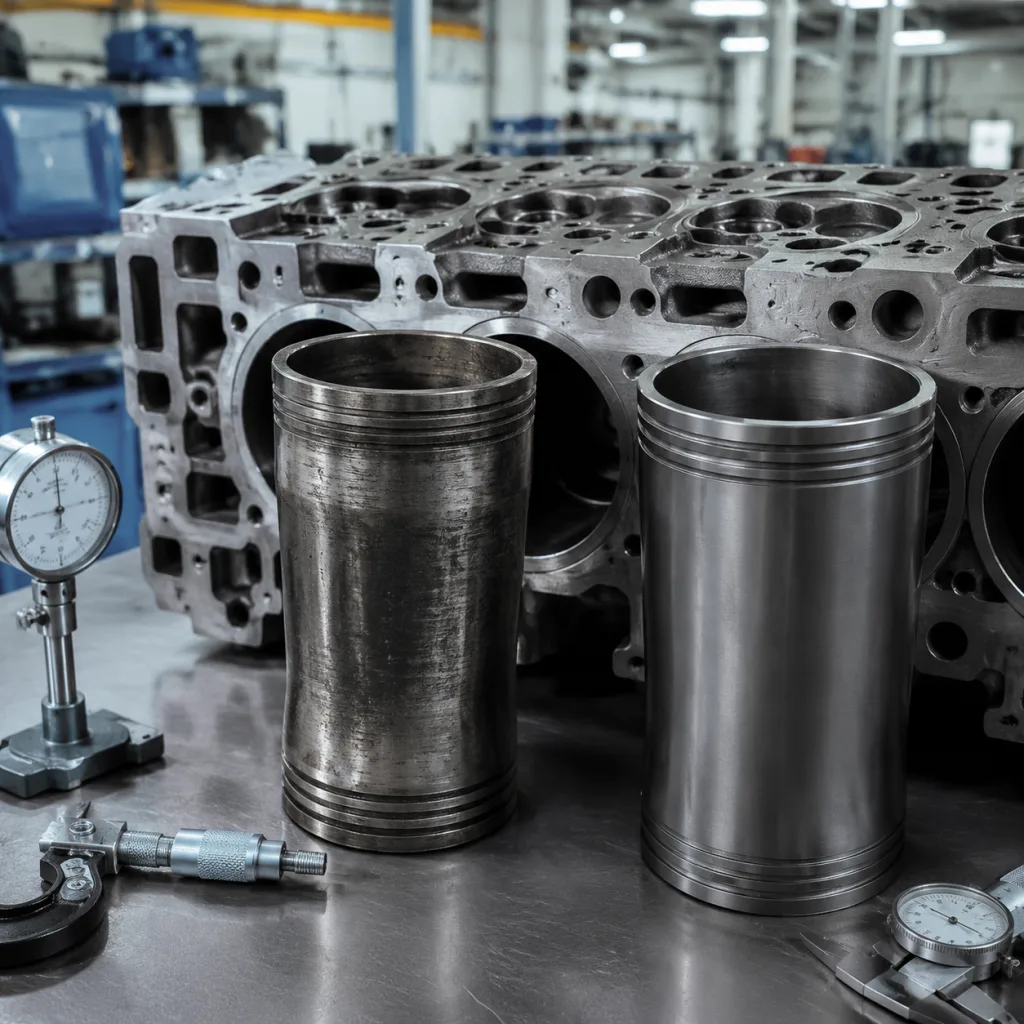
A cylinder head does not need a visible crack to damage the liner interface. A small local bend near the fire ring can lower gasket clamp load on one side of the bore. Combustion gas then escapes through the weak sector, raises local temperature, disrupts the oil film, and marks the liner wall, top flange, or sealing land.
In many warranty reviews, the liner is the damaged part but not the first fault. The trigger is often uneven clamp load from head flatness, block deck condition, gasket selection, bolt stretch, liner stand-proud variation, or a contaminated seating face.
Common damage paths include:
Combustion gas leakage: erosion at the liner top, black tracking on the gasket, heat marks, and uneven fire-ring imprint. Gas cutting often starts as a 10–40 mm arc, not as full-circle damage.
Coolant loss or aeration: hot spots that increase scoring risk and may lead to piston scuffing or seizure. Vapour pockets, poor inhibitor control, or low coolant can leave cavitation pitting, rust staining, or vertical scuffing even when bore size was correct.
Uneven gasket compression: fretting on wet liner flanges, polished high spots, or disturbed raised sealing areas. If the same cylinder position repeats, compare gasket imprint width between cylinders.
Incorrect protrusion control: head resurfacing, deck machining, or liner-seat wear not followed by stand-proud checks can remove gasket crush margin. Many wet-liner engines work inside narrow protrusion windows, often around 0.03–0.12 mm depending on design; the engine specification is always the authority.
Bolt load variation: reused torque-to-yield bolts, stretched fasteners, dirty threads, wrong lubrication, or the wrong tightening sequence can create local sealing loss. One underloaded bolt position can make a sound gasket and liner look defective after short running.
Treat a warped cylinder head cylinder liner complaint as a system diagnosis. If the liner is replaced without checking the head, deck, gasket, bolt loading, protrusion, and cooling condition, the next build can fail in the same bore. A B2B claim file should name the cylinder number, failure hours or mileage, head flatness data, liner protrusion readings, gasket part number, bolt status, coolant condition, and whether the engine failed during break-in, dyno test, road test, or field operation.
Warranty teams need a fast way to decide what the case is before they decide who pays. Start with the field symptom, then ask what evidence would prove or disprove a head-related cause.
Field symptom
Likely head-related risk
Liner inspection focus
B2B decision point
Coolant pressurises soon after cold start
Combustion leakage through a low-clamp sector
Top flange, fire-ring contact, cavitation marks, heat staining
Request traceable liner material and dimensional reports, but do not approve replacement without flatness and protrusion data
Match liner finish to the ring pack and piston specification
Gasket fails again at the same cylinder
Head flatness, block deck, liner seat, or bolt-load error
Protrusion consistency across cylinders
Require cylinder-by-cylinder protrusion records before credit
Oil-coolant contamination
Gasket breach, cracked casting, or wet-liner seal failure
External wall, seal groove damage, O-ring seating
Audit packaging, corrosion prevention, and seal specification
</tr></thead><tbody> </tbody></table>A scored-bore photo is not enough. Minimum claim data should include head flatness readings, block deck readings, liner protrusion, bore diameter, taper and ovality, surface finish, coolant condition, torque procedure records, gasket identification, and machining history.
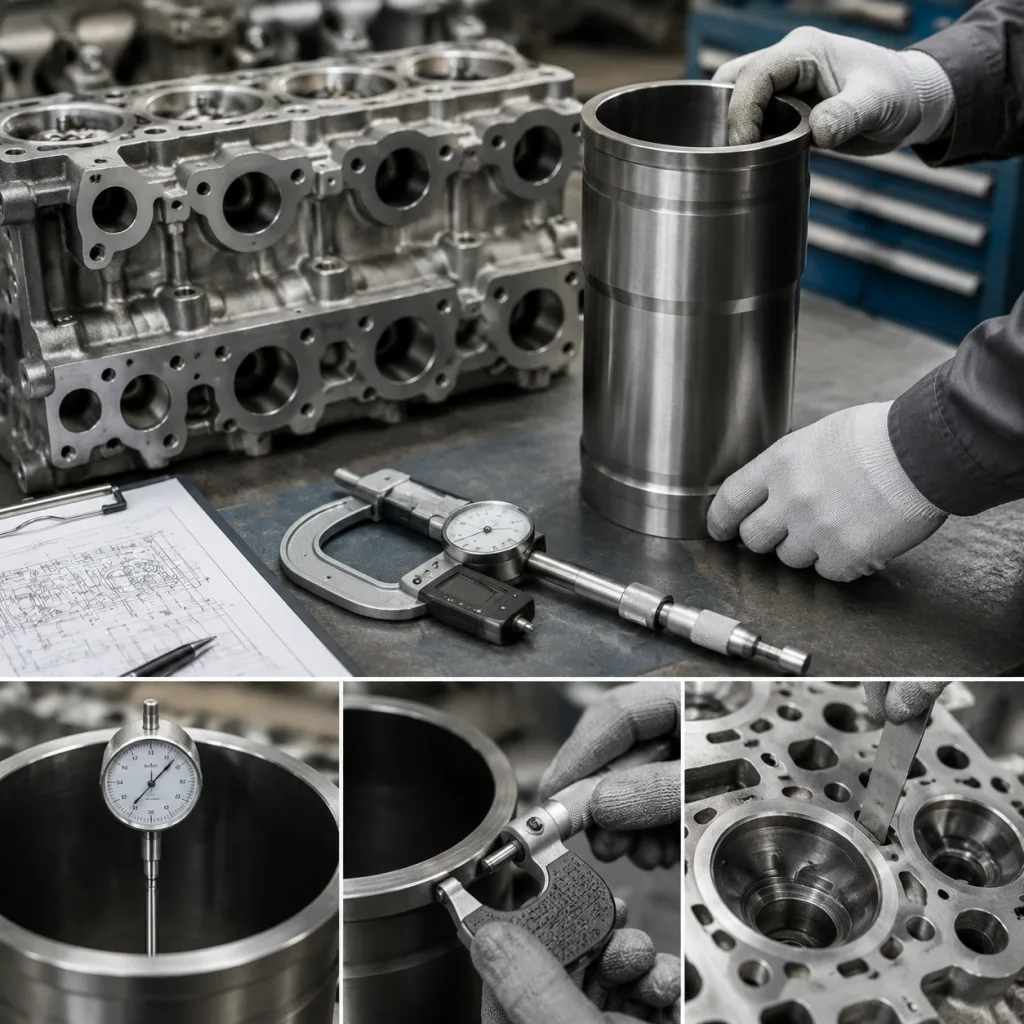
Useful inspection forms record values, not pass/fail notes. Capture head flatness lengthwise, crosswise, and diagonally. Record protrusion at 12, 3, 6, and 9 o’clock. Measure bore diameter 10–15 mm below the top, at mid-stroke, and near the lower reversal zone. Calculate taper and ovality from those readings.
Classify the case before commercial action:
Installation/process case: no incoming dimensional defect is proven, but protrusion, torque, coolant, machining, or gasket evidence is missing or outside procedure.
Application mismatch case: the liner fits one engine version but does not match the gasket, piston, ring pack, or block counterbore used in the rebuild.
Supplier investigation case: multiple liners from the same batch show repeatable bore, flange, seal groove, hardness, or surface-finish variation before installation.
Emergency stock case: replacements are needed immediately, but evidence collection continues to stop repeat failures.
For replacement planning, buyers can review cylinder liner availability in our catalog and cross-check broader engine part coverage under engine components.
Step-by-Step Evidence Pack Before Approval
Procurement does not need to machine the engine. It does need to define the evidence required from rebuilders, workshops, and service networks before a claim is credited. The aim is simple: protect good parts from assembly-related rejection and find true supplier issues quickly when dimensions, material, or process control are involved.
Build the approval pack in this order:
1. Confirm head and deck geometry. Measure cylinder head flatness with a precision straightedge and feeler gauge, or CMM equipment for high-volume or disputed cases. Record gauge resolution, measuring temperature, and direction. Many workshops use 0.02 mm feeler increments; tighter limits need finer methods. Check the block deck around coolant holes, fire-ring zones, bolt holes, and liner seats for corrosion pits, pull-up, cutter marks, and counterbore step wear. 2. Measure liner position before judging the liner. Check protrusion or recession at four points per cylinder with a dial indicator and bridge fixture. A 0.01 mm indicator is normally the minimum; 0.001–0.002 mm resolution is preferred for production audits or high-value disputes. Dirt, rust film, paint, old sealant, or burrs under the flange can change protrusion enough to overload or underload the gasket. 3. Check bore geometry with calibrated tools. Measure bore diameter at top, centre, and bottom positions on thrust and non-thrust axes. Use a calibrated bore gauge set from a micrometer or setting ring, not a worn caliper. Report taper, ovality, and out-of-round against engine service data. A case with 0.01 mm taper is not the same as one with 0.08 mm taper. 4. Verify flange, seat, and sealing features. Check flange thickness, seating-face cleanliness, counterbore condition, seal grooves, and O-ring seating. Wet liners are sensitive to small errors because height, fit, and seal compression work together. 5. Measure finish, coolant, and fastener variables. Surface finish should match the ring supplier’s requirement, including plateau-honing needs where applicable. Controlled checks may include Ra, Rz, Rpk, Rk, Rvk, and crosshatch angle when the drawing requires them. Record coolant pH, contamination, inhibitor condition, aeration signs, fastener condition, lubrication, tightening sequence, torque-angle method, and bolt reuse status.
Dimensional tolerances must come from the engine design and service information. As a sourcing control, Driventus can support liner drawings with agreed requirements for bore size, flange height, wall thickness, seal groove dimensions, hardness, and surface finish during quotation. Where customer drawings are supplied, custom manufacturing can define inspection points, PPAP-level documentation where applicable, and packaging requirements.
Management standards do not define a universal liner protrusion limit. IATF 16949:2016 and ISO 9001:2015 set expectations for process control, traceability, corrective action, and risk-based quality management. The service limit must come from the engine specification, approved customer drawing, or validated rebuild procedure. If the buyer cannot provide an OE drawing, the RFQ should at least define the sample basis, target engine code, gasket type, piston/ring supplier, required documents, and whether dimensions are confirmed on production parts before shipment.
Decision Framework: Reuse, Machine, or Replace
Head distortion changes the risk profile. A liner that looks clean after polishing may still have lost roundness, flange contact, surface integrity, or seal-groove condition. Decide from measured condition, not from appearance.
Reuse may be acceptable when
Bore diameter, taper, and ovality remain inside the engine service limit, measured on at least two axes and three heights.
No vertical scoring catches a fingernail after cleaning, and no aluminium transfer from piston scuffing remains.
The liner flange seating face is flat, clean, and free of fretting or gas-cutting marks.
Wet liner sealing grooves are not pitted, cut, corroded, or distorted, and O-rings seat without twist or local compression loss.
Surface finish remains compatible with the ring pack and oil-retention requirement. If the liner was deglazed or honed, measure the finish.
Protrusion is consistent across the engine after proper seating. If the engine maker gives a cylinder-to-cylinder spread, use it; if not, still record the measured spread for claim review.
Replacement is usually required when
The fire-ring area shows erosion, gas cutting, or abnormal gasket imprint.
The liner has cracks, flange damage, cavitation pitting, or corrosion in the seal area.
Bore wear exceeds the oversize or service limit, or taper/ovality cannot be corrected while maintaining required wall thickness and finish.
The liner cannot maintain protrusion consistency after the seat is cleaned and verified.
Coolant corrosion has attacked the external wall, shoulder, or O-ring area.
Heat damage, piston seizure marks, or severe scoring point to lubrication loss or local overheating.
Machining can solve some bore-condition problems on parent bores and certain dry liner assemblies, if enough material remains and the final finish is controlled. Wet liners are less forgiving. Flange geometry, counterbore fit, protrusion, and O-ring compression all have to remain correct. A dry liner may allow controlled boring or honing to a specified oversize if the application supports it. A wet liner with flange fretting, seal-groove damage, or cavitation is usually a replacement item.
For fleet and repair-chain purchasing, complete liner kits reduce mismatch between liners, seals, and installation consumables. Specify liner quantity, O-ring material and colour, seal lubricant or installation note, corrosion protection, carton label data, and whether pistons, rings, or gaskets are supplied separately. Otherwise a workshop may combine a correct liner with low-cost seals, old-stock gaskets, or mixed installation parts, making later warranty evidence almost useless.
Supplier Comparison: Controls That Make Claims Easier
A replacement liner cannot fix a warped head, damaged deck, or wrong tightening process. It can remove avoidable variables from the investigation. The best supplier is not just the lowest unit price; it is the one that gives buyers stable evidence on material, machining, finish, preservation, and traceability.
Use these questions when comparing liner suppliers:
Material control: What grade is used, and is chemical composition verified by batch? For cast iron liners, request the agreed grade, hardness range, microstructure requirement where applicable, and melt or heat traceability.
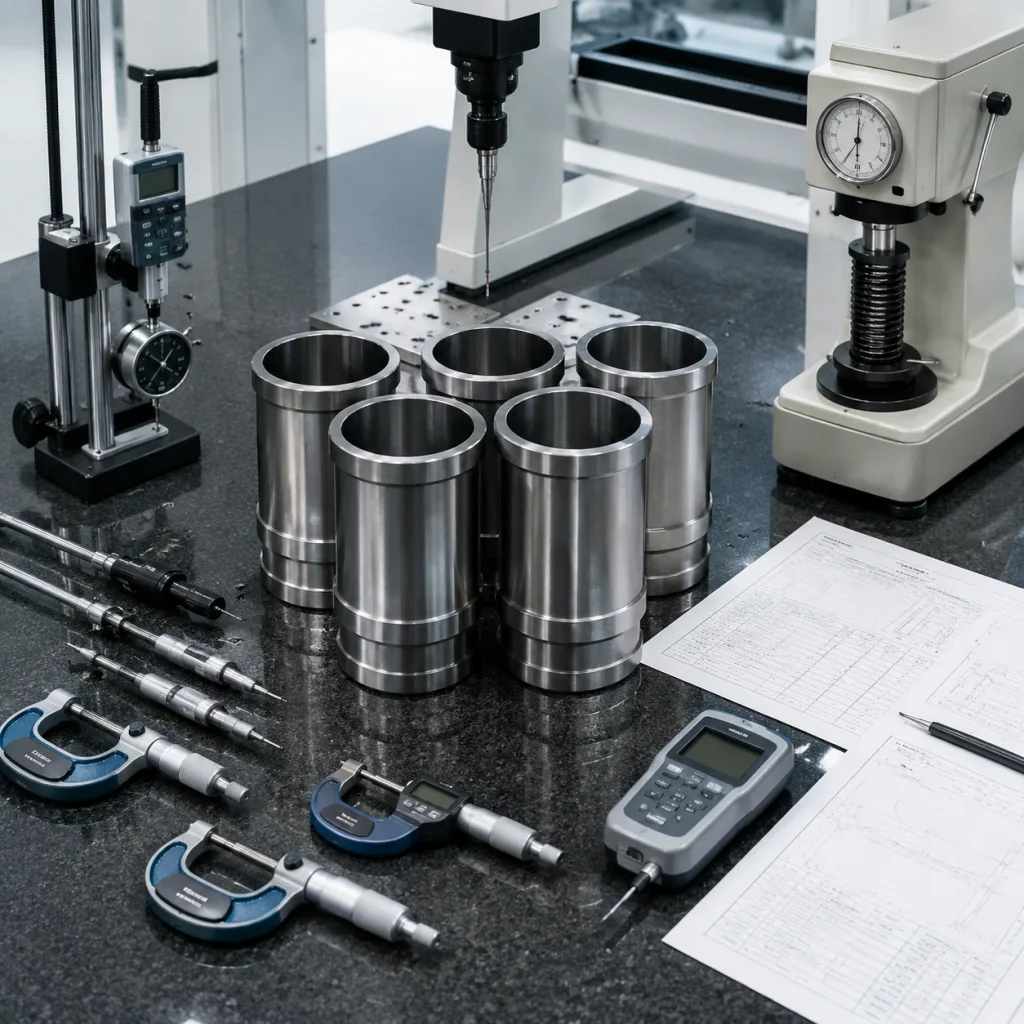
Dimensional control: Are bore diameter, roundness, flange height, wall thickness, and seal groove dimensions recorded during production? Define which dimensions are checked 100%, which are sampled, and which are reported before shipment.
Surface finish control: What honing process is used, and how are roughness parameters documented? If the programme uses a known ring pack, align Ra/Rz or plateau parameters with that supplier’s requirement.
Corrosion protection: Are liners cleaned and preserved for sea freight, humid warehouses, and long distribution cycles? Export packaging should define VCI bag or paper, anti-rust oil, desiccant where needed, carton strength, pallet wrapping, and expected shelf life.
Traceability and packing: Can cartons, labels, and palletisation support distributor traceability and mixed-SKU control? Minimum label data should include part number, batch/lot, quantity, country of origin where required, barcode format if needed, and carton weight.
Complaint handling: What corrective action format is used for field complaints? Agree whether 8D, 5-Why, or a customer template is required, and define timing for containment and final analysis.
Document linkage: Can inspection reports, drawing revisions, and packaging specifications be linked to the quoted programme? A low price is not comparable if it excludes reporting, marking, kit packing, or private-label carton control.
Driventus manufactures cylinder liners and related engine components in Taizhou, Zhejiang, for aftermarket distributors, OEM/Tier-1 supply chains, and multi-location repair groups. Our quality system is built around IATF 16949:2016 and ISO 9001:2015. Material and substance compliance requirements can be reviewed against customer market needs, including REACH (EC) No 1907/2006 where applicable for EU supply.
The commercial review should separate unit price from tooling or fixture cost, sample cost, inspection-document cost, carton/label cost, and freight term. A typical RFQ should state annual volume, first order quantity, reorder quantity, Incoterms, destination port or warehouse, private-label needs, and whether pricing should be EXW, FOB, CIF, or delivered. For engines with known head-warp sensitivity, request installation notes covering cleaning, seating, protrusion measurement, gasket compatibility, torque procedure alignment, and coolant compatibility.
Scenario: A Repair Network Has Repeat Failures
Suppose a repair network reports several warped cylinder head cylinder liner failures after rebuild. Treat the pattern as a programme problem, not a rush-buy problem. Group the data by engine family, mileage, duty cycle, coolant history, workshop, gasket brand, bolt usage, machining vendor, and failed cylinder. Once the evidence is standardised, patterns usually show up quickly.
A practical supply specification should include:
Drawing-controlled critical dimensions for bore, flange, shoulder, wall thickness, and seal grooves.
Batch identification on carton labels and, where feasible, part-level marking.
Pre-shipment inspection reports for agreed critical-to-function dimensions.
Corrosion-resistant packaging for ocean freight, humid warehouses, and long shelf life.
Agreed AQL sampling or a customer-specific inspection plan. Commercial programmes often use AQL-based final inspection for appearance and packaging, while critical dimensions follow a tighter control plan.
Defined evidence requirements for claims involving overheating, gasket failure, coolant contamination, or head machining.
A technical review route for repeat failures by engine family or workshop location.
For catalogue liner supply, the goal is OE-equivalent fit, stable availability, and controlled replacement quality. For private-label or engineered programmes, the goal is to lock dimensions, material, packaging, inspection documents, and claim-handling rules before production.
Set the buying logic before issuing the purchase order:
MOQ: catalogue liners may be quoted by carton or pallet quantity. Custom liners, private-label cartons, or special inspection documents usually require higher MOQ because of setup, packaging, and reporting time.
Price: compare landed cost, not only EXW unit price. Include machining specification, surface-finish control, included seals, carton type, inspection reports, payment terms, tooling amortisation, and warranty-handling workload.
Lead time: stocked or repeat catalogue items may move faster. New drawings, first-article samples, private-label packaging, or PPAP-style documentation add engineering and approval time before mass production.
Order release: for multi-SKU programmes, group low-volume liners by bore family, engine family, or carton format to reduce mixed-pallet errors and improve freight efficiency.
Safety stock: engines with known head-warp or gasket sensitivity should carry enough stock to cover the claim-investigation cycle, not only normal monthly sales.
As an RFQ baseline, buyers should share engine family, OE/reference numbers for fitment, target annual volume, first order quantity, destination, documentation level, packaging style, and claim process expectations. Driventus is an independent aftermarket manufacturer; brand names are referenced for fitment only.
Frequently asked questions
Yes. Uneven head flatness or clamp load can allow combustion leakage, local overheating, and gasket failure. A new liner may then show scoring, flange fretting, seal-area damage, or fire ring erosion even if its dimensions were correct before installation. Record head flatness, liner protrusion, bolt procedure, gasket part number, and coolant condition before blaming the liner batch.
Record head flatness, block deck flatness, liner protrusion at four points, bore diameter at three heights and two axes, taper, ovality, surface finish, coolant condition, gasket condition, machining history, and bolt tightening data. Photographs alone are usually not enough for root-cause analysis.
Yes. Driventus supplies cylinder liners and related engine components for aftermarket distribution, repair-chain supply, and engineered sourcing programmes. MOQ, price, lead time, inspection documentation, packaging, and traceability are agreed according to SKU range, annual volume, documentation level, and customer market requirements.
If you are reviewing liner claims or sourcing a controlled replacement programme, share the engine family, target SKUs, annual volume, first order quantity, destination, packaging needs, and inspection requirements. You can [request a quote](/contact.html).