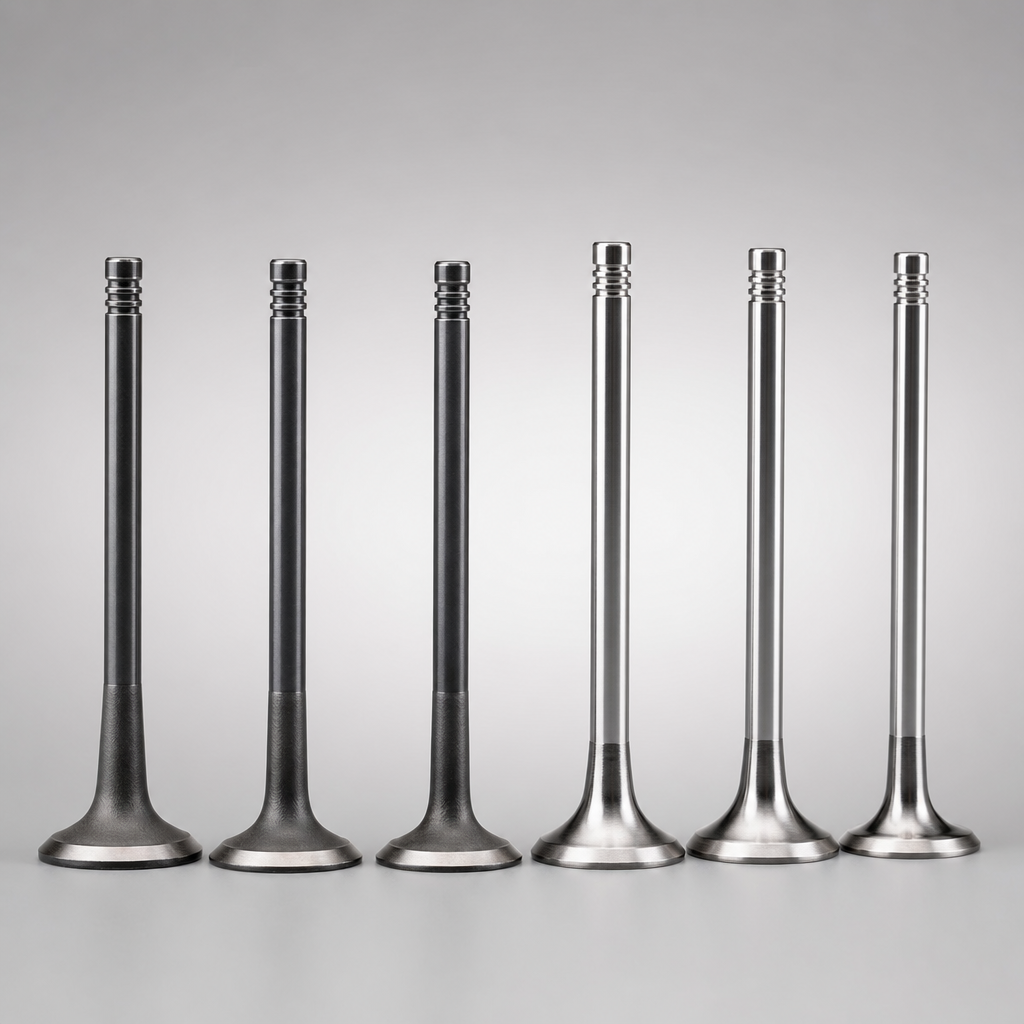
Carbon buildup on intake valves and sealing loss at the intake manifold joint often arrive as the same complaint, especially on direct-injection petrol engines and higher-mileage light commercial vehicles. For distributors, repair chains, and sourcing teams, that overlap is not a workshop detail. It affects diagnostic accuracy, labour exposure, parts returns, and warranty cost. A rough idle, lean code, or cold-start misfire may come from intake valve deposits, but the same vehicle can also have an intake manifold gasket that has hardened, taken a compression set, or been damaged on a previous service. The practical job is to separate airflow disruption from vacuum leakage before parts are ordered. When the manifold comes off, replacement guidance should usually treat the gasket as part of the service event. For sourcing teams, that means defining material, tolerance, MOQ, lead time, and inspection controls early, because a low-cost seal can trigger a high-cost comeback. Driventus is an independent aftermarket manufacturer; any brand names are referenced for fitment only.
Start with the decision: deposit problem, sealing problem, or both?
The most expensive mistake in a carbon buildup intake valves intake manifold gasket job is assuming the first symptom tells you the root cause. It usually does not.
Direct-injection engines let oil mist and combustion residues accumulate on the back of the intake valves because fuel no longer washes that surface continuously. Those deposits can change airflow, disturb tumble or swirl, and weaken combustion stability at idle and cold start. On many DI petrol engines, deposits in the 0.5-1.5 mm range are already enough to upset running quality. Severe buildup above 2 mm can materially reduce effective port area.
A leaking intake manifold gasket creates a different failure mode. The engine ingests unmetered air downstream of the airflow meter or MAP reference point, so measured air mass no longer matches actual air entering the cylinder. That tends to hit idle hardest because manifold vacuum is highest there. A leak that barely shows above 2,500 rpm can still push fuel trims well positive at idle.
The symptom overlap is why these faults are routinely mixed up:
Rough idle after cold start
Light-load hesitation
Lean mixture fault codes
Cylinder-specific misfire counts
Elevated long-term fuel trim
Reduced low-speed torque
Use a simple framing rule. If the complaint is strongest at idle and eases as rpm rises, suspect sealing loss early. If the complaint includes cold-start instability, uneven cylinder filling, or reduced response under load, deposits move higher up the list. In real vehicles, both faults often exist together.
For service guidance, a useful trigger for combined inspection is idle LTFT in roughly the +8% to +12% range, positive STFT swing at idle, and symptoms that reduce with engine speed. That pattern does not prove an intake manifold gasket leak, but it is enough to justify smoke testing before committing parts.
Use this comparison before you release any parts order
Procurement teams get better first-time repair rates when workshops follow the same comparison logic instead of ordering by symptom label.
Symptom
More consistent with carbon deposits
More consistent with gasket leak
Cold-start roughness
Common
Common
Lean fuel trim at idle only
Possible
Very common
Power loss at higher rpm
Common
Less common
Audible hissing near manifold flange
Uncommon
Common
Misfire concentrated on one bank or one port area
Possible
Common
Visible deposit on valve stem/back
Common
Not relevant
</tr></thead><tbody> </tbody></table>Recommended checks, in order:
1. Compare short-term and long-term fuel trims at idle and again around 2,500 rpm. Leak-driven faults often show the strongest positive correction at idle, then improve as rpm climbs. 2. Run a smoke test around manifold joints, injector seats, vacuum take-off points, and nearby hoses. Regulated smoke pressure around 0.5-1.0 psi is common; pushing higher can create false positives on some plastic manifolds. 3. Inspect the intake manifold gasket for cracks, flattening, extrusion, hardening, or local tearing. 4. Borescope the intake valves where access allows. Cylinder-by-cylinder photo records help with warranty analysis and buyer feedback. 5. Check flange flatness and torque sequence against service data. On plastic manifolds, uneven clamp load can create a leak even when the gasket is nominally acceptable. 6. Read freeze-frame data to see whether the fault is concentrated at idle, cold start, or light-load cruise.
This process cuts return risk. It also prevents the common failure where a workshop orders only for carbon cleaning, removes the manifold, then discovers the existing intake manifold gasket is no longer fit for reuse.
For multi-branch networks, the buying rule can stay simple:
Confirmed leak: order gasket and related seals
Confirmed deposits without leak: plan valve cleaning, then replace gasket at reassembly
Both conditions present: supply the full service kit as one line item
That reduces vehicle-down time and avoids split orders for a part that is cheap to stock but costly to miss.
Spec deep-dive: what actually matters in an intake manifold gasket
Buyers should not treat the intake manifold gasket as a generic catalogue add-on. In a carbon buildup intake valves intake manifold gasket service event, the seal is a functional reliability component.
Typical specification points
Base material: moulded rubber carrier, fibre composite, or metal-elastomer construction depending on engine design
Temperature resistance: stable performance across normal intake-side exposure, often up to 150-200 C for elastomer sealing elements depending on compound
Compression set control: low permanent deformation after heat ageing; many buyers request data after 70 h at 125 C or similar internal conditions
Fluid resistance: compatibility with oil mist, fuel vapour, coolant traces, and approved cleaning chemicals
Dimensional tolerance: controlled bead height, port geometry, and bolt-hole position to support clamp distribution; critical features may sit in the +/-0.10 to +/-0.25 mm range depending on design
Hardness window: elastomer hardness commonly specified within a defined Shore A range, for example 60-75 Shore A where applicable
Traceability: batch identification aligned with IATF 16949:2016 and ISO 9001:2015 documentation controls
Chemical compliance: material screening to support REACH (EC) No 1907/2006 obligations where relevant
The better buyer questions are not broad. They are specific:
What sealing material is used?
What compression-set or ageing data supports it?
Which dimensions are treated as special characteristics?
How is variation controlled by cavity, batch, or cure window?
Can a complaint be traced to tooling lot, material lot, and pack date?
Commercial terms deserve the same discipline:
MOQ: aftermarket standard items often run around 100-300 sets per part number; private-label or custom geometry may start at 500-1,000 sets depending on tooling and packaging
Tooling lead time: modified or new geometry often needs 20-45 days for tool manufacture and first samples
Production lead time: repeat orders commonly work on 30-45 day cycles after artwork and packaging approval
Price logic: material system, cavity count, packaging, and annual volume all move unit price; a simple elastomer gasket and a tighter-control metal-elastomer design should not be priced by the same logic
Sampling: dimensional reports, material declarations, and first-article samples should come before volume release
For nomination, ask how the gasket is packed. Trays, sleeves, and flat-layer cartons matter because sealing beads can deform in transit if packaging is treated as an afterthought.
After manifold removal, inspect for failure mode not just damage
Once the manifold is off, the useful question is not simply whether the gasket looks used. The question is why it failed, or why it might fail on reassembly.
Use these acceptance or rejection checks:
Reject if the sealing bead shows cuts, hardening, glazing, flattening, or section loss.
Reject if bead recovery is poor after removal or compressed areas show permanent collapse relative to adjacent sections.
Reject if imprint depth is uneven, which may point to flange distortion or an incorrect torque sequence.
Reject if the carrier shows delamination, cracked support ribs, or torn port bridges.
Check the manifold flange for nicks, contamination, and warpage before fitting a new gasket.
Clean mating faces without removing base material from aluminium components.
Inspect port areas for blow-by marks, dust tracking, or oil staining that indicate prior leakage.
This is also the point where intake valve deposit severity should be documented properly. If carbon buildup is heavy, removed material must not enter the combustion chamber during cleaning. Vacuum extraction and controlled media use are standard practice. Walnut shell blasting is common on suitable engines; in many workshops, media around 0.4-0.8 mm is used, with piston position controlled so the intake valves on the serviced cylinder are fully closed.
Installation discipline matters as much as the part. A replacement intake manifold gasket should normally be fitted dry unless the engine manufacturer explicitly specifies sealant at defined points. Excess sealant can extrude into the port, alter airflow, and complicate the next repair.
For field reporting, capture four items on every removed gasket:
Vehicle mileage
Engine code
Leak location by port number
Photo evidence of bead condition
That small record set gives sourcing teams something usable when deciding whether a complaint is age-related, installation-related, or batch-related.
What separates a credible supplier from a catalogue trader
Sealing complaints are expensive because they are often intermittent. The vehicle may idle badly only when cold. It may set lean codes only after reassembly. That is why buyers should evaluate process control, not fitment claims alone.
A capable gasket supplier should be ready to explain:
Incoming checks for elastomer hardness, compound identity, and carrier dimensions
Tool maintenance intervals and cavity-control records
In-process checks for bead height, flash, and critical port geometry
Final inspection and packaging protection against deformation in transit
Batch traceability linked to material lot and production date
Retained records that support warranty review and corrective action
At Driventus, these controls are managed within our quality system, with production processes aligned to IATF 16949:2016 and ISO 9001:2015 requirements. For private-label or application-specific sealing geometry, custom manufacturing can support drawing-based development, validation planning, and packaging configuration.
Buyers often ask for concrete control points such as:
Elastomer hardness verification per batch, for example target Shore A +/-5
Dimensional checks on first-off, in-process, and final samples for bead height, hole pitch, and port outline
Flash limits on sealing surfaces so excess material does not affect seating
Ageing or compression-set validation before PPAP-style approval or aftermarket release
Packaging validation showing no distortion after stacking, transit, and storage
One question is especially revealing: what happens when the process drifts?
A credible answer should include containment, lot segregation, root-cause analysis, and timing for corrective action. If bead height trends 0.15 mm low on one cavity, the supplier should be able to quarantine that lot, identify affected cartons by batch code, and issue a dimensional report within 24-48 hours. That is the level of control that actually reduces field exposure.
Scenario planning: when gasket replacement should be automatic
For repair chains and distributors, the lowest-risk service rule is straightforward: if the intake manifold is removed, the intake manifold gasket should normally be replaced during reassembly.
That rule becomes even stronger when:
Vehicle mileage is high, commonly above 80,000-120,000 km on DI petrol applications
The engine family has a known vacuum-leak history
The gasket uses an elastomer bead with visible compression set
The manifold has multiple ports and uneven thermal exposure
Comeback labour materially exceeds gasket cost
The original seal shows hardening, flattening, or edge damage
Viewed commercially, this is a simple control point. The gasket is low value on paper, but high leverage in the warranty model. Once a carbon buildup intake valves intake manifold gasket job is opened, access cost is already absorbed. Reusing a compressed seal to save a small part cost is usually the wrong trade.
A practical stock model looks like this:
Pair each common valve-cleaning application with the matching intake manifold gasket set under the same branch stocking rule
Set min/max levels based on service frequency, not gasket price alone
Compare gasket cost against comeback labour; even a modest repeat repair can exceed part value by 10x to 30x
For high-runner SKUs, use blanket orders with scheduled releases so workshops are not exposed to 4-6 week replenishment gaps
For slower movers, hold regional buffer stock or use mixed-carton purchasing to avoid dead inventory
For programme sourcing, request dimensional reports, material data, and packaging detail before nomination. If you need application coverage, validation information, or supply terms for intake manifold sealing products, use the contact form to request a quote.
Frequently asked questions
In most workshop environments, yes. Once removed, many gaskets show compression set, edge marking, or minor handling damage that can lead to vacuum leaks after reassembly. Replacement cost is low compared with repeat labour, lost workshop time, and diagnostic rework. For chain workshops, the more practical rule is to treat gasket replacement as mandatory whenever the manifold is removed, unless the engine service procedure explicitly states otherwise.
Yes. Both can produce rough idle, lean codes, hesitation, and misfire. The difference should be confirmed with smoke testing, fuel-trim analysis, and visual inspection rather than symptoms alone, because carbon deposits affect airflow while a leaking intake manifold gasket affects sealing and air measurement. A leak tends to influence idle fuel trims more strongly, while heavier deposits are more likely to show as airflow imbalance, cold-start instability, and reduced response under load.
For supplier controls, buyers commonly look for manufacturing systems aligned to IATF 16949:2016 and ISO 9001:2015. For material compliance in Europe, REACH (EC) No 1907/2006 is also relevant. Beyond certifications, buyers should also ask about batch traceability, validation data, dimensional tolerances, hardness control, MOQ, and standard lead times so commercial risk is covered alongside technical fitment.
If you are reviewing intake manifold gasket supply for aftermarket or OEM-adjacent programmes, Driventus can provide application coverage, material details, MOQ guidance, lead-time planning, and production support. Contact our team here: /contact.html