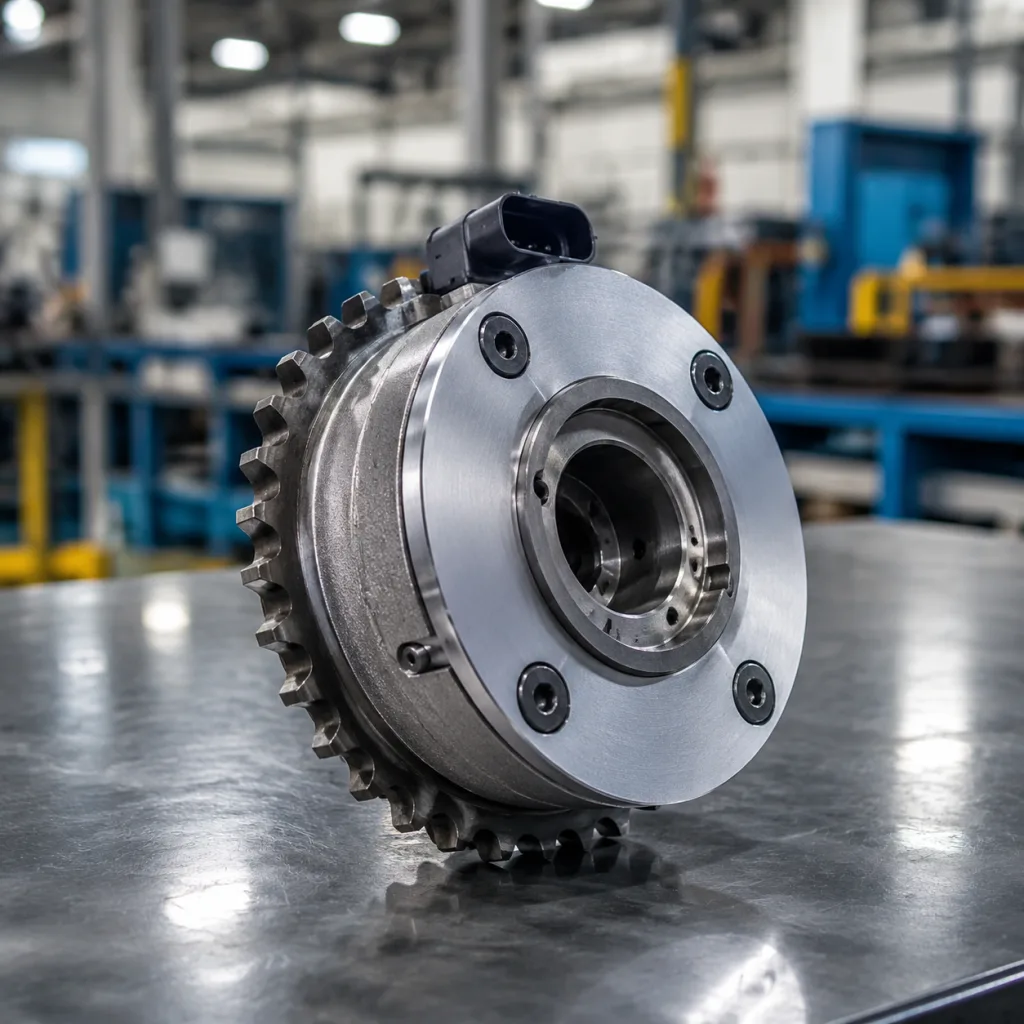
Buying a camshaft phaser for Volkswagen applications is not a part-number exercise. Fitment has to line up with the engine’s oil passages, locking position, vane count, and control strategy; otherwise the unit may pass a visual check and still fail in service. For wholesale buyers, the bigger risk is not price. It is a wrong cross-reference, inconsistent batch quality, or packaging that does not survive export handling.
Driventus manufactures engine and powertrain components in Taizhou, Zhejiang and exports to more than 60 countries. We supply B2B customers under IATF 16949:2016 and ISO 9001:2015 controls. Driventus is an independent aftermarket manufacturer; brand names are referenced for fitment only. This guide walks through the decision points procurement teams should check before placing a camshaft phaser Volkswagen wholesale order, from OE validation and sample review to documentation and replenishment planning.
Start with the fitment gate, not the price tag
For this part family, the first decision is whether the application is truly matched. A camshaft phaser must align with the engine code, oil control strategy, locking position, and vane geometry. If any of those are off, the part can create noise, timing instability, or premature wear.
Minimum procurement checks
OE and engine-code match confirmed from a current catalogue
Critical dimensions checked for bore, bolt pattern, and spline features
Full phasing window verified in functional testing
Seal faces and actuator ports protected during packing
Lot marking and traceability available for repeat orders
When enquiries cover several Volkswagen platforms, group them by engine family and model year before requesting a quote. That cuts back-and-forth and reduces cross-reference errors. If your programme includes broader engine parts, you can also review our catalog and the wider engine components range.
Where wholesale phasers usually fail in the field
The common failure modes are predictable. They usually come from oil contamination, poor machining, weak seal integrity, or inconsistent assembly rather than from the part name itself. A unit that looks correct on arrival can still fail after heat cycling if the internal control surfaces were not kept clean or the leakage path was not controlled.
Typical risk points include:
Burrs or chips left in oil passages during assembly
Radial play outside the drawing requirement
Leakage that appears only after hot-oil cycling
Mismatch between actuator travel and ECU expectation
Weak carton protection that damages sealing faces in transit
That is why wholesale buyers should ask how the supplier tests movement, cleanliness, and leak resistance. A low unit price does not offset a failed field claim.
What the spec sheet needs to prove
A catalogue entry is not enough. Procurement teams should ask for measurable controls that show the phaser was built to a repeatable standard, not just matched to a photo.
Check item
Procurement target
Housing material
Machined aluminium or steel alloy per application design
Vanes / rotor geometry
Matched to OE-style phasing travel
Radial play
Controlled to drawing requirement
Leakage
No abnormal external oil seepage after test
Cleanliness
No chips, burrs, or trapped debris
Identification
Lot traceability and durable marking
</tr></thead><tbody> </tbody></table>Published references that may apply to sourcing and compliance include IATF 16949:2016, ISO 9001:2015, REACH (EC) No 1907/2006, and, where vehicle-level emissions behaviour is relevant, ECE R-83 or SAE J2527 for related durability contexts. Those standards support a controlled supply chain, but they do not replace application-specific fitment testing.
How Driventus structures wholesale supply
Driventus supports camshaft phaser Volkswagen wholesale programmes for aftermarket distributors, OEM / Tier-1 supply chains, and multi-location repair groups. The advantage for procurement teams is that machining, finishing, assembly, inspection, and packaging are coordinated in one manufacturing base.
We support sourcing teams with:
Batch traceability and incoming-material control
Dimensional inspection on critical interfaces
Assembly verification and end-of-line functional checks
Export packaging suitable for mixed-SKU palletisation
If you are comparing vendors, ask for process evidence rather than marketing claims. The quality system should show how nonconformity is handled, how gauges are calibrated, and how lot records are retained. That matters when the same application is reordered across multiple countries.
Ordering logic: MOQ, lead time, and inventory risk
Wholesale purchasing works best when the buying decision reflects service level, not just unit cost. Camshaft phasers are application-specific, so the mistake cost of a wrong cross-reference is high. A sensible MOQ and realistic lead time usually matter more than chasing the lowest quote.
A practical ordering sequence looks like this:
Confirm annual demand by engine family before placing first-order stock
Separate fast-moving aftermarket references from slower fleet applications
Hold sample approval status before committing to container quantity
Lock labelling, carton count, and pallet pattern before mass production
Request photo approval for outer cartons and barcodes before dispatch
If your buying team needs repeat supply across several markets, ask for a forecast-based replenishment model. It helps stabilize deliveries and reduces changeover risk. For an initial enquiry, you can request a quote with OE reference, engine code, target volume, and destination market.
Approval before release: the step buyers should not skip
A part can pass dimensional checks and still fail in service if oil control or response time is inconsistent. Before release, wholesale buyers should ask for evidence of functional validation on representative samples.
Recommended release file:
Dimensional inspection report with sampling basis
Functional actuation results across full travel
Visual inspection for burrs, chips, and seal damage
Packaging approval sample
Traceability record for the production lot
A practical approval gate is to compare the sample against the OE reference on an engine stand or bench fixture, then confirm installation compatibility with the related gasket, fastener, and oil supply condition. Driventus is an independent aftermarket manufacturer; brand names are referenced for fitment only. That keeps the procurement process focused on technical compatibility and repeatable supply, not branding claims.
Frequently asked questions
Yes. We work from application data, engine code, and OE cross-reference where available. Final fitment should be confirmed by the buyer’s own application database and sample check before bulk release.
Ask for dimensional inspection data, functional test evidence, packaging approval, lot traceability, and the supplier’s quality documentation. For regulated markets, also review REACH-related declarations where applicable.
Yes. We support private-label pack formats and carton specifications through our custom manufacturing service. Share artwork, label rules, carton count, and destination-market requirements during enquiry.
If you are building a stock programme or validating a new reference, send your OE number, engine code, and target volume. Our team can review options and prepare a wholesale quotation at /contact.html