Procurement teams searching for a camshaft phaser Mercedes-Benz OEM supplier are not buying a simple sprocket with a matching bolt pattern. They are qualifying a hydraulic variable valve timing actuator that has to move, lock, seal, and report predictably while running in hot oil, cold starts, start-stop cycles, chain-drive torsional pulses, and ECU cam/crank correlation logic.
The common warranty triggers are familiar: cold-start rattle, P0016/P0017-type complaints, slow advance or retard response, locking-pin sticking, vane or housing wear, debris sensitivity below roughly 100-200 µm, and weak traceability when field returns arrive. A supplier that cannot connect a failed unit to machining, washing, assembly, torque, functional test, and packing records leaves the buyer exposed.
Driventus manufactures engine timing and powertrain components in Taizhou, Zhejiang, with export supply to more than 60 countries. Our work covers independent aftermarket supply and contract manufacturing programs, supported by IATF 16949:2016 and ISO 9001:2015 process controls. This article takes a practical sourcing route: first fitment risk, then factory capability, audit evidence, validation data, sourcing-route comparison, and the RFQ details that prevent expensive assumptions before purchase orders are released.
Start with the decision risk, not the part photo
A camshaft phaser adjusts camshaft angle relative to crankshaft position so the ECU can optimize valve timing across load, speed, temperature, and emissions conditions. For Mercedes-Benz fitment programs, the first decision is whether the supplier understands the functional system around the part: engine family, chain-drive layout, oil control strategy, locking-pin behavior, sprocket tooth geometry, sensor target compatibility, and ECU diagnostic tolerance.
A visual match is not enough. Two phasers can look interchangeable and still differ in internal oil routing, angular travel, lock position, oil-fill volume, vane sealing, or diagnostic response. That gap is where warranty claims start.
Use the first supplier screen to confirm:
Fitment mapping by engine application, production year range, and intake or exhaust position.
OE part-number cross-reference format where applicable, for example OE 06A… or OE 11251… only when those references already appear in customer data.
Sprocket tooth count, chain pitch, datum location, mounting bolt pattern, and center bore tolerance. Where the bore is a functional locating feature, buyers often review center-bore control in the 0.01-0.03 mm range.
Angular travel range, default lock position, and mechanical stop consistency. The RFQ should state whether travel is measured in crankshaft or camshaft degrees and define allowable variation, for example ±1.0° unless the drawing requires tighter control.
Oil gallery configuration, rotor-vane sealing method, internal spring design, and locking-pin release characteristics.
Flatness and parallelism of oil-sealing faces, rotor width, housing depth, and end clearance. Watch for burr-free oil passages, no raised edges at ports, and controlled internal leakage.
Compatibility with oil control valve response, camshaft sensor target requirements, and ECU diagnostic thresholds.
Batch traceability from raw material and critical components through machining, washing, assembly, torque check, functional test, and final packing.
Driventus is an independent aftermarket manufacturer; brand names are referenced for fitment identification only. We do not claim approval, authorization, or endorsement by any vehicle manufacturer. Buyers reviewing Mercedes-Benz applications can compare program requirements against our catalog and engine-related product scope at /products/engine-components.html.
When capacity looks fine but the process fails
A reliable camshaft phaser program is usually lost in small variations, not dramatic production errors. Rotor width shifts. Housing flatness drifts. A locking pin fits slightly tight. A washing process leaves particles in an oil passage. Sprocket runout sits near the limit. Any one of these can become cold-start rattle, delayed camshaft response, correlation faults, oil-pressure sensitivity, or accelerated wear.
Before accepting a quote, confirm whether the plant controls the real production route: CNC turning and milling, broaching or gear processing, heat-treatment sub-suppliers, washing, leak testing, assembly, and 100% functional checks. A low price from a plant that cannot explain these steps should be treated as an incomplete quote.
Typical commercial and manufacturing parameters for B2B programs are shown below. Exact figures depend on drawing control, annual forecast, packaging requirements, validation scope, and whether the program is standard aftermarket catalog supply or customer-specific development.
Item
Typical sourcing requirement
Procurement note
MOQ for existing references
300-1,000 pcs per SKU
300-500 pcs may fit repeat catalog items; 800-1,000 pcs is more realistic for slower SKUs or private packaging
New development MOQ
1,000-3,000 pcs or agreed annual forecast
Driven by tooling, gauges, sample builds, validation hours, and special materials
Standard lead time
45-75 days after order confirmation
Includes material preparation, machining, assembly, inspection, packing, and export booking
Sample lead time
20-45 days for available designs
New-development samples may need 45-90 days if tooling or fixtures are required
Price drivers
Volume, material grade, machining time, testing level, packaging
Unit price can change materially if 100% leak/angle testing, PPAP files, or branded boxes are included
Documentation
Inspection report, material record, traceability code
PPAP-style files can be prepared for qualified programs and should be quoted separately if extensive
</tr></thead><tbody> </tbody></table>A sourcing file should state whether the buyer needs standard aftermarket supply, private-label distribution, or custom manufacturing. For new designs, Driventus normally recommends a gated process: 3-7 working days for technical review, feasibility confirmation before tooling, prototype production, validation testing, a 50-200 pc pilot order where applicable, and controlled mass production after dimensional and bench data are approved.
This sequence is slower than jumping from sample approval to a full order. It is also safer. It forces the buyer and supplier to agree on critical dimensions, test criteria, packaging, and documentation before production volume is at risk.
Audit the control chain: material to complaint closure
Camshaft phasers should be sourced from a plant that can prove process control, not only sort finished parts. Final inspection may catch some defects. It cannot repair unstable machining, poor cleaning, weak assembly discipline, or undocumented process changes.
Driventus operates under IATF 16949:2016 and ISO 9001:2015. These standards do not guarantee performance for every application by themselves, but they create the management framework for traceability, nonconforming product control, corrective action, calibration, internal audits, and production change management.
For an audit or remote supplier assessment, procurement and supplier quality engineers should request evidence in these areas:
Control plan covering machining, heat treatment if applicable, washing, cleanliness control, assembly, leakage testing, functional checks, and final inspection.
PFMEA identifying risks such as burrs in oil passages, rotor-to-housing clearance variation, sprocket runout, incorrect spring orientation, locking-pin sticking, mixed components, incorrect laser marking, and wrong packaging label.
Calibration records for CMM, air gauges, torque tools, hardness testers, profile measuring equipment, and leakage test equipment. Critical gauges should show current calibration status and defined frequency.
Lot traceability for steel, powder metal components, springs, seals, fasteners, and purchased subcomponents, with batch codes linking finished goods to machining date and assembly shift.
Cleanliness controls for oil-wetted internal parts, including defined washing media, filtration, drying, glove handling, and sealed WIP storage after washing.
In-process inspection for critical dimensions such as center bore, mounting face runout, tooth profile, rotor thickness, housing depth, and oil-port burr condition.
Change-control procedure for material source, machining process, tooling, inspection method, coating, heat-treatment supplier, and sub-supplier changes.
Containment and corrective-action process for customer complaints, including return analysis, 8D timing, batch-risk assessment, and retained-sample comparison.
Ask practical questions. Is sprocket runout checked from the same datum used in assembly? Are leak-test master parts available? Are torque tools verified each shift? Are first-off and last-off inspection records retained? Can the supplier isolate a suspect batch without blocking unrelated shipments?
Our quality system is structured for export programs where buyers require incoming inspection data, corrective-action response, and stable repeat-order consistency. For high-volume customers, process audits may be supported by video review, document submission, remote meetings, or scheduled on-site visits.
Spec deep-dive: the validation data that changes the quote
A camshaft phaser Mercedes-Benz OEM supplier search often starts with price. Warranty exposure is usually decided by the validation plan. A quotation that excludes durability, hot-oil leakage testing, detailed dimensional reporting, cleanliness measurement, or material documentation is not directly comparable with one that includes them.
Agree on the test package early. The actuator should be evaluated across defined oil temperature, oil pressure, engine speed, and torsional load conditions. Pass/fail language is not enough when the field problem may be marginal response time or intermittent lock-pin release.
Recommended validation evidence includes:
Dimensional inspection against controlled drawings or approved reverse-engineered specifications, with at least 5-piece initial-sample data and critical dimensions marked.
Sprocket tooth profile, pitch, concentricity, and runout measurement. A buyer may specify maximum face or radial runout such as 0.05-0.10 mm depending on datum and design.
Angular travel verification, including default lock position, stop position, and commanded movement range. Record actual degree values rather than only pass/fail status.
Locking-pin engagement and release pressure test under defined oil conditions, for example at room temperature and hot-oil conditions using the customer-agreed oil viscosity.
Internal leakage test at specified oil pressure and temperature. RFQs should state pressure points such as 1 bar, 3 bar, and 5 bar if the buyer has a standard.
Response-time check from locked to advanced or retarded position under controlled oil flow, pressure, and temperature.
Torque resistance, backlash assessment where relevant, and torsional durability cycling. Durability plans should define cycle count, load amplitude, oil temperature, and acceptance limits.
Noise check during simulated start-up, oil-fill transition, and lock-pin release, with a comparison sample if the buyer has an OE or benchmark part.
Surface hardness and metallurgical report where hardened wear surfaces are used, including case depth if the drawing requires it.
Cleanliness or particle contamination data for oil-wetted areas when required by the buyer, with test method, extraction fluid, filter size, particle count, and gravimetric residue stated.
Salt-spray or corrosion-resistance data for exposed surfaces where relevant to packaging, storage, or destination market.
Engine timing performance can interact with emissions and onboard diagnostic behavior, including frameworks such as ECE R-83 at the vehicle level, although the component itself is not certified as a complete emissions system. Material declarations may also be relevant for importers supplying the EU, including REACH (EC) No 1907/2006 responsibilities. Buyers should state any IMDS, material declaration, restricted-substance reporting, or customer-specific compliance requirement at RFQ stage.
Where the program requires higher documentation depth, Driventus can support PPAP-style submissions, including process flow, control plan, PFMEA summary, dimensional report, material confirmation, test summary, appearance approval where relevant, packaging specification, and initial sample inspection report.
Four sourcing routes compared by warranty visibility
Some distributors buy camshaft phasers through exporters or trading companies for convenience. That can work for small, mixed orders, especially when administrative simplicity matters more than technical access. It is less effective when the buyer needs repeat demand control, warranty monitoring, private-label consistency, or a defined supplier quality process.
The real comparison is not “cheap versus expensive.” It is how much visibility the buyer has when something goes wrong.
Sourcing route
Advantages
Risks to manage
Trading company
Low administrative burden, broad SKU consolidation, flexible small orders
Limited process visibility, slower technical feedback, unclear change control, weak access to test records
General parts assembler
Competitive pricing, broad aftermarket coverage
Variable sub-supplier control, limited machining capability, inconsistent cleanliness control
Vertically integrated manufacturer
Direct technical review, controlled production data, easier audit trail
Requires clearer forecasts, technical communication, and agreed release process
Customer-specific manufacturer
Drawing-based control, packaging and validation alignment
Longer development lead time, sample approval steps, higher initial MOQ
</tr></thead><tbody> </tbody></table>For buyers seeking a camshaft phaser Mercedes-Benz OEM supplier, the practical question is not only whether the supplier can quote the part. It is whether the supplier can contain, analyze, and prevent a repeat failure. A low unit price is not enough if the supplier cannot trace a returned unit to a production batch, inspection record, material lot, assembly date, operator or line, torque result, and test result.
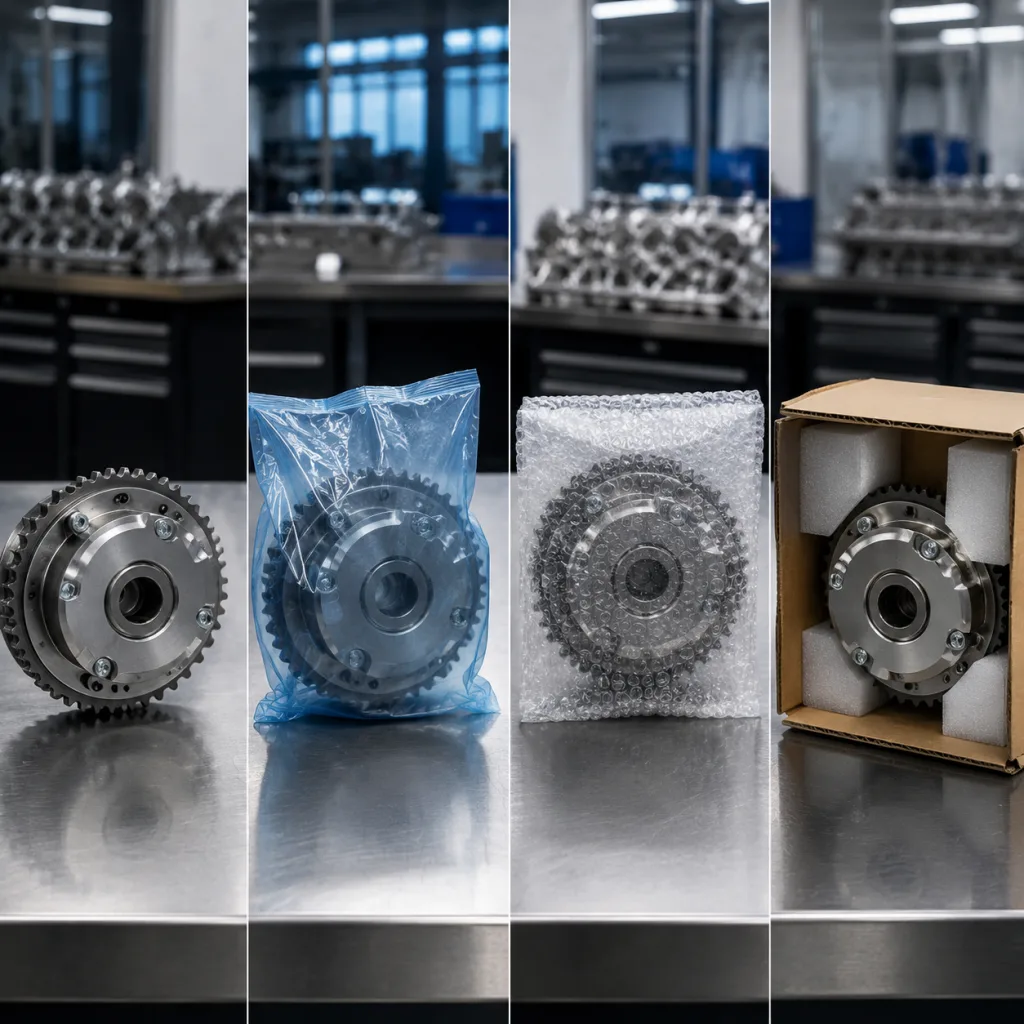
Commercial comparison should also separate ex-works unit price from total landed cost. Private-label cartons, VCI bags, palletization, barcode labels, inspection reports, PPAP-style documentation, special incoming inspection, and air-freight recovery for urgent launches can change the real cost.
A practical RFQ should ask suppliers to quote three versions separately: standard catalog supply, private-label supply, and enhanced-validation supply. That split shows which cost items are optional and which are embedded in the normal production route.
Driventus supports aftermarket distributors, OEM/Tier-1 purchasing teams, and multi-location repair-chain suppliers with catalog supply and customer-specific programs. RFQs should include annual volume, target market, packaging type, fitment list, expected documentation level, warranty expectations, and any buyer-specific audit format.
RFQ sequence: ask these questions before price negotiation
A complete RFQ reduces quotation cycles and prevents mismatched assumptions. For camshaft phasers, the best sequence is technical fitment first, validation second, commercial terms third. If the process starts with target price alone, suppliers may quote different assumptions for testing, packaging, and documentation.
Before commercial negotiation, provide or confirm:
Application list with engine code, model year range, and intake/exhaust position.
Existing reference number format, if used, such as OE 06A… or OE 11251… only where already present in customer data.
Required quantity by SKU, annual forecast, first-order quantity, and whether mixed-SKU shipment is acceptable.
Target price basis, if available, and whether quotation should include inspection reports, private packaging, PPAP-style documentation, or validation testing.
Target market, including EU, UK, US, Canada, Australia, Brazil, or other destination regions.
Required documents: ISO certificate copies, IATF certificate copy, inspection report, material declaration, PPAP-style file, supplier questionnaire, or customer-specific forms.
Validation expectations, such as leakage test, angular travel report, durability summary, hardness report, cleanliness data, runout measurement, or locking-pin release data.
Critical tolerances or functional requirements from the buyer drawing, including tooth profile, center bore, mounting face, oil-port layout, angular travel, and surface finish.
Incoterms, port preference, shipment method, consolidation requirements, and whether the first order needs pre-shipment inspection.
A clear technical package helps the supplier determine whether the requirement is an existing catalog item, a modified version, or a full development project. It also lets buyers compare quotations on the same basis instead of comparing offers that quietly exclude different levels of testing, packaging, or documentation.
For formal pricing, drawings, samples, photos of markings, or cross-reference lists can be submitted through request a quote.
Frequently asked questions
Yes. Driventus supplies camshaft phasers and related engine timing components for independent aftermarket and contract manufacturing programs. Fitment must be confirmed by application data, intake or exhaust position, dimensions, angular travel, sprocket details, and cross-reference information. Driventus is an independent aftermarket manufacturer; brand names are referenced for fitment only.
Buyers should request current IATF 16949:2016 and ISO 9001:2015 certificates, plus part-specific inspection and validation records. Depending on the destination market, material declarations related to REACH (EC) No 1907/2006, IMDS reporting, or customer-specific restricted-substance requirements may also be needed.
Provide the fitment list, intake or exhaust position, reference numbers if available, annual volume, first-order quantity, packaging requirement, target market, documentation level, validation expectations, critical tolerances, and shipment terms. Samples or drawings improve quotation accuracy for non-catalog programs.
If you are qualifying a camshaft phaser supplier for Mercedes-Benz fitment programs, Driventus can review your RFQ, documentation requirements, tolerances, validation plan, MOQ target, and forecast volumes. Send your sourcing details through /contact.html