Choosing a turbo actuator supplier is not a catalogue-matching exercise. The part is small, but it controls boost behaviour, drivability, emissions-related performance and warranty exposure. A cheap actuator that looks correct can still create boost deviation faults, limp-mode complaints, installation delays or high return rates if calibration, stroke, connector fit or bracket geometry is inconsistent.
A better sourcing decision starts with proof. Buyers should compare suppliers on controlled drawings, measurable test limits, production traceability, packaging discipline, lead-time reliability and corrective-action capability—not only unit price. Pneumatic and electronic actuators also require different checks, so the RFQ must define the actuator type, operating range and critical dimensions before quotations are compared.
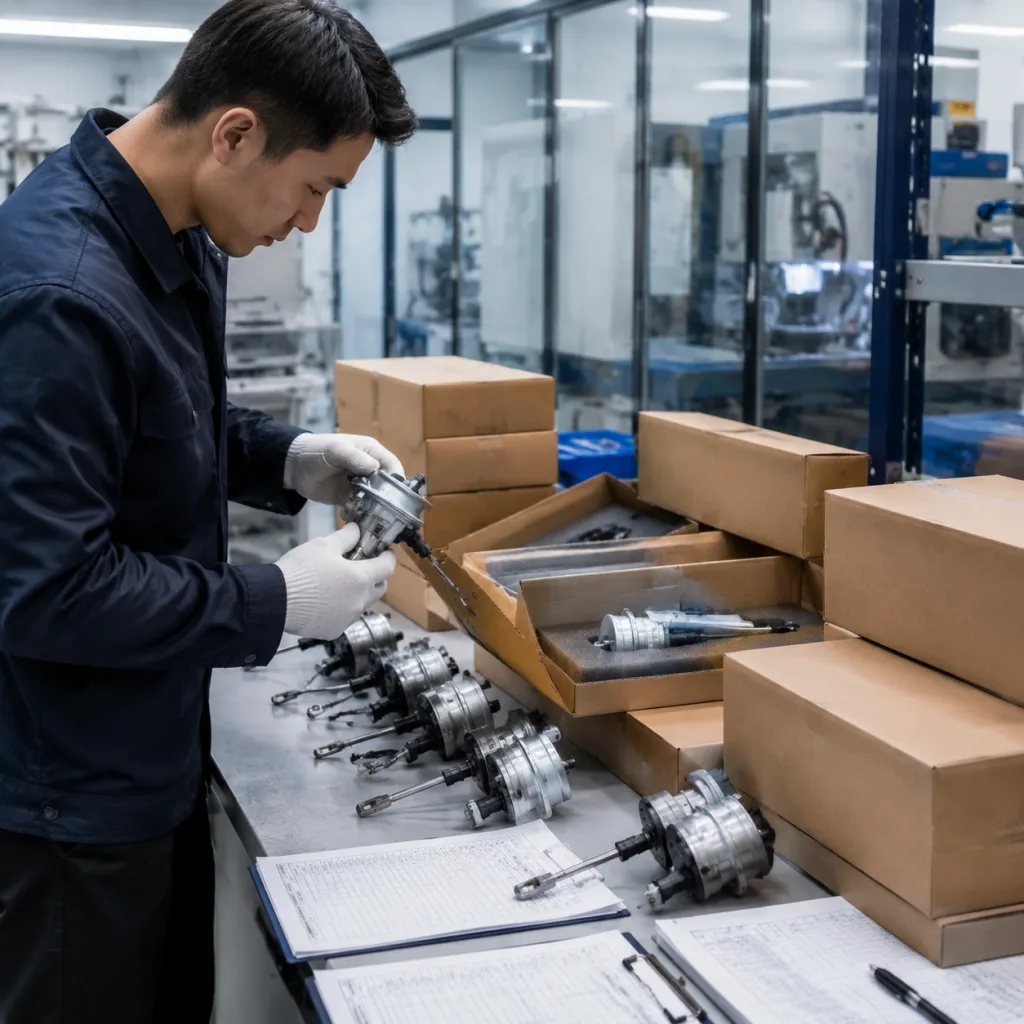
This article explains how to choose a turbo actuator supplier using a practical B2B decision process for aftermarket distributors, OEM service-channel buyers, private-label programmes and multi-location repair chains. Driventus manufactures turbo actuators and other engine components in Taizhou, Zhejiang for B2B export programmes. Driventus is an independent aftermarket manufacturer; any brand names or OE references are used only to identify fitment compatibility.
1. Start with the actuator decision map, not a price request
The first mistake is asking several suppliers for “the same part” before defining what “same” means. A pneumatic wastegate actuator, an electronic turbo actuator and a variable-geometry turbo actuator can share a similar market description while requiring very different process controls, fixtures and test equipment.
Use a decision map before sending the RFQ:
Actuator family
What can go wrong
Evidence to request
Pneumatic wastegate actuator
Wrong crack pressure, weak spring control, diaphragm leakage, rod-length error
Pressure-vs-stroke data, leak test, spring checks, dimensional report
</tr></thead><tbody> </tbody></table>Build the fitment matrix before asking for quotations. Include vehicle application, engine code where available, turbocharger model reference, actuator type, connector type, rod length or lever geometry, voltage, mounting hole pattern, target market and packaging quantity. Add numbers rather than descriptions: rod centre-to-centre length in mm, thread size such as M6 or M8, bracket hole diameter and pitch, nominal stroke in mm, lever angle, connector pin count, operating voltage such as 12 V or 24 V, and required annual quantity per SKU.
If your programme uses OE part-number cross-references, keep them controlled in the RFQ and tie them to your internal data. Do not approve a supplier on catalogue claims alone. Ask for dimensional drawings, application confirmation and sample inspection records.
For electronic actuators, define whether the part is supplied pre-calibrated, whether calibration is turbocharger-specific or vehicle-specific, and how final signal output is verified before shipment. Request the accepted supply-voltage range, current draw limit, position feedback range, connector pull-off requirement and error-code screening method.
For pneumatic actuators, do not accept a visual match as proof of function. Require crack pressure, full-stroke pressure, usable stroke, return hysteresis and maximum leak rate to appear in the quotation and the test report.
Mark critical-to-function dimensions in the RFQ. Typical tolerances to discuss include rod length ±0.3 mm to ±0.5 mm, bracket hole position ±0.2 mm to ±0.5 mm, mounting face flatness, stroke limit ±0.2 mm to ±0.5 mm, and connector key geometry checked against a go/no-go gauge. If the supplier proposes looser or different tolerances, ask for the reason and the validation evidence.
For current Driventus engine and powertrain lines, buyers can review our catalog before issuing a detailed RFQ.
2. Look for factory capability signals that expose weak process control
Supplier websites often show certificates, export cartons and a wide product range. Those signals are useful, but they do not prove that a factory can repeatedly build a stable turbo actuator. The important question is where the supplier controls the process and where it depends on outside parties.
Ask whether the factory produces actuator core parts, assembles finished units, or purchases complete assemblies from third parties. More internal control over stamping, machining, spring selection, housing quality, assembly fixtures and final testing usually improves consistency—especially when orders repeat and volumes increase.
Minimum items to verify:
Evaluation item
What to request
Why it matters
Quality management
IATF 16949:2016 and ISO 9001:2015 certificates where applicable
Confirms documented automotive quality controls and audit discipline
Production flow
Process flow chart, control plan and PFMEA summary
Shows risk planning from incoming material to final inspection
Test equipment
Test bench capability, gauge calibration records and fixture controls
Confirms repeatable measurement of stroke, pressure, signal output and electrical performance
Traceability
Batch number format, retention period and sample record
Supports field investigation, warranty containment and shipment-level analysis
Change control
Engineering change procedure and customer notification rules
Prevents unapproved changes to springs, sensors, connectors, housings or surface treatment
Export compliance
Material declarations when required
Supports REACH (EC) No 1907/2006 and buyer substance-control requirements
</tr></thead><tbody> </tbody></table>For actuator programmes connected to emissions-related systems, stable boost control affects the vehicle’s compliance performance under regulations such as ECE R83. The actuator may not be certified separately, but poor control accuracy can influence turbocharger behaviour, diagnostic trouble codes and return rates.
A capable supplier should explain the process parameters it controls. For pneumatic actuators, ask about diaphragm leak testing, spring free-length and load testing, crimp height control, rod welding or riveting checks, and pressure-vs-stroke curves. For electronic actuators, request evidence of PCB or sensor incoming checks where applicable, motor no-load current, gear backlash inspection, end-stop learning, position-signal verification, connector continuity and final functional cycling.
Sampling rules matter. A serious supplier should be able to state whether it uses 100% final functional testing, AQL-based dimensional checks, or both. It should also show how failed units are marked, segregated and investigated.
Check gauge discipline before trusting any test report. Pressure gauges and digital sensors should have calibration records, commonly at 6- or 12-month intervals depending on use and internal procedure. Fixtures should be identified by number and revision. If the supplier uses a master sample, confirm where it is stored, who approves it and how often it is rechecked.
For critical parts, ask whether the supplier can provide capability data such as Cpk on rod length, stroke or pressure points. A target of 1.33 or higher is often used for stable production characteristics; new or unstable processes need closer monitoring.
Review the supplier’s quality system, then request audit evidence when order value or technical risk justifies it. Useful proof includes recent internal audit results, calibration certificates, nonconformance logs, corrective-action examples and photos or videos of actual production and test stations.
3. Run validation like a release gate, not a sample review
A good-looking sample only proves that one unit was made well once. Validation should answer a harder question: can the supplier produce the same actuator repeatedly, within the agreed limits, under real order conditions?
Use a release-gate sequence:
1. Send controlled technical data. Include drawings, photographs, application list, expected annual volume, packaging requirements, target markets, restricted materials and labelling rules. 2. Receive the supplier’s cross-reference proposal. Confirm geometry, connector, operating range and installation orientation. 3. Approve drawings before tooling or production. Check rod length, stroke, mounting bracket position, lever interface, connector keying, housing orientation and critical clearances. 4. Test initial samples. Use bench testing and installation checks where possible. Electronic units need electrical and response testing; pneumatic units need pressure and leakage testing. 5. Review dimensional reports. Require measurements against all critical-to-function dimensions, not just overall size. 6. Run a pilot order. Use the pilot to check packaging damage, labelling accuracy, installation feedback, defect rate and batch-to-batch consistency. 7. Freeze the specification. Define approved materials, spring rate, sensor type, connector supplier or equivalent requirement, test limits, surface treatment and packaging.
Typical validation points include:
Stroke or angular travel across the operating range
Crack pressure and full-stroke pressure for pneumatic units
Position sensor output and repeatability for electronic units
Electrical resistance, current draw and connector retention
Rod end, clevis or lever interface dimensions
Mounting bracket position and hole pattern
Corrosion resistance of housing, bracket, fasteners and rod
Leak rate for diaphragm or pressure chamber designs
Thermal exposure suitable for the turbocharger environment
Final inspection record by batch
Make every test measurable. A pneumatic actuator report should show pressure points and actual rod travel, not only “OK”. Depending on the application, buyers often specify crack pressure tolerance in the range of ±3 kPa to ±10 kPa, full-stroke pressure tolerance in the range of ±5 kPa to ±15 kPa, stroke tolerance around ±0.2 mm to ±0.5 mm, and leakage limits such as no visible pressure decay beyond the agreed value over 30 seconds. The exact figures must match the turbocharger design, but they should not be left undefined.
For electronic units, request a 100% final test printout or electronic record by batch. Useful fields include software or calibration ID if applicable, supply voltage, no-load or operating current, sensor output at learned end stops, travel angle, response time, fault-code screening result and connector continuity. Where heat exposure is relevant, ask for thermal cycling or soak-test evidence, followed by functional retesting. For corrosion-sensitive brackets and rods, request salt-spray evidence such as 48, 96 or 240 hours depending on target market and coating specification.
Sample quantity should follow risk. A simple catalogue extension may need 5 to 10 pieces for bench and installation checks. A private-label launch or service-channel programme should use 20 to 50 pre-production units across at least two production batches where possible. Record failures by defect category: no fit, wrong calibration, leak, noise, connector issue, packaging damage or labelling error.
If the supplier cannot explain its test limits, the quotation is incomplete. A low unit price does not help if the actuator creates boost faults, poor drivability, difficult installation or repeat warranty claims.
4. Compare offers by total sourcing risk, not by unit price alone
Unit price, MOQ and lead time are easy to compare. They are also easy to misread. A supplier that saves a few percent on the first order may cost more after returns, rework, urgent air freight and customer complaints.
Compare commercial terms beside technical risk:
Sourcing factor
Low-risk supplier behaviour
Higher-risk warning sign
MOQ
Clear MOQ by part number, range-build policy and mixed-container options
MOQ changes after sample approval or only high-volume items are supported
Lead time
Standard production lead time, urgent-order option and peak-season forecast planning
Vague delivery dates, no capacity data or frequent schedule changes
Pricing
Quotation separates product, tooling, packaging, testing and freight terms
One-line quotation with missing assumptions
Samples
Provides tested samples with labels and inspection records
Sends unlabelled samples with no data or traceability
Warranty support
Uses 8D or equivalent corrective-action process
Handles claims case by case with no root-cause report
Packaging
Defines inner box, carton strength, palletisation and labels
Generic packaging not tested for export handling
Forecast handling
Accepts rolling forecasts and scheduled releases
Requires full payment before confirming capacity or material planning
</tr></thead><tbody> </tbody></table>The best commercial structure depends on the buyer. A distributor expanding range may need flexibility because demand is spread across many part numbers. An initial aftermarket range can include 20 to 80 SKUs with annual demand of only 50 to 300 pieces per SKU. In that case, a supplier that allows mixed production runs, carton-level consolidation or a minimum order value may be more useful than one requiring 500 or 1,000 pieces for every reference.
For OEM service-channel or Tier-1 supply, repeatability, PPAP-style evidence where required and stable engineering change control usually carry more weight. For repair chains, availability, predictable fitment and low comeback rates are often more valuable than the lowest purchase price.
Ask the supplier to quote normal lead time, urgent lead time and the order quantity at which lead time changes. Typical aftermarket production may run 30 to 45 days after deposit and specification approval for repeat orders. New references, tooling changes or calibration development may require 45 to 90 days. Samples may take 7 to 20 days if parts are already developed, and longer if a new bracket, rod or connector is required.
Confirm when the lead-time clock starts. Is it after deposit, drawing approval, packaging artwork approval or receipt of buyer samples? Misalignment here is a common cause of delayed launches.
Use landed-cost logic. Compare actuator price, tooling or fixture charges, inspection cost, private-label packaging, inner box and carton cost, inland freight, export charges, ocean or air freight, duty, expected defect rate and warranty handling. A 3% lower unit price can disappear quickly if the supplier has a 2% return rate, requires emergency air shipments or cannot provide replacement stock. If the actuator is sold under your brand, include the cost of technical calls and customer goodwill.
Clarify whether electronic actuators require calibration by part number and whether that calibration is completed and recorded before shipment. Also confirm spare packaging availability, label revision control and the process for adding new references to an existing programme. For payment terms, match risk to maturity: samples may be prepaid, first production may use deposit and balance before shipment, and established programmes may move to scheduled releases or negotiated credit after stable performance.
5. Test the hidden failure points: packaging, labels and batch history
Many actuator problems are not caused by the actuator design. They happen after production: a bent rod, cracked connector, corroded bracket, wrong label or missing batch code. These failures are avoidable if packaging, labelling and traceability are treated as part of the specification.
Turbo actuators need protection because rods, connectors, brackets and lever arms are exposed. Even a slight bend can cause poor fitment, incorrect travel or installation delay. Electronic versions may also need moisture control and electrostatic handling precautions.
A practical packaging specification should define:
Individual protection for rod, lever, connector and mounting face
Anti-corrosion treatment for metal brackets, fasteners and exposed rods
Carton drop-test expectations based on export handling conditions
Part number, batch number, quantity and country-of-origin labelling
Barcode format if required by the buyer’s warehouse system
Pallet dimensions, pallet height and maximum carton weight
Moisture control for sea freight where needed
Private-label artwork approval and revision control when applicable
Set numbers, not just descriptions. Inner boxes should immobilise the actuator so the rod and connector cannot carry impact load. Export cartons should have an agreed board grade or burst/edge-crush requirement, carton gross weight limit and pallet pattern. Many buyers cap cartons at 15 kg to 20 kg for manual handling.
A common validation method is a carton drop test from 0.8 m to 1.0 m on corners, edges and faces, followed by inspection of rod straightness, connector condition and functional performance. For sea freight, consider desiccant, sealed polybags or VCI protection for exposed metal, especially when transit and warehouse time exceed 30 to 60 days.
Traceability should connect the finished actuator to incoming materials, assembly date, operator or production line, test bench result and packing record. It does not need to be complicated, but it must be retrievable. A robust batch code might include production date, line number, shift and sequence, then link to spring lot, diaphragm lot, motor or sensor lot, coating batch and final test record.
When a field claim occurs, the supplier should be able to identify whether the issue is isolated to one batch, one component lot, one production line, one shipment or a wider specification problem. Agree record-retention time in advance. For normal aftermarket orders, two to five years is often practical; for service-channel or regulated programmes, buyers may require longer.
Set response expectations. For example, batch identification within 24 to 48 hours and initial containment within 2 working days. For warranty claims, ask whether returned parts are photographed, bench tested, disassembled if needed and reported using 8D or a similar format.
Ask for a sample label and mock packing list before the pilot order. Warehouse errors often begin with unclear labels, inconsistent part numbers or missing batch information. Labels should show buyer part number, supplier part number if allowed, description, quantity, batch or lot number, production date, country of origin, barcode and revision level where relevant.
For buyers developing private-label or application-specific actuator programmes, Driventus can support custom manufacturing, including packaging, labelling and controlled specification requirements subject to project review.
6. Final Q&A: which supplier should win the order?
Q: Should the lowest-price supplier win if the sample fits?
No. A sample fit check is only one gate. The supplier should also prove dimensional conformity, functional stability, test capability, traceability, packaging performance and change control. Unit price matters, but it should be judged against the likely cost of returns, installation complaints and emergency replacement stock.
Q: What scorecard weighting works for turbo actuator sourcing?
Use a written scorecard and keep technical factors dominant. One practical model is:
Criteria
Suggested weight
Dimensional and functional conformity
25%
Quality certification and audit result
20%
Test capability and validation evidence
20%
MOQ, lead time and capacity
15%
Packaging, labelling and traceability
10%
Commercial terms and communication
10%
</tr></thead><tbody> </tbody></table>Adjust the weights to your business model, but do not let price override validation. The real cost of an unstable turbo actuator programme appears after shipment.
Q: How should each score be supported?
Convert each score into evidence. Give full points for dimensional conformity only when the supplier provides a ballooned drawing, actual measurements on at least 5 samples, critical-dimension tolerances and installation confirmation. Give full points for test capability only when the supplier shows calibrated equipment, actual pressure or electrical curves, 100% final-test records and a reaction plan for failures.
Penalise suppliers that refuse to freeze drawings, cannot identify component lots or treat calibration as undocumented operator judgement.
Q: What must be confirmed before the first production order?
Confirm these items in writing:
Approved drawing or specification revision
Critical dimensions and functional test limits
Sample approval status and sample retention plan
Batch traceability requirement
Packaging specification and label artwork
Warranty terms and corrective-action process
Incoterms, payment terms and shipment schedule
Rules for engineering changes, material substitutions and supplier changes
Q: How should the first release be controlled?
Use a staged release. A typical approach is sample approval, then a pilot order of 50 to 300 pieces or one mixed-SKU shipment, followed by a 60- to 90-day performance review before increasing volume. Define acceptable incoming quality, such as zero critical defects, no wrong labels, no damaged rods or connectors, and an agreed limit for minor cosmetic issues.
If the supplier misses a key requirement, require containment and corrective action before repeat orders. A discount is not a corrective action.
This is the practical answer to how to choose a turbo actuator supplier: select the company that can prove conformity repeatedly, communicate changes clearly and support the programme after shipment. Production stability—not one good sample—is what protects your margin, customer relationships and brand reputation. Driventus is an independent aftermarket manufacturer; any brand names or OE references are used only to identify fitment compatibility.
Frequently asked questions
Request a quotation, fitment list, drawing, material or component specification, dimensional report, functional test report, packaging specification and quality certificates such as IATF 16949:2016 and ISO 9001:2015 where applicable. For larger or higher-risk programmes, ask for a process flow chart, control plan, PFMEA summary, traceability procedure, calibration records and corrective-action example.
Prioritise experience that matches your product range. Pneumatic actuators require strong control of diaphragm sealing, spring rate, rod travel, crack pressure, full-stroke pressure and leak rate. Electronic actuators require additional capability in motors, sensors, connectors, calibration, electrical testing, response verification and final functional records. A supplier should show test data for the exact actuator type being sourced.
For low-volume aftermarket validation, 5 to 20 samples per part number may be sufficient depending on risk and application coverage. For higher-volume, private-label or service-channel programmes, use 20 to 50 pre-production units where possible and a pilot order to confirm batch repeatability, packaging performance, labelling accuracy and installation feedback before full release.
If you are comparing suppliers for turbo actuator or related engine component programmes, Driventus can review your fitment list, target volumes and packaging requirements. To discuss specifications or [request a quote](/contact.html), contact our export team.