A camshaft phaser for GMC applications is not just a toothed wheel with a cam bore. It is a mechanical-hydraulic timing device that has to agree with the ECU strategy, the oil-control circuit, the chain drive, the locking position, and the installation envelope of a defined engine family.
For distributors, repair-chain buyers, and sourcing engineers, that creates a sourcing problem: two phasers may look interchangeable and still behave differently once oil temperature, vane clearance, lock-pin release pressure, return spring force, or oil-feed clocking enter the picture. The result can be start-up rattle, cam/crank correlation codes, unstable idle, delayed timing response, or early warranty returns.
This guide reframes camshaft phaser GMC OE equivalent sourcing as a controlled decision process, not a catalog match. It covers fitment boundaries, approval checks, validation evidence, process failure modes, RFQ structure, and commercial risk. Driventus manufactures engine and powertrain components in Taizhou, Zhejiang, under IATF 16949:2016 and ISO 9001:2015 systems for export customers in North America, Europe, Australia, Brazil, and other international markets.
Decision framework: when is a GMC phaser truly OE-equivalent?
For an aftermarket replacement camshaft phaser, OE-equivalent means the part is engineered to meet the fit, function, and performance requirements of the original design for the stated application. It does not mean the vehicle manufacturer has approved, authorized, or endorsed the part.
The practical question is narrower: will this phaser install correctly, receive and meter oil correctly, lock and unlock at the right time, rotate through the intended authority range, and remain stable in the engine family being serviced?
Use four decision gates before adding a reference to a programme:
1. Application gate: engine family, displacement, model year range, market region, production-date limits, and VIN breakpoints where available. 2. Position gate: intake or exhaust, left bank or right bank, and any bank-specific oil-feed or reluctor orientation. 3. Interface gate: cam bore, center bolt, sprocket tooth count and pitch, oil-port location, chain alignment, supplied hardware, and installation note requirements. 4. Function gate: advance/retard angle, lock position, locking-pin release behavior, return spring preload, oil-flow path, and response under hot and cold oil conditions.
A controlled fitment matrix should record each reference by engine family, year range, position, market version, and OE reference convention, such as OE 126… or OE 125… where the buyer provides it. Keep the format consistent. Avoid phrases that imply proprietary approval.
Do not let the quotation process merge lookalike parts. Common traps include phasers that share an external profile but differ in 20–60 crank degrees of authority, reluctor features, oil-feed clocking, center-bolt length, or left/right bank orientation. These are not clerical details; they change engine timing behavior.
For RFQ control, define each reference through measurable characteristics: nominal cam bore, bolt specification, sprocket tooth count and pitch, phaser travel range, oil-port location, lock position, and whether the part ships with a bolt, seal, or instruction sheet. Driventus is an independent aftermarket manufacturer; brand names are referenced only to identify fitment. Replacement selection should always be confirmed against vehicle application, engine code, production date, market version, and original part reference before bulk purchasing.
Approval checklist: measure the part before you price the programme
A camshaft phaser is a precision mechanical-hydraulic assembly. Appearance is a weak approval method. A clean casting, good plating, or matching tooth count will not prove that the lock pin releases correctly, the oil gallery is open, or the vane clearance is stable.
For first approval, buyers commonly request 5–10 fully measured samples per reference, followed by routine inspection by lot or shift. Each reference needs its own evidence. A family resemblance between parts is not enough when oil flow, timing authority, and chain alignment can change by application.
Key checks should include:
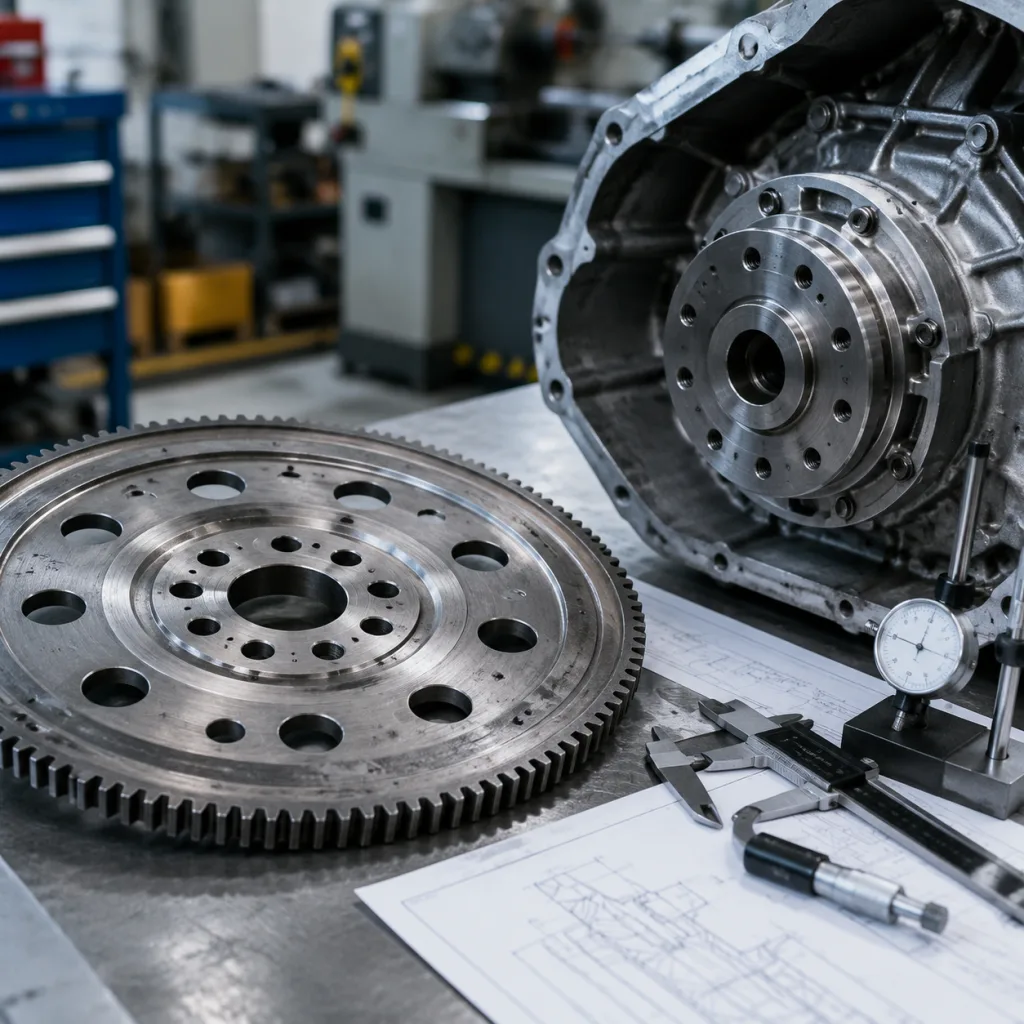
Camshaft bore diameter, roundness, cylindricity, and face runout; buyers often specify bore tolerance in the 0.01–0.03 mm range depending on design
Sprocket tooth profile, tooth count, pitch, concentricity, and radial runout, commonly controlled within 0.05–0.10 mm for timing stability
Bolt hole diameter, counterbore depth, seating face flatness, and thread engagement zone
Oil gallery position, diameter, edge break, burr condition, and cleanliness level; loose chips or blocked passages should be treated as critical defects
Vane-to-housing radial and axial clearance, rotor axial movement, and end-plate parallelism
Locking pin engagement depth, release pressure, return force, and repeatability over repeated cycles
Return spring torque and angular preload, where applicable
Advance and retard angle range measured on a functional test bench, recorded in crankshaft or camshaft degrees as specified by the buyer
Surface hardness and case depth on wear interfaces, with heat-treatment records linked to material lot
Balance condition or rotational runout where required by the design
</tr></thead><tbody> </tbody></table>Ask which characteristics are tested 100% and which are sampled. Functional actuation, lock/unlock confirmation, and oil-leak checks are strong candidates for 100% end-of-line verification. Full CMM layouts can usually be batch-based if the process is stable.
For distributors building a broader timing range, related timing and valvetrain items can be reviewed in our catalog and under engine components.
Validation scenario: what the phaser must survive after installation
Picture the first week after installation. The vehicle sits overnight in a cold climate. Oil viscosity is high. The driver starts the engine, and the locking pin has to hold position cleanly, release when commanded, and avoid rattle before pressure stabilizes. Later the same day, the engine idles hot in traffic at lower oil pressure. The phaser still has to respond quickly without excessive leak-down or unstable timing.
That is the environment a camshaft phaser GMC OE equivalent has to survive. Room-temperature rotation is not enough.
A useful validation plan should include:
Functional actuation testing at low, nominal, and high oil pressure, for example 100–600 kPa depending on the reference and test oil
Advance and retard response-time measurement, with curves recorded at cold, ambient, and hot oil conditions
Locking pin release, engagement, and re-lock cycling, including cold-oil start simulation
Hot-oil endurance cycling at controlled temperature, commonly 100–130 °C for hydraulic timing components
Cold-oil start simulation using higher-viscosity test fluid, often at -20 °C to -30 °C for North American programmes
Leak-down and internal bypass measurement at defined pressure and oil temperature
Torsional load and reverse-torque assessment to check vane, rotor, and stop durability
Wear inspection after endurance cycling, including vane scoring, pin wear, spring condition, and housing contact marks
Salt spray or corrosion-resistance testing for exposed surfaces, where relevant, commonly 48–96 hours for packaged service parts unless the buyer specifies more
Packaging vibration and drop testing for long-distance export shipments, especially mixed-container and e-commerce channels
The validation record should define sample quantity, pass/fail limits, test oil grade, temperature, pressure, cycle count, inspection method, and whether parts came from pilot production or hand-built samples. For higher-volume programmes, buyers may also request pilot-run parts from production tooling and short-term capability data on critical characteristics, such as Cpk ≥1.33 after process adjustment.
Compliance should be handled early, not after goods are packed. Export programmes to the EU may require declarations aligned with REACH (EC) No 1907/2006. Quality records should be consistent with IATF 16949:2016 and ISO 9001:2015 practices, including traceability, corrective action, supplier control, and process-change management. Vehicle emissions regulations such as ECE R-83 may be relevant to the complete vehicle system, but a phaser supplier should not claim that a standalone replacement component certifies emissions compliance.
Failure modes: where warranty risk usually enters the process
Most camshaft phaser warranty problems are not dramatic breakages. They are small process errors that become intermittent engine symptoms.
A burr in an oil passage can delay vane movement. A weak locking-pin spring can create start-up noise. Heat-treatment drift can accelerate wear. Poor cleaning can send debris into the oil-control path. Incorrect spring torque can shift response behavior. These defects may pass a visual inspection and still create costly labor claims for repair chains.
That is why buyers should audit the manufacturing route and control plan, not just the golden sample.
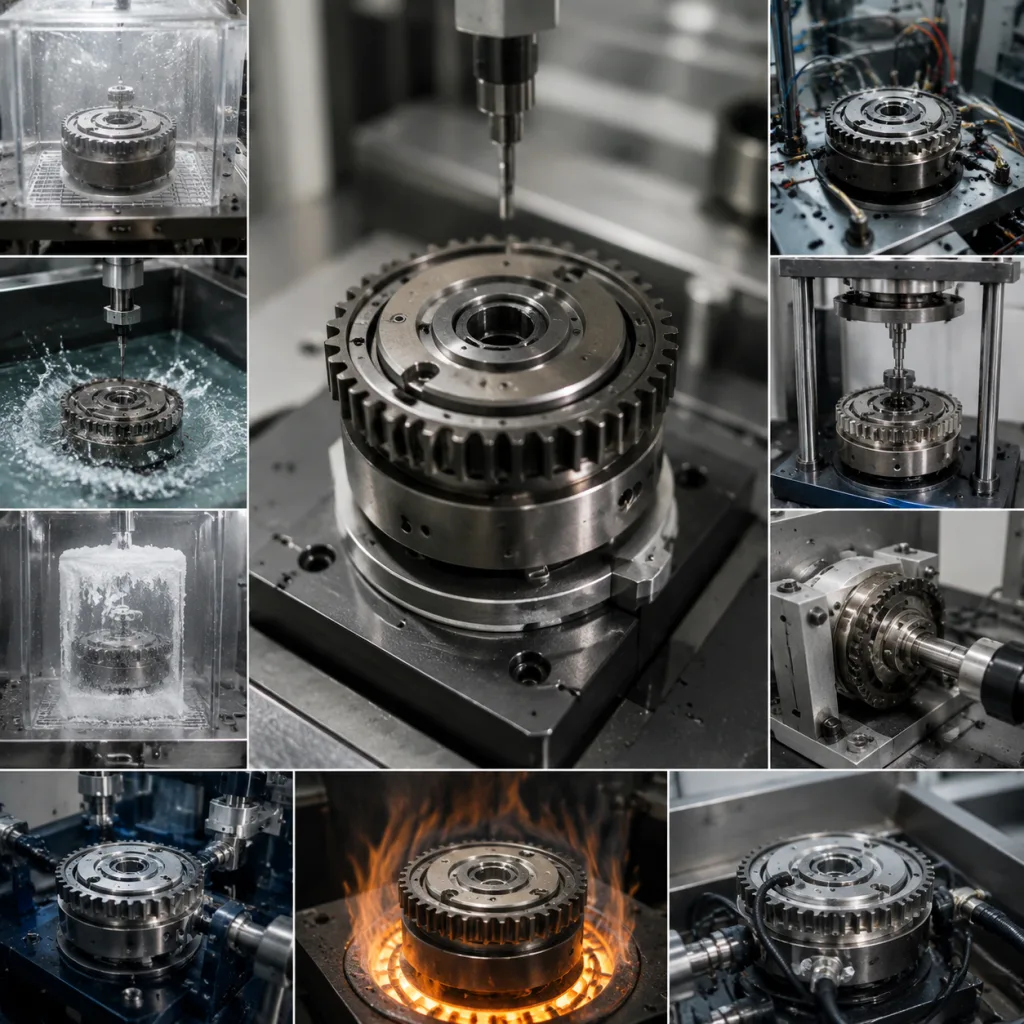
At Driventus, camshaft phaser production control can include incoming steel verification, CNC machining control, heat-treatment monitoring, precision grinding, deburring, ultrasonic or aqueous cleaning, controlled assembly, functional bench testing, and final inspection. In-process controls typically include first-piece approval after tool changes, patrol inspection during machining, heat-treatment batch hardness checks, post-cleaning visual and particle checks, torque-controlled fastening, and end-of-line actuation testing.
Traceability should identify the batch, production date, material lot, machining route, heat-treatment batch, and inspection record. Without that trail, root-cause analysis becomes guesswork.
Procurement teams should ask for:
Process flow diagram and control plan identifying critical and special characteristics
PPAP-style documentation where required by the customer, often Level 3 for new private-label or Tier-style programmes
Material certificates and heat-treatment reports with lot numbers and hardness/case-depth results
Gauge repeatability and reproducibility records for critical dimensions, with %GRR targets agreed before launch
Functional test limits, test frequency, oil pressure, temperature, and rejection criteria
Cleaning process controls for oil passages and internal cavities, including filtration, bath-change rules, and particle limits
Batch traceability method used on packaging or product marking, such as date code, lot code, QR code, or carton label reference
8D corrective action process for field returns and customer complaints, including containment timing and root-cause evidence
Inspection intensity should match programme maturity. A small trial order may justify tighter outgoing inspection and retained samples from every lot. Once volume stabilizes, buyers can move to agreed AQL sampling, for example critical defects 0, major defects 0.65 or 1.0, and minor defects 2.5 depending on channel risk.
Our quality system is structured around IATF 16949:2016 and ISO 9001:2015 requirements for automotive manufacturing. For Tier-1 or private-label programmes, Driventus can also support custom manufacturing based on customer drawings, samples, or validated reference parts.
RFQ playbook: compare suppliers without hiding risk in the unit price
A low unit price is useful only if the quotation describes the same product, inspection level, packaging, hardware, lead time, and warranty support. Otherwise, the cheapest quote may simply be the least defined one.
Before issuing a purchase order, build the RFQ around technical and commercial boundaries:
1. Confirm engine family, model year range, production-date limits, and market region. 2. Match the original reference format, such as OE 126… or OE 125…, where supplied by the customer. 3. Verify whether the phaser is intake, exhaust, left-bank, or right-bank specific. 4. Check for design differences such as advance angle, reluctor feature, oil-feed position, and bolt specification. 5. Review dimensional inspection and functional bench test reports before price approval. 6. Confirm packaging requirements for e-commerce, wholesale, workshop, or private-label distribution. 7. Define label format, country-of-origin marking, barcode requirements, carton strength, and pallet pattern. 8. Agree AQL level, pre-shipment inspection method, and retained-sample policy. 9. Check compliance documentation required by the destination market. 10. Confirm lead time, MOQ, forecast flexibility, and safety-stock expectations. 11. Agree return analysis procedure before launch, including evidence needed from the installer or distributor.
Evaluate MOQ by reference, not by total order value. Mature references may support lower MOQs. New or slow-moving references may need a larger first run to cover fixtures, validation, packaging setup, and inspection time.
A practical launch model separates the programme into three stages: 2–5 samples for bench and fitment review, a pilot lot for controlled market release, then scheduled production based on 3–6 months of forecast. Lead time is normally driven by material availability, machining capacity, heat treatment, validation, packaging approval, and export booking. Urgent orders should not skip functional testing to meet a shipment date.
When comparing suppliers, normalize Incoterms, packaging type, inspection level, included bolts or seals, warranty handling, retained-sample policy, and whether the quoted price includes test reports or only goods shipment. A camshaft phaser with inconsistent locking performance, poor cleanliness, or unstable actuation can generate labor claims and customer disruption that exceed the component cost many times over.
Q-and-A: how Driventus runs an OE-equivalent phaser project
What happens first? Driventus starts with the buyer’s target references, annual forecast, packaging format, and destination-market requirements. Engineering then reviews samples, drawings, application data, and production feasibility before quotation.
Can established replacement items move faster? Yes. For established items, we can usually provide specification confirmation, inspection data, and packaging options. The approval path is shorter when the reference, test requirements, and packaging format are already defined.
What about new or private-label programmes? For new programmes, Driventus can assess reverse-engineered samples or customer drawings and develop tooling, machining fixtures, inspection plans, and validation routes. A typical sequence is RFQ review, sample or drawing confirmation, quotation, prototype or existing-sample approval, pilot production, inspection report submission, packaging approval, mass production, pre-shipment inspection, and retained-sample archiving.
When should packaging be frozen? Before production packing begins. Private-label artwork, barcode format, carton dimensions, label position, country-of-origin marking, and carton drop or compression expectations should be approved early. Late packaging changes often create avoidable delays.
Which commercial details help quotation accuracy? Buyers should provide target annual demand, preferred order frequency, acceptable MOQ per reference, target price band, required delivery window, destination market, inspection expectations, and warranty-handling requirements. With those inputs, Driventus can advise whether a consolidated shipment, blanket order, or staged release plan is more practical than spot purchasing.
Driventus supplies engine and powertrain components to distributors, wholesalers, OEM/Tier-1 customers, and multi-location repair chains in more than 60 countries. We do not claim approval, authorization, or endorsement by GMC, General Motors, or any other vehicle manufacturer.
A well-specified camshaft phaser GMC OE equivalent should be treated as a controlled mechanical-hydraulic component, not a commodity sprocket. Buyers who define fitment rules, function, documentation, packaging, and warranty expectations at the RFQ stage usually reduce launch delays, fitment disputes, and field-return uncertainty. To discuss current references, target MOQ, and validation requirements, use the request a quote form with your application list and annual volume estimate.
Frequently asked questions
Provide the target OE reference format, engine family, model year range, intake or exhaust position, bank position if applicable, annual forecast, target MOQ, packaging requirement, destination market, and requested test documentation. Photos or samples help confirm tooth geometry, oil passages, locking design, and installation interface.
Yes. Driventus can support neutral packaging, customer labels, barcode formats, and private-label carton specifications where agreed. Technical approval, application data, inspection requirements, artwork control, carton strength, and label traceability should be fixed before mass production.
No. OE-equivalent means the replacement part is designed to match fit, function, and performance requirements for the stated application. Driventus is an independent aftermarket manufacturer; brand names are referenced for fitment only and do not imply approval or endorsement.
For a controlled camshaft phaser sourcing review, send your reference list, forecast, target MOQ, packaging requirements, validation expectations, and destination market. Driventus will respond with available options and technical next steps at /contact.html