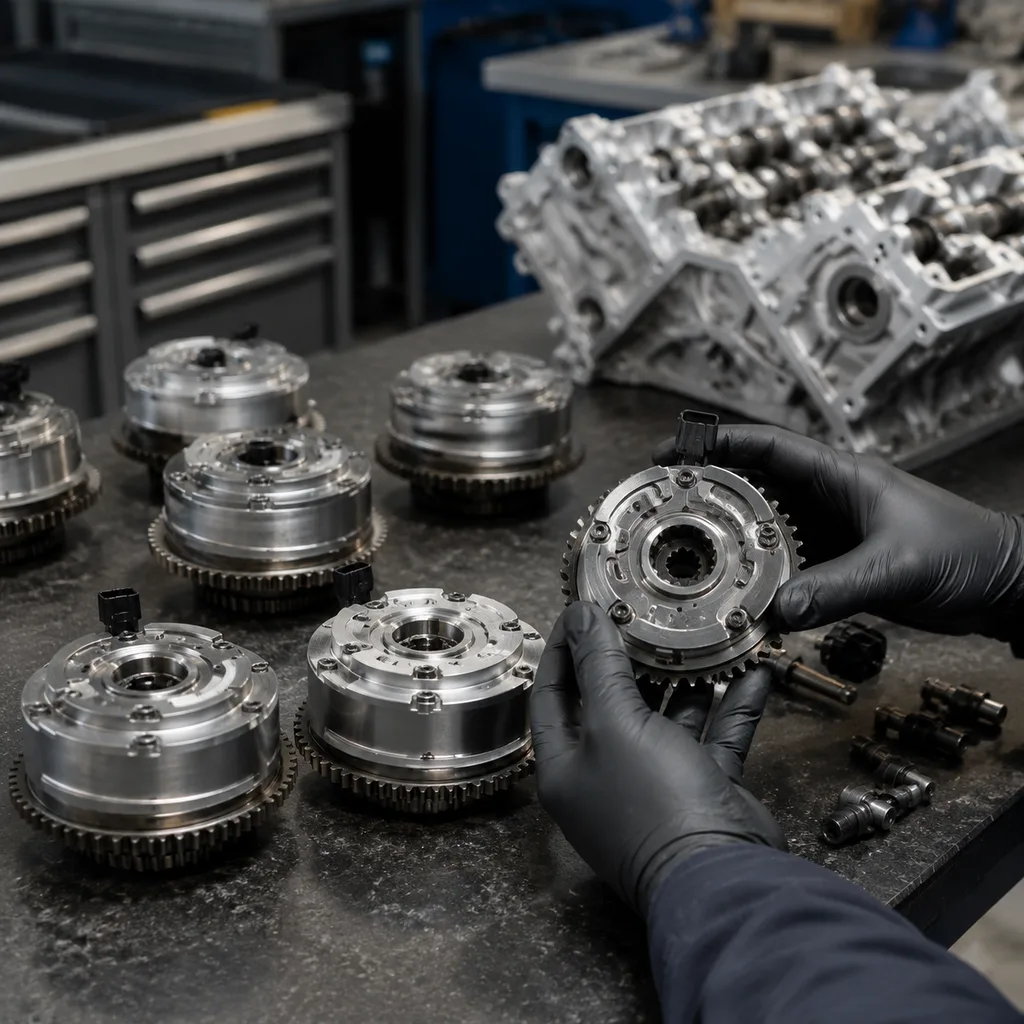
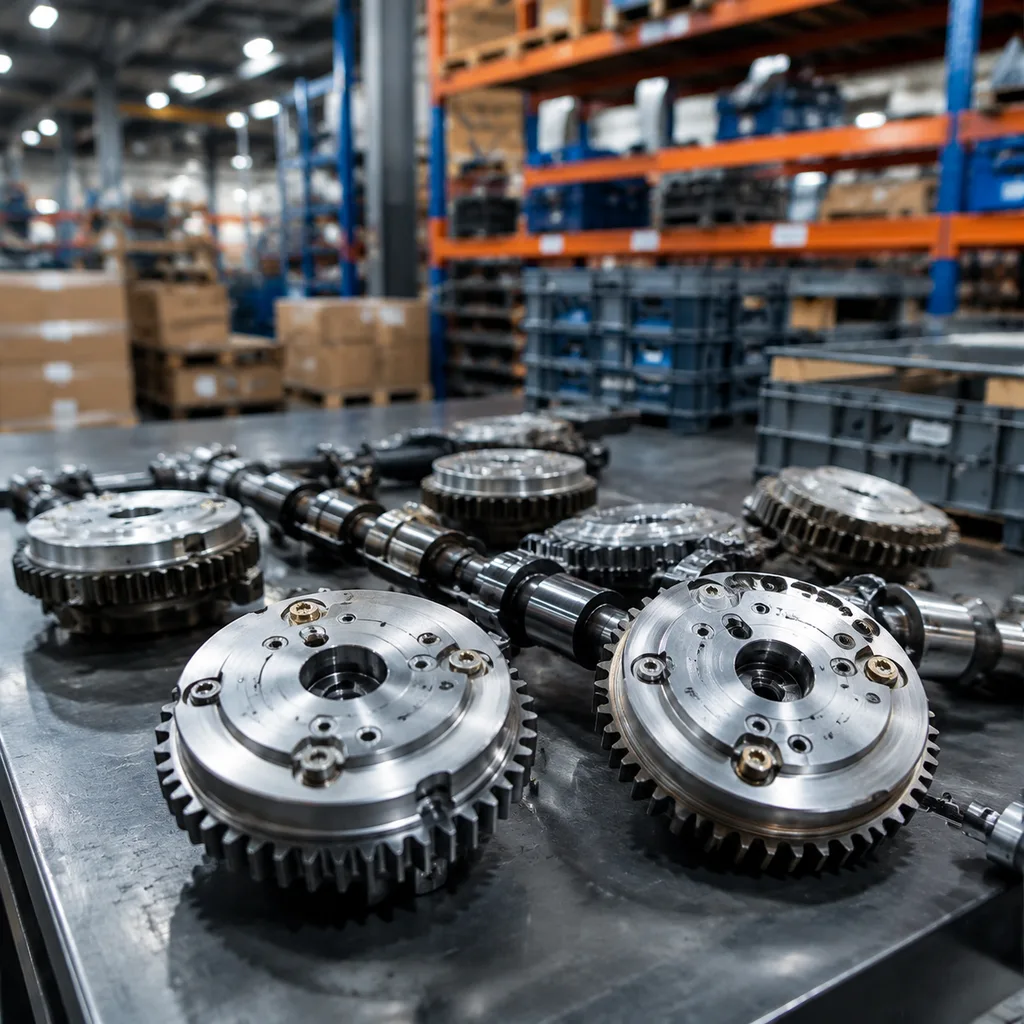
A GMC VVT phaser can look like a sprocket and still behave like a calibrated hydraulic actuator. It must lock at start-up, meter oil cleanly, rotate the cam through the expected angle, and return to the park position the ECU is trying to see. That makes camshaft phaser GMC aftermarket replacement sourcing a functional approval project—not a simple catalogue match.
Small errors create expensive symptoms. A burr in an oil feed, loose vane sealing, excessive face runout, or a lock pin that releases outside the pressure window can show up as cold-start rattle, unstable idle, slow cam response, P0011/P0014/P0016-style timing faults, or repeat warranty returns. The buyer’s job is to prove that the replacement part matches the OE envelope, oil circuit behaviour, angular authority, and installation logic before inventory is launched.
This article is structured as a practical sourcing review for distributors, repair-chain buyers, category managers, and sourcing engineers. It covers the decision points that separate a stable phaser range from a risky spot buy: functional equivalence, failure modes, validation evidence, catalogue control, production repeatability, MOQ/lead-time logic, and RFQ data. Driventus manufactures engine and powertrain components in Taizhou, Zhejiang, under IATF 16949:2016 and ISO 9001:2015 systems for export aftermarket and B2B supply programmes.
Decision gate: when is a GMC phaser truly OE-equivalent?
Do not approve a camshaft phaser because it “fits the engine.” Approve it because it reproduces the timing system’s functional behaviour. The phaser interfaces with the timing chain, camshaft nose, engine oil feed, VVT control solenoid, and ECU strategy. If intake and exhaust phasers look similar, assume they are different until oil-port timing, park position, vane travel, and sprocket offset prove otherwise.
Use this decision gate before sampling moves to volume:
Mounting geometry: bolt pattern, camshaft locating feature, sprocket pitch, datum faces, installed height, bore diameter, bolt PCD, face runout, and sprocket alignment. Critical dimensions are often held around ±0.02–0.05 mm where the drawing requires it.
Hydraulic behaviour: oil chamber volume, vane sealing, leakage rate, and pressure response. Test points should represent hot idle and cold start conditions, for example 100–600 kPa depending on the agreed test method.
Angular authority: measured advance/retard travel, stop-to-stop repeatability, hysteresis, and return-to-lock accuracy. Ask for degrees, not a pass/fail label.
Locking function: lock pin engagement depth, release pressure, travel, and spring return force. A phaser that parks inconsistently can trigger noise and correlation complaints even if the outer dimensions are right.
NVH behaviour: controlled lash, stable vane contact, and suitable spring force where used. Backlash between rotor and housing can become start-up knock.
ECU compatibility: correct base angle and no unintended shift in cam/crank relationship under operating temperature.
Service compatibility: correct intake/exhaust identification, installation orientation, torque sequence, and compatibility with chains, guides, bolts, seals, and VVT solenoids.
The approval question is simple: can a technician install this part without modification and have the engine respond inside the same calibration window as the original design? Visual similarity does not answer that. A strong supplier should provide an OE sample comparison sheet that maps every functional interface, not only the outside shape. Driventus is an independent aftermarket manufacturer; GMC and other brand names are used only for fitment identification and do not imply vehicle-maker approval.
Failure-mode review: what to inspect before the first purchase order
A phaser can pass a quick visual check and still fail after installation. The usual weak points are internal: vane sealing, oil cleanliness, locking-pin depth, burrs in cross-drilled passages, unstable heat treatment, or surface finish on rotating faces. Before adding a camshaft phaser GMC aftermarket replacement SKU, inspect the part against how it can fail in the field.
Failure risk
Inspection or control point
Why it matters
Chain noise or accelerated wear
Confirm chain pitch, tooth count, pressure angle, and tooth form against OE sample or drawing
Prevents mismatch between sprocket and chain
Timing variation
Control sprocket runout, often around 0.05–0.10 mm TIR depending on diameter and drawing
Reduces chain tracking and phasing error
Incorrect cam position
Datum-controlled bore, locating feature, face height, and bolt seating surface
Maintains concentricity, installed height, and clamp load
Slow cam response
Vane-to-housing clearance checked by air gauge or precision pins
Limits internal leakage and actuation delay
Cold-start rattle
Locking-pin travel, engagement depth, and release movement recorded by functional gauge
Confirms stable park and release behaviour
Solenoid contamination
Burr-free oil passages, washing, filtered drying, and no loose chips
Prevents blocked feeds and scored sealing faces
Unstable oil control
Specified surface finish on sealing and rotating faces
Supports repeatable leakage and wear behaviour
Sprocket or vane wear
Case/core hardness and heat-treatment depth checks where applicable
Prevents early wear or brittle failure
Corrosion during storage
Surface treatment and salt-spray target agreed by market need
Supports shelf life and sea-freight durability
Warranty trace gaps
Batch code linked to material, machining, assembly, and test records
Enables containment and root-cause analysis
</tr></thead><tbody> </tbody></table>Material choice depends on the architecture. Powder metallurgy, forged steel, or machined steel can all be suitable when the original design and process capability support them. The claim itself is not enough. A sintered sprocket may need density control and steam-treatment checks. A machined steel housing may need flatness control, hardness verification, and aggressive burr prevention after drilling.
Ask how the supplier controls incoming material certificates, hardness checks, metallographic review where required, and torque verification for fastened assemblies. Cleaning deserves special attention. Define cleanliness by particle size/count or maximum residue mass per part, then audit washing and filtered-air drying. For distributors, this converts warranty debates into factual batch analysis instead of guesswork.
Validation package: tests that separate usable parts from lookalikes
Validation should imitate the complaints workshops actually report: rattle on the first start, delayed actuation, timing correlation codes, oil leakage, and early mechanical wear. Separate routine production tests from type-validation tests for a new part number or design change. Also set acceptance limits before samples are built. A test report with no limits is only paperwork.
A practical validation package may include:
Dimensional inspection: CMM or dedicated gauges for datum faces, bore, sprocket runout, bolt holes, tooth profile, and critical heights. Initial sample reports often use 3–5 pieces per tooling route; higher-risk launches may justify 30-piece capability studies.
Leakage and pressure testing: oil-pressure testing for vane sealing and chamber integrity. The report should state oil viscosity, temperature, pressure points, stabilization time, and maximum allowable leakage.
Locking-pin cycling: repeated lock/release checks at defined pressure and temperature ranges. Cold, room-temperature, and hot-oil conditions help confirm that the phaser parks and releases consistently.
Phase-angle verification: advance/retard travel, stop positions, hysteresis, repeatability, nominal angle, upper/lower stop tolerance, and return-to-lock accuracy measured in degrees.
Endurance cycling: repeated actuation to evaluate wear, spring stability, vane sealing, and housing contact surfaces. Scope can range from tens of thousands of bench cycles to longer schedules agreed for the programme risk.
Cleanliness inspection: particle control after machining and washing, especially inside oil galleries. Hard metallic particles need strict limits because one chip can jam a solenoid or score a sealing face.
Torque and assembly checks: fasteners, plates, rivets, and subassemblies verified under operating load. Assembly torque should be controlled with calibrated tools and recorded by batch where practical.
Corrosion assessment: neutral salt spray or equivalent checks where humid storage, sea freight, or long shelf life is expected. A commercial target may be 48–96 hours for external surfaces, but the correct requirement depends on coating and customer specification.
Packaging drop and vibration tests: inner support, anti-rust bag, carton burst strength, and pallet stack height validated for LCL and container shipment.
Quality systems matter because the part is sensitive to process drift. IATF 16949:2016 and ISO 9001:2015 do not mean a specific phaser is approved by a vehicle manufacturer, but they support APQP-style planning, traceability, corrective action, gauge calibration, risk management, and continuous improvement. For EU importers, chemical substances, surface treatments, rust preventives, oils, and packaging materials may also require REACH (EC) No 1907/2006 support declarations when requested.
Catalogue control: stop returns before the part reaches a workshop
Fitment errors are commercial failures, not only technical ones. One wrong application link can create workshop returns, chargebacks, catalogue disputes, and distributor distrust. Treat fitment as controlled data. Engineering cross-reference and marketing fitment must be checked separately before launch.
A reliable fitment file should answer: why does this phaser fit this GMC application? The answer should include engine family, displacement, model year, market, intake/exhaust position, OE-style reference, and physical comparison evidence.
Control these data points:
Engine code, displacement, model year range, and market region.
Intake or exhaust position. Where needed, label the part and box clearly with “INT” or “EXH” to prevent warehouse mixing.
Timing-chain system notes, including one-time-use bolts, seals, gaskets, actuator solenoids, or recommended service kits.
OE-style reference format where available, such as OE 06A… or OE 11251…, without claiming brand approval.
Supersession and interchange notes validated by geometry and function, not copied from online cross-reference alone.
Exclusion notes for visually similar but hydraulically different parts, including oil-port layout, park position, sprocket offset, or vane travel.
Packaging labels with SKU, barcode, batch, country of origin, position information, and customer part number for private-label supply.
Driventus can support part-number mapping, sample comparison, drawing review, and private-label packaging for distributors building an engine timing range. Buyers can review related parts in our catalog and engine timing items through engine components. Programmes requiring drawings, customer-specific markings, barcode rules, carton artwork, or controlled packaging can be reviewed through custom manufacturing.
The safest launch method is approval by application group and position, not by appearance. This matters when the same engine family uses different calibrations across model years, markets, or emission specifications. Freeze a fitment file revision number before launch. Match it to the price list, packaging label database, and customer approval record. Do not expand catalogue coverage without written technical confirmation.
Supply scenario: mixed-SKU aftermarket orders without quality drift
Aftermarket demand rarely behaves like OE production. A distributor may need 40 pieces of one active SKU, 300 pieces of another, private-label cartons for a chain account, and emergency replenishment before the next container closes. The risk is quality drift across small batches, repeat runs, and schedule changes. Production control has to be designed for that reality.
Before committing volume, ask the supplier to show controls for:
Machining, heat treatment, washing, assembly, final test, rust prevention, and packing in one control plan.
PPAP-style documentation where required: dimensional reports, material records, process flow, PFMEA, control plan, and gauge list.
Batch traceability from raw material heat/lot to finished packaged goods, with retention matching the agreed warranty period.
Calibrated gauges for sprocket runout, bore size, locking-pin depth, oil leakage, phase travel, bolt torque, and surface finish.
Nonconforming material containment, including initial response timing and root-cause/corrective-action deadlines where contractually agreed.
Change control for material source, tooling, heat treatment, surface treatment, washing media, test pressure, gauge method, and packaging material.
Packaging specifications for sea freight, air freight, e-commerce handling, and warehouse storage, including anti-rust period and pallet stack limit.
Retained samples or retained records for warranty investigation.
Driventus operates under a documented quality system for engine and powertrain components. For phasers, repeatability is the main target: stable machining, clean oil passages, controlled assembly torque, corrosion protection, and functional checks matched to customer requirements. Depending on risk and volume, final inspection may be 100% functional testing or a justified sampling plan backed by process capability data. Lock release, leakage, and phase travel are often best controlled by 100% final test; stable dimensional characteristics with proven Cpk can be sampled by lot.
Commercial planning should follow SKU maturity. Existing replacement references may have sample lead times of 7–15 days and mass-production lead times of about 30–45 days after deposit and packaging approval. New-tooled or customer-specific variants may need 30–60 days for tooling/sample build plus validation time before the first 45–60 day production lot. MOQ is usually lower for active SKUs and higher for special variants. As a planning rule, mixed-SKU orders may require carton-level or 100–300 piece minimums per SKU, while new or private-label production may require 300–1,000 pieces per SKU depending on tooling, packaging, and material batch.
Compare unit price only at the same scope: test level, documentation, warranty support, packaging, Incoterm, and annual forecast. A low quotation that excludes functional testing, private-label packaging, or traceability can become expensive after the first return campaign.
RFQ checklist: send the data that prevents re-quoting and re-sampling
A thin RFQ produces a thin quotation. For a camshaft phaser replacement project, the supplier needs enough detail to judge fitment risk, tooling status, validation scope, MOQ, and packaging work. If the range covers several GMC engines, group SKUs by platform, intake/exhaust position, forecast, and launch priority so the supplier can quote realistic tiers instead of one vague price.
Include these details in the RFQ:
Vehicle applications and engine codes by region, with model year start/end and emission or market exclusions.
Intake/exhaust position and quantity per engine.
OE-style cross-reference used in the buyer’s system, plus aftermarket interchange numbers that must be verified.
Photos or samples of the current part, including markings, sprocket profile, mounting face, bolt pattern, locating feature, and oil-port layout.
Required documents: inspection report, material certificate, control plan, PPAP elements, IMDS where applicable, or REACH-related declarations.
Packaging requirements: neutral box, private label, barcode type, label fields, pallet specification, carton drop-test needs, language requirements, and anti-rust duration.
Target order quantity, annual forecast, desired MOQ, delivery window, shipment method, and preferred Incoterms such as EXW, FOB Ningbo/Shanghai, CIF, or DDP via customer forwarder.
Commercial assumptions: target price range, sample quantity, payment terms, warranty handling process, spare-label requirements, and whether tooling cost should be quoted separately.
Known field issues, such as start-up noise, timing correlation fault, oil contamination, low-oil-pressure sensitivity, broken locking pin, or repeat failure after installation.
For buyers evaluating camshaft phaser GMC aftermarket replacement supply, early technical comparison is faster than trial-and-error sampling. Driventus can review samples, drawings, and target interchange lists before quoting, then recommend an approval route based on programme size and risk level. To begin, request a quote with the available part data, forecast, target packaging requirements, and requested launch date.
Frequently asked questions
Yes. An independent aftermarket phaser can be engineered to match OE dimensions and functional behaviour, but this is not the same as vehicle-maker approval. Buyers should request dimensional data, leakage or pressure test results, phase-angle verification, lock-release checks, material records, and batch traceability before approval.
Common causes include incorrect locking-pin function, excessive internal leakage, oil contamination, wrong application, worn timing-chain components, low oil pressure, incorrect installation torque, or using the wrong intake/exhaust position. A quality replacement part should be tested for lock/release performance and oil-control behaviour before shipment.
Typical documents include dimensional inspection reports, material certificates, functional test records, batch traceability, packaging specifications, and quality management certificates such as IATF 16949:2016 and ISO 9001:2015. EU importers may also request REACH-related material declarations or IMDS data where applicable.
If you are building or reviewing a GMC timing-component replacement range, Driventus can compare samples, validate fitment data, and quote production supply with MOQ, lead-time, packaging, and test-level options. Send the application list and forecast through /contact.html.