Camshaft Phaser Audi Replacement: Sourcing and Validation Notes
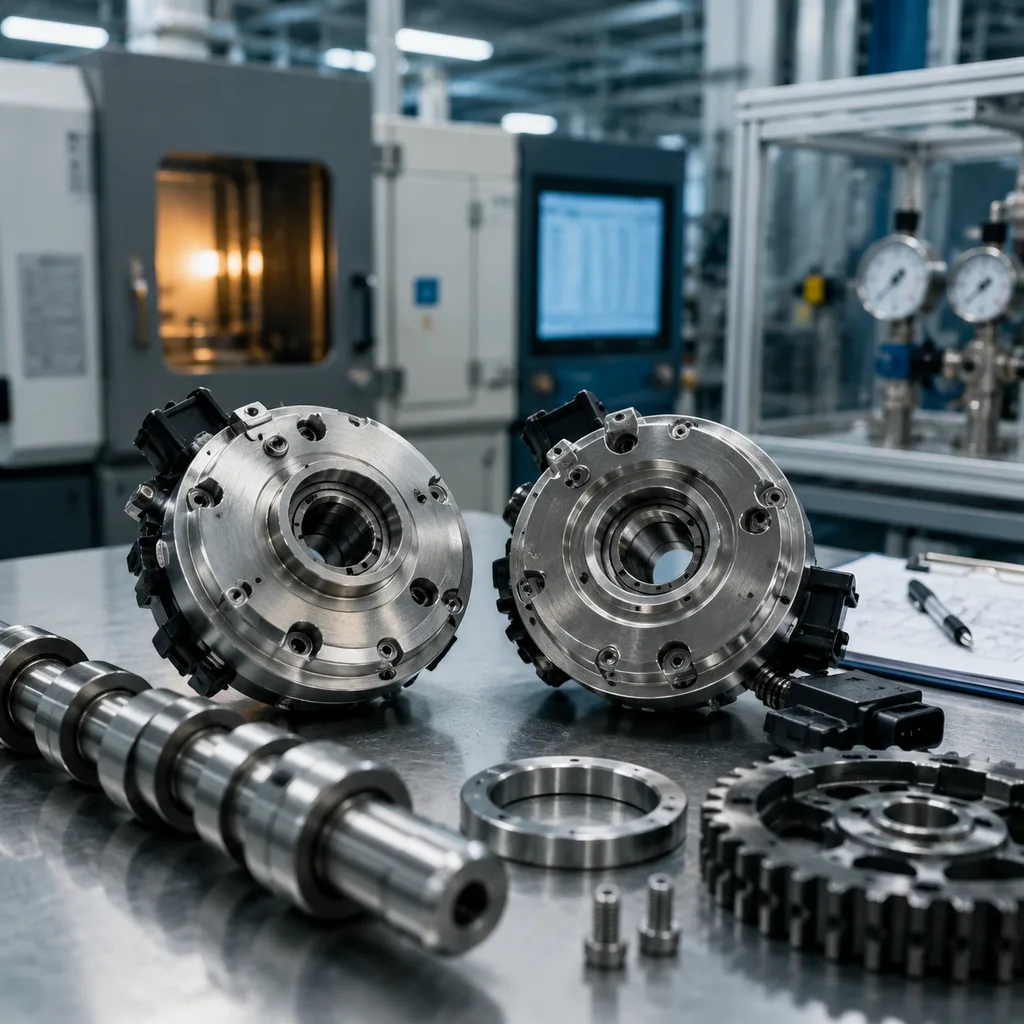
A camshaft phaser adjusts variable valve timing by rotating the camshaft against the timing drive. In Audi applications, replacement demand is usually not random. It often follows start-up rattle, cam/crank correlation faults such as P0011, P0016, or P0341, unstable phase control, dirty oil, low oil pressure, or wear at the locking pin, rotor, and vane chamber.
For distributors, importers, and repair-chain buyers, the sourcing question is sharper than “does it bolt on?” A workable camshaft phaser Audi replacement must hold the commanded phase angle as oil temperature, oil pressure, engine speed, and duty cycle change. A unit that looks right externally can still leak internally, release the lock pin late, sit in the wrong rest position, or respond too slowly for the ECU’s control window.
Use this article as a buying and validation framework. It covers OE-equivalent geometry, hydraulic response, failure points, test planning, supplier audit checks, MOQ and lead-time logic, and export packaging controls. Driventus manufactures engine timing and powertrain components in Taizhou, Zhejiang, for aftermarket distributors, OEM/Tier-1 suppliers, and multi-location repair networks. Driventus is an independent aftermarket manufacturer; vehicle brand names are referenced for fitment identification only.
Start With the Decision: Is This Phaser Truly the Same Application?
The first decision in a camshaft phaser Audi replacement program is not price. It is application certainty. Audi engines using variable valve timing rely on the phaser to move smoothly, lock when required, and stay inside the ECU’s expected control range. If the replacement differs in chain line, oil circuit, cam interface, or rest angle, the field result can be noise, DTCs, unstable idle, poor drivability, or early wear.
Check compatibility at three levels before commercial approval:
Physical fit: mounting face, bore, spline or key interface, overall width, bolt pattern, fastener seating, chain alignment, and axial offset. For critical cam interfaces, drawing controls often require bore tolerance around ±0.01–0.02 mm, mounting-face flatness within 0.02 mm, and sprocket run-out below 0.05 mm TIR unless the buyer drawing specifies otherwise.
Hydraulic behavior: oil gallery position, advance/retard movement, internal leakage rate, lock-pin release pressure, rotor vane travel, and rest position. Define oil grade, oil temperature, pressure, and leakage limits. A phaser that passes with cold oil may fail at 90–110°C.
System compatibility: the phaser must respond correctly with the specified oil control valve, camshaft position sensor, and ECU calibration. On the bench, look for smooth movement through the required angular window, no sticking during duty-cycle sweeps, and stable return to the commanded lock or rest position.
OE part-number references can help identify a target, for example OE 06A… or OE 11251… where relevant to the buyer’s application data. They are not enough by themselves. Confirm engine code, production date, camshaft position, emissions specification, and market region. For intake/exhaust pairs, verify whether the unit is normally locked in advance, retard, or center position. Two phasers can look nearly identical and still differ by 5–10 crank degrees in working range.
Driventus does not claim approval, affiliation, or endorsement by any vehicle manufacturer.
Where Approvals Fail: The Checks That Catch Wrong Parts Early
Most sourcing mistakes appear before shipment if the sample plan is strict enough. Catalogue photos and cross-reference tables are useful, but they do not prove chain fit, leakage control, lock behavior, or phase response. Compare samples against an approved original part, controlled drawings, or a validated golden sample.
Failure mode to prevent
Verification method
Practical acceptance target to define
Buyer risk if missed
Chain mismatch or noisy engagement
Profile projector, chain fit gauge, CMM
Pitch, roller seating, and tooth thickness matched to OE sample; no burrs over 0.03 mm
Chain noise, accelerated wear, timing error
Poor camshaft seating
Micrometer, plug gauge, flatness inspection
Bore and seat within drawing tolerance; face flatness commonly ≤0.02 mm
Run-out, poor clamping, oil leakage
Excess internal bypass
Section inspection, pressure decay, air leakage test
Rotor vane clearance and side gap matched to master sample; no scoring after cycling
Slow response, unstable phase angle
Lock pin does not behave consistently
Oil pressure test at defined temperature
Positive lock at rest; release pressure and reset pressure recorded by lot
Hole center position typically within ±0.05 mm; no blocked cross-drilling
Insufficient actuation or internal leakage
Soft or inconsistent wear surfaces
Rockwell or Vickers test
Sprocket/locking surfaces within agreed HRC/HV range; case depth recorded if specified
Wear at sprocket teeth or locking surfaces
Excess run-out or imbalance
Dynamic balance and dial indicator
Run-out generally below 0.05 mm TIR; balance per buyer NVH requirement
NVH issues at higher engine speed
Slow or sticky phase movement
Hot-oil functional rig
Full angular travel, repeatability within agreed degrees, no sticking in duty sweep
DTCs, poor drivability, warranty claims
</tr></thead><tbody> </tbody></table>A practical approval sequence is simple: 3–5 initial samples, then 20–50 pilot-lot pieces if tooling or process is new, then batch inspection using AQL or buyer-defined critical-characteristic sampling. For distributors carrying multiple engine families, cross-reference discipline matters. Similar-looking phasers may differ in rotor angle, rest position, cover design, oil circuit layout, or intake/exhaust application. External appearance often hides the difference.
Spec Deep-Dive: Materials, Heat Treatment, Leakage, and Hot-Oil Testing
A camshaft phaser works in hot oil while absorbing repeated torsional load from the timing drive and valve train. That environment punishes shortcuts. Material route, machining accuracy, heat treatment, surface finish, and cleanliness all affect warranty rate.
Common construction may include a sintered or machined steel sprocket body, precision-machined rotor, hardened locking pin, spring components, seals, and cover plates. The final route depends on expected volume, geometry, duty cycle, buyer specification, and whether the program is aftermarket, private-label, or OE/Tier-1 style.
Driventus validation for phaser programs can include:
CMM inspection of critical mounting, sprocket, and oil-control features, with recorded values for bore, face, oil port, tooth profile, bolt seat, and overall height.
Metallurgical inspection for hardness depth, microstructure, and surface condition. Locking pins and wear faces usually need higher hardness than non-contact covers; agree the HRC/HV range before mass production.
Pressure decay or flow testing for internal leakage, preferably at both room temperature and hot-oil conditions such as 80–110°C.
Functional cycling across defined oil temperature and pressure ranges, for example 1–5 bar oil pressure and low/high duty-cycle command points, depending on application.
Endurance testing for repeated advance/retard movement. Aftermarket programs often request 100,000–300,000 bench cycles; OE/Tier-1 projects may require higher counts.
Cleanliness checks where particle limits apply to oil-contact parts, such as ISO 16232/VDA 19 style extraction and measurement.
Salt spray or surface protection checks when export routing requires additional corrosion control, often 48–96 hours unless the buyer specifies more.
Batch traceability by production date, lot number, operator, machine, heat-treatment batch, and inspection record.
Quality controls are managed under IATF 16949:2016 and ISO 9001:2015 expectations. Environmental and substance compliance can be supported against REACH (EC) No 1907/2006 documentation where requested by EU buyers. Where customer drawings, special characteristics, or PPAP requirements apply, the inspection plan can be aligned with the buyer’s incoming quality process. For high-risk applications, ask for a control plan that separates critical items such as lock pin hardness, angular travel, oil leakage, sprocket run-out, and phaser identification markings.
Buying Scenario: Distributor Program Versus Repair-Chain Rollout
A distributor and a repair chain may buy the same camshaft phaser, but their risks are different.
A distributor usually needs broad coverage, clean cross-references, private-label consistency, and low claim rates across many installers. A repair chain cares more about repeat installation success, fast warranty diagnosis, and predictable availability across branches. In both cases, the supply program should be defined before the first container leaves the factory.
Buyers can review Driventus camshaft phaser coverage through our catalog, including related timing and engine components. For private-label or application-specific projects, custom manufacturing can include drawing review, reverse engineering from approved samples, tooling development, sample validation, and packaging configuration.
Set the purchasing specification in writing. Include:
Application list by engine code, displacement, camshaft position, market, and production year.
OE cross-reference structure, using generic references such as OE 06A… only when relevant to the confirmed application.
First-shipment and recurring inspection reports, including CMM key dimensions and functional leakage/lock-release records.
Functional test requirements for leakage, lock release, reset, response time, and phase travel where applicable.
Packaging drop-test and corrosion protection requirements for sea freight or long storage. For export cartons, specify inner bag, VCI or oil protection, foam/partition layout, carton burst strength, and pallet wrap standard.
Barcode, carton label, inner box, and pallet marking format, including EAN/UPC, batch number, production date, and private-label part number where required.
Warranty return analysis procedure with photos, installation notes, oil condition, mileage, fault codes, and whether the oil control valve, timing chain, or tensioner were replaced.
MOQ and price depend on tooling status. Repeat production from existing tooling is usually most economical from 100–300 pcs per reference. Private-label cartons often require 300–500 pcs per SKU. New tooling or special validation projects may require 500–1,000+ pcs or a tooling charge. Unit price is driven by material route, machining cycle time, heat treatment, 100% functional testing, packaging complexity, and forecast stability.
Lead time is typically 7–15 days for available stock or repeat small batches, 30–45 days for scheduled production after deposit and packaging approval, and 60–90+ days when new tooling, endurance testing, or PPAP-style documentation is required.
Driventus is an independent aftermarket manufacturer; vehicle brand names are referenced for fitment only.
Supplier Audit Questions That Reveal Process Control
Do not audit a camshaft phaser supplier only by catalogue range. The part combines precision-machined interfaces, hydraulic control, heat-treated wear surfaces, and timing accuracy. A good first sample is not proof of repeatable production.
Use the audit to answer these questions:
Can incoming steel, sintered blanks, springs, seals, and purchased components be traced to heat or batch certificates?
Are CNC fixtures controlled, and are tool-change rules linked to first-off and last-off inspection?
Is heat treatment controlled by qualified suppliers or in-house furnace records, including hardness map, case depth where applicable, and furnace batch traceability?
Are cleaning, deburring, and contamination-control steps documented for oil-contact areas, including magnetic particle removal and post-wash drying/rust prevention?
Are functional test rigs calibrated, correlated to master parts, and checked daily with leak-test verification?
Can a finished part be traced back to production batch and inspection lot by laser mark, ink code, carton label, or bag label?
Are non-conforming products segregated, and is rework controlled? Hydraulic leakage, hardness failure, or lock failure should not be cosmetically reworked without engineering approval.
Does the supplier issue corrective actions in 8D format, with containment within 24–48 hours, root-cause confirmation, and effectiveness checks on the next batch?
Is there a documented control plan, inspection frequency, and reaction plan for failed tests?
Driventus maintains a structured quality system based on IATF 16949:2016 and ISO 9001:2015. For supplier onboarding, standard audit documentation, process flow, control plans, and sample inspection reports can be prepared. PPAP-style submissions can also be discussed for OEM/Tier-1 projects where the buyer provides drawings, tolerances, special characteristics, and validation criteria.
For aftermarket importers, a practical document pack normally includes business license and certificates, drawing or controlled specification sheet, material report, hardness report, dimensional report, functional test report, packaging specification, and batch traceability sample label.
Pre-Shipment Checklist: Data Your Teams Must Agree On
Wrong-part shipments often start with vague ordering data. Before confirming a camshaft phaser Audi replacement order, align technical, commercial, inspection, packing, and aftersales information in one written specification.
Minimum confirmation list:
Target engine family and engine codes.
Vehicle model range and production year coverage.
Camshaft position: intake, exhaust, or both where applicable.
Chain or belt drive interface, tooth count, sprocket width, and chain line offset.
Rest position and phasing angle requirement, stated in cam degrees or crank degrees to avoid misunderstanding.
Oil feed layout and oil control valve compatibility, including oil port position and expected operating pressure range.
OE cross-reference format, such as OE 06A… where the customer has confirmed applicability.
Sample approval status and inspection report reference, including approved sample number or golden sample photos.
Branding, neutral packaging, or private-label packaging requirement, with artwork, barcode, label language, and country-of-origin rules.
MOQ, forecast quantity, delivery schedule, and Incoterms.
Required documents: invoice, packing list, certificate of origin if needed, inspection report, material/hardness report, and any compliance declaration requested by the destination market.
For mixed-container buyers, consolidating phasers with pistons, gaskets, water pumps, and related timing components can reduce freight cost per line item. Still, technical confirmation must remain part-specific. Similar engine platforms may use different VVT hardware by production date, camshaft position, or emissions calibration.
A typical export packing plan should define pieces per inner box, inner box dimensions, gross/net weight, cartons per pallet, pallet height limit, moisture protection, and whether cartons must pass a 1.0 m drop test or ISTA-style transit check. To check coverage or discuss a sample order, buyers can request a quote.
Frequently asked questions
Common causes include contaminated oil, low oil pressure, blocked oil galleries, worn timing chain components, incorrect torque, or using a phaser with the wrong rest position, phasing angle, or oil circuit. The oil control valve, chain tensioner, guides, and oil condition should be checked during diagnosis. For warranty review, record mileage, oil grade, fault codes, oil pressure, and whether the chain kit was replaced.
Yes. Driventus can support neutral packaging, distributor branding, carton labels, barcode formats, and buyer-defined packing rules. Private-label supply depends on MOQ, artwork approval, and confirmed technical specifications. Typical private-label planning starts around 300–500 pcs per SKU when custom boxes or labels are required, subject to part number and forecast.
No. Driventus is an independent aftermarket manufacturer; brand names are referenced for fitment only. OE-style references are used to help buyers identify application compatibility and do not indicate vehicle manufacturer endorsement.
For camshaft phaser sourcing, sample validation, or private-label replacement programs, send your application list, OE cross-reference, annual forecast, packaging request, and required test standard. Driventus will review fitment, MOQ, lead time, and supply options at /contact.html