For distributors, engine rebuilders, and repair-chain buyers, camshaft Peugeot replacement demand is usually tied to high-mileage wear, timing-drive failure, lubrication problems, or cylinder-head refurbishment. Procurement decisions should go beyond application lists and low-price offers. A replacement camshaft must match the original profile, journal layout, thrust control, sensor trigger features, oil-feed design, and material specification closely enough to restore valve timing and durability without creating installation risk. In practical sourcing terms, that means checking micrometre-level journal dimensions, lobe lift and phase, runout, hardness, oil-hole orientation, end-drive geometry, packaging protection, and traceability before committing to range stock. This article outlines actionable sourcing checks for Peugeot petrol and diesel engine camshafts, including dimensional control, validation testing, documentation, packaging, MOQ, price, and lead-time planning. It is written for B2B buyers comparing independent aftermarket supply options for Europe, the UK, North America, Australia, and Brazil. Driventus manufactures engine and powertrain components in Taizhou, Zhejiang, under IATF 16949:2016 and ISO 9001:2015 systems, with export supply to more than 60 countries.
Replacement Fitment: What Buyers Should Verify
Camshaft replacement programs for Peugeot applications can cover many engine families, cylinder-head layouts, valve-train types, and emissions generations. A procurement team should not confirm fitment by displacement and model year alone. The more important question is whether the part matches the OE design intent for the exact cylinder head, camshaft position, and timing system.
Key fitment points include:
Camshaft position: intake, exhaust, single overhead camshaft, or dual overhead camshaft application. For DOHC engines, intake and exhaust shafts may share journals but differ in lobe phase, sensor reference, or pump drive.
Valve-train interface: direct-acting bucket, roller follower, rocker arm, or hydraulic lash adjuster arrangement. Do not interchange flat-tappet and roller-follower profiles.
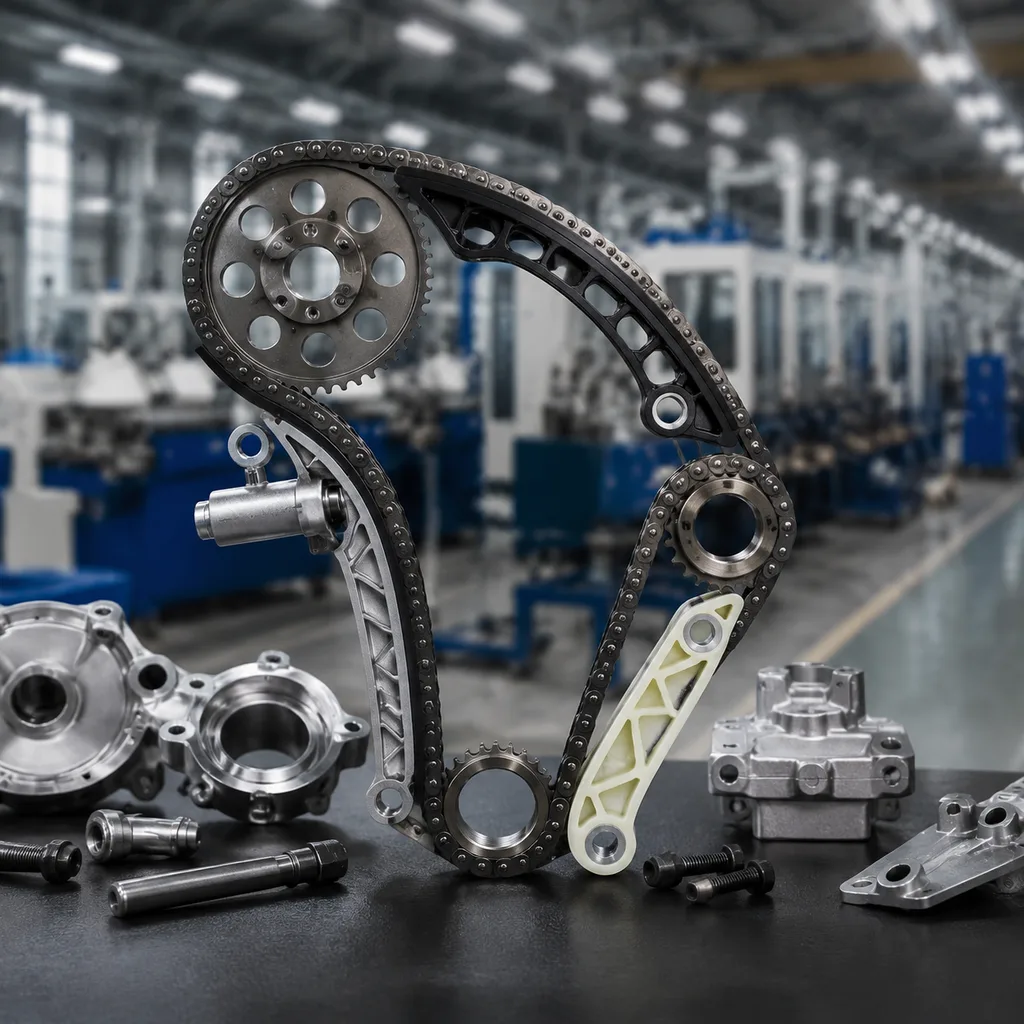
Timing drive: belt, chain, gear, or combined system depending on the engine family. Confirm sprocket locating pin diameter, keyway width, bolt thread, and phaser interface where used.
Sensor features: trigger wheel, machined reference slot, or end-face profile for camshaft position sensing. Even a 1–2 degree phase error can create cam/crank correlation faults.
Thrust control: thrust plate groove, shoulder location, or bearing-cap controlled axial location. End float is often controlled in the 0.05–0.20 mm range, but the application drawing should govern.
Oil-feed design: journal oil holes, grooves, and orientation. Confirm hole diameter, groove width, and angular position against sample.
End connection: sprocket, pulley, vacuum pump, high-pressure fuel pump, or auxiliary drive interface. Pump drive tang depth and slot width should be gauged, not checked visually only.
Where OE part-number mapping is required, use controlled cross-reference data and avoid loose interchange. A single Peugeot model name may include several engine codes and production changes, while visually similar camshafts can differ in phase position, sensor detail, or end-drive geometry. In RFQ sheets, ask customers to provide engine code, build range, cam position, OE reference, quantity, and sample availability. If a customer quotation file uses an OE-style reference, that reference should be verified against a reliable application database or supplied sample before range launch.
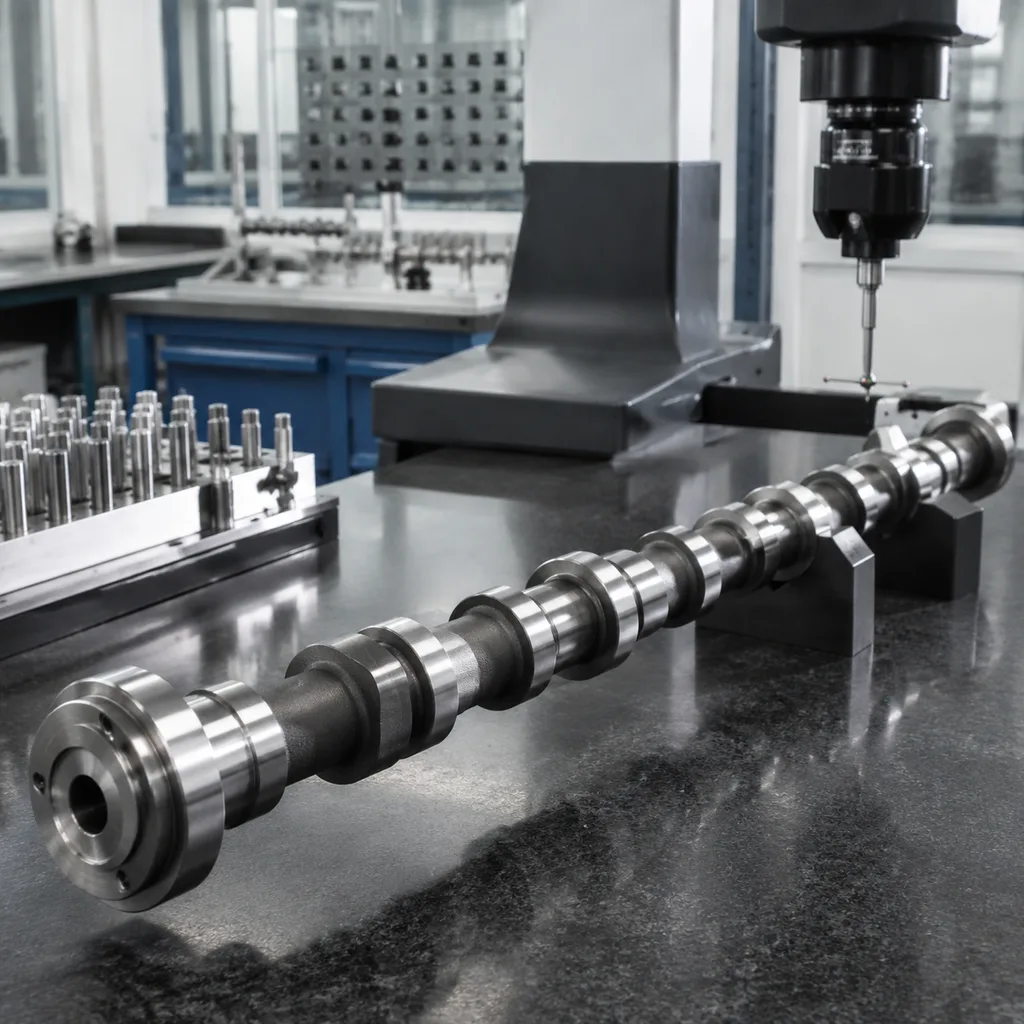
For sample comparison, buyers should request a first-article report covering at least overall length, all journal diameters, lobe lift, base-circle diameter, nose radius or profile scan, sprocket/pump end dimensions, sensor trigger geometry, oil-hole position, runout, and hardness. Driventus is an independent aftermarket manufacturer; Peugeot and other brand names are referenced for fitment identification only. Buyers can review related engine parts in our catalog and the engine range at /products/engine-components.html.
OE-Equivalent Dimensions and Material Control
A replacement camshaft is not only a shaped shaft. Lobe geometry, journal finish, straightness, hardness depth, and runout determine whether the part will assemble correctly and maintain oil film under load. For camshaft Peugeot replacement sourcing, the supplier should define measurable inspection points rather than describing the part only as “OE type” or “standard quality”.
Control item
Typical buyer requirement
Procurement risk if uncontrolled
Overall length
Drawing/sample match, commonly ±0.10 mm unless otherwise specified
Timing cover or end-drive interference
Journal diameter
Micrometer controlled, typically ±0.010–0.020 mm with roundness check
Low oil pressure, seizure, or bearing noise
Lobe lift
Profile verified, typically within ±0.03–0.05 mm of approved master
Reduced power, emissions fault, valve-train noise
Base circle
Matched to valve-train design, typically ±0.02–0.04 mm
Incorrect hydraulic lifter preload or lash
Surface hardness
Confirmed by heat-treatment record and sample test, often 50–60 HRC depending on material/process
Accelerated lobe and follower wear
Effective case/depth
Application-specific; induction-hardened lobes often require controlled hardened depth, not surface reading only
Spalling after short mileage
Straightness/runout
Checked between centres, commonly ≤0.03–0.05 mm TIR
Bearing-cap loading and rotation resistance
Journal roughness
Polished surface, often Ra 0.2–0.4 µm depending on bearing design
Bearing scoring and oil-film instability
Lobe roughness
Ground/polished surface, often Ra 0.4–0.8 µm depending on follower
Break-in wear and follower damage
Oil-hole position
Visual and dimensional inspection with angular check
Starved journal or follower contact area
Sensor trigger feature
Gauge, optical comparator, or CMM confirmed
Cam/crank correlation fault codes
</tr></thead><tbody> </tbody></table>Material selection varies by engine design. Common manufacturing routes include chilled cast iron, alloy cast iron, forged steel, or assembled camshaft construction with separately formed lobes. The correct choice depends on follower type, contact stress, engine speed range, lubrication regime, and OE construction. Heat treatment may include induction hardening, carburising, nitriding, or another controlled hardening process appropriate to the base material.
A buyer should also check whether the supplier controls surface finish after grinding and polishing. Journals that are dimensionally correct but too rough can damage bearing surfaces, while lobes with poor finish can accelerate follower wear during break-in. For incoming approval, request measurement records from at least 3–5 sample pieces and confirm the same gauges will be used in mass production. For repeat orders, a practical control plan normally separates 100% checks for visible damage, oil-hole presence, and critical end features from sampled CMM/profile/hardness checks per batch.
Driventus uses drawing-based inspection plans, hardness checks, profile measurement, and batch traceability for camshaft production. The target is dimensional and functional match to approved samples or customer drawings, not broad generic interchange.
Validation Testing for Replacement Programs
Procurement teams should ask how a supplier validates a camshaft before adding it to a replacement range. A dimensional report is necessary, but it is not enough for a rotating valve-train component. Validation should combine drawing inspection, bench testing, process capability review, controlled pilot production, and packaging assessment.
A practical validation package may include:
Initial sample inspection report with critical-to-function dimensions, normally covering all journals, all lobes, end interfaces, oil holes, and trigger features.
Cam profile measurement for lift curve and phase position, with a master profile or approved OE sample as the reference.
Surface roughness report for journals and lobes using calibrated roughness equipment.
Hardness and case-depth verification where applicable, including cut sample or approved non-destructive method when required.
Metallurgical structure check for cast or heat-treated parts, especially chilled cast iron or induction-hardened steel.
Runout inspection between centres before and after final machining where process risk justifies it.
Assembly trial in a representative cylinder head or fixture, including bearing-cap torque sequence and free-rotation check.
Rotation and end-float checks after trial assembly. A good practical target is smooth hand rotation with no binding and end float within the drawing limit.
Packaging drop and corrosion-resistance checks for export shipments, including VCI effectiveness and carton compression.
Batch traceability from raw material heat/lot to final inspection and carton label.
For new references, buyers should consider a staged approval process: 1–2 dimensional samples for drawing review, 5–20 pilot pieces for assembly and workshop feedback, then a controlled first mass order. For a high-volume distributor SKU, ask for capability evidence on critical dimensions such as journal diameter, lobe lift, and trigger phase. Cpk targets are application and volume dependent, but many professional buyers expect Cpk ≥1.33 on stable critical machining characteristics before unrestricted release.
For replacement parts entering regulated markets, material and chemical compliance should also be controlled. REACH (EC) No 1907/2006 is relevant for chemical substances in articles supplied to the EU. Quality management should be aligned with IATF 16949:2016 and ISO 9001:2015, including control plans, corrective action, nonconforming product handling, and supplier management. Driventus explains these controls in its quality system overview.
Camshafts themselves are not certified under emissions regulations such as ECE R-83, but incorrect valve timing can affect combustion and emissions performance. That makes timing-feature accuracy, lobe profile control, and sensor reference geometry important for professional replacement channels, especially where repair chains track comeback rates and diagnostic fault codes.
Common Failure Modes Behind Camshaft Replacement Demand
A buyer’s forecast is stronger when it reflects why the part fails in service. Peugeot camshaft demand often follows wider engine repair activity, not only isolated camshaft wear. The same stock program may need timing kits, gaskets, hydraulic lifters, followers, oil seals, head bolts, oil pumps, and water pumps depending on the engine family and repair procedure.
Typical causes include:
Lubrication starvation from extended oil intervals, blocked oil galleries, incorrect oil grade, or sludge. Wear often appears first as lobe scoring, blueing, pitting, or journal pickup.
Timing belt or chain failure causing valve contact and lobe or journal damage. If the engine suffered valve-to-piston contact, inspect cam caps, cam carrier alignment, and follower damage before reuse.
Follower, rocker, or hydraulic lifter failure that damages the cam lobe surface. A new camshaft run against damaged followers may fail within a short mileage interval.
Incorrect installation torque or sequence on bearing caps or cam carriers. Aluminium cam carriers can distort when tightened unevenly; follow the OE sequence and torque-angle procedure.
Overheating and oil degradation after cooling-system failure. Burnt oil residues can block small oil feeds.
Debris contamination after turbocharger, bearing, or timing-system failure. Metal particles can embed in followers and bearing surfaces.
Previous repair using mismatched followers, caps, sealants, or reused damaged hardware. Excess sealant can migrate into oil galleries.
For repair chains, these causes affect warranty policy. Replacing the camshaft alone may not solve the root problem if oil supply, followers, cam caps, or timing components are not inspected. Installation notes should remind technicians to lubricate journals and lobes at assembly, follow the correct tightening sequence, prime oil where required, rotate the engine by hand through two full crank revolutions, and verify timing alignment before start-up. After first start, oil pressure and abnormal top-end noise should be checked immediately.
For distributors, failure analysis affects catalog notes and kit strategy. A camshaft sold with recommended associated parts can reduce returns caused by incomplete repairs. In commercial terms, a kit that bundles the camshaft with followers, seals, and key fasteners may carry a higher unit value but reduce warranty disputes and technical calls. Driventus can support range planning for camshaft programs, including linked components such as gaskets, seals, timing-related hardware, and other engine components.
Sourcing Checklist for Importers and Distributors
A camshaft program should be evaluated using commercial and technical criteria together. Low unit price is not useful if the part creates high warranty exposure, unclear interchange, or catalog confusion. Buyers should request clear data before trial orders and should treat first shipments as a controlled launch, not only a purchasing transaction.
Recommended sourcing checklist:
Application list with engine codes, production ranges, and position notes.
OE cross-reference policy based on supplied customer references or verified databases.
Approved sample or drawing basis for each part number.
Critical dimension report and control plan.
Material specification and heat-treatment method.
Surface hardness, roughness, and runout inspection records.
Cam profile and phase-position verification method.
Packaging design for sea freight and parcel distribution.
Corrosion protection duration under normal warehousing conditions, commonly targeted at 6–12 months for export stock when VCI and dry storage are used.
Batch marking and traceability method on part, carton, or both.
Warranty analysis process and response time, including photo review, return sample inspection, and 8D or corrective action when justified.
MOQ, lead time, and mixed-container options for range launches.
MOQ and price logic should be discussed early. For catalog camshafts using existing tooling, trial orders may be possible at lower quantities, while new or slow-moving references usually need higher MOQ because grinding wheels, fixtures, gauges, packaging, and setup time must be amortised. As a practical planning assumption, buyers should separate SKUs into A/B/C demand groups: A-movers may justify 200–500+ pieces per reference, B-movers may launch at 50–150 pieces, and C-movers may need mixed-SKU consolidation or make-to-order planning. Exact MOQ depends on material route, machining setup, packaging, and whether private labelling is required.
Lead time is driven by material availability, heat treatment, grinding capacity, inspection queue, and packaging approval. Existing validated references are often planned on a shorter production cycle than new development. For new references, allow time for sample measurement, approval feedback, pilot production, and carton artwork confirmation before mass production. A realistic launch calendar usually reserves several weeks for sample approval and several more for production and export consolidation; urgent orders should identify which steps cannot be skipped.
For OEM/Tier-1 or private-label programs, buyers may need drawing-controlled development rather than catalog supply. Driventus provides custom manufacturing for camshafts and related engine components using customer drawings, approved samples, or agreed technical specifications.
A structured supplier audit should cover incoming material control, machining capability, heat treatment, final inspection, gauge calibration, packaging, and nonconformance handling. Certification to IATF 16949:2016 and ISO 9001:2015 supports this process, but buyers should still review the actual process controls used for the camshaft family. The strongest sourcing decisions combine documentation, sample approval, repeatable inspection data, and a practical plan for warranty feedback.
Packaging, Documentation, and Launch Planning
Camshafts are vulnerable to corrosion, impact damage, and bending during international transport. Export packaging should protect journals, lobes, sensor features, and end-drive surfaces from vibration, moisture, and rough handling. For distributors supplying multiple branches, the carton and label system must also support fast identification and low picking error.
A typical export specification may include:
VCI bag or equivalent anti-corrosion protection, sealed after final inspection and handled with gloves or clean oil film.
Oil or protective coating compatible with warehouse handling and customer cleaning procedures.
Individual formed tray, sleeve, or reinforced carton support that prevents metal-to-carton rubbing at lobes and journals.
End protection for sprocket, pump, or sensor-drive interfaces.
Neutral or private-label carton options.
Outer carton strength suitable for palletised sea freight; heavy camshafts should not be packed so that one carton can bend under stacking load.
Barcode, part number, batch number, quantity, net/gross weight, and country-of-origin labelling.
Installation caution note where timing alignment, follower replacement, torque sequence, or lubrication priming is critical.
Documentation should include invoice description, HS classification support where required by the importer, packing list, certificate of origin if applicable, and compliance declarations requested by the destination market. For EU supply, REACH (EC) No 1907/2006 declarations may be part of the customer document pack. Private-label buyers may also require artwork approval, label language checks, barcode verification, and carton drop-test confirmation before mass shipment.
For launch planning, start with an RFQ file that separates confirmed demand from exploratory coverage. Include annual forecast, first-order quantity, target warehouse, private-label requirement, and any price band needed for the market. Then agree sample quantity, inspection documents, packaging artwork, and approval deadline. After the first shipment, review fitment questions, workshop feedback, damage rate, slow movers, and any warranty claims before expanding the range.
For a new camshaft Peugeot replacement range, a practical launch plan starts with high-demand references, validates fitment and returns data after the first shipments, then expands to slower-moving applications. This approach reduces inventory exposure while building reliable coverage. It also gives the supplier and buyer time to refine carton labels, catalog notes, associated-part recommendations, MOQ strategy, and replenishment lead times before the range becomes larger.
Frequently asked questions
Provide the engine code, camshaft position, vehicle application range, target quantity, packaging requirement, and any customer-supplied OE cross-reference. If no drawing is available, an approved sample can support dimensional confirmation. For faster quoting, add annual forecast, first-order quantity, private-label needs, destination port or warehouse, and any required inspection report format.
Yes. Driventus can supply neutral or private-label packaging for qualified B2B programs, subject to MOQ, labelling rules, artwork approval, and agreed documentation. Packaging should be confirmed during sample approval, including barcode format, carton strength, VCI protection, batch marking, and installation-note language.
No. Driventus is an independent aftermarket manufacturer; brand names are referenced for fitment only. The focus is OE-equivalent dimensional match, controlled manufacturing, and validation against approved drawings or samples.
If you are planning a camshaft range or need a controlled replacement source, share your application list, engine codes, target volumes, packaging requirements, and destination market. You can [request a quote](/contact.html).