camshaft · 2026-06-21

Camshaft for Peugeot 308 OE Equivalent: Sourcing Guide

For procurement teams, an OE equivalent camshaft is defined by more than the vehicle badge. It has to match the engine code, valve timing profile, journal geometry, surface finish, and material specification required for stable valve actuation. For Peugeot 308 applications, the correct camshaft depends on the exact engine variant, model year, and whether the part is for intake, exhaust, or a paired set. Driventus is an independent aftermarket manufacturer; brand names are referenced for fitment only. Our method is to build dimensional and functional parity against the target reference, then verify it through inspection and performance checks under controlled production conditions. We manufacture in Taizhou, Zhejiang and supply B2B buyers across aftermarket, OEM, and repair-chain channels. All production is managed under IATF 16949:2016 and ISO 9001:2015 aligned controls, with material and compliance consideration for REACH (EC) No 1907/2006 where applicable.

Decision rule: what makes a camshaft OE equivalent for Peugeot 308

An OE equivalent camshaft has to do three things at once: fit the head correctly, reproduce the valve event timing, and survive the same operating load as the reference part. That is a tighter standard than matching the part number alone.

For buyers, the practical test is whether the shaft preserves engine behaviour across idle, torque rise, and high-load operation. If the lobe shape, journal geometry, or thrust position drifts, the part may still install cleanly but fail in service.

Key equivalence points:

  • Journal diameter, length, and concentricity
  • Cam lobe lift, base circle, and ramp profile
  • Overall shaft length and thrust face location
  • Sensor target features, where used
  • Surface hardness and finish on bearing and lobe surfaces

For Peugeot 308 sourcing, start with the engine code, then check displacement, fuel type, and aspiration. Intake and exhaust shafts are not interchangeable in many variants. A close-looking shaft with mismatched timing can trigger idle instability, misfire complaints, or accelerated follower wear. Buyers should ask suppliers for the controlled tolerance window on the drawing and the actual inspection result from the production lot. Common control points are journal diameter within ±0.01 mm, total indicated runout within 0.02 mm, and lobe lift within ±0.03 mm of the validated reference unless the customer drawing is tighter.

Failure modes that turn a near-match into a return

The most expensive camshaft mistakes usually happen before installation, not after. The part looks correct, but one hidden variable is off.

Common failure modes include:

  • Wrong engine family or emissions variant
  • Intake shaft supplied for an exhaust application
  • Sensor feature missing or in the wrong position
  • Lobe profile matched visually, not functionally
  • Bearing journals finished outside the oil-clearance target
  • Packaging mix-up between superseded references

The vehicle record is the fastest way to avoid these errors. If the engine code is unavailable, request the VIN, a service label photo, or markings from the removed shaft. For repeat programmes, keep one master sample and compare every new lot against it before release. Measurement method matters too: journal size should be checked with a micrometer or air gauge at a fixed location, and runout should be measured between centres on a calibrated bench so results are repeatable across lots.

Buyer checklist: the data to confirm before ordering

A clean order starts with fitment data that leaves no room for interpretation. Treat the OE reference as a cross-check, not the whole answer.

</tr></thead><tbody> </tbody></table>If the buyer cannot confirm the engine code from the vehicle, request the VIN, service history, or a clear photo of the existing part markings. For repeat programmes, retain the approved sample and compare it against every new batch before release. A supplier should be able to state not only the nominal dimension but the measurement method used to verify it.

Spec deep-dive: how Driventus validates replacement camshafts

We validate replacement camshafts as production parts, not catalogue guesses. The process starts with a controlled reference and ends with batch-level inspection.

Core checks

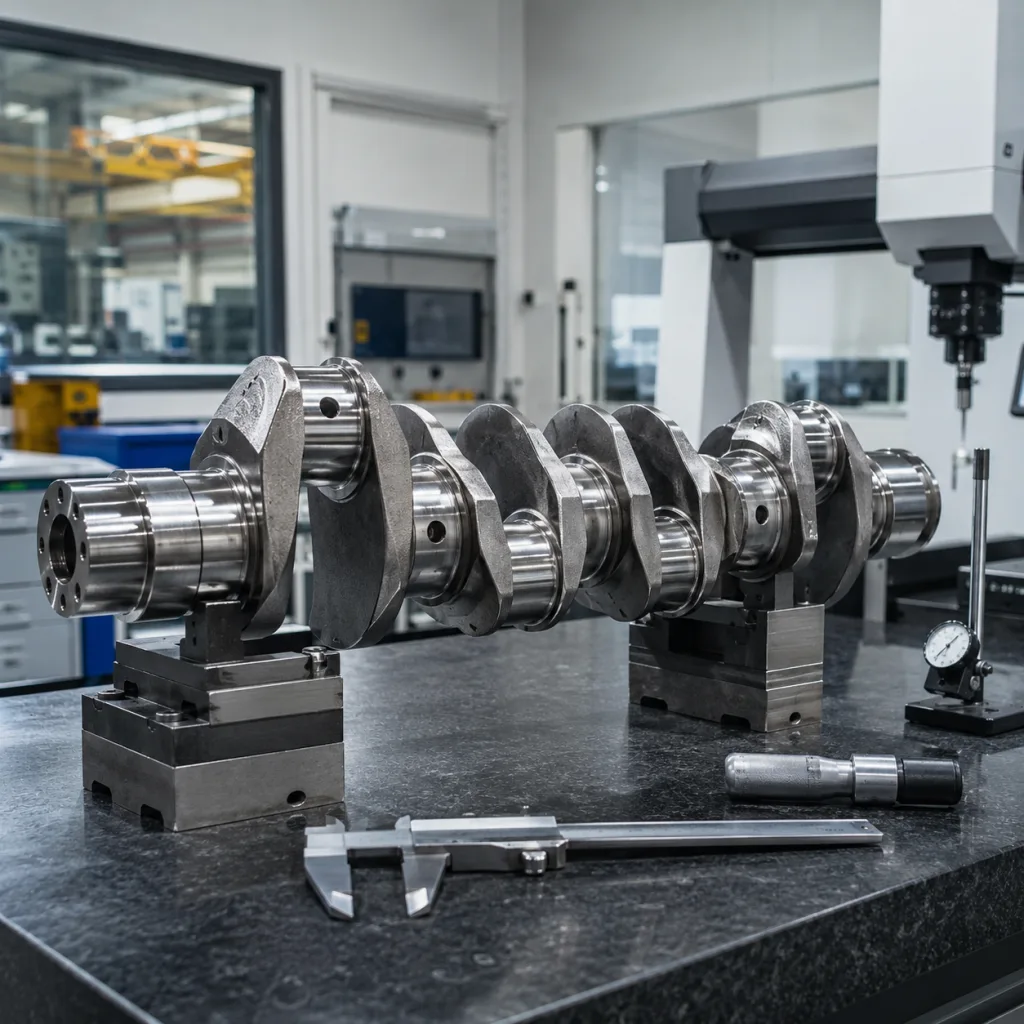
  • Coordinate and profile inspection of lobe geometry
  • Journal and runout measurement on calibrated equipment
  • Surface hardness confirmation on critical wear areas
  • Visual inspection for burrs, scoring, and machining damage
  • Traceability control from casting or bar stock to finished lot

Where required by programme, we can support dimensional reports, PPAP-style documentation, and test data for buyer approval. Buyers supplying multiple markets often want the same fitment maintained across EU, UK, Canada, and Brazil channels, so stable geometry and repeatable hardness matter more than cosmetic finish alone.

Our production system is built under IATF 16949:2016 and ISO 9001:2015 controls, with documented inspection points for incoming material, in-process checks, and final release. Typical acceptance targets we can build to include surface hardness around 55–62 HRC on wear zones depending on material grade, lobe-to-lobe indexing within 0.5°, and surface roughness on bearing journals no higher than Ra 0.4–0.8 μm when the design calls for fine finish. If the programme uses a nitrided surface or chilled-cast blank, we can also align case-depth or microstructure checks to the buyer’s control plan.

When the camshaft should be replaced with a wider repair set

A camshaft failure is often a system problem. If the old unit shows lobe scoring, blueing, or bearing pickup, the root cause may be oil starvation, blocked galleries, worn followers, or incorrect installation torque. Replacing the shaft alone can lead to repeat failure.

Common companion parts to review:

  • Lifters or tappets
  • Rocker arms or finger followers
  • Timing chain or belt components
  • Cam seals and gaskets
  • Oil pump and filter condition
  • VVT phaser or actuator, if fitted

If the engine has high mileage, inspect the full valvetrain and lubrication path before release. For procurement teams supporting repair networks, a matched repair kit is often a better choice than a single shaft when wear is systemic. Quote the shaft with companion components when wear exceeds the service limit on two or more items, or when the vehicle history shows oil-pressure complaints, metal contamination, or previous top-end repairs.

Commercial terms buyers should pin down early

For replacement programmes, supply reliability matters as much as geometry. Buyers should ask for lead time, minimum order quantity, packaging standard, and traceability format before approval.

Driventus supports B2B sourcing for distributors, OEM and Tier-1 programmes, and multi-location repair chains. We can align packaging, labelling, and batch control to regional warehouse needs. Where customers require programme-specific adaptation, our custom manufacturing service can support drawing-based production and controlled revisions.

For broader part-family sourcing, see our catalog and the engine-component overview at [/products/engine-components.html]. For process and compliance detail, review our quality system.

Most camshaft programmes are quoted on a tiered basis: a prototype or sample lot for validation, a pilot batch for fitment sign-off, then a production MOQ that reflects machining setup and packaging cost. For many buyer programmes, MOQ is set in the 50–200 unit range per reference, with better unit pricing above 500 units and additional freight efficiency above 1,000 units. Typical lead time is 2–4 weeks for repeat production after approval, and 4–6 weeks for first-time tooling or new-reference validation, depending on material availability and inspection depth. Buyers should also clarify whether the quote is EXW, FOB, or delivered, because carton spec, export packing, and palletization can change landed cost materially.

Step-by-step purchase flow for Peugeot 308 applications

Use this sequence to keep sourcing tight and avoid rework:

1. Confirm the engine code and model year range. 2. Identify intake or exhaust position, or confirm a paired set. 3. Match the OE reference and note any supersession history. 4. Request a dimensional report, hardness data, and sample photos. 5. Compare the supplier sample against the approved master sample. 6. Lock the tolerance limits, packaging, and labelling in writing. 7. Clarify MOQ, lead time, Incoterm, and reorder stability. 8. Approve production only after fitment and inspection sign-off.

If the application is shared across several trim levels, ask for batch consistency data and retained sample policy. For Europe and the UK, material compliance and controlled declarations may also be required for REACH (EC) No 1907/2006 workflows. For diesel or high-load petrol variants, buyers often request endurance validation against duty-cycle expectations before broad rollout. A practical sourcing rule is to approve only when the supplier can show a signed sample record, lot traceability, and a clear inspection report tied to the same revision that will ship in production.

Frequently asked questions

Not necessarily. It means the replacement is designed to match the required fit, timing, and wear performance for the target application. Driventus is an independent aftermarket manufacturer; brand names are referenced for fitment only.

Send the engine code, OE reference if available, intake or exhaust position, quantity, and destination market. A photo of the old part and any package label also helps confirm compatibility. For a commercial quote, include target annual volume, requested MOQ, preferred Incoterm, and whether you need sample, pilot, or production pricing.

Yes. We support drawing-based and sample-based programmes through our custom manufacturing workflow, with controlled inspection, batch traceability, and customer-specific packaging where required.

If you are comparing options for a Peugeot 308 programme, send the engine code and target volume, and we will confirm fitment and supply terms. Use /contact.html to request a quote.

Request a Quote
Verification item What to confirm Why it matters
Engine codeExact engine family and variantCam timing and lobe profile vary by engine
OE referenceCross-reference only when listed in the customer dataPrevents mismatched substitutions
Intake or exhaustSingle cam or paired cam applicationThe two shafts are often not interchangeable
Sensor featuresReluctor wheel, trigger window, or flatsImpacts ECU synchronisation
Bearing specsJournal size and oil clearance targetProtects oil pressure and durability
Packaging levelBare shaft, with gear, or with phaser interfaceAffects assembly readiness
Validation sampleOne master sample per engine familyLocks the approved geometry for repeat orders