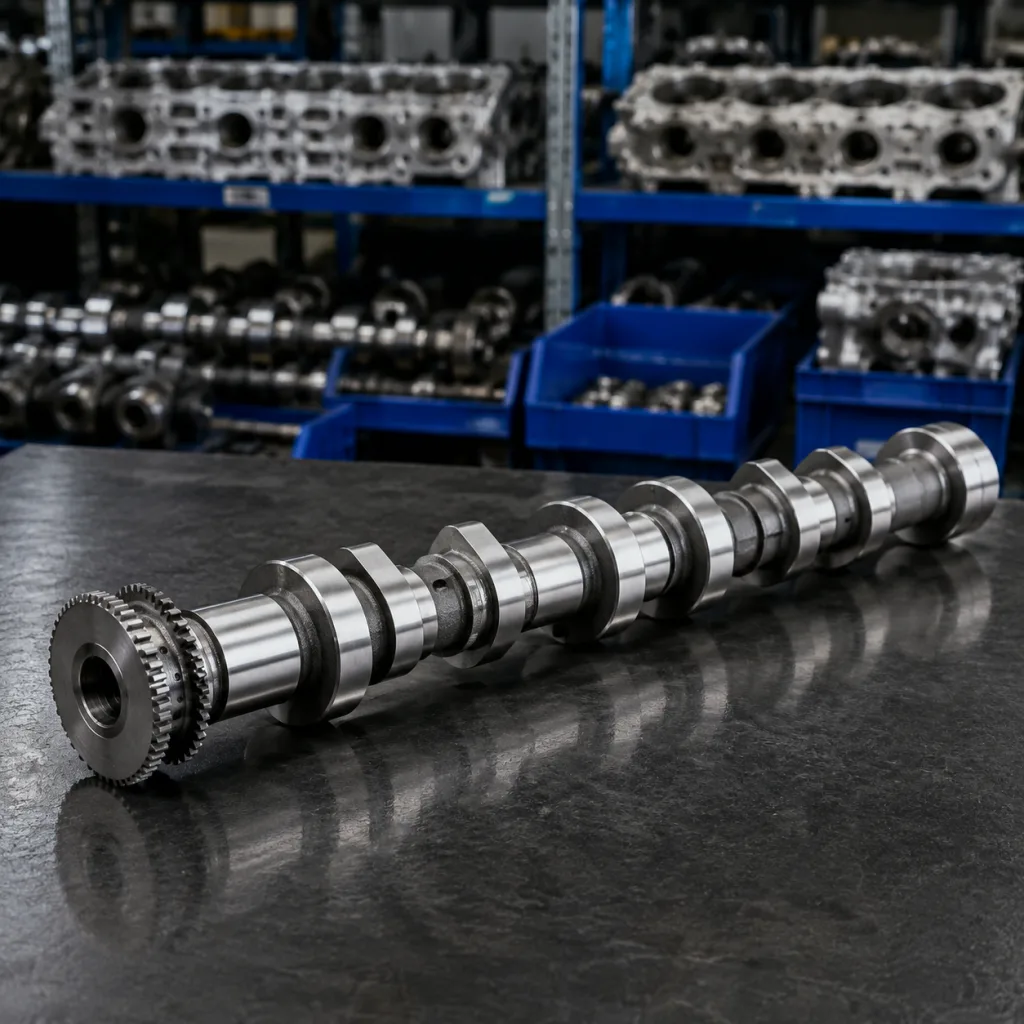
A camshaft Nissan replacement program fails when it treats the part as a shape match. The commercial risk sits in the details: wrong intake/exhaust variant, trigger-angle drift, lobe wear, journal scoring, VVT oil-feed mismatch, noisy cold starts and repeat warranty claims. For distributors, importers and repair-chain category teams, one bad SKU can create returns, technician distrust and stock that cannot be sold.
The buying question is simple: can the supplier prove the shaft will work in the intended engine family, valve-train layout, sensor strategy, phaser interface and lubrication path—then repeat that result in production? This guide turns that question into practical sourcing controls: application data, drawing tolerances, material targets, process checks, validation stages, MOQ logic, lead-time assumptions, packaging and import documentation. Driventus manufactures engine and powertrain components in Taizhou, Zhejiang, under IATF 16949:2016 and ISO 9001:2015 systems for export markets. Driventus is an independent aftermarket manufacturer; brand names are referenced for fitment only.
Start With a Fitment Decision, Not a Quote
Do not open a camshaft quote with only the vehicle model name. Nissan-fit applications can split by engine code, displacement, cylinder head design, intake or exhaust position, cam phaser type, emissions package, sales region and production period. The first decision is whether the buyer and supplier are discussing one variant or several similar-looking shafts.
For aftermarket range development, map demand by engine family and repair frequency. High-volume repair-chain programs often need separate SKUs for intake and exhaust camshafts even when the cast blank looks alike. The differences may be small: reluctor position, dowel-pin location, thrust face width, oil-control groove geometry or the machined surface used by a sensor. Small does not mean harmless. A 1-tooth timing error or a few degrees of trigger-angle deviation can become a no-start, rough-idle or check-engine complaint.
Use this decision set before asking for final pricing:
Confirm engine code, displacement range and fuel type
Define vehicle platform, model year range and target sales region
Separate intake, exhaust or combined camshaft positions
Identify valve-train type: direct acting bucket, rocker arm or roller follower
Record variable valve timing interface, phaser mounting details and centre-bolt style
Capture sensor trigger wheel, reluctor profile or machined timing feature
Cross-check OE number, interchange number and existing aftermarket reference where available
Provide sample part, 2D drawing, 3D scan data or buyer-approved golden sample
State target markets, 12-month forecast volume, launch date and replenishment cycle
A practical RFQ package is compact: one clean used sample per variant, photos of timing features from three angles, target annual volume, packaging preference and inspection report format. If only photos are available, treat the quotation as preliminary until dimensional confirmation is complete. Buyers can review related engine items in our catalog or narrow the scope through engine components when building a coordinated repair range.
Where Geometry Mistakes Become Warranty Claims
Dimensional accuracy is the main control point in a camshaft Nissan replacement program because geometry decides valve timing, oil clearance, idle quality and noise behaviour. A supplier can produce a clean-looking shaft and still miss the function if base circle, lobe centreline, journal diameter or trigger angle is wrong. Treat the camshaft as a functional precision component, not a commodity casting.
The highest-risk checks are lobe lift, base circle diameter, lobe separation angle, journal diameter, overall length, thrust face width, keyway or dowel position and runout. Variable valve timing adds more traps: phaser mounting face, centre bolt bore, oil feed path, locating features and sealing surfaces. If the original part uses a pressed-on or machined trigger feature, angular position must be checked against a controlled datum. Visual comparison is not enough.
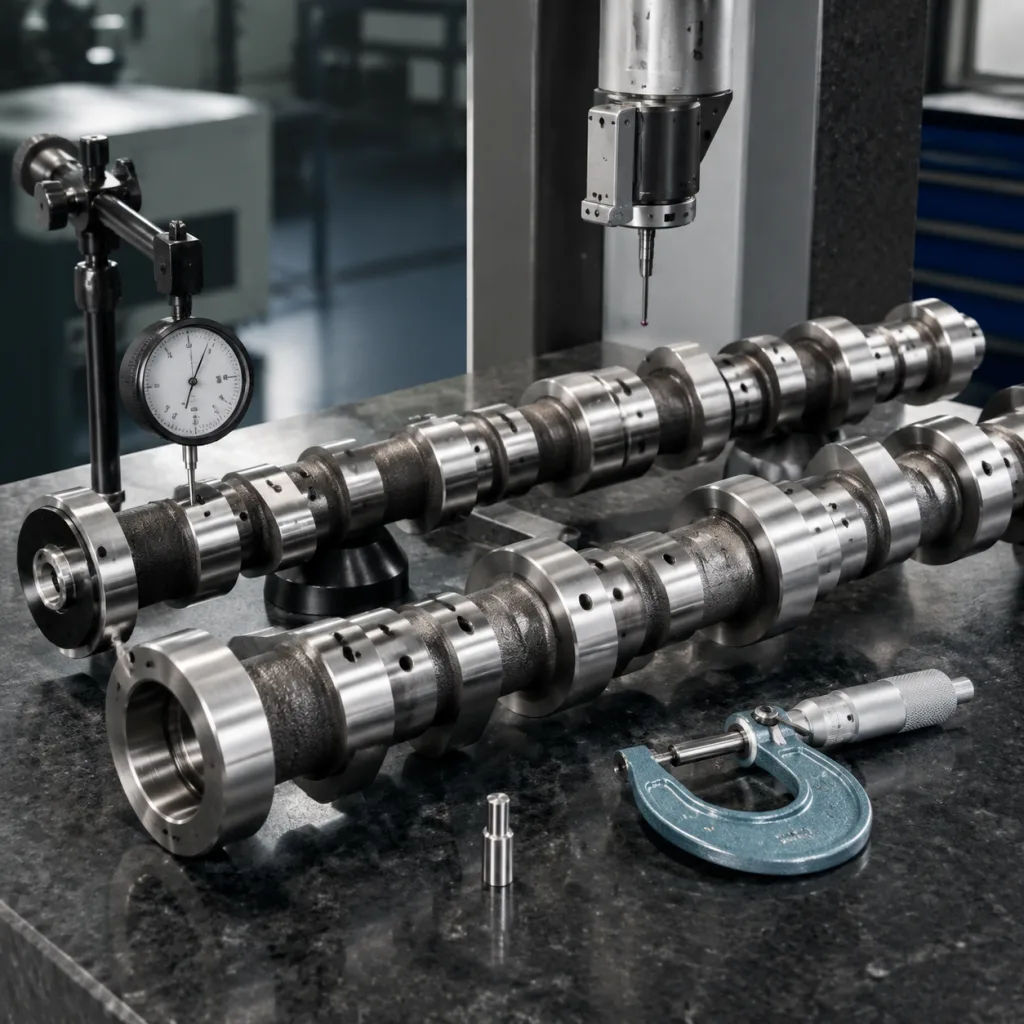
Agree which tolerances are print-controlled and which are supplier process targets. Common aftermarket control ranges are journal diameter within ±0.010 mm to ±0.020 mm, lobe lift within ±0.020 mm to ±0.030 mm, total runout within 0.030 mm to 0.050 mm, thrust width within ±0.030 mm, and dowel or trigger angular position within ±0.5° to ±1.0°. These figures must be confirmed against the actual engine design, bearing clearance and follower type; they are not a substitute for the buyer's final drawing.
Failure mode
Dimension to control
Typical control method
Low oil pressure or journal scoring
Journal diameter and roundness
Micrometer, air gauge and roundness check
Incorrect valve event
Lobe lift and lobe centreline
CMM or cam profile measuring machine
Lash or follower contact issue
Base circle
Profile trace and sample comparison
Vibration or uneven journal loading
Runout
Between-centres inspection or V-block check
Timing offset
Dowel/key position
Fixture gauge and angular measurement
Excessive end-float
Thrust face width
Caliper, CMM or dedicated gauge
VVT response issue
Oil feed path
Bore gauge, air check, pin gauge or borescope
Cam/crank correlation fault
Trigger feature angle
Datum-based angular inspection
</tr></thead><tbody> </tbody></table>For initial approval, Driventus can work from samples, drawings or buyer-controlled specifications through custom manufacturing. A sound approval package includes a ballooned drawing, full dimensional report for 3 to 5 samples, cam-profile traces, material certificate, hardness results and photos of the timing-interface setup. No vehicle manufacturer approval is implied or claimed.
Material and Surface Specs That Decide Service Life
The camshaft lives in a harsh contact environment. Lobes and followers see rolling and sliding load under boundary lubrication, especially during cold starts, extended drain intervals and temporary oil starvation. Material choice therefore depends on the original design, follower type, expected duty cycle and price target. Common options include chilled cast iron, alloy cast iron and forged or machined steel for selected applications.
The base material is only the starting point. Buyers should define hardness, case depth where applicable, lobe surface finish, journal finish and cleanliness limits. Surface finish is not cosmetic. Excessive roughness accelerates follower wear; uncontrolled polishing can change the effective cam profile or reduce oil-film stability.
Typical replacement-program targets include lobe hardness around 50-60 HRC for hardened steel designs or an equivalent chilled-iron hardness scale agreed by the drawing. Journal hardness may be lower where the OE design requires machinability and bearing compatibility. Lobe surface roughness is commonly Ra 0.2-0.4 µm after finishing, while journal roughness is commonly Ra 0.15-0.30 µm. For induction-hardened steel camshafts, specify effective case depth and hardness cut-off, often in the 1.0-2.5 mm range depending on section size and OE construction.
A usable sourcing specification should answer these points:
Which material grade or buyer-approved equivalent is allowed, such as alloy cast iron or 45/40Cr-class steel where suitable?
What lobe hardness range, test location and inspection frequency apply per batch?
What journal hardness and surface finish are required?
Is case depth or hardened layer depth required?
What straightness, concentricity and runout limits apply after heat treatment and final grinding?
How must oil holes, chamfers and machined edges be deburred?
What cleanliness target applies to oil passages, including no loose chips, blasting media or burrs?
Which rust-prevention method protects the shaft for 60-120 days of sea freight and warehouse storage?
How is traceability maintained by batch, heat number, furnace lot or production lot?
Process routing matters as much as the written spec. Confirm whether the supplier controls casting or forging source approval, rough machining, stress relief where required, heat treatment, straightening, finish grinding, polishing, washing, rust prevention and final inspection. For regulated markets, documentation may also need to address REACH (EC) No 1907/2006 for chemical substances in coatings, packaging or corrosion inhibitors. Driventus aligns production controls with its quality system, including incoming material checks, process inspection and final verification.
A Validation Path for Low-Risk Launches
Validation should match channel risk. A distributor stocking broad but slow-moving coverage may only need dimensional, hardness and material reports. A multi-location repair chain has more exposure and may require installation trials, hot and cold noise checks, oil-pressure observation and warranty return analysis before national release.
Build the launch in stages: sample approval, pilot-lot inspection, production part approval documentation where contractually required, then ongoing batch monitoring. IATF 16949:2016 does not approve an individual part by itself, but it does provide a structured framework for process control, corrective action, traceability and change management. ISO 9001:2015 supports documented quality management and continual improvement requirements.
For a new camshaft Nissan replacement SKU, buyers commonly use 3 to 5 initial samples for dimensional and bench review. A pilot lot of 20 to 50 pieces should follow before full stocking. Higher-risk or high-volume programs should add engine installation checks covering cold start, idle stability, oil pressure, cam/crank correlation, VVT response and fault-code scan. If the buyer operates repair shops, a 30- to 90-day controlled field trial can expose packaging, fitment and installation issues before a national launch.
Request evidence that covers the real failure points:
Profile measurement for every critical lobe family, with intake and exhaust reports separated
Hardness testing on lobes and journals, with test marks outside functional contact zones where possible
Metallurgical review when material, foundry, forging source or heat treatment changes
Magnetic particle or crack inspection where specified by drawing or risk review
Trial assembly with cam caps, followers, seals and phaser interface
Oil passage cleanliness, burr inspection and edge-condition review
Timing feature verification against the agreed datum, not against package label only
Packaging drop or vibration checks for export cartons
Ongoing control should define sampling clearly. A typical production plan may use 100% visual inspection, 100% runout or straightness screening for sensitive designs, full profile inspection on first-off and last-off parts, and batch sampling for hardness, journal diameter and surface finish. Emissions standards such as ECE R-83 may affect the engine system in which the part operates. In most aftermarket sourcing programs, however, a replacement camshaft is evaluated by fit, durability, timing accuracy and engine function rather than certified as an emissions device on its own.
The Hidden Cost of Bad Packing and Paperwork
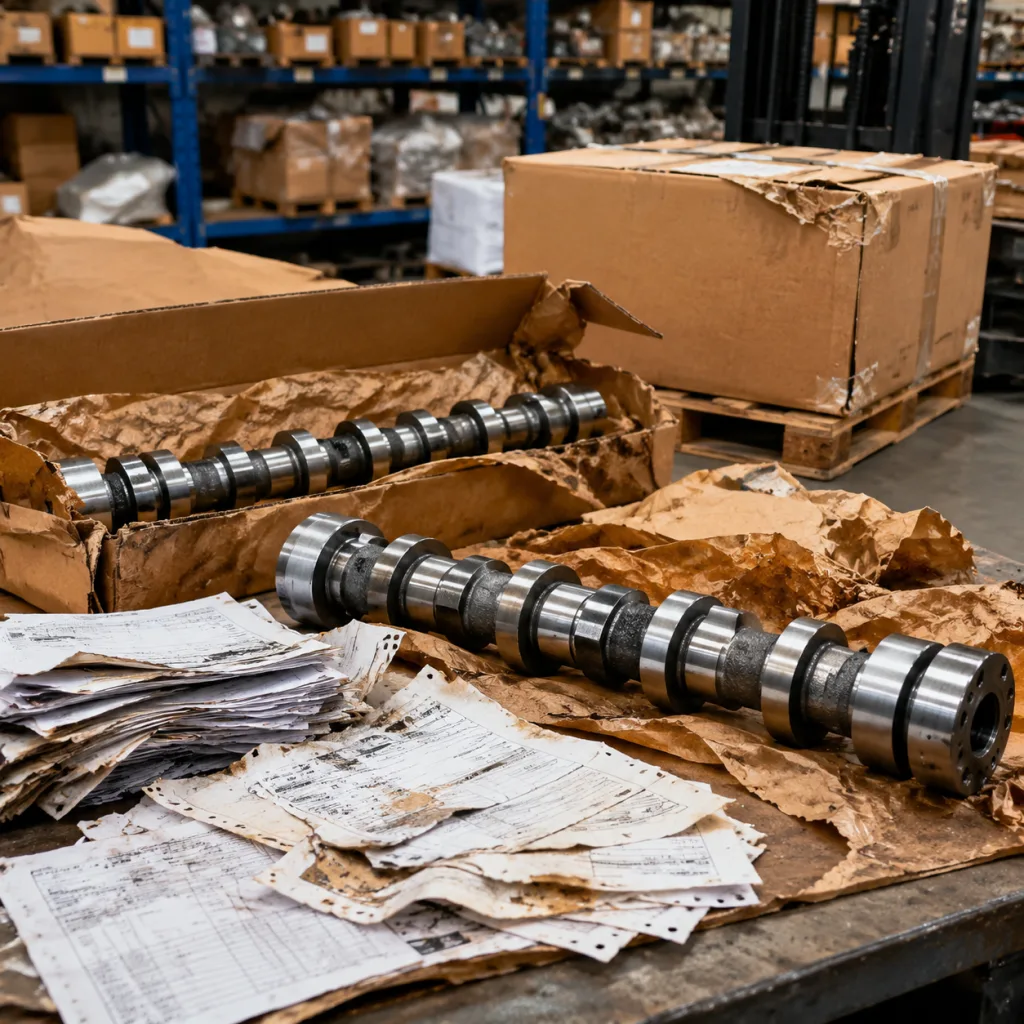
A technically correct camshaft can still lose money if it arrives corroded, mislabelled or mixed with a similar intake or exhaust variant. Packaging must protect machined lobes, journals, thrust faces and timing features from contact damage during container movement, customs handling and warehouse storage.
For B2B shipments, specify VCI protection or approved anti-rust oil, individual sleeves or moulded supports, carton strength, pallet configuration and barcode format. For private-label programs, include artwork control, label revision approval and carton drop-test expectations in the purchase agreement. A practical export pack is one camshaft per inner box or sleeve, fixed at journals rather than lobes, with end protection for dowels, trigger features and threaded bores. Heavy camshafts should not float inside cartons or contact another shaft during vibration.
Match packaging choice to MOQ and freight cost. Neutral bulk packing may suit wholesalers ordering 300 to 1,000 pieces per SKU. Private-label retail cartons usually make sense when the buyer can commit to higher carton print quantities or accept shared carton dimensions with SKU-specific labels. For mixed orders, require clear intake/exhaust segregation, carton-level SKU labels, pallet maps and a packing list that matches the physical pallet sequence.
Import documentation should be aligned before mass production. Typical files include commercial invoice, packing list, country-of-origin statement where applicable, material declaration when requested, inspection report and batch traceability record. For customers in the EU, UK, US, Canada, Australia and Brazil, HS code review, destination labelling rules, wood-packing requirements and packaging waste obligations should be confirmed by the importer or customs broker.
The supply agreement should also define the non-conforming product process: containment time, photo evidence, sorting responsibility, replacement shipment terms and corrective action format. Set response targets, such as 24-48 hours for containment confirmation and 5-10 working days for an 8D or corrective-action report when a batch issue is confirmed. Clear rules reduce slow email cycles when a distributor has vehicles waiting for repair and limited local stock.
Supplier Questions That Separate Price From Value
A camshaft supplier should be judged on engineering control, repeatability and export discipline. Unit price matters, but warranty exposure, labour reimbursement and channel disruption usually cost more than a controlled inspection plan. Ask for evidence before placing a production order. Keep golden samples for future comparison.
Discuss MOQ, price and lead time early because they change with process route and validation scope. As a planning reference, new sample development often requires 30-60 days after sample or drawing confirmation. Pilot production may require another 30-45 days. Repeat production commonly runs 35-60 days depending on machining capacity, heat treatment and packing complexity. MOQ may be lower for existing designs or shared blanks, while new tooling, private-label cartons or low-frequency applications usually require higher commitments.
Compare total landed cost, not only EXW unit price. Machining complexity, hardness route, inspection level, packaging, inland freight, duty, ocean freight and expected warranty rate all affect the real cost per saleable unit.
Use these questions in supplier review:
Can the factory measure full cam profiles, not only overall dimensions?
Are lobe hardness, journal finish, runout and timing-feature angle recorded by batch?
Is traceability maintained from material receipt to final packing and carton label?
Can intake and exhaust variants be physically segregated during machining, inspection and packing?
Are control plans, inspection reports and corrective-action documents available in English?
Does the supplier operate under IATF 16949:2016 and ISO 9001:2015?
Can the factory support private label, neutral packing, bulk packing and barcode rules?
How are engineering changes, tooling revisions and non-conforming lots communicated?
A buyer-ready RFQ should state target annual quantity, first-order quantity, replenishment frequency, Incoterms, required documents, warranty expectations and whether PPAP-style documentation is needed. Driventus supplies aftermarket engine components to distributors, wholesalers, OEM/Tier-1 programs and repair-chain buyers in more than 60 countries. The company can support sample-based development, drawing-controlled production and range expansion for Nissan-fit applications. For a camshaft Nissan replacement enquiry, include engine code, target annual volume, packaging preference and any required inspection format when you request a quote.
Frequently asked questions
Provide engine code, model year range, intake or exhaust position, OE reference where available, sample or drawing, target market, annual volume, first-order quantity and packaging requirement. Photos of timing features, sensor trigger areas and phaser interfaces help avoid incorrect variants.
Yes. Driventus can review buyer drawings, samples or 3D data for custom manufacturing. Feasibility depends on material, profile tolerance, heat-treatment requirement, MOQ, annual volume, tooling requirement and validation scope.
No. Driventus is an independent aftermarket manufacturer; brand names are referenced for fitment only. No approval, endorsement or sponsorship by any vehicle manufacturer is claimed.
For sourcing review, send the engine code, sample photos, target annual volume, first-order quantity and inspection requirements. Driventus can confirm feasibility, MOQ, lead time, validation scope and packing options through /contact.html