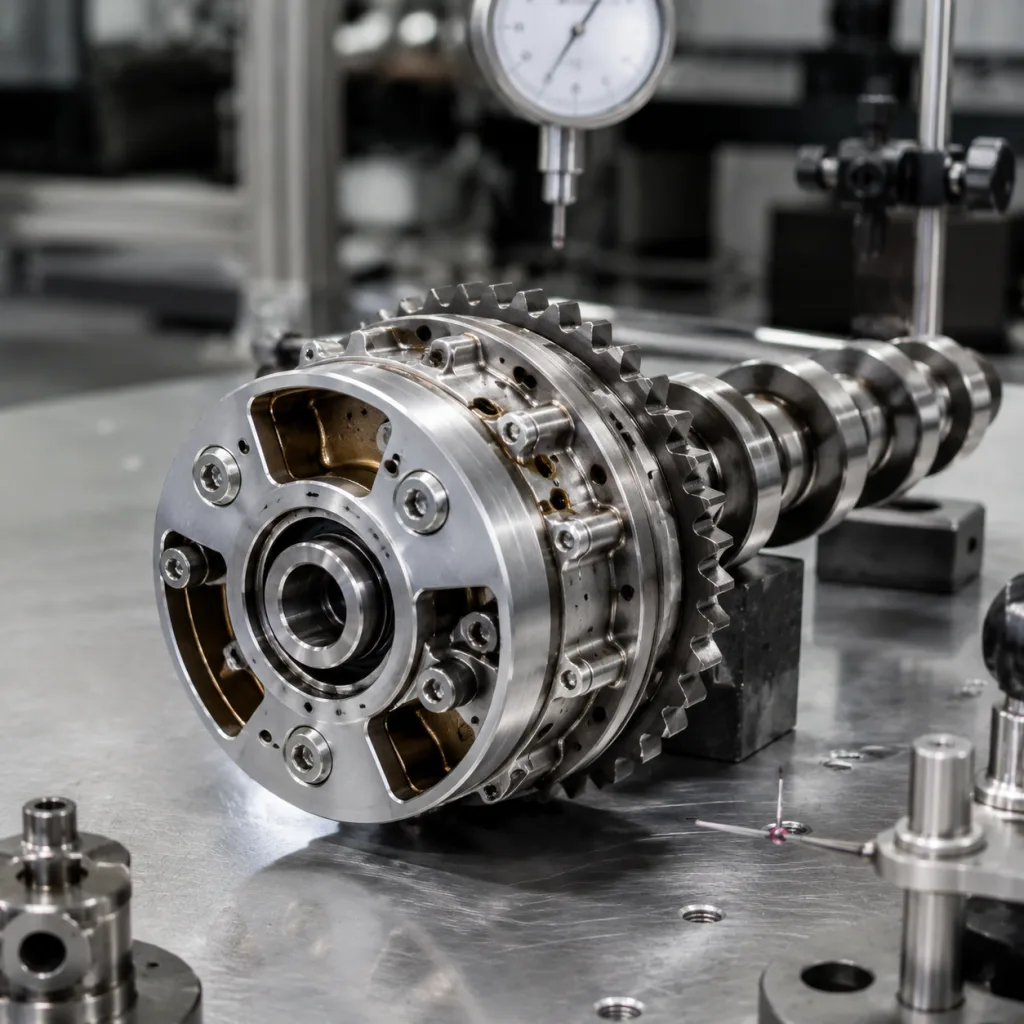
Camshaft for Lexus IS Aftermarket Replacement Sourcing
A camshaft for Lexus IS aftermarket replacement is a precision engine component, not a catalogue filler. One wrong bank, trigger feature, oil hole, or lobe phase can turn a low-cost import line into noise complaints, timing faults, bearing damage, and warranty arguments. For distributors, repair chains, and sourcing engineers, the buying decision should start with fitment proof and measurable process control: engine code, intake or exhaust position, bank location, variable valve timing interface, cam-position sensor feature, journal layout, lobe geometry, oil-feed design, thrust control, hardness, runout, and export protection. Driventus manufactures engine and powertrain components in Taizhou, Zhejiang, for B2B aftermarket and OE-service channels in more than 60 countries. This article gives a practical procurement framework for Lexus IS camshaft replacement programmes, from first application mapping through inspection evidence, MOQ planning, packaging, and supplier audit questions. Driventus is an independent aftermarket manufacturer; brand names are referenced for fitment only.
Start With the Fitment Decision, Not the Catalogue Line
The Lexus IS platform has used different petrol engine families across generations and markets, including inline-four and V6 layouts. That means a sourcing programme cannot safely begin with one broad catalogue description. It has to begin with a decision tree: which engine, which year range, which market, which camshaft position, which bank, and which timing-control interface?
For a camshaft for Lexus IS aftermarket replacement, the supplier should confirm fitment by engine code, production year range, market region, intake or exhaust position, bank 1 or bank 2 where relevant, variable valve timing actuator interface, cam-position sensor feature, and OE part-number cross-reference where available. Do not accept a fitment claim that only says “Lexus IS camshaft” unless the engineering basis is visible.
A practical RFQ should ask the factory to return a fitment matrix with these columns:
Model year and destination market
Engine code and displacement
Intake or exhaust position
Bank 1 or bank 2 where applicable
Timing actuator type and locating feature
Cam-position sensor trigger, slot, tooth, or machined reference feature
Reference number and internal distributor number
Drawing, sample, or validated data source used for approval
The decision point is simple. If two references look similar but differ in lobe phasing, trigger angle, oil-feed position, thrust face location, or actuator interface, they are not interchangeable without evidence.
Key fitment checks include:
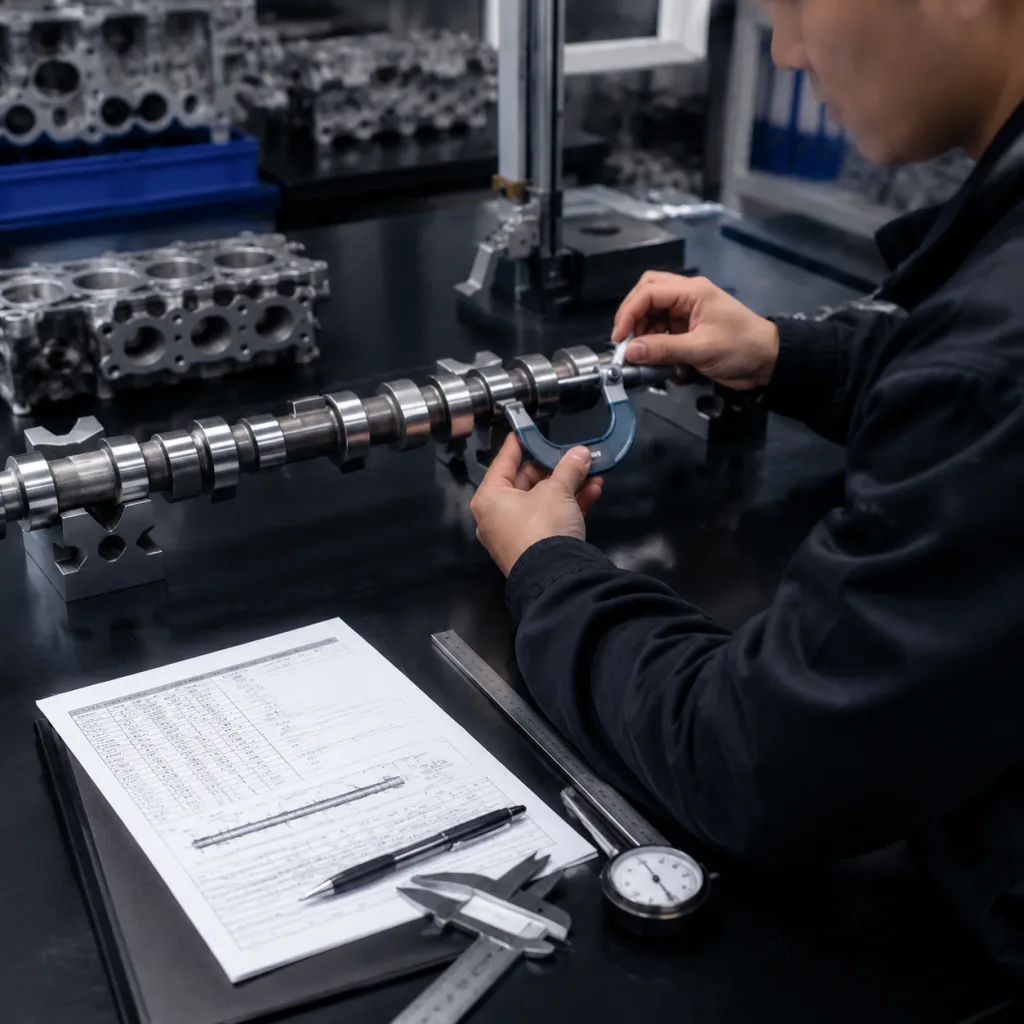
Overall length, journal count, and journal sequence, verified with caliper, height gauge, and fixture records
Lobe count, lobe orientation, and firing-order relationship, checked against a master sample or CAD/profile data
Intake or exhaust identification, including left/right or bank markings on the part or label if requested
Variable valve timing actuator geometry, dowel or locating feature, bolt pattern, centre hole, and fastening method
Cam-position sensor trigger feature, with angular position controlled against agreed datum surfaces
Oil passage location, diameter, deburring, and cleanliness, including confirmation that cross-drilled holes remain open after washing
Thrust face width, axial control surface finish, and end-play control area, because small errors can cause noise or timing drift
Packaging label data for warehouse, importer, and repair-chain use, including part number, position, batch code, quantity, and country of origin where required
For first sourcing, buyers should send at least one used or new sample per camshaft position, plus a vehicle application file and any historical claim notes. If no drawing exists, request a reverse-engineering report that defines the datum scheme, critical-to-quality dimensions, and surfaces that cannot be trusted from a worn sample alone. Driventus can review buyer samples, drawings, or validated cross-reference files and align them with our catalog, including related engine parts listed under engine components. No claim of vehicle manufacturer approval is implied.
Where Aftermarket Camshafts Usually Fail
Camshaft failures rarely come from one visible defect. More often, the part looks correct in the box but carries a hidden process weakness: shallow hardening, poor lobe profile control, excessive runout, blocked oil passages, wrong surface finish, or an angular error at the timing interface.
Procurement teams should review the camshaft as a system of contact zones. The lobe surface, journal surface, oil-feed holes, straightness, thrust face, and timing interface all have to work together. A clean casting with poor hardness depth can wear early. A hard lobe with incorrect profile can create valve-train noise. A correct journal diameter with rough finish can damage bearings during start-up.
Common manufacturing routes include chilled cast iron, ductile iron, and forged or machined steel, depending on engine design, valve-train contact type, expected volume, and cost target. The selected route should match the original duty cycle, follower or rocker contact condition, lubrication environment, and wear requirement. In an RFQ, the material line should not say only “OE quality.” It should state the agreed blank route, target hardness method, surface finish, straightness control, and whether the blank is existing, modified, or newly tooled.
Failure mode to prevent
Control item to specify
Practical range or method to agree
Bearing noise or oil-film instability
Journal diameter
Drawing-controlled; many programmes use ±0.005–0.015 mm depending on bearing design
Local scoring or uneven bearing load
Journal roundness/cylindricity
Commonly controlled within 0.005–0.010 mm where required by design
Timing variation, assembly noise, or journal loading
Camshaft runout
Often ≤0.03–0.05 mm TIR, measured on centres or V-blocks by agreed datum method
Low power, rough running, or valve-train complaints
Lobe lift and base circle
Lift commonly within ±0.02–0.05 mm; profile compared with master data or CMM trace
Diagnostic faults or valve timing error
Lobe angular position
Typically within ±0.5–1.0° where timing sensitivity is high
Lobe, follower, or journal wear
Surface hardness
Verified after heat treatment, induction hardening, or chilling; scale and depth must be stated
Start-up wear or bearing distress
Surface roughness
Journals often around Ra 0.2–0.4 µm; thrust and non-contact areas by drawing
Early oil starvation or debris scoring
Oil hole cleanliness
Visual, air-flow, and particle-control inspection after washing and deburring
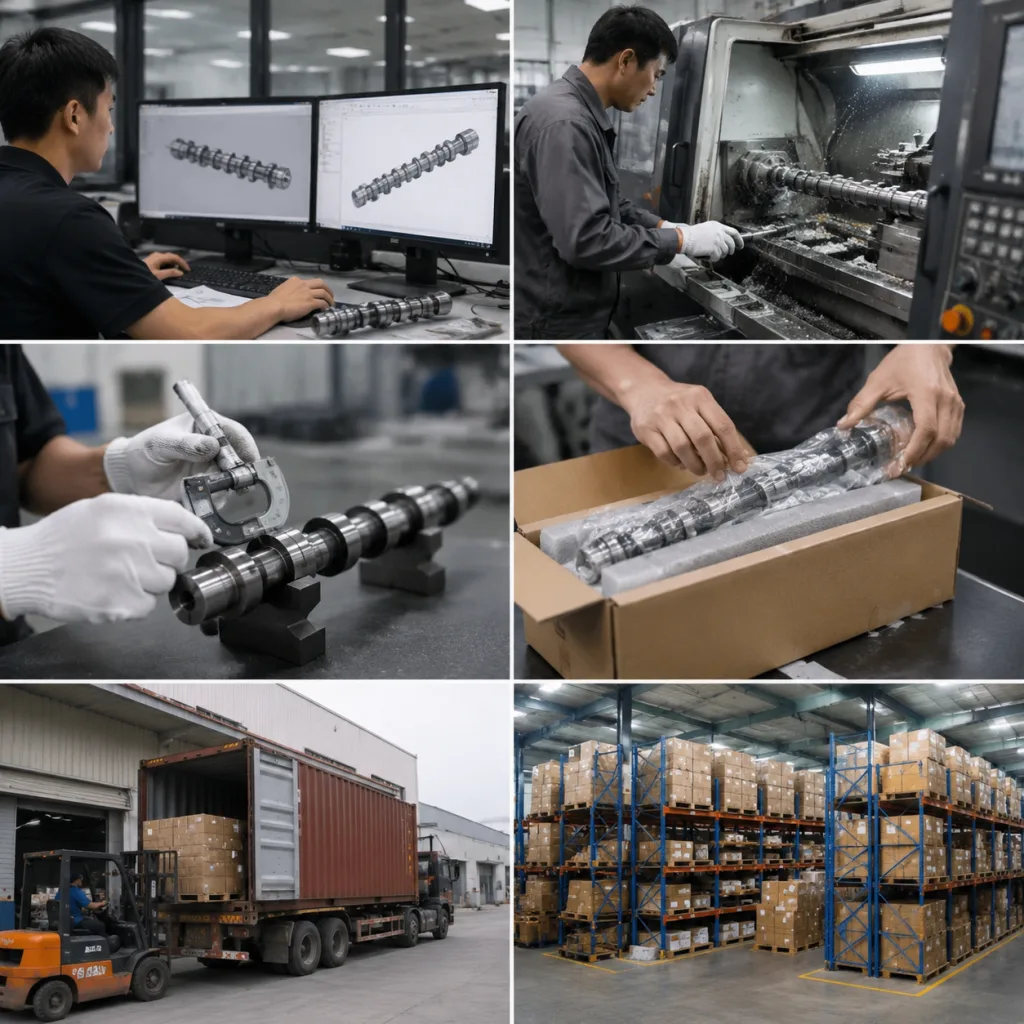
</tr></thead><tbody> </tbody></table>A workable control plan usually includes incoming blank inspection, rough machining, stress-relief or heat-treatment control where applicable, centre-hole protection, CNC turning, drilling, deburring, grinding, washing, magnetic or visual defect inspection as specified, final oiling, and protected packing. Buyers should ask which dimensions are checked 100%, which are sampled by batch, and which require SPC records.
Driventus applies controlled casting or forging sourcing, CNC machining, grinding, washing, and final inspection under documented process controls. The production route is selected according to the target camshaft family, annual volume, buyer specification, and inspection evidence required for the channel.
The Inspection File That Should Exist Before Shipment
A replacement camshaft programme needs two layers of proof. Development validation shows that the design and production route are suitable for the target application. Routine production inspection shows that the shipment still follows the approved control plan after material, tooling, operator, or process changes.
A useful validation file may include:
Dimensional layout report against approved drawing or master sample, covering journals, lobes, shoulders, thrust faces, oil holes, and timing interfaces
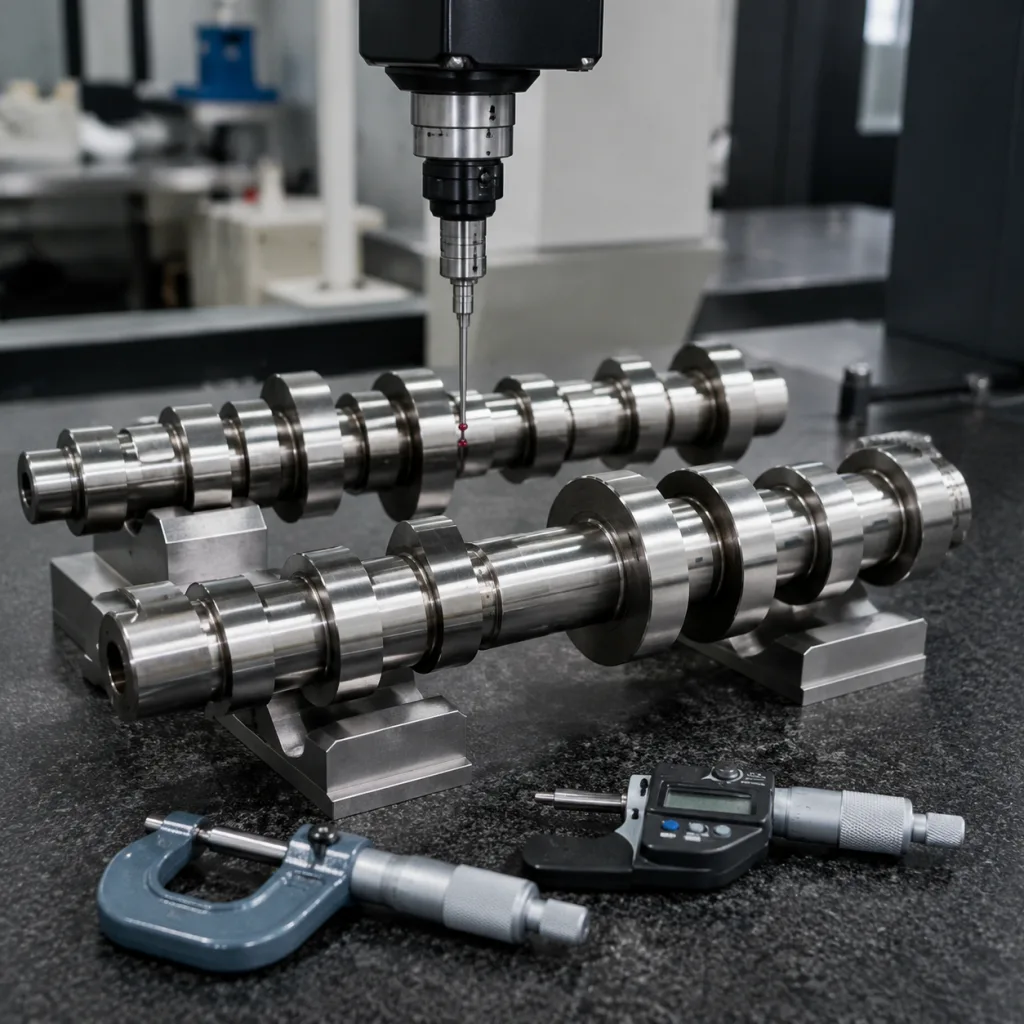
Lobe profile measurement, including lift, duration reference points, flank shape, nose radius, base circle, and angular relationship to the timing datum
Journal diameter, roundness, cylindricity, and surface-finish report using agreed measuring tools and gauge calibration records
Straightness or runout record, stating whether the part was measured between centres, on V-blocks, or in a dedicated fixture
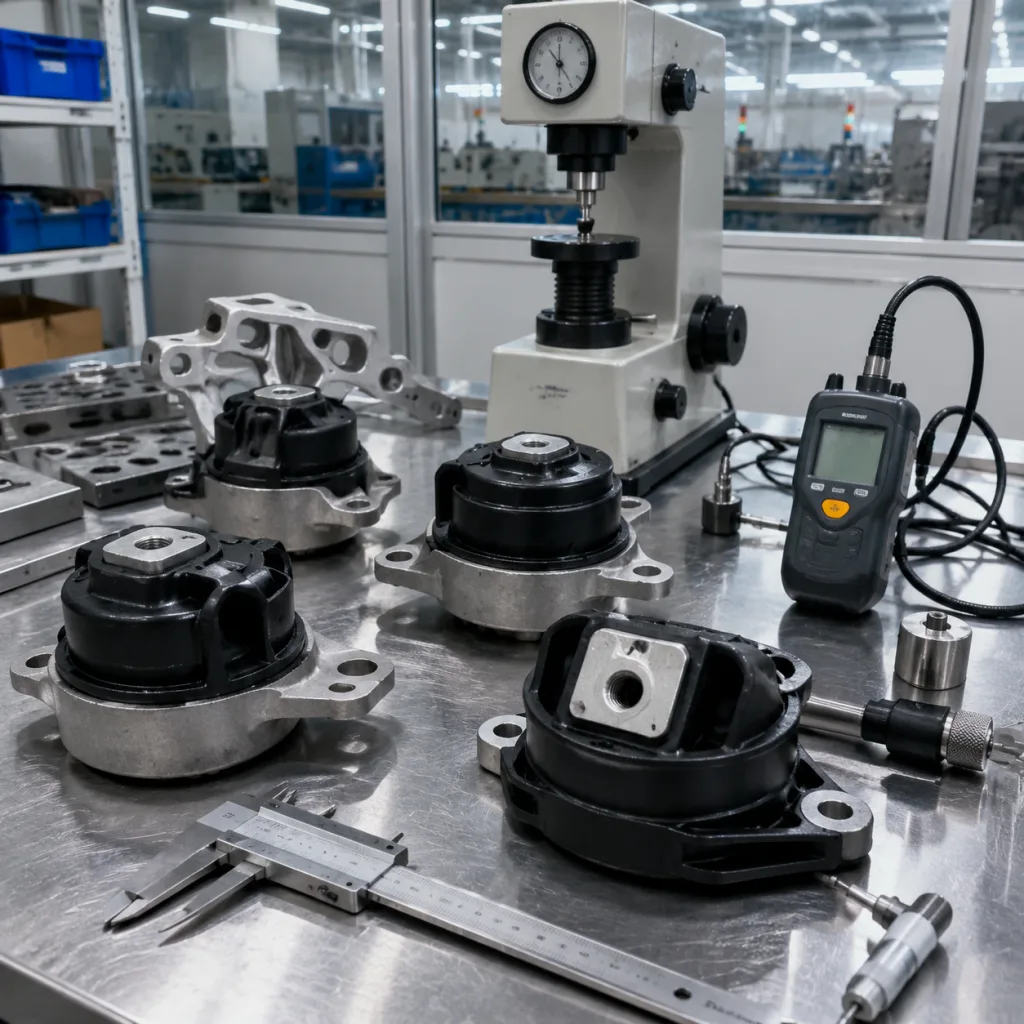
Hardness report with method identified, such as Rockwell, Brinell, Vickers, or Shore where applicable, plus test location and acceptance range
Metallographic review for casting structure, chill depth, carbide distribution, nodularity, decarburisation, or heat-treatment consistency when required
Surface roughness readings for journals, thrust faces, lobes, and critical contact surfaces, with Ra/Rz values where specified
Oil passage cleanliness inspection after washing and deburring, including air-flow check or particle limit when buyer standards require it
Trial-fit confirmation with timing actuator, cam sensor feature, bearing caps, and thrust control where available
Packaging drop or vibration checks for export cartons when requested, especially for mixed-SKU sea shipments
For higher-risk launches, buyers may request PPAP-style documentation even when the project is aftermarket rather than an OE nomination. A lean aftermarket package normally includes dimensional layout, material certificate, hardness report, surface-roughness report, process flow, control plan, first-article inspection report, appearance standard, packing standard, and sample approval record. Repeat production can usually move to batch inspection records and certificates defined in the purchase order.
Ask one more question before approving the file: what happens when a batch is out of tolerance? The answer should include segregation, root-cause review, corrective action, replacement timing, and traceability back to production batch.
Driventus operates to IATF 16949:2016 and ISO 9001:2015 principles through its quality system, including incoming inspection, in-process inspection, final inspection, nonconforming material control, corrective action, and traceability by production batch.
Environmental and market access requirements should be addressed at sourcing stage. For EU supply, material declarations may need to support REACH (EC) No 1907/2006 obligations. For packaging, buyers may specify 5-layer export cartons, inner sleeves or VCI bags, anti-rust oil coverage, desiccant for humid lanes, pallet height limits, gross-weight limits, barcode structure, and labelling format by destination market.
“OE-Equivalent” Needs a Boundary Line
OE-equivalent is useful only when the buyer defines what it covers. In a camshaft project, it should mean the aftermarket part matches the functional geometry, installation interfaces, lubrication paths, and durability requirements of the intended engine application. It should not mean unsupported use of brand-owned part numbers, uncontrolled copying, or a claim of endorsement by a vehicle manufacturer.
A defensible replacement project normally uses one or more of these fitment foundations:
Buyer-supplied sample with confirmed application data and a note stating whether the sample is new, used, worn, or previously rebuilt
Buyer drawing with critical-to-quality dimensions marked, including datums, tolerances, material route, heat-treatment requirements, and surface finish
Verified aftermarket cross-reference database, checked against engine code, model year, market region, and camshaft position
Engine-code and model-year application table, separated by intake/exhaust and bank where applicable
Controlled reverse engineering where legally permitted, with a measurement report and engineering judgement on worn surfaces
The approval boundary should be written before production. A buyer may approve one camshaft position for one engine family and one market range only. A visually similar camshaft for another bank, timing actuator, or model year remains unapproved until proven. If the supplier proposes consolidation across multiple references, ask for evidence that lobe phasing, sensor trigger position, oil-feed holes, thrust face location, and actuator interface are identical or functionally interchangeable.
This boundary also protects the importer. It makes clear which applications can be sold, which references require more validation, and which claims fall outside the approved scope.
Driventus can support custom manufacturing for private-label distributors, importers, and repair-chain programmes. This may include buyer-specific packaging, inspection reports, batch labels, carton labels, and agreed sampling levels. For any Lexus IS camshaft programme, brand names are used only to describe fitment. Driventus is an independent aftermarket manufacturer; brand names are referenced for fitment only.
A useful sourcing rule is blunt: if the supplier cannot explain which dimensions are critical, why they matter, how they are measured, and what happens when a batch fails inspection, the part should not be approved for a repair-chain or wholesale programme.
A Step-by-Step RFQ Path for Importers and Repair Chains
Before placing a blanket order, turn fitment and quality expectations into a written specification. This prevents quotation gaps and forces the factory to price the correct process instead of the cheapest approximation. The RFQ should state whether the buyer needs a catalogue replacement, a private-label boxed item, a repair-chain controlled part, or a programme with first-article approval and batch records.
Use this RFQ path:
1. Confirm engine code, production year range, market region, camshaft position, and bank location where relevant. 2. Provide a sample, drawing, or verified cross-reference file before tooling or launch. 3. Define material route and heat-treatment, induction-hardening, or chilling requirement, including target hardness and test method. 4. Agree critical dimensions, tolerance bands, measuring tools, inspection method, and whether measurement is 100% or sampled. 5. Request first-article inspection before production release, with sample quantity agreed in advance, commonly 3–10 pieces per reference. 6. Define routine inspection frequency for journals, lobes, runout, hardness, roughness, oil holes, timing interfaces, and appearance. 7. Confirm anti-corrosion oil, sleeve protection, carton strength, pallet limits, moisture protection, and minimum rust-prevention period. 8. Require batch traceability on part label, carton label, packing list, and inspection record. 9. Review supplier certificates for IATF 16949:2016 and ISO 9001:2015 where applicable. 10. Agree claim-handling process, evidence requirements, containment timing, replacement policy, and credit-note rules.
MOQ and lead time should be discussed by manufacturing status, not as a fixed catalogue promise. Existing tooled camshafts with standard neutral packaging may carry lower MOQs, often from several dozen to a few hundred pieces per reference depending on stock, batch size, and export packing efficiency. Private-label packaging can raise MOQ because printed boxes, labels, inserts, and carton artwork have separate minimums. New applications requiring a casting, forging, fixture, or profile programme normally need a development batch, sample approval, and a larger commercial order to absorb tooling and setup cost.
Price follows the same logic. Unit cost is affected by blank route, machining time, grinding cycle, heat-treatment or chilling control, inspection level, scrap allowance, packaging, order quantity, and whether the buyer needs reports with every shipment. When comparing quotations, ask whether tooling, sample freight, private-label artwork, inspection reports, pallets, and export cartons are included or charged separately.
For planning, separate the timeline into engineering review, sample manufacture, first-article report, pilot order, and repeat-order lead time. Existing references may move quickly after order confirmation and packing preparation. Newly developed references usually need sample review, drawing confirmation, tooling if needed, first-article inspection, pilot shipment approval, and production release.
A camshaft for Lexus IS aftermarket replacement should be bought as a controlled mechanical part with traceable measurements, not as a catalogue-only line item.
Scenario: Turning a Camshaft Enquiry Into a Controlled Programme
A typical enquiry starts with a short message: “Need Lexus IS camshaft, aftermarket replacement, private label, quote MOQ.” That is not enough to quote responsibly. Driventus first separates the project into application risk, engineering evidence, manufacturing status, documentation level, and packing requirement.
The usual workflow is:
1. Application confirmation by engine code, model year, market, intake/exhaust position, and bank where relevant. 2. Sample, drawing, or validated reference review, with critical dimensions highlighted for buyer approval. 3. Manufacturability assessment, including blank route, machining sequence, grinding method, heat-treatment or chilling requirement, and inspection points. 4. Quotation split by existing-part supply, modified-part development, or new-tooling project. 5. First-article inspection and sample approval before commercial production. 6. Pilot order, claim feedback window, and production release. 7. Repeat shipment control using agreed batch records, labels, packaging, and traceability.
Typical B2B support includes:
Fitment review by engine application and camshaft position, including intake/exhaust and bank separation where relevant
Engineering comparison against buyer sample, drawing, or validated reference file, with critical dimensions highlighted for approval
Production control plan for critical dimensions and process checkpoints, including blank inspection, machining, grinding, washing, inspection, oiling, and packing
Batch inspection records when specified in the purchase agreement, such as journal size, runout, lobe lift, hardness, roughness, and appearance
Export packaging suitable for sea or air freight, using inner protection, corrosion prevention, reinforced cartons, and palletisation where required
Neutral, Driventus, or buyer-approved private-label packaging, with label fields matched to distributor ERP or warehouse requirements
Consolidation with related engine components such as gaskets, timing parts, pistons, valve-train parts, sensors, or water pumps
For buyers in the EU, UK, US, Canada, Australia, and Brazil, documentation needs vary by importer, customs route, and market channel. Driventus can align commercial documents, carton labels, packing lists, and inspection records to the buyer’s receiving process. The goal is not just shipment. It is stable fitment, predictable warehouse handling, reduced claim friction, and fewer installation disputes across distributed repair networks.
To keep RFQs efficient, buyers should prepare the target application list, annual demand estimate, target purchase quantity per release, packaging requirement, inspection expectations, sample availability, and any historical failure data. Driventus can then quote the real work: engineering, validation, tooling, documentation, MOQ, lead time, and packaging control.
Frequently asked questions
Provide engine code, model year range, market region, intake or exhaust position, bank location where relevant, timing actuator type, sensor feature, and verified cross-reference data. A physical sample or drawing helps confirm journal layout, lobe profile, oil passages, timing interface, thrust surfaces, and sensor features before quotation or production release.
Yes. Driventus supports B2B private-label programmes with agreed packaging, carton labels, batch traceability, and inspection documentation. Requirements should be confirmed during RFQ so packaging materials, label formats, testing scope, artwork approval, and minimum order quantities are quoted correctly.
No. Aftermarket fitment means the part is intended to match the relevant application requirements. It does not imply approval, sponsorship, or endorsement by any vehicle manufacturer. Driventus is an independent aftermarket manufacturer; brand names are referenced for fitment only.
For application review, sample matching, MOQ planning, or a controlled RFQ for camshaft replacement programmes, contact Driventus to [request a quote](/contact.html).