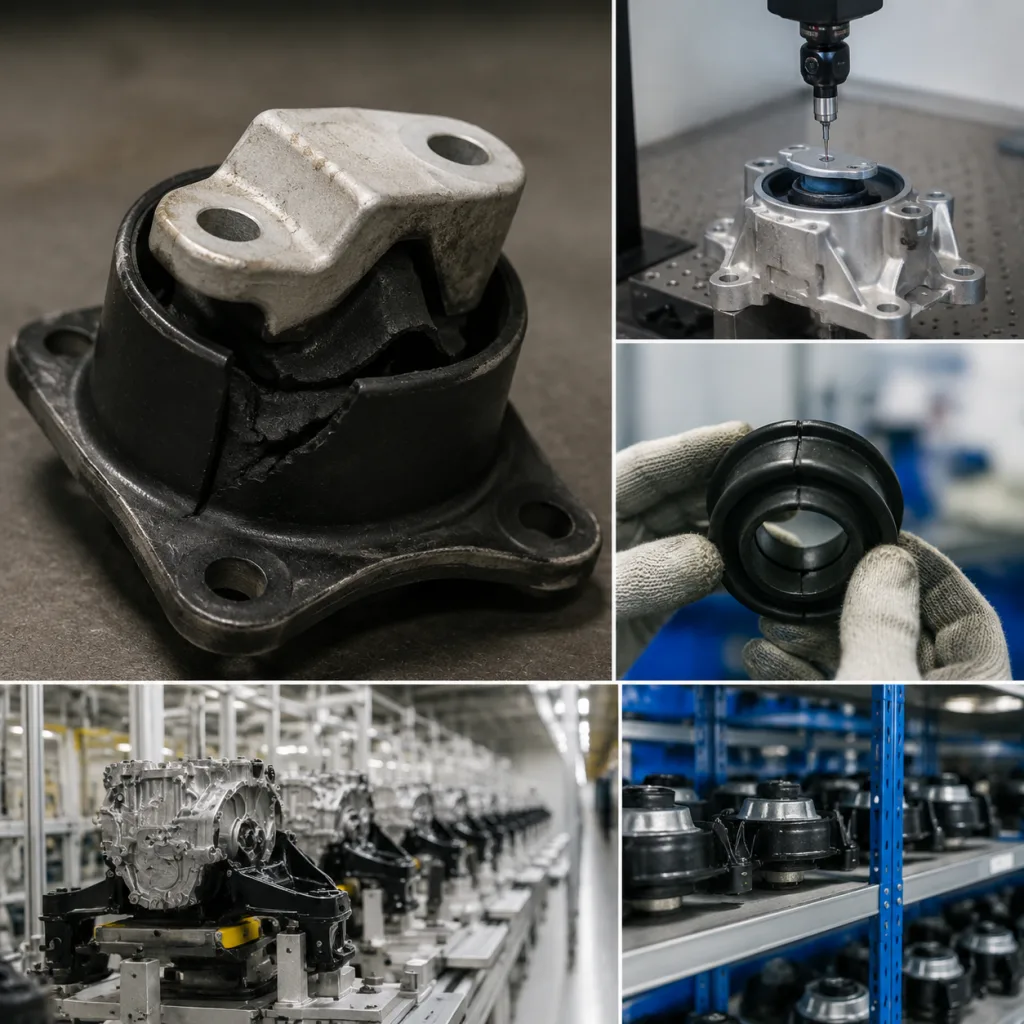
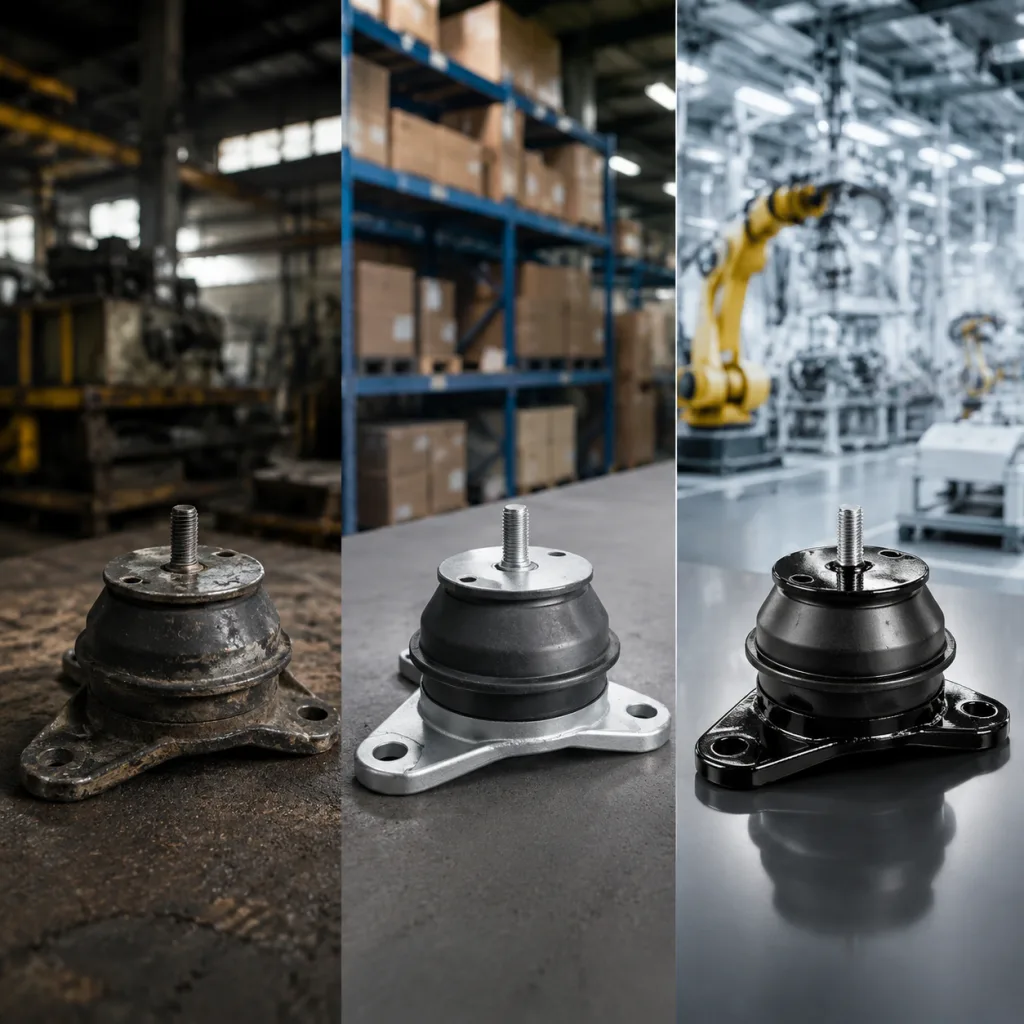
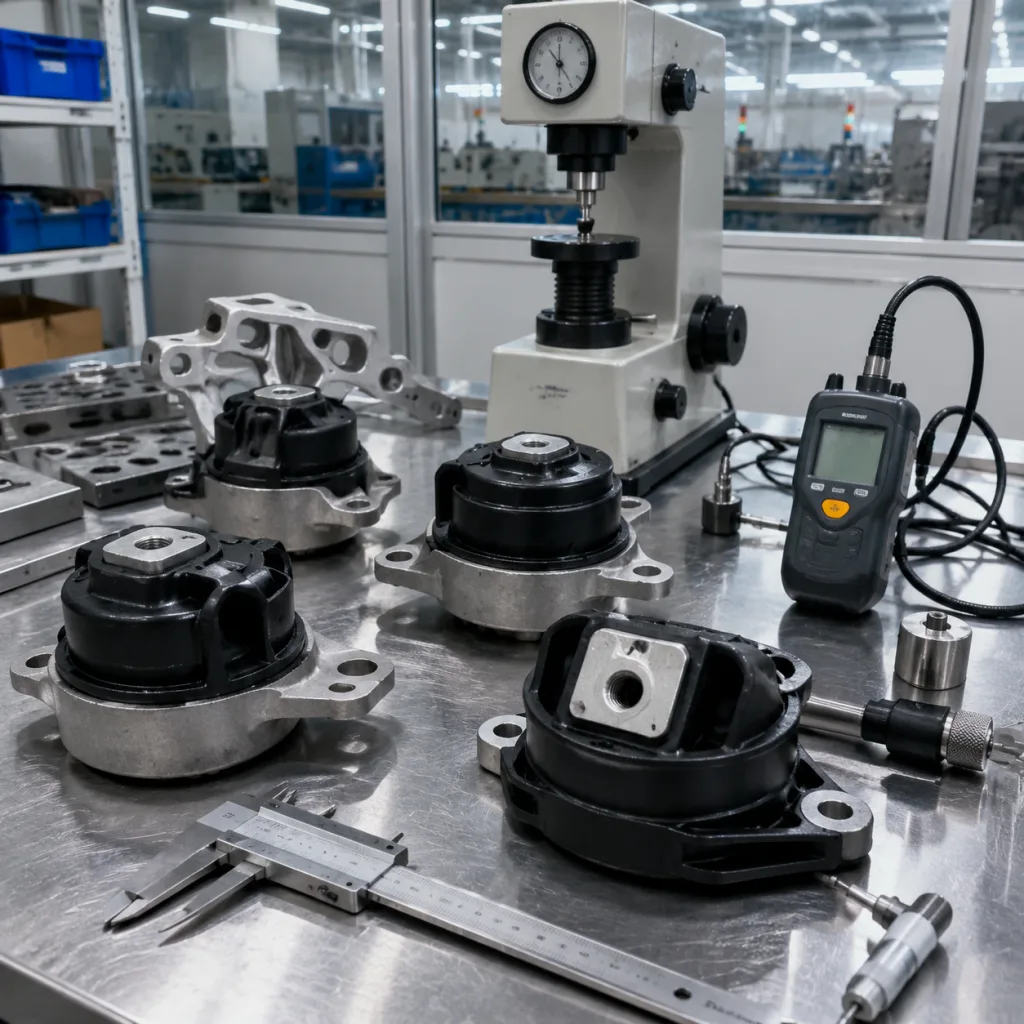
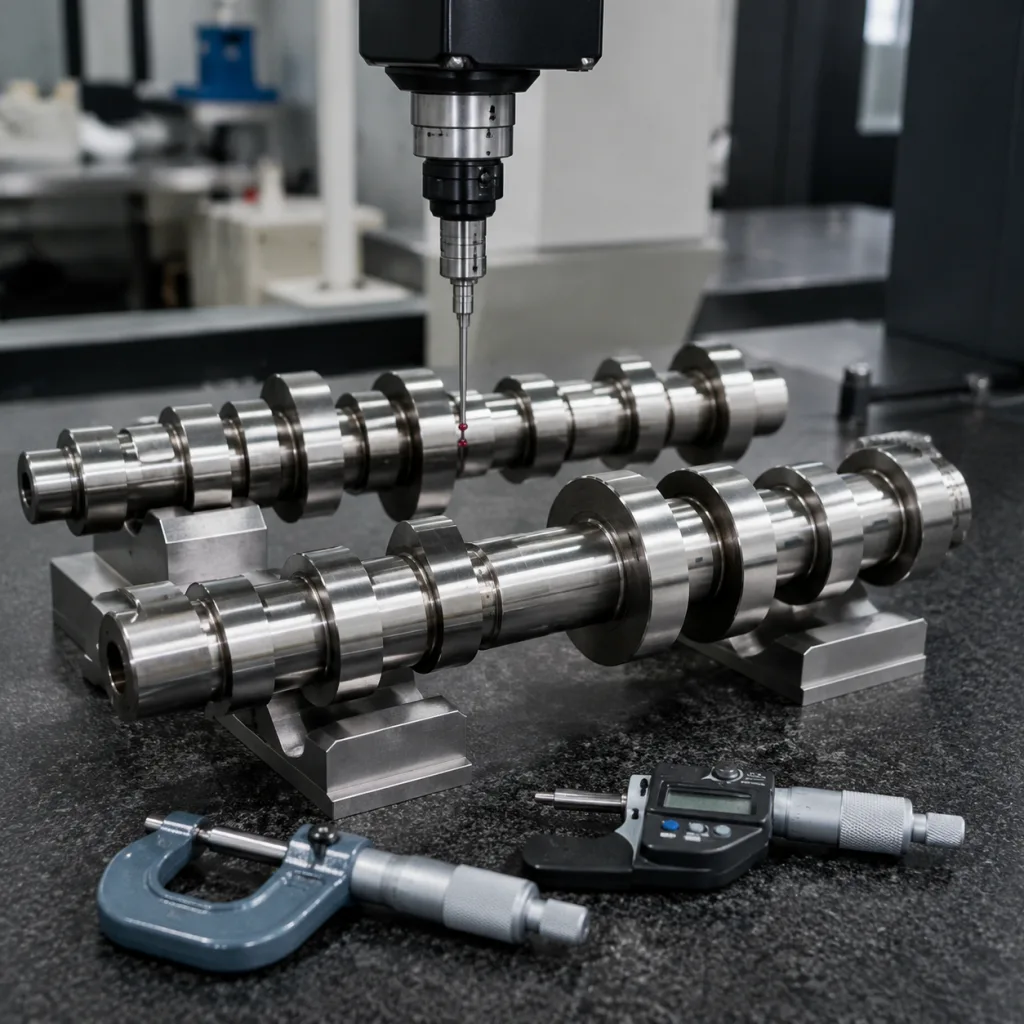
How to choose a transmission mount supplier is not mainly a price question. It is a risk question: will the supplier deliver the same geometry, hardness, bonding strength and shipment accuracy every time? A transmission mount affects NVH, drivetrain alignment, shift feel, warranty exposure and inbound logistics. It carries static drivetrain load, controls torque movement, isolates vibration, resists oil and heat, and holds bracket position through repeated acceleration and deceleration. For aftermarket distributors, repair-chain buyers, OEM teams and Tier-1 sourcing groups, the right evaluation blends engineering proof with commercial discipline. Use fitment evidence, material control, quality records, validation testing, production capacity, MOQ logic and lead-time reliability before awarding volume. Driventus manufactures engine and powertrain components in Taizhou, Zhejiang, under IATF 16949:2016 and ISO 9001:2015 systems. Driventus is an independent aftermarket manufacturer; brand names are referenced for fitment identification only.
Decision Gate 1: Prove Fitment Before Price
Start with catalogue accuracy. A cheap mount that does not fit creates returns, bay delays, customer credit claims and lost trust in the range. Ask for an application file that maps each mount to vehicle model, platform, engine code, gearbox type, production year, market region and installation position. For a buying team, the file should arrive in Excel, CSV or TecDoc-compatible format, with buyer part number, supplier part number, OE reference, EAN or UPC field, carton quantity and status code for active, superseded or discontinued items.
For aftermarket programmes, the supplier may support OE part-number cross-references where relevant, using buyer-provided references such as OE 06A… or OE 11251…. Treat broad cross-reference expansion as a warning unless it is backed by drawings, physical samples, catalogue evidence or installation checks. Two mounts can look nearly identical while differing in bracket offset, stud height, thread pitch, Shore hardness, load rating or hydraulic damping structure. Reject any proposed cross-reference where the supplier cannot confirm at least three identifiers: OE number, vehicle application and key interface dimensions.
Minimum fitment data to verify:
Vehicle make, model, platform and production year range, including month break where applicable
Engine displacement, engine code and fuel type where mount load differs
Manual, automatic, CVT or dual-clutch gearbox application
Left, right, rear, front or torque mount position
Bracket material, coating type and visible finish, such as e-coat, zinc plating or powder coating
Stud thread, bolt-hole diameter, centre distance and bracket offset, normally controlled to drawing tolerances such as ±0.2 mm on critical holes and ±0.5 mm on non-critical bracket edges
Installed height, free height and load direction, with static compression target where available
Rubber hardness range, commonly controlled within ±5 Shore A unless the drawing specifies tighter limits
Mount type: solid rubber, voided rubber, hydraulic or active-style replacement
Packaging label fields, barcode format, buyer part number, country-of-origin field and carton quantity
Ask the supplier to flag high-risk fitment SKUs before sampling. These often include cast aluminium brackets, hydraulic chambers, unusual stud angles, similar-looking manual and automatic applications, or parts affected by regional production differences. For the first 20 to 50 SKUs in a new programme, request a fitment matrix showing OE reference, supplier drawing revision, sample status, tooling status and last production date. If the supplier cannot keep this matrix current, the quote probably understates the return risk.
Buyers can review examples of current powertrain components in our catalog. For private-label numbering, buyer-specific labels or application-specific bracket changes, confirm whether the supplier can support custom manufacturing before price negotiation begins.
Spec Deep-Dive: Rubber, Metal and Bonding Controls
Transmission mounts are rubber-to-metal systems, not generic rubber blocks. Natural rubber or synthetic compounds must work with steel, aluminium or cast brackets under heat, oil exposure, compression and repeated torque movement. Ask the supplier to identify the rubber compound family, metal grade, bonding process, coating specification and normal inspection limits. Do not ask vaguely for “material details.” Ask for the controlled drawing, rubber compound specification, metal specification, adhesive system category, coating standard, hardness range and inspection frequency.
A credible supplier should provide controlled drawings, material specifications and inspection records instead of relying on verbal assurance. For bonded parts, bonding strength matters as much as rubber hardness. Poor shot blasting, weak degreasing, expired adhesive, humidity exposure or unstable curing can cause delamination even when the mount fits during installation. Confirm how the supplier controls surface roughness, pre-treatment time, primer and adhesive shelf life, drying time, mould temperature, cure time and post-cure handling.
Item to verify
Practical target or control point
Typical evidence to request
Rubber hardness
Drawing value, often ±5 Shore A; tighter control may be needed for NVH-sensitive SKUs
Shore A test record from at least 3 points per sample lot
Compression set
Lower is better; buyers often ask for aged results at defined temperature and time, such as 70°C or 100°C exposure
Ageing and compression test report with method and acceptance limit
Static deflection
Installed height must match OE-style geometry under load
Load-deflection curve and fixture setup photo
Dynamic stiffness
Controls vibration isolation and shift feel
Dynamic stiffness report with frequency, preload and amplitude
Metal bracket dimensions
Prevents installation stress and drivetrain misalignment
CMM, go/no-go fixture or gauge inspection report
Bonding strength
Reduces risk of rubber-metal separation
Peel, pull-off or destructive test summary with failure mode noted as rubber tear or interface failure
Corrosion resistance
Protects brackets during storage and road exposure
Salt spray or coating test report, commonly 96–240 hours depending on coating and buyer requirement
Thread and stud quality
Prevents assembly damage and warranty claims
Thread gauge, torque check and plating thickness record
</tr></thead><tbody> </tbody></table>For steel brackets, ask whether the supplier uses Q235, Q345 or another specified grade, and whether thickness tolerance is controlled before stamping. For aluminium brackets, ask for alloy grade, casting process and X-ray or porosity control if the part carries high load. For rubber compounds, natural rubber may provide strong resilience, while EPDM, NBR or blended compounds may be selected for heat, ozone or oil resistance. The supplier should explain the compound choice by application, not by cost alone.
Dimensional control should separate critical-to-quality dimensions from cosmetic dimensions. Critical points include stud location, bolt-hole centre distance, mating face flatness, bracket angle, installed height and limiter gap. For these points, ask for sample inspection data from at least 5 pieces per SKU during approval and routine production records by lot. For a new supplier, buyer-side measurement of 3 to 10 pieces per key SKU is a reasonable first check before approving a pilot order.
Published standards help only when they apply to the supplier’s system, material or process. IATF 16949:2016 and ISO 9001:2015 define quality management requirements. REACH (EC) No 1907/2006 may be relevant for chemical substance compliance in EU supply. None of these replaces part-level validation, so buyers should still request product-specific test evidence.
Failure Modes an Audit Should Expose
A certificate is useful. It is not proof that every mount will be made consistently. Use the supplier’s quality system documentation as the entry point, then test how the system works on the shop floor. The audit should cover incoming material control, rubber mixing or compound approval, metal preparation, adhesive application, moulding parameters, bonding, curing, final inspection and traceability. For a remote audit, request recent photos or video of the rubber mixing area, shot blasting or degreasing line, adhesive storage, moulding press, curing controls, final inspection area and finished-goods warehouse.
For OEM or Tier-1 supply, ask whether the supplier can support APQP, PPAP, control plans, process flow diagrams, PFMEA and MSA studies. For aftermarket distribution, the same discipline is valuable even when the submission package is lighter. Batch traceability should connect finished goods to rubber compound lots, metal bracket lots, adhesive batches, production date, mould cavity, operator or shift, inspection records and packing records. A practical traceability test is simple: give the supplier a carton label or production date code and ask them to retrieve the related compound batch, moulding record and final inspection result within 24 hours.
Audit for these failure points:
Certificate scope does not include rubber-to-metal or powertrain mount production
ISO 9001:2015 coverage applies to a trading office rather than the actual manufacturing site
Critical-to-quality dimensions are missing from the control plan
Moulding temperature, cure time, pressure or mould cavity is not recorded by batch
Adhesive batch number, opening date, expiry date or storage temperature is uncontrolled
First-off, in-process and final inspections are merged into one vague record
Bonding failures are not separated from dimensional defects, cosmetic defects and packaging defects
Nonconforming parts are not physically segregated, labelled and logged before disposition
Corrective actions rely on “operator retraining” without root-cause evidence such as 5 Why, fishbone analysis or process parameter change
Gauge calibration records are missing for calipers, height gauges, hardness testers, torque tools or thread gauges
Ask for process capability data on the dimensions that cause returns. For high-volume or high-risk parts, request Cp/Cpk results for bolt-hole centre distance, stud height or installed height. A Cpk above 1.33 is a common automotive benchmark for capable production, but the required value should follow the buyer’s quality agreement. If the supplier cannot provide statistical capability data, use tighter incoming inspection on the pilot order and delay any annual-volume commitment.
Strong suppliers answer with records, examples and recent production data. Weak suppliers answer with general claims. If the audit finds poor traceability, uncontrolled adhesive storage or no separation between appearance checks and functional checks, treat the issue as a launch risk even when the samples look acceptable.
Validation Scenario: From Bench Test to Field Confidence
Imagine two suppliers submit visually acceptable transmission mounts. Supplier A provides a low price and a clean-looking sample. Supplier B provides the sample plus load-deflection data, dynamic stiffness results, bonding test evidence, coating reports and installation photos. Supplier B is not automatically the winner, but it has reduced the unknowns. That is the point of validation: move the decision from appearance to behaviour under load.
Transmission mounts operate under static drivetrain weight and dynamic torque loads. The supplier should prove that its design or OE-equivalent replacement has been tested beyond a visual fit check. For a carry-over aftermarket part, validation may include benchmark comparison, controlled drawings, durability testing, material checks and installation trials. For a new development project, the buyer and supplier should agree the test plan before tooling or production release, including sample quantity, test sequence, failure definition and who pays for destructive testing.
Core validation areas:
Static load deflection to confirm installed height under drivetrain weight, using a defined preload, load direction and acceptance band
Dynamic stiffness to support NVH performance targets, with frequency and amplitude stated instead of one unexplained number
Torque reaction or fatigue cycling to simulate acceleration, deceleration and gear-change loads
Heat ageing for engine-bay exposure, typically at defined temperatures such as 70°C, 100°C or higher depending on application
Oil, fuel, coolant or transmission-fluid resistance where contamination is likely
Low-temperature performance for cold-market applications, with checks after exposure such as -30°C or -40°C when required
Corrosion testing for metal brackets and fasteners, often 96, 120 or 240 hours of salt spray depending on coating and buyer market
Installation check on representative gearbox, engine bracket and subframe interfaces
Packaging drop or vibration check where long ocean freight or parcel distribution is expected
Avoid supplier presentations that list impressive but unrelated standards. SAE J2527 is associated with brake friction dynamometer testing, not transmission mounts. ECE R-83 concerns vehicle emissions approval and is not a mount validation standard. Ask for the actual test method, equipment type, sample size, cycle count, temperature range and acceptance criteria. A useful minimum report includes photos of the fixture, part number and revision, date, operator, equipment ID, load curve, number of cycles, post-test dimensions and failure description.
For approval of a new mount family, use a staged test plan. Stage 1 compares 3 to 5 supplier samples with OE or approved benchmark samples for weight, hardness, geometry and visual construction. Stage 2 checks static load-deflection and key dimensions after load. Stage 3 runs durability or fatigue on the highest-risk SKUs, such as hydraulic mounts, high-torque diesel applications or mounts with long cantilevered brackets. Stage 4 confirms packaging, barcode scan rate and installation feedback from a pilot order.
For repair-chain buyers, field performance data is valuable. Request warranty rates by part family, main failure modes, mileage or time-in-service where available, and corrective actions from the last 12 to 24 months. If the supplier claims a warranty rate below 0.5%, ask how the rate is calculated: shipped pieces, sold pieces, claims accepted or claims received. For broad aftermarket ranges, the trend and failure mode are often more useful than a single percentage.
Commercial Comparison: Cheap, Flexible or Reliable?
The lowest ex-works price is not always the lowest total cost. A useful supplier comparison includes MOQ, tooling ownership, lead time, packaging, export documentation, payment terms, defect handling, forecast flexibility and replenishment support. Transmission mount ranges usually include slow- and medium-moving SKUs, so MOQ discipline matters. A very low price paired with a 500-piece MOQ on slow movers can create more cost than a slightly higher price with flexible mixed-SKU cartons.
Sourcing factor
Low-risk expectation
Buyer concern if weak
MOQ
SKU-level MOQ aligned with demand class, such as 50–100 pieces for slow movers, 100–300 for medium movers and 300–1,000 for fast movers
Excess inventory, dead stock and cash tied in low-turn references
Price logic
Transparent quotation by material, bracket complexity, hydraulic structure, tooling amortisation, packaging and annual volume
Unexplained price gaps or later surcharges
Standard lead time
Clear range, often 30–60 days after order confirmation depending on SKU mix, raw material status and packaging
Unstable replenishment planning and stockouts
Pilot order
Smaller launch quantity, often 20–50 pieces per key SKU or one mixed pallet where feasible
High first-order exposure before fitment and packaging are proven
Tooling policy
Written ownership, cavity count, maintenance responsibility and transfer conditions
Dispute during supplier change or after quality problem
Packaging
Export cartons, anti-corrosion protection, pallet pattern and barcode support
Damage, relabelling cost or warehouse errors
Warranty handling
Defined evidence review, response time and credit process
Slow claims and unclear liability
Documentation
Invoice, packing list, COO where applicable and compliance declarations
Customs delays and missed delivery windows
</tr></thead><tbody> </tbody></table>Treat MOQ, price and lead time as one decision. A fast-moving mount may justify a 500-piece MOQ if the price is competitive and lead time is stable at 35 to 45 days. A slow-moving hydraulic or regional application may require a 50-piece MOQ even if the unit price is 8% to 15% higher, because dead stock and warehouse handling can erase the saving. For mixed containers, ask whether the supplier can combine 80 to 200 SKUs in one shipment, and whether the MOQ is by SKU, moulding batch, carton or total order value.
Price review should include Incoterms and landed-cost assumptions. Compare EXW, FOB Ningbo or Shanghai, CIF and DDP only after confirming what is included: export carton, pallet, fumigation if required, inland transport, customs paperwork, bank fees and inspection cost. For a B2B distributor, a landed-cost sheet should include unit price, inland freight, sea or air freight, duty rate, customs broker fee, inspection cost, packaging change cost and expected defect allowance. A supplier that cuts unit price by 3% but increases carton damage or claims by 2% may not be the better commercial option.
For EU and UK importers, substance compliance under REACH (EC) No 1907/2006 should be addressed in supplier declarations where applicable. For the US, Canada, Australia and Brazil, confirm labelling, carton strength, pallet format and shipping marks early. Small packaging errors become large warehouse costs when a range includes hundreds of mount references. Ask for a pre-shipment packing photo set, carton label PDF, master carton dimensions, gross weight, pallet height and barcode scan sample before the first shipment is released.
Step-by-Step Award Process for Transmission Mount Sourcing
Use a structured award process so technical evidence and commercial pressure do not get mixed too early. Apply the same sequence to new suppliers and to existing suppliers entering a new mount family. This is the most reliable way to apply the principles of how to choose a transmission mount supplier without letting price override fitment, bonding or traceability risk.
1. Define the sourcing scope: SKU list, annual volume, demand class, target markets, packaging type and required cross-references. 2. Rank SKUs by risk: high-volume, high-warranty-cost, hydraulic, difficult-fitment, new-to-range and slow-moving references. 3. Screen the supplier: manufacturing site, product range, certificates, export markets, engineering-document language and experience with private-label supply. 4. Request technical data: drawings, material specifications, hardness range, inspection plan, load-deflection data and test summaries. 5. Compare samples: check dimensions, weight, bracket finish, rubber appearance, bonding line, hardness, label accuracy and installation fit. 6. Review quality evidence: IATF 16949:2016, ISO 9001:2015, control plan, traceability, calibration records and corrective-action process. 7. Confirm compliance: REACH (EC) No 1907/2006 declarations where relevant, packaging materials, country-of-origin requirements and buyer-specific documentation. 8. Build the commercial model: MOQ by SKU class, target price, tooling cost, payment terms, lead time, forecast window, warranty process and replenishment model. 9. Place a pilot order: monitor inbound quality, packaging accuracy, barcode scan rate, carton damage, dimensional consistency and early field feedback. 10. Approve controlled ramp-up: release volume only after the pilot order meets agreed acceptance criteria, such as no critical fitment defects, barcode accuracy above 99%, packaging damage within buyer limit and corrective actions closed for any launch issue.
A scoring model helps prevent emotional supplier selection. Weight technical fitment and drawings at 25%, quality system and traceability at 20%, validation evidence at 20%, commercial terms at 20%, and communication or replenishment support at 15%. A supplier with the lowest price should not win if it fails on fitment proof, bonding control or traceability. A technically strong supplier may still be unsuitable if MOQ and lead time force the buyer into excessive inventory.
Driventus supports B2B buyers with catalogue supply, private-label packaging and project-based manufacturing for engine and powertrain components. Keep the award evidence-led: samples, drawings, process controls, validation records and delivery performance should decide the supplier, not claims of brand equivalence.
Frequently asked questions
Request the business licence, IATF 16949:2016 and ISO 9001:2015 certificates, controlled drawings, material specifications, inspection plans, load-deflection or durability test summaries, traceability process, packaging specification and compliance declarations such as REACH (EC) No 1907/2006 where relevant. For higher-risk programmes, also ask for control plans, PFMEA, gauge calibration records, Cpk data for critical dimensions and sample inspection reports.
For a new supplier, check samples across high-volume SKUs, difficult-fitment SKUs and any parts with bracket or hydraulic damping complexity. A practical first review includes 3 to 10 pieces per key SKU for dimensional measurement, installation fit, rubber hardness, bracket finish, packaging and barcode accuracy. For critical programmes, add static load-deflection, bonding or durability testing before pilot production.
Yes, if the supplier has controlled manufacturing, engineering documentation and flexible commercial support. Aftermarket programmes need broad coverage, cross-reference discipline, reasonable SKU-level MOQs and packaging accuracy. OEM-style projects require stronger APQP, PPAP, traceability, validation discipline and tighter change control.
If you are building a transmission mount sourcing plan, Driventus can review your SKU list, packaging needs, MOQ targets and validation requirements. To discuss samples, lead times or private-label supply, [request a quote](/contact.html).