Camshaft Lexus Wholesale Sourcing Guide
Camshaft Lexus wholesale buying should start with fitment certainty, then move to process control and landed cost. A low unit price is not useful if the intake or exhaust camshaft misses the engine family, drifts on lobe geometry after the first batch, arrives with weak corrosion protection, or lacks inspection records for warranty review. For distributors, Tier-1 sourcing teams, and repair-chain procurement managers, the useful RFQ questions are specific: which references are already controlled, what sample route applies, which tolerances are measured by batch, how MOQ changes by programme type, and what documentation ships with the goods. Driventus manufactures engine and powertrain components in Taizhou, Zhejiang, and exports to more than 60 countries. Our camshaft supply process covers batch traceability, incoming material checks, machining control, heat-treatment verification, final inspection, and carton-level packing confirmation. Driventus is an independent aftermarket manufacturer; vehicle brand names are used only to identify fitment.
Start with the fitment boundary, not the catalogue title
Many sourcing mistakes begin with a vague line item such as “Lexus camshaft.” That is not enough for wholesale purchasing. The buying file should define whether the programme needs an intake camshaft, exhaust camshaft, VVT-compatible profile, or matched set. It should also identify engine code, model year range, sales market, drive configuration where relevant, and whether the part is supplied as a bare camshaft or with timing features such as a trigger wheel, oil passage, dowel, keyway, or threaded end.
Driventus supports aftermarket distribution, private-label packaging, and controlled build-to-order lots. Buyers can review related engine parts through our catalog and the engine product family page at /products/engine-components.html. For non-catalogue drawings, sample-based development, or reverse-engineered programmes, custom manufacturing is available after technical review.
A usable wholesale scope usually includes:
- Application list by engine family, vehicle platform, year range, and market region
- OE part-number cross-reference format where available, supplied by the buyer
- Sample approval route, normally 2–5 pcs per reference for existing items or 5–20 pcs for new development
- Private-label carton, neutral carton, or bulk export packaging with agreed barcode, label, and shipping-mark rules
- Batch-level inspection report, packing list, carton count, net weight, gross weight, and pallet dimensions
- Export documentation for EU, UK, US, Canada, Australia, Brazil, or other import workflows
No approval, sponsorship, or endorsement by any vehicle manufacturer is claimed.
Where camshaft batches usually fail: geometry, hardness, and drift
A camshaft can pass a visual check and still create problems in the field. Lobe lift, base-circle diameter, journal size, straightness, roughness, oil-hole cleanliness, and timing-feature position all affect valve timing, lubrication stability, engine noise, and service life. In wholesale supply, the bigger risk is not one bad prototype. It is batch drift after setup changes, grinding wheel wear, heat-treatment variation, or poor segregation between similar references.
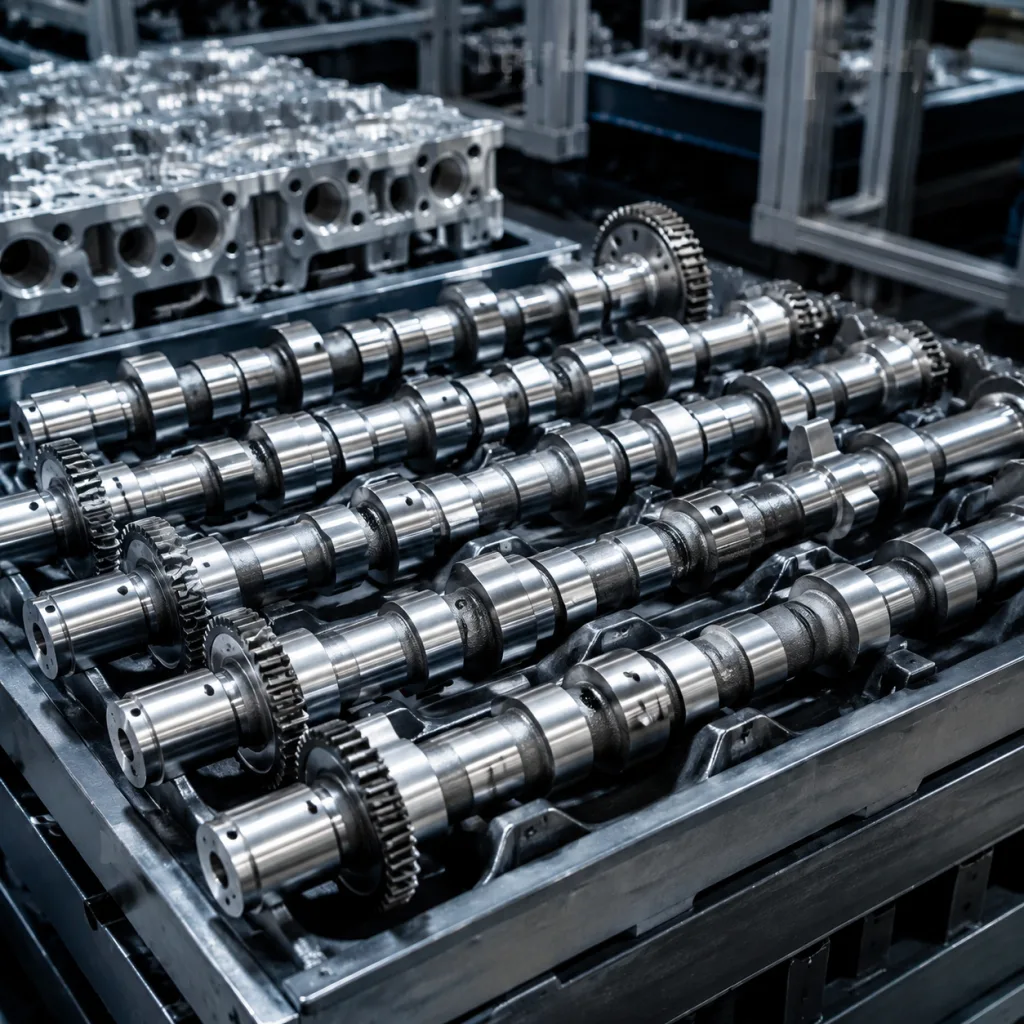
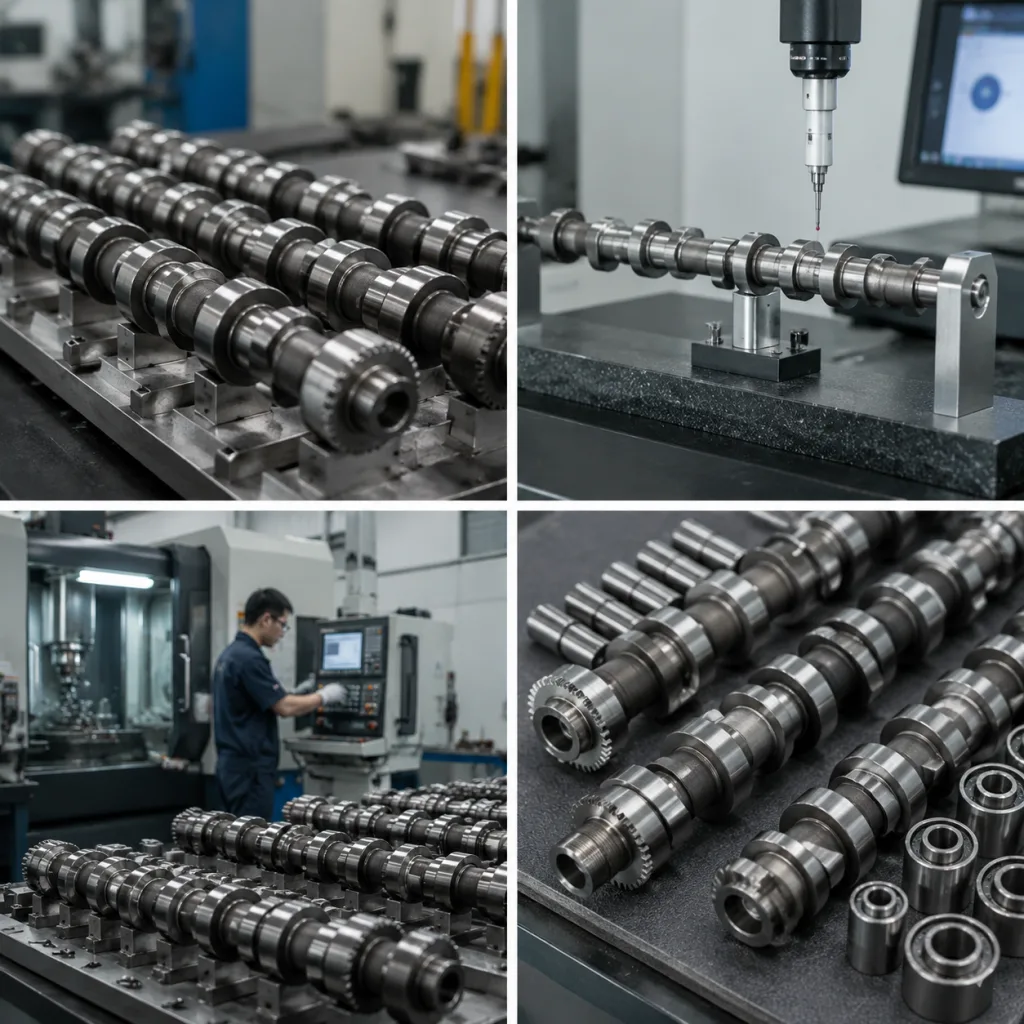
Driventus manages production through documented routings that may include material verification, rough turning, CNC machining, drilling or oil-hole processing, heat treatment or surface hardening, straightening, finish grinding, deburring, washing, rust prevention, and final inspection. Control plans align with IATF 16949:2016 and ISO 9001:2015 requirements for process control, traceability, corrective action, and continual improvement.
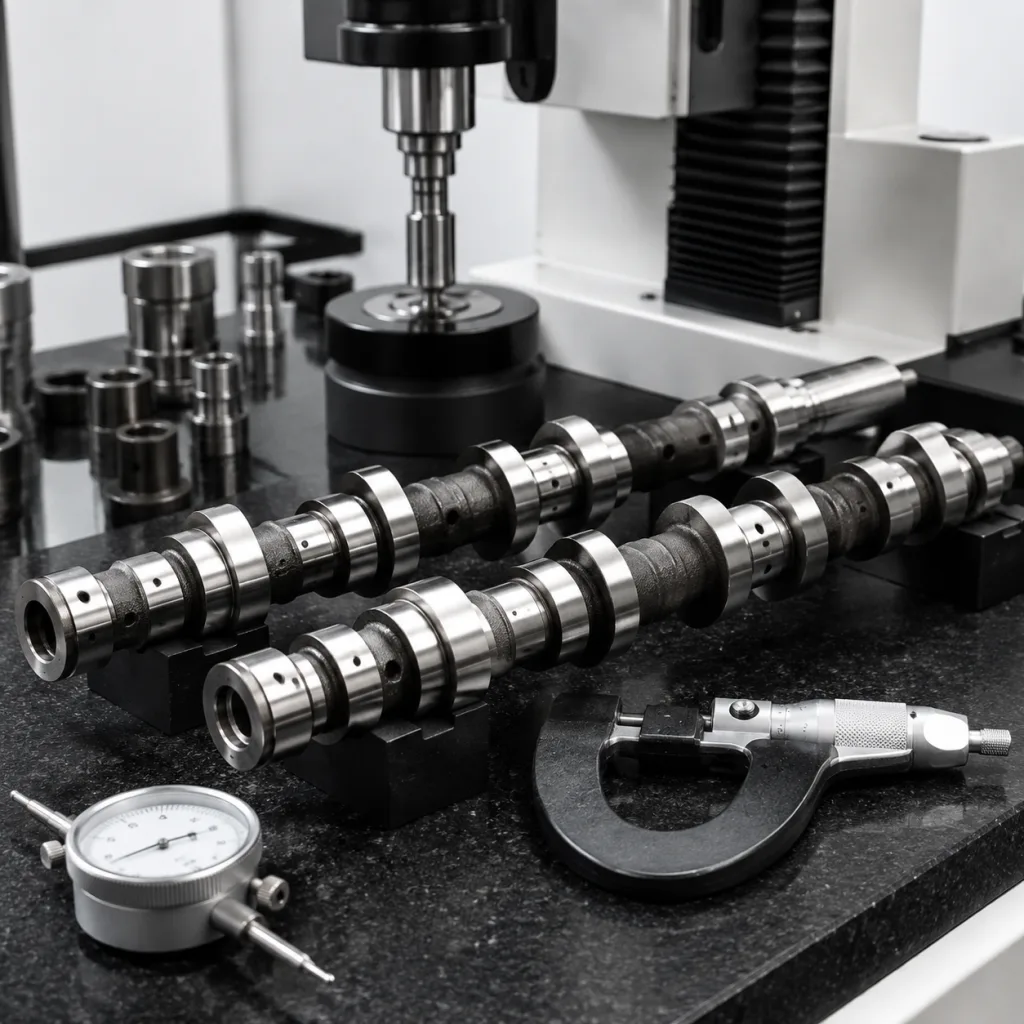
Key control points normally specified for camshafts include:
| Control item | Typical procurement requirement | Inspection method | ||
|---|---|---|---|---|
| Journal diameter | Drawing tolerance, commonly controlled within ±0.010–0.025 mm when specified | Micrometer, air gauge, CMM where required | ||
| Lobe lift and profile | Agreed profile tolerance, often reviewed within ±0.03–0.05 mm against approved reference | Cam profile measuring equipment | ||
| Runout / straightness | Defined by drawing and application, commonly checked to ≤0.03–0.05 mm TIR where applicable | V-block, dial indicator, CMM | ||
| Surface hardness | According to material and heat-treatment route, typically verified on each heat-treatment batch | Rockwell or equivalent hardness test | ||
| Surface roughness | Journal and lobe finish per drawing, commonly Ra 0.4–0.8 μm for ground bearing surfaces when specified | Roughness tester | ||
| Timing feature position | Matched to approved reference or drawing datum, normally fixture-checked after machining | Fixture gauge or CMM | ||
| Cleanliness | No machining debris, corrosion, blocked oil holes, burrs, or handling damage | Visual and process cleanliness checks |
| Programme type | Indicative MOQ | Typical sample lead time | Typical production lead time | Price logic |
|---|---|---|---|---|
| Existing catalogue reference | 50–200 pcs | 7–15 days if stock or semi-finished stock exists | 25–45 days | Best for mixed-SKU replenishment; price affected mainly by packing and shipment mix |
| Private-label stock order | 100–300 pcs | 10–20 days including packaging confirmation | 30–50 days | Carton artwork, label format, barcode rules, and minimum printed-carton quantity affect cost |
| New sample from buyer reference | 5–20 pcs | 30–60 days after technical confirmation | 45–75 days after approval | Development cost may include measuring, fixture adjustment, sample machining, and extra inspection |
| Custom drawing programme | By quotation, often 100–500 pcs after approval | 45–75 days depending on tooling | 60–90 days | Tooling, gauges, material grade, heat-treatment route, and PPAP-style documentation drive quotation |