Blue Smoke From Exhaust: Manifold Gasket Checks
Blue smoke from exhaust is an oil signal first, not a gasket signal. Oil may be burning inside the cylinder, entering the exhaust through a turbo fault, or smoking on a hot external surface near the manifold. That distinction matters for buyers because a vague “blue smoke from exhaust exhaust manifold gasket” claim can become a false return, a rushed replenishment order, or a warranty dispute against a good part. The exhaust manifold gasket seals exhaust gas at the cylinder head. It does not normally seal pressurised engine oil. Still, a leak at the manifold face can put ticking noise, soot, heat, odour, and visible haze in the same 50–150 mm zone where valve-cover leaks, turbo oil-line leaks, and service spills are found. This article gives procurement, warranty, and supplier-quality teams a cleaner way to separate oil-control faults from exhaust sealing faults, record useful evidence before replacement, and specify exhaust manifold gaskets by material, tolerance, MOQ, price, lead time, packaging, and claim-control requirements. Driventus is an independent aftermarket manufacturer; brand names are referenced for fitment only.
Decision Point: Is the Smoke Tailpipe, Manifold, or Oil-on-Hot-Metal?
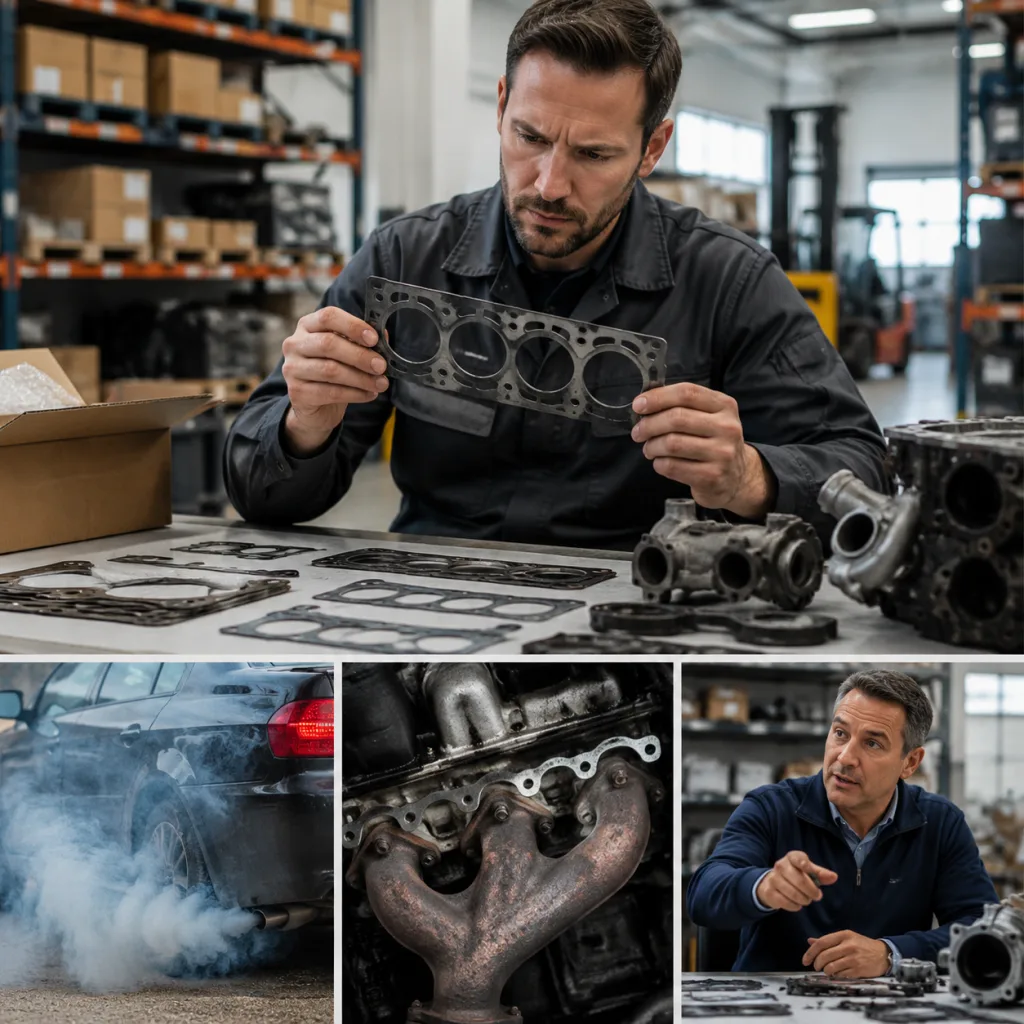
Start with location. A tailpipe plume usually points to oil entering the combustion chamber, intake tract, turbocharger exhaust side, or exhaust stream. Smoke rising from the engine bay often means oil is touching a hot external surface. Exhaust manifolds commonly operate around 450–650°C during road use and can approach 800–950°C near turbocharged applications, so a small oil seep can look dramatic.
Use the smoke pattern as the first sorting tool:
- Cold-start smoke: suspect valve stem seals, hardened valve guide seals, or oil pooled in the intake; record whether the plume clears in under or over 30 seconds.
- Acceleration smoke: suspect piston rings, cylinder bore wear, crankcase pressure, or turbocharger oil seal leakage; compare compression readings and flag cylinder variation above 10–15%.
- Smoke after long idle: suspect valve guide leakage, restricted turbo drain, or excess oil level; check whether oil sits more than 3–5 mm above the maximum mark.
- Engine-bay haze: suspect oil dripping onto the manifold, heat shield, turbo housing, or exhaust flange; inspect at least 100 mm above the manifold before blaming the gasket.
For a blue smoke from exhaust exhaust manifold gasket complaint, do not begin with the part number. Begin with a video. Require the workshop to show smoke location, engine temperature, mileage, and operating condition: cold start, hot idle, snap acceleration, deceleration, or load. If the smoke exits the tailpipe, the diagnostic route is oil control. If it rises near the manifold, the route is external oil leakage plus exhaust sealing inspection.
Failure Mode Reality Check: What the Manifold Gasket Can and Cannot Do
The exhaust manifold gasket seals high-temperature exhaust gas between the cylinder head and manifold. Its normal job is to prevent gas leakage, ticking noise, oxygen-sensor disturbance, heat damage, and loss of exhaust energy on turbocharged applications. It is not designed as an engine-oil seal.
A failed gasket can still appear in a smoke case in three limited ways:
1. Escaping exhaust gas blows across nearby oil residue and makes haze visible. 2. Local heat from leakage burns oil from a valve cover, cam carrier, turbo oil feed, turbo oil return, or recent service spill. 3. Soot tracks around the port are mistaken for wet oil during a quick inspection.
That is involvement, not proof of root cause. Replacing the manifold gasket will not repair worn piston rings, glazed bores, leaking valve stem seals, turbo bearing housing leakage, blocked oil drains, incorrect oil grade, or positive crankcase ventilation faults.
For distributors and repair chains, this distinction protects margin. A gasket claim should include the removed part, installation date, mileage since fitting, torque method, fastener condition, and photos of both sealing faces. Without that evidence, the complaint may belong to the engine, the turbocharger, the oil system, or the installation process—not the gasket stock. Misdiagnosis drives returns, delays repair completion, and creates pressure to credit parts that meet material, dimensional, and process requirements.
Comparison Table: Smoke Pattern vs. Likely Source vs. Buyer Response
Use this table as a first-pass screen before issuing credit, authorising replacement, or escalating a supplier 8D. It is not a full diagnostic procedure; it is a claim triage tool for warranty teams, technical helpdesks, and supplier quality engineers.
| Observed condition | Likely source | Gasket involvement | Buyer action |
|---|---|---|---|
| Blue smoke from tailpipe on acceleration | Piston rings, bore wear, crankcase pressure | Low | Request compression/leak-down data; flag cylinder variation above 10–15% |
| Blue smoke after idle | Valve stem seals or turbo drain restriction | Low | Ask for idle duration, oil level, turbo drain photos, and intake oil evidence |
| Smoke rising near manifold | Oil leaking onto hot exhaust | Medium | Inspect valve cover, cam plug, turbo feed/return, manifold flange within 100–150 mm |
| Ticking noise and soot at port | Exhaust gas leak | High | Check gasket crush, flange flatness, bolt torque, soot track direction |
| Oxygen sensor fault with exhaust leak | Unmetered oxygen near sensor | Medium to high | Inspect upstream joints, sensor boss area, port sealing, and downpipe gasket |
| Burn mark on gasket fire ring | Local sealing loss | High | Measure surface finish, flatness, bolt load, thermal cycling evidence |