A camshaft for Jeep Compass OE equivalent program should not start with a catalogue match. It should start with a fitment decision: which engine variant, which cam position, which timing interface, which sensor datum, and which durability target are you actually buying for?
That distinction matters. One wrong timing slot, phaser nose length, trigger offset, journal sequence, or oil-feed detail can turn a stocked SKU into workshop delays, repeat labour, cam/crank correlation codes, unstable idle, warranty disputes, and inventory that cannot be safely cross-referenced.
Driventus manufactures engine and powertrain components in Taizhou, Zhejiang for B2B aftermarket and OEM/Tier-1 supply channels. Our camshaft programs are built around dimensional verification, controlled material routes, production traceability, export packaging, and batch-level inspection under IATF 16949:2016 and ISO 9001:2015 management systems. For a new Jeep Compass camshaft project, buyers should plan around sample approval, pilot-lot inspection, MOQ logic, tooling or fixture needs, and confirmed shipment lead times—not catalogue interchange alone. Driventus is an independent aftermarket manufacturer; vehicle and brand names are used only to identify fitment.
Decision Framework: When Is a Camshaft Truly OE-Equivalent?
For procurement teams, OE-equivalent means functional interchangeability with the original application. Not visual similarity. Not a loose cross-reference. Not “fits Compass” without engine-level proof.
A replacement camshaft must match the target engine’s valve timing, lift profile, bearing journal fit, thrust control, timing drive interface, oil-feed layout, and camshaft position sensor geometry where applicable. The sourcing file should record the reference sample, measured dimensions, accepted tolerances, inspection method, and approval status for every engine variant.
For Jeep Compass applications, start with engine family, production year, sales region, and OE-style part-number cross-reference when available. Then verify. Any reference number, including examples such as OE 06A… or OE 11251…, should be treated as an investigation lead rather than final compatibility proof. Emissions market, cylinder head revision, cam phaser arrangement, follower type, oil-feed detail, and sensor wheel configuration can all change the part.
Use this decision rule: if two versions differ by timing slot, phaser nose length, trigger wheel offset, journal sequence, oil passage, or datum face, keep them as separate SKUs until interchange is proven by measurement and assembly trial.
A reliable camshaft for Jeep Compass OE equivalent program should document:
Application coverage by engine code, displacement, model year, and market, with excluded variants listed separately
Intake or exhaust camshaft position where the engine uses separate shafts, including left/right or front/rear references if used by the catalogue
Timing interface details, including gear, sprocket, slot, keyway, phaser connection, bolt size, dowel position, and datum face
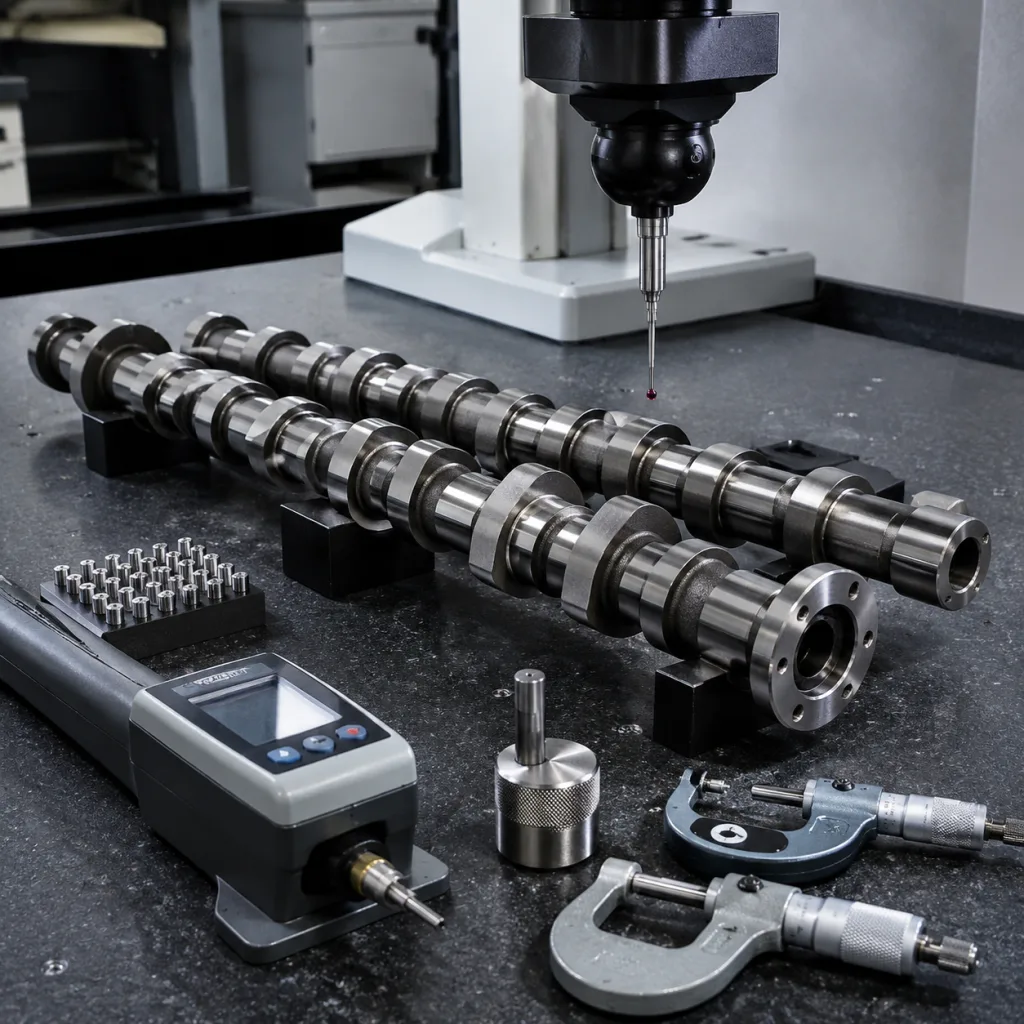
Cam position sensor trigger feature and datum confirmation, typically controlled by a master fixture or CMM angle report
Material route, heat treatment, hardness range, surface roughness, and rust-prevention requirement
First-article dimensional inspection against the approved benchmark, including critical-to-fit dimensions at 100% or tightened sampling where required
Packaging specification for sea freight, warehouse storage, parcel handling, and private-label barcode control
Commercial terms, including MOQ, sample cost, production lead time, Incoterm, and expected annual forecast band
Failure Modes: The Fitment Checks That Prevent Claims
Dimensional control is where a replacement camshaft becomes either a dependable part or an expensive claim. The usual symptoms are not subtle: valve-train noise, timing faults, oil-pressure instability, poor idle quality, premature lobe wear, or a no-start condition after installation.
The highest-risk areas are journals, lobes, runout, thrust faces, end features, timing datum positions, sensor triggers, and phaser or sprocket interfaces. For modern applications, the sensor trigger and timing interface can be as important as the visible lobe profile.
The exact limits must follow the approved drawing or measured OE benchmark. As a working RFQ baseline, buyer-controlled inspection plans often discuss tolerance bands such as ±0.01–0.02 mm for bearing journals, ±0.02–0.05 mm for lobe lift after profile approval, ≤0.03–0.05 mm total indicated runout depending on shaft length, and angular control for key timing features within ±0.5° where the engine design requires it. These are not universal specifications. Lock them only after the benchmark sample, material route, and inspection fixture are agreed.
Runout check on V-blocks or centres before packing
Thrust face width and finish
Excess axial movement in the cylinder head
Surface roughness and dimension report, commonly targeting Ra values agreed by drawing
Timing drive interface
Installation mismatch and timing error
Fixture check against master sample, plus photo record for first article
Sensor trigger feature
Cam/crank correlation faults or no-start complaints
Functional gauge, CMM datum report, or controlled visual comparison
Oil holes and end features
Lubrication failure or assembly conflict with plugs, bolts, seals, or phasers
Go/no-go checks, burr inspection, and cleanliness confirmation
</tr></thead><tbody> </tbody></table>Tolerances should be agreed in the technical drawing or PPAP-style submission package. Where drawings are not available, control plans should be based on verified OE sample measurement, approved customer samples, and repeatable inspection fixtures. A useful RFQ asks the supplier to state the measuring equipment, resolution, sampling frequency, and reaction plan if a critical dimension trends toward the control limit.
Do not merge similar-looking camshafts into one SKU unless the timing feature, phaser interface, journal set, lobe sequence, oil-feed detail, and sensor datum are confirmed identical. Small differences become hard-to-diagnose warranty problems once the engine is assembled.
Spec Deep-Dive: Material, Hardness, Finish, and Corrosion Control
Camshafts work under high contact stress at the lobe and follower interface, with additional load at bearing journals and thrust surfaces. The material route should follow the original design intent and engine architecture. Common routes include cast iron camshafts, chilled cast profiles, forged steel, billet steel, and assembled camshaft constructions. A useful specification names the route; it does not accept a generic “steel” or “iron” description.
A practical replacement specification should include:
Material grade or controlled equivalent approved by the buyer, with supplier material certificate by batch
Lobe and journal hardness range, with HRC or HB/HV values defined separately for chilled cast iron, induction-hardened steel, or assembled steel designs
Case depth or chilled layer requirement where applicable, verified by section sample or hardness traverse during development
Surface roughness target for lobes, journals, and thrust faces, with Ra values and measuring direction stated in the control plan
Straightness and runout limits after machining and heat treatment, checked before rust prevention and packing
Magnetic particle, visual, or crack inspection method when required, with 100% inspection for high-risk features if agreed
Cleanliness requirement for oil holes, drilled passages, and deburred edges
Rust prevention period suitable for export shipments and warehouse storage, typically 6–12 months when VCI bagging, anti-rust oil, and dry cartons are specified correctly
The failure logic is simple. If hardness is too low, lobe wear can accelerate, especially during break-in or low-lubrication starts. If hardness is excessive, microstructure is poor, or surface finish is wrong, the camshaft can damage followers and raise early failure risk. If rust prevention is weak, a technically correct part may arrive with journal staining or lobe corrosion after sea freight and warehouse storage.
Ask for both certificate and process evidence: material certificate, heat-treatment batch number, hardness readings by feature, surface roughness readings, and non-destructive inspection results where required.
For RFQ comparison, avoid judging only the unit price. A cheaper camshaft may use a different casting route, wider runout acceptance, reduced inspection frequency, lighter packaging, or no private-label carton. The offer should identify whether sample measurement, fixture development, material testing, salt-spray or humidity validation, and third-party inspection are included or quoted separately.
Driventus aligns production controls with our quality system, including incoming material checks, in-process inspection, final audit sampling, and lot traceability. For regulated-market customers, material declarations can be managed to support REACH (EC) No 1907/2006 obligations where applicable to supplied articles.
Step-by-Step Launch Path From Sample to Repeat Orders
A camshaft for Jeep Compass OE equivalent replacement program should be validated before full procurement release. The safest route is staged: sample confirmation, pilot order, field feedback, then regular shipment. This protects the buyer from stocking a part that fits only part of the advertised application range and creates a documented basis for catalogue listing, warranty analysis, and repeat reorders.
Recommended validation steps include:
1. Sample mapping: Compare the proposed part with OE samples and customer-supplied benchmarks, recording sample source, engine code, position, and measured datum scheme. 2. Dimensional report: Verify journals, lobes, datum positions, thrust faces, oil holes, end features, and sensor triggers, with critical dimensions measured on every first-article sample. 3. Assembly trial: Install the camshaft in the correct cylinder head or fixture to confirm bearing fit, axial movement, phaser or sprocket seating, and freedom from interference. 4. Timing confirmation: Check the valve timing relationship and any phaser, sprocket, keyway, slot, or trigger interface, preferably with a master fixture or degree measurement record. 5. Surface verification: Confirm hardness, roughness, crack-free condition, burr removal, and cleanliness according to the agreed specification. 6. Packaging trial: Confirm that lobes, sensor features, journals, threaded ends, and thrust faces remain protected during carton drop, pallet stacking, and container vibration risk. 7. Pilot shipment review: Release a controlled pilot lot, often 50–200 pieces depending on SKU risk and buyer network size, before opening full catalogue coverage.
A typical launch path is 2–4 weeks for sample measurement and feasibility review after receiving a benchmark, 3–6 weeks for tooling, fixture, or process preparation when a new variant is required, and 30–45 days for the first production lot after sample approval. Repeat orders for a stable SKU are normally shorter, but buyers should still plan for material availability, heat-treatment capacity, packaging print lead time, and export booking windows.
Where customers supply a complete technical file, Driventus can support custom manufacturing for private-label programs, regional SKU consolidation, or controlled design changes. For higher-volume buyers, approval documents may include control plans, inspection records, material certificates, sample retention references, traceability labels, agreed packaging specifications, and corrective-action formats. We do not claim approval or endorsement by any vehicle manufacturer.
Importer Scenario: Comparing Two Quotes Without Getting Trapped
Imagine two suppliers quote the same Jeep Compass camshaft description. One price is lower. The description looks similar. The catalogue cross-reference looks familiar. On paper, it is tempting to choose the cheaper offer.
That is where camshaft sourcing often goes wrong. Replacement camshafts are low-tolerance procurement items because installation labour is high and some symptoms only appear after assembly. Buyers should qualify both the component and the factory process before adding the SKU to a catalogue, tender, or repair-chain supply program. The RFQ should make every supplier price the same technical package, not merely the same part name.
Use this checklist before issuing a purchase order:
Confirm model, engine code, displacement, year range, market region, and excluded applications.
Separate intake and exhaust camshafts where the engine design requires it, and confirm any phaser, sprocket, or sensor-wheel difference.
Treat OE cross-reference data as fitment support, not as brand approval or automatic interchange proof.
Review first-article dimensional data against the approved sample or drawing, including measurement equipment and calibration status.
Check whether the supplier operates under IATF 16949:2016 and ISO 9001:2015, and ask which processes are in-house or outsourced.
Require traceable lot coding on product labels, inner boxes, export cartons, and pallet labels.
Define packaging for container shipment, warehouse storage, and parcel distribution, including VCI bag, end caps, foam, dividers, carton burst strength, and pallet height limits.
Agree a warranty analysis procedure for wear, breakage, noise, timing complaints, installation marks, lubrication condition, and returned-part documentation.
Lock the commercial basis: MOQ, annual forecast, sample cost, tooling or fixture charges, payment term, Incoterm, port, carton quantity, and lead time.
For planning, common B2B purchase structures are sample orders of 2–10 pieces for inspection and catalogue photography, pilot lots of 50–200 pieces for launch control, and regular MOQs agreed by SKU complexity and packaging type. A mature distributor program may consolidate several camshaft SKUs into a mixed container or monthly shipment. A new or low-volume variant may need a higher unit price until machining, heat treatment, and inspection are amortized across repeat orders.
Compare landed cost and risk, not only EXW unit cost. Model unit price, packing cost, inland freight, ocean or air freight, duty, inspection cost, expected claim rate, and stock-turn speed. A lower MOQ may be valuable for a slow-moving Jeep Compass variant. A higher MOQ may reduce unit cost if demand and application coverage are proven.
For EU, UK, US, Canadian, Australian, and Brazilian importers, documentation consistency is part of the supply decision. Commercial invoices, packing lists, labels, country-of-origin marking, HS-code description, and product descriptions should match customs, catalogue, and marketplace requirements. If the part moves through multi-location repair chains, installation notes, torque references where provided by the buyer, oil-change recommendations, and disciplined cross-reference management become as important as unit price.
Q&A: How Driventus Structures a Camshaft Supply Program
What does Driventus actually support?
Driventus produces engine and powertrain components for aftermarket distributors, wholesalers, OEM/Tier-1 suppliers, and repair-chain supply programs. For camshafts, our support focuses on fitment verification, controlled manufacturing, inspection discipline, and shipment consistency rather than broad, unsupported coverage claims.
What is included in a typical Jeep Compass camshaft program?
Typical support includes:
Review of customer application lists and cross-reference structure, with risky or unverified interchanges flagged before quotation
Sample comparison against supplied OE or approved aftermarket benchmarks, including timing interface and sensor datum checks
Dimensional inspection before production release, with first-article reports covering critical journal, lobe, runout, thrust, and end-feature data
Batch traceability from material intake to final packing, with production date, lot code, and inspection record linkage
Export packaging with corrosion prevention and journal/lobe protection, including VCI bagging, anti-rust oil, separators, and reinforced cartons when specified
Private-label packing options for qualified B2B programs, including carton artwork, barcode labels, neutral packing, and pallet label formats
Technical communication for non-conformance analysis and corrective action, including returned-part review and 8D-style response when agreed
Commercial planning for MOQ, forecast bands, pilot-lot release, repeat-order scheduling, and mixed-SKU shipment consolidation
Which quality systems apply?
Production and inspection activities are managed under IATF 16949:2016 and ISO 9001:2015 frameworks. For customers consolidating several engine-component lines, Driventus can also supply pistons, crankshafts, gaskets, water pumps, turbochargers, and related powertrain parts through the same export process.
What should the RFQ include?
A practical RFQ should state the target annual volume, acceptable MOQ, launch quantity, requested Incoterm, destination port or warehouse, documentation package, packaging brand level, and whether the buyer requires samples before tooling or production release. For stable repeat programs, Driventus can discuss price tiers by order quantity, but the final quotation depends on material route, machining complexity, inspection level, packaging, and forecast reliability.
If your team is building a camshaft for Jeep Compass OE equivalent range, share the target engine codes, annual forecast, packaging requirement, documentation level, target price band if available, and any OE sample or approved drawing. You can request a quote with the fitment list and required approval package.
Frequently asked questions
Provide the engine code, displacement, model year range, target market, intake or exhaust position, OE-style cross-reference if available, forecast volume, target MOQ, packaging requirement, Incoterm, destination, and any sample or drawing. Clear photos of timing interfaces, end features, oil holes, and sensor triggers help reduce matching errors.
Yes. For B2B projects, Driventus can measure supplied samples and build a controlled specification for customer review. Sample-based development should still include dimensional reports, material confirmation, fixture checks, validation steps, and customer approval before volume production.
No. OE-equivalent means the part is designed to match fit and function for the stated application. Driventus is an independent aftermarket manufacturer; vehicle and brand names are referenced for fitment only.
For fitment review, sample matching, pilot-lot planning, or volume pricing, send your Jeep Compass camshaft requirements to Driventus. Start a technical sourcing discussion at /contact.html