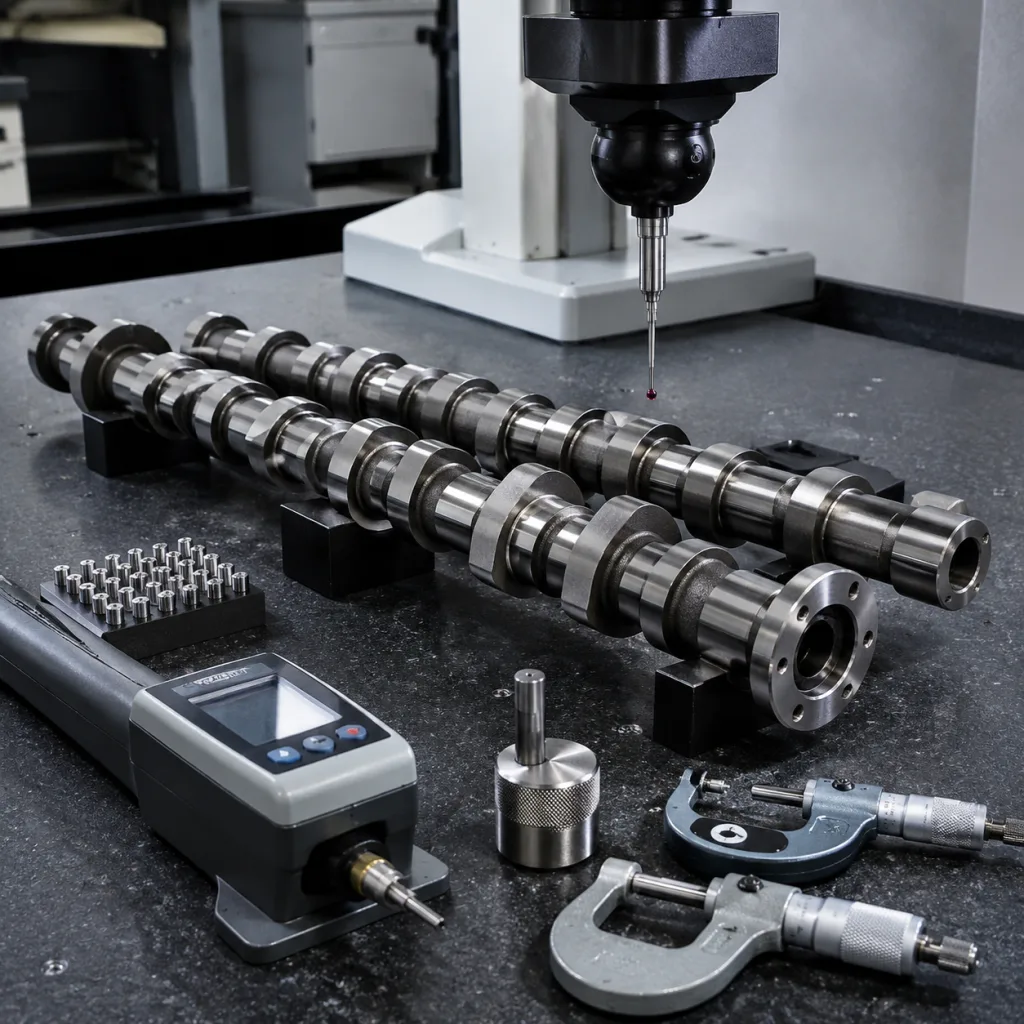
A camshaft for Iveco Eurocargo replacement is not a simple catalogue match. It has to reproduce the engine’s valve timing, journal geometry, thrust control, lubrication paths and surface durability in a medium-duty diesel environment. For distributors, repair-chain buyers and fleet parts programmes, the risk is both technical and commercial: one wrong lobe centreline, shallow hardening layer, rough journal or misclocked sensor feature can create valve-train noise, low compression, follower wear, repeat labour claims and lost customer trust.
Driventus manufactures engine and powertrain components in Taizhou, Zhejiang, and supplies export markets in more than 60 countries. This article approaches Eurocargo camshaft sourcing as a release decision, not a generic parts checklist: which data proves fitment, which failure modes matter, which tests are worth paying for, and which ordering details prevent claims later. Driventus is an independent aftermarket manufacturer; vehicle and brand names are used for fitment reference only.
Start With the Release Decision, Not the Model Name
“Eurocargo” is not enough information to approve a camshaft. The platform covers different engine generations, emissions stages and duty cycles, so the release question should be: does this part match the exact engine architecture and timing system the buyer intends to service?
For a camshaft for Iveco Eurocargo replacement, confirm the engine code, rated power, production year range, emissions market, valve-train layout, fuel-system variant and timing or sensor interface before issuing a purchase order. A 1° indexing error, a small base-circle change or an incorrect thrust-face position can change combustion timing, valve lash and follower load.
Use this fitment gate before sampling:
Overall camshaft length and thrust-face position checked against the reference sample or approved drawing
Main journal diameter, width, spacing and oil-hole location, typically controlled in the ±0.01–0.03 mm range where precision bearing fits are specified
Lobe count, firing sequence and angular indexing, with intake and exhaust centreline deviation agreed before sample approval
Intake and exhaust lift, duration, base circle and flank form measured as a complete lift curve, not only as peak lift
Gear, keyway, dowel, tone-wheel or sensor-trigger interface, including slot width, dowel diameter, pitch circle and angular clocking
Compatibility with followers, tappets, rocker arms and timing components, especially where mixed aftermarket parts are used
End-play and lubrication-path alignment checked with the thrust plate, gear and cylinder-head oil feed where available
OE part-number cross-references are useful for quoting, but they should not be treated as engineering approval unless the data has been validated by measurement or reliable field history. If an OE-style reference is used, keep it generic unless the buyer has verified the source, for example OE 06A… or OE 11251… formats where applicable. The specification should lead the quotation; the catalogue number should support it.
A practical release matrix compares the buyer sample, drawing and first-off inspection report feature by feature: journal diameters, lobe lift, base circle, nose radius, keyway or tone-wheel position, oil holes and thrust faces. Driventus can support confirmation against physical samples, technical drawings, controlled photos, interchange lists or approved buyer specifications. Related engine components can be reviewed in our catalog and on the engine range page at /products/engine-components.html.
Where Replacement Camshafts Usually Fail
Most camshaft sourcing problems do not start with an obviously wrong part. They start with a dimension that is nearly right, a surface that looks acceptable, or a heat-treatment result that was never checked. The component may install cleanly, then create noise, wear or timing complaints after the vehicle returns to service.
The highest-risk controls are the ones that affect oil film, valve timing and contact stress:
Failure mode
Control to specify
Why it matters
Bearing noise or seizure
Journal diameter commonly held around ±0.01–0.03 mm where precision fits are specified
Maintains oil-film stability and bearing clearance
Local bearing loading
Journal roundness typically controlled within 0.005–0.010 mm where specified
Reduces high spots and oil-film collapse
Timing scatter or tight rotation
Straightness/runout checked before and after heat treatment; common targets are ≤0.03–0.05 mm over controlled spans
Limits bearing load and timing variation
Low power or valve-train complaint
Lobe lift verified by cam profile equipment, often within ±0.02–0.05 mm depending on drawing
Protects valve lift and combustion behaviour
Cylinder-to-cylinder variation
Lobe angular position checked against the master curve
Keeps intake and exhaust events consistent
Accelerated lobe or follower wear
Surface hardness specified by drawing and material route, such as hardened lobes in the HRC 50–60 range where applicable
Resists repeated contact load
Early surface breakdown
Case depth or hardened layer commonly verified around 0.8–2.5 mm depending on material and process
Supports durability below the surface
Poor run-in or oil starvation
Lobe and journal roughness commonly controlled around Ra 0.2–0.8 µm by application
Balances oil retention with wear control
Axial wear or thrust noise
Thrust-face finish measured after grinding, with burr-free oil grooves and edges
Controls end-load contact and lubrication
</tr></thead><tbody> </tbody></table>Material selection should match the engine design, follower type and duty cycle. Depending on the application and cost target, replacement camshafts may use chilled cast iron, alloy cast iron, forged steel or assembled steel construction. The right route depends on lobe contact stress, oil quality, lubrication margin and expected service environment, not only on purchase price.
For serial production, Driventus applies incoming material inspection, blank machining, drilling and oil-hole processing, heat-treatment control, straightening where required, CNC finish machining, cam and journal grinding, deburring, washing, anti-corrosion treatment and final inspection. Critical features are checked with calibrated gauges, micrometers, hardness testers, surface roughness testers, runout fixtures and cam-profile measurement methods appropriate to the drawing. Control plans are maintained under IATF 16949:2016 and ISO 9001:2015 management systems.
Define inspection frequency before price approval. A first article normally requires 100% measurement of critical-to-function features. Stable serial batches may move to agreed AQL or control-plan sampling, with 100% visual inspection for cracks, bruises, blocked oil holes, rust and handling damage. Do not approve a replacement camshaft by visual comparison alone; two parts can look identical while having different lobe centre angles, hardening depth, oil-hole geometry or journal finish.
Validation: What Evidence Is Worth Paying For?
Validation should prove that the camshaft operates within the buyer’s required functional envelope. It should not be reduced to a supplier statement that the part is “OE quality.” Driventus does not claim approval or endorsement by any vehicle manufacturer. The target is OE-equivalent fit, function and durability against the buyer’s approved specification.
A useful validation package for a camshaft for Iveco Eurocargo replacement includes evidence that can be reviewed by engineering, purchasing and warranty teams:
Dimensional report for journals, lobes, gear interface and thrust surfaces, listing nominal, tolerance, actual result and measuring tool
Cam profile inspection for lift curve, base circle and angular position, preferably compared with a buyer-approved master sample
Hardness and microstructure checks according to the approved material route, including lobe and journal test locations
Case-depth or hardened-layer verification where specified, with cross-section method and acceptance depth stated
Magnetic particle or crack inspection for steel or heat-treated parts where required
Surface roughness report for lobes, bearing journals and thrust faces, using agreed Ra/Rz parameters
Oil-hole and gallery check using pin gauges, air blow-through or visual bore inspection where geometry allows
Trial assembly check with mating valve-train and timing components, including end play, gear seating and sensor-trigger clearance
Anti-corrosion, packaging drop or vibration checks for export handling where required
For larger B2B launches, buyers can define PPAP-style submission content if their internal process requires it. A sensible launch pack may include 3–5 initial samples, a ballooned drawing, dimensional results, material certificate, hardness report, process flow, control plan, packaging specification and traceability label format. The AIAG Production Part Approval Process manual is widely used in automotive supply chains, but the submission level, sample quantity and supporting documents should be agreed before tooling, sampling or batch production begins.
One scenario deserves extra attention: camshaft replacement after follower damage. A new camshaft installed with worn followers, blocked oil galleries, contaminated lubricant or incorrect assembly preload can fail early even when the part is dimensionally correct. For claim-sensitive fleets or repair chains, validate the camshaft together with the related followers, lubrication checks and installation instructions, including oil grade, pre-lube procedure, torque sequence and first-start inspection. Record installation mileage, oil condition and failed-part photos so real product issues can be separated from repair-process causes.
Documentation That Prevents Receiving and Warranty Disputes
Documentation should answer three questions: what was approved, what was shipped and how the batch can be traced if a problem appears later. The document pack should match the risk level of the programme. Routine replenishment may need a concise inspection record; a new private-label launch, fleet repair contract or high-volume distributor programme normally needs stronger evidence before the first shipment.
Recommended supply documents include:
Drawing revision or buyer-approved specification reference
Inspection report for critical-to-function dimensions, with actual measured values rather than pass/fail only
Material certificate or material conformity statement showing grade, heat number where available and supplier batch link
Heat-treatment and hardness record when specified, including test position and acceptance range
Cam profile or surface roughness report for controlled batches where required
Process control plan summary for serial production, including inspection frequency for journals, lobes and timing interfaces
Batch traceability code, carton label reference and packing list tied to production date or lot number
Packaging specification with VCI bag, oil paper, end protection, carton quantity, gross weight and pallet pattern where required
Declaration support for REACH (EC) No 1907/2006 where applicable
Driventus operates under IATF 16949:2016 and ISO 9001:2015. The quality system covers supplier control, process inspection, nonconforming product handling and corrective action. Certification does not replace the buyer’s own application validation, but it gives procurement teams a structured basis for supplier approval, incoming inspection planning and repeat-order control.
For private-label or application-specific variants, Driventus can support custom manufacturing using buyer drawings, controlled samples, packaging requirements or mutually agreed specifications. Agree label content before mass production: part number, application note, batch code, country-of-origin marking, barcode format and any warranty or fitting-warning insert should match the buyer’s receiving and aftersales process. This small step prevents many avoidable disputes at warehouse intake and during claim review.
Ordering Playbook for Distributors and Repair Chains
The final sourcing decision should bring technical approval, commercial terms and packaging into one controlled file. If those items sit in separate email threads, disputes become likely after goods arrive. The quotation should identify the application range, controlled features, inspection scope and any private-label requirements before price and lead time are finalised.
Use this ordering sequence:
1. Confirm Eurocargo engine code, model years and emissions market. 2. Confirm camshaft type, sensor interface and timing gear arrangement. 3. Provide sample, drawing, interchange list or validated cross-reference. 4. Define acceptance criteria for critical dimensions, profile and surface hardness. 5. Agree packaging format: neutral, private label or bulk service pack. 6. Confirm carton strength, corrosion protection and pallet configuration. 7. Agree MOQ, lead time, inspection level and spare-part warranty process. 8. Define documents required for each shipment and each batch. 9. Clarify whether matching followers, gaskets or timing components are included.
Commercial logic should be transparent before sampling. For a catalogue line already in production, MOQ may be set by carton or batch quantity. For a new or slow-moving Eurocargo variant, MOQ is usually driven by raw blank availability, fixture setup, heat-treatment batch size, grinding setup time and packaging artwork. Buyers can often reduce unit cost by consolidating several engine-component SKUs in one shipment, but they should not mix unapproved camshaft variants simply to reach volume. Typical planning assumptions are 2–4 weeks for sample review when drawings or samples are clear, and 45–75 days for first mass production after sample approval, depending on tooling, heat treatment, inspection scope and packaging.
Price should be judged against landed risk, not only the EXW or FOB unit line. Confirm whether the quotation includes anti-rust treatment, individual sleeves, private-label cartons, palletisation, inspection reports, spare samples and document preparation. A lower price that removes profile inspection, hardness records or protective packaging can create higher receiving rejection and warranty cost. For annual contracts, agree price validity, raw-material adjustment logic, forecast releases, safety stock target and claim response time before the first container ships.
Two buyer groups tend to fail in different ways. Distributors usually struggle with incomplete interchange data. Repair chains more often replace only the visible failed component. When a Eurocargo valve train shows metal debris, follower scoring or lubrication loss, the repair process should also inspect followers, bearings, oil feed, timing components and cylinder head condition. This protects the new camshaft and reduces repeat repairs that may otherwise be misread as a parts-quality issue.
Driventus can quote single camshaft lines or broader engine-component programmes including pistons, gaskets, crankshafts, water pumps and turbocharger-related parts. To start a technical review, send drawings, samples, annual volume, target market, target price level, required MOQ, lead-time expectation and packaging requirements through request a quote.
Frequently asked questions
Provide the engine code, vehicle application range, camshaft photos, critical dimensions, timing interface details and any validated interchange references. A physical sample or buyer drawing is preferred for new programmes.
Yes. Driventus can support neutral packaging, private-label packaging and buyer-specific inspection requirements, subject to MOQ, artwork approval and agreed technical specifications.
No. Driventus is an independent aftermarket manufacturer; brand names are referenced for fitment only. Supply is based on OE-equivalent fit and function against buyer-approved specifications.
For a controlled camshaft sourcing review, share your Eurocargo application list, samples or drawings with the Driventus team. Start a technical enquiry at /contact.html