Camshaft Isuzu OE Equivalent: Sourcing Without Fitment Risk
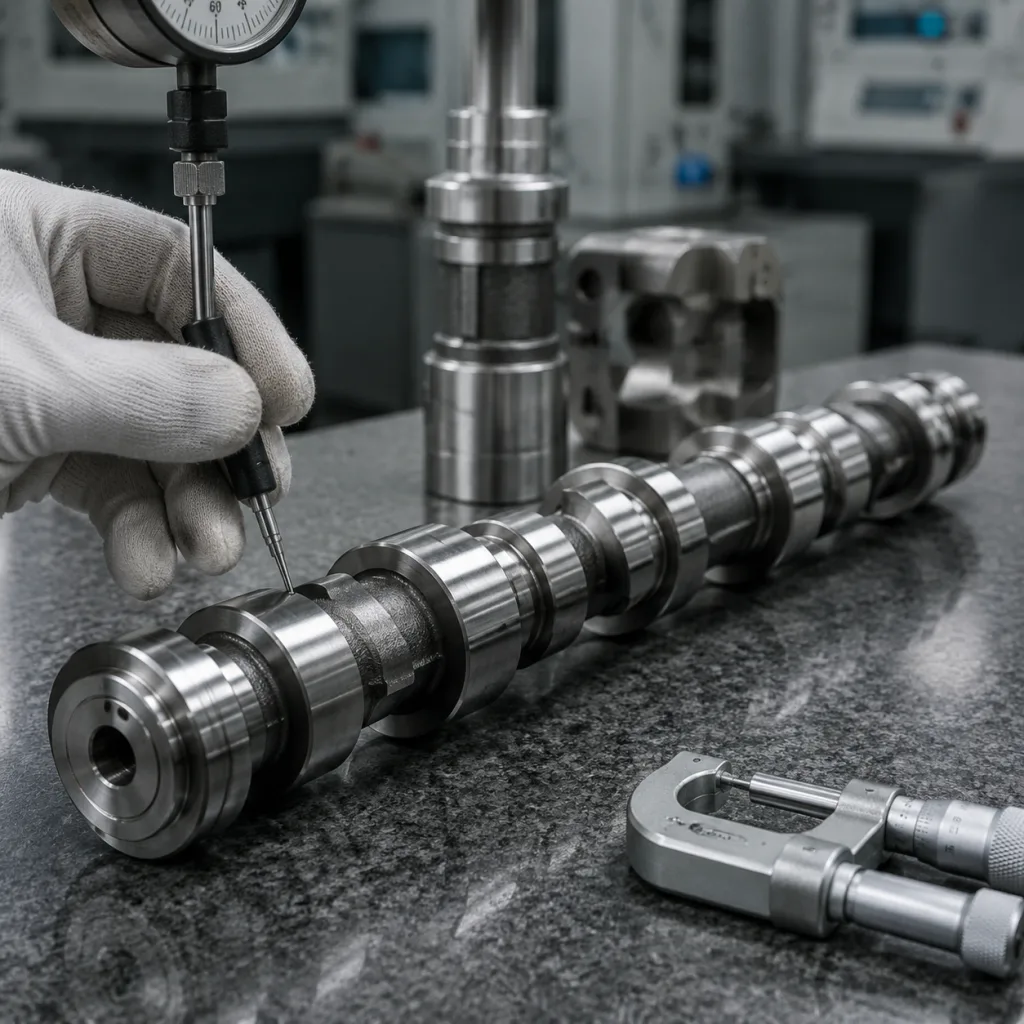
A camshaft is not a catalogue line item with a familiar silhouette. It is a timing component. If the journal is 0.01–0.02 mm off, the oil film changes. If the lobe centreline is wrong, valve events shift. If an oil hole carries a burr, a clean inspection report will not prevent field wear.
For buyers sourcing a camshaft Isuzu OE equivalent, the question is not “Does it fit Isuzu?” The useful question is: “Which evidence proves this part will repeat the OE function in our market, packaging route, and warranty environment?” That evidence sits across lobe geometry, journal control, heat treatment, lubrication features, timing interfaces, traceability, and commercial terms.
This article gives procurement teams, importers, distributors, and repair-chain category managers a practical way to separate a controlled aftermarket programme from a risky lookalike. Driventus manufactures engine and powertrain components in Taizhou, Zhejiang, under IATF 16949:2016 and ISO 9001:2015 systems, supplying B2B aftermarket and OEM-channel customers in 60+ countries. Driventus is an independent aftermarket manufacturer; brand names are referenced for fitment identification only.
Start With the Definition: OE-Equivalent Is a Function Test
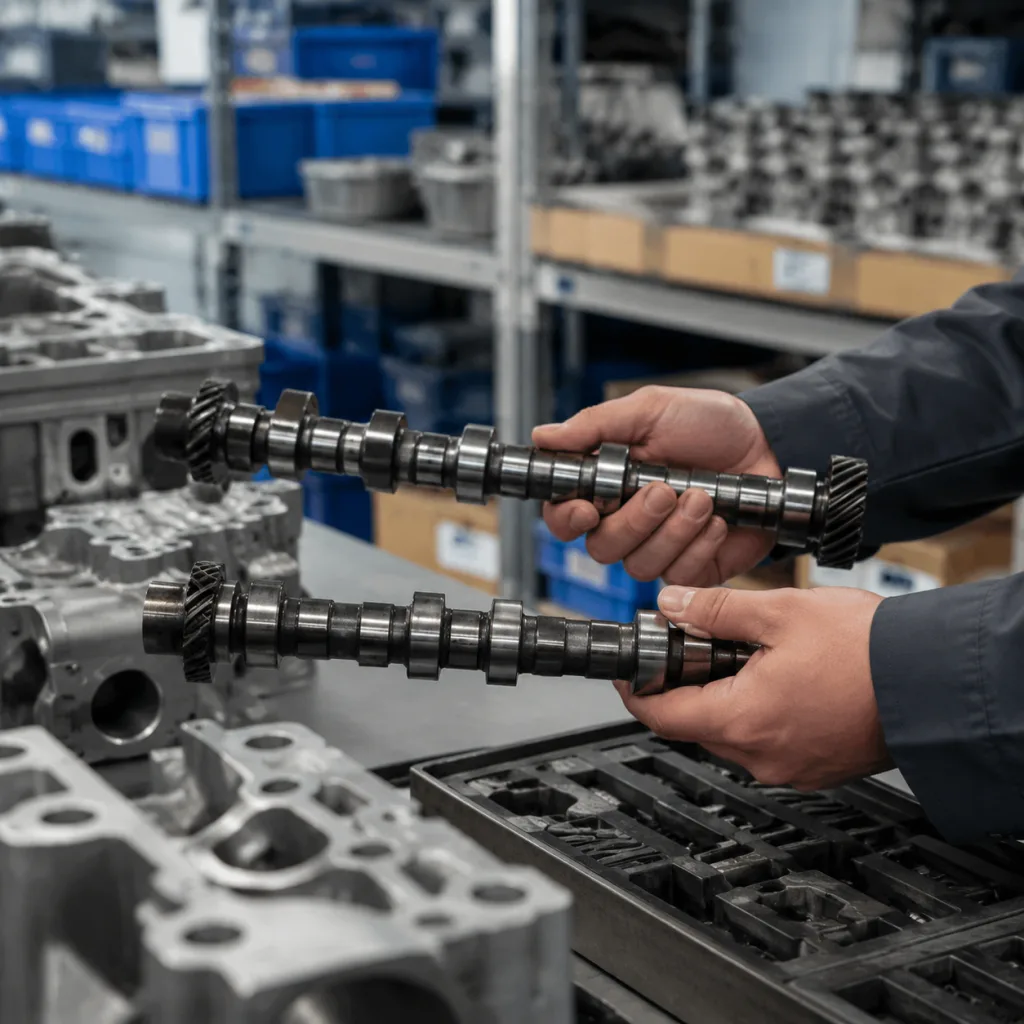
Treat OE-equivalence as a controlled engineering target, not a phrase on a quote sheet. The replacement camshaft must reproduce the original valve events and assembly interfaces within agreed tolerances. That means more than matching length and journal count.
A serious review covers the full functional system:
Cam lobe profile: lift, opening and closing ramps, base circle diameter, flank geometry, and nose radius. For many replacement programmes, lift variation is typically controlled within about ±0.03 mm against the approved master, subject to drawing requirements.
Journal geometry: diameter, roundness, cylindricity, width, surface roughness, and oil groove location where applicable. Journal diameter is commonly controlled in the ±0.005–0.015 mm range depending on bearing design.
Timing references: dowel pin, keyway, gear face, or sprocket mounting position relative to lobe centreline. Timing-critical angular features should be defined in degrees, not described only as “same as sample.”
End control surfaces: thrust flange thickness, face flatness, parallelism, and bearing contact finish, with axial-control dimensions tied to the engine housing datum.
Material condition: casting or forging grade, nodularity where applicable, alloy content, hardness range, case depth or chilled layer, and heat-treatment method.
Lubrication features: drilled passages, oil-feed holes, chamfers, deburring, cleanliness, and anti-rust protection after final washing.
Traceability: batch number, inspection record, drawing or sample revision, and cross-reference mapping for the relevant Isuzu-fitment application.
When buyers request a camshaft Isuzu OE equivalent, Driventus treats the inquiry as a controlled fitment programme rather than a simple catalogue lookup. The workflow starts with sample, drawing, or reference confirmation, then moves through 3D and profile measurement, material verification, trial production inspection, packaging review, and batch release under the company’s documented quality system.
For a new reference, do not compress the approval stage. Allow time for sample review, tooling or fixture confirmation, first article inspection, and written approval before serial production.
Failure Modes the Dimensional Report Must Catch
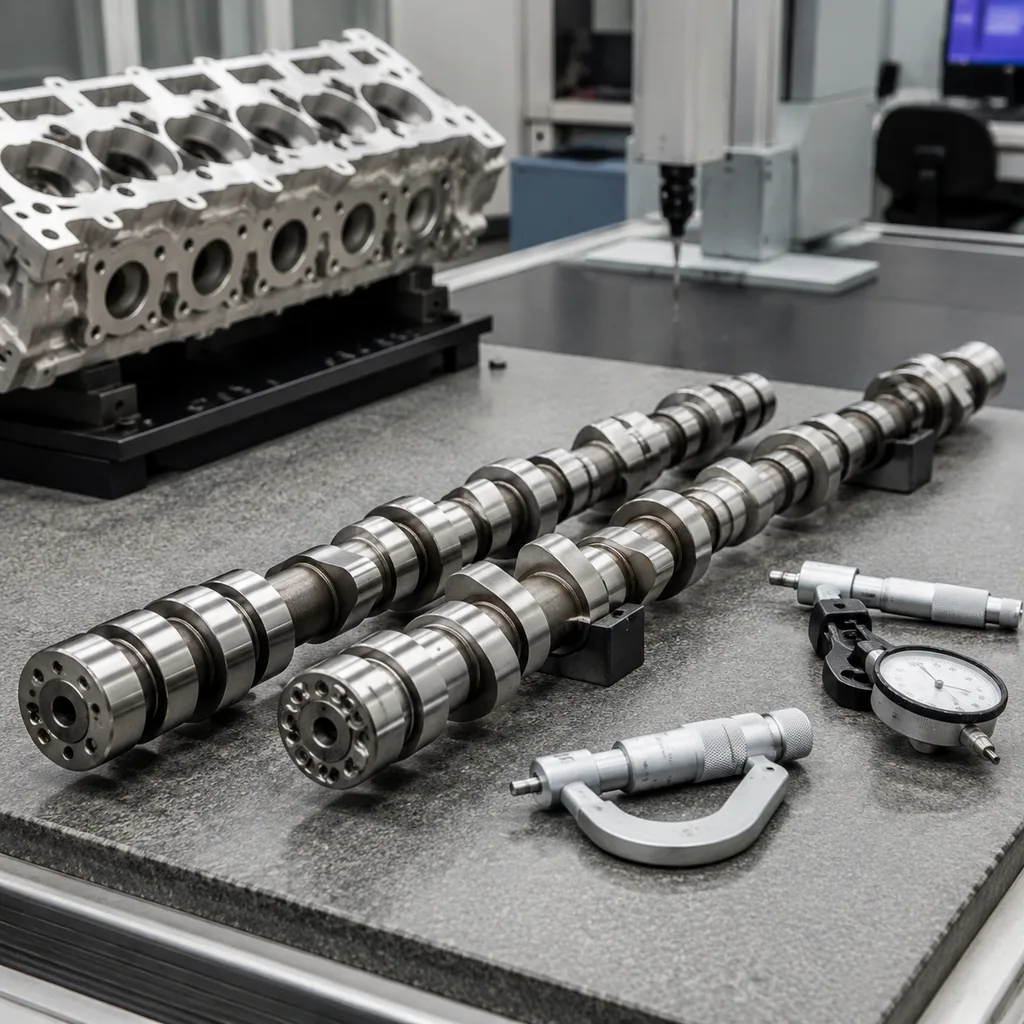
A dimensional report is not paperwork for the file. It is the buyer’s first filter for noise, wear, poor oil control, timing error, and warranty returns. High-volume distributor programmes should request a first article inspection report before container release. Repair-chain supply needs the same discipline because one weak batch can affect many branches at once.
Check point
Failure mode if missed
Typical target or control window
Typical verification method
Journal diameter and roundness
Oil-film instability, bearing wear, noise
Diameter often ±0.005–0.015 mm; roundness commonly ≤0.005–0.010 mm
Micrometer, air gauge, roundness tester
Cam lobe lift and base circle
Incorrect valve lift, poor combustion breathing
Lift commonly ±0.02–0.05 mm against approved master
Cam profile measuring machine
Lobe centre angle
Shifted valve timing, cylinder imbalance
Commonly ±0.25–0.50° where specified
CNC profile measurement or CMM fixture
Runout over journals
Rotation drag, wear, oil-film breakdown
Often ≤0.03–0.05 mm total indicated runout
V-block or centre support runout check
Thrust face width and flatness
Excess axial movement or end contact wear
Width often ±0.02–0.05 mm; flatness typically ≤0.02 mm
Angular position defined to drawing; go/no-go for datum features
CMM, go/no-go gauge, functional fixture
Overall length and datum stack-up
Housing interference or assembly clearance issue
Usually ±0.05–0.15 mm depending on design
CMM, height gauge, dedicated fixture
</tr></thead><tbody> </tbody></table>Inspection frequency matters as much as the tolerance. Development lots, low-volume references, new tooling, and first shipments should normally use 100% inspection on critical dimensions. Once serial production is stable, SPC may be appropriate for repeatable machining features, such as 5-piece start-up checks plus hourly patrol checks. Timing-critical, oil-hole, runout, or historically sensitive characteristics often still justify 100% checks.
Keep cross-references explicit on commercial documents. If a customer specification cites a number such as OE 06A107065 or OE 11251…, identify it as a fitment cross-reference, not as a vehicle-manufacturer approval claim. Driventus does not claim approval or endorsement by any vehicle manufacturer.
Spec Deep-Dive: Material, Hardness, Finish, and Rust Protection
Camshaft durability comes from a chain of controls. Core strength supports the part. Surface hardness protects the working faces. Profile accuracy keeps valve events correct. Lubrication and finish determine what happens during break-in.
Depending on the application, camshafts may use chilled cast iron, ductile iron, forged steel, or assembled steel constructions. The correct route depends on follower type, engine load, rpm range, lubrication design, and original construction. Buyers should avoid accepting a material substitution unless the supplier explains the functional equivalence and validation plan.
For Isuzu-fitment replacement sourcing, request evidence for these items:
Material certificate, melt record, or controlled internal material report for each batch, tied to casting or heat-treatment lot number.
Chemical composition verification by spectrometer where applicable, including carbon, silicon, manganese, chromium, molybdenum, nickel, and other alloying elements specified by the drawing.
Hardness checks on lobes, journals, and thrust surfaces using a defined scale, such as HRC, HRB, or HB. Chilled iron lobes may be controlled around 50–60 HRC equivalent, while ductile iron or steel designs must follow the approved specification.
Case depth, chilled layer, or induction-hardened zone assessment when the process requires it. Require both target depth and minimum acceptable depth, not only a surface hardness value.
Microstructure review for nodularity, carbide distribution, retained structure, graphite form, or decarburisation control where relevant.
Surface roughness measurements on journals, lobes, and thrust faces. Journal Ra values are commonly controlled around 0.2–0.4 µm, while lobe finish may be specified around 0.4–0.8 µm depending on follower type.
Magnetic particle inspection or other crack detection for specified designs, especially after induction hardening, straightening, or aggressive grinding.
Cleaning validation to limit abrasive residue in oil passages, drilled holes, and machined grooves.
Do not judge the part by shine. A journal can be dimensionally correct and still too rough for stable bearing life. A lobe can be polished but functionally wrong for the follower and oil-film design. The target is the correct tribological finish, not the brightest surface.
Packaging is part of the specification. Machined surfaces should be protected with VCI paper or bagging, anti-corrosion oil where permitted, plastic end caps or sleeves for timing features, separators between parts, and export-grade cartons or plywood crates for long-distance transport. For ocean freight, specify corrosion protection duration, such as 90 or 180 days, and require packaging drop or compression checks for heavy camshaft cartons.
Driventus applies inspection planning within IATF 16949:2016 and ISO 9001:2015 frameworks. Where market access requires materials disclosure, buyers may also request documentation aligned with REACH (EC) No 1907/2006 for regulated substances.
What a Useful Validation Package Looks Like
Dimensional inspection answers one question: does this batch match the approved requirement? Validation answers a different one: can the design route and production process survive service conditions? Buyers need both.
A practical validation package for a camshaft Isuzu OE equivalent usually includes:
1. Profile comparison: measured lobe data overlaid against the approved master sample or drawing to confirm lift curve, ramp behaviour, base circle, and nose geometry. Ask for maximum lift deviation and angular deviation values, not only pass/fail wording. 2. Hardness mapping: checks on lobes, journals, and thrust surfaces at defined locations to confirm the hardened zone and avoid soft spots. A useful report identifies test points by lobe number, journal number, and distance from edge. 3. Runout and straightness testing: confirmation that machining and heat treatment did not introduce unacceptable distortion. If straightening is used, it should be controlled and recorded before final grinding. 4. Oil passage inspection: verification of drilling depth, hole intersection, edge break, burr removal, and cleanliness. High-risk oil holes should be checked by pin gauge, borescope, or compressed-air flow method. 5. Fixture or bench rotation check: confirmation of clearance at journals, thrust faces, gear faces, sprocket interfaces, and sensor features. A functional fixture is valuable when housing drawings are unavailable. 6. Crack detection where specified: magnetic particle inspection or another agreed method for susceptible materials and designs. Inspection should occur after heat treatment and straightening, not only before machining. 7. Endurance or engine bench support where required: testing for new programmes, material changes, process changes, high-risk applications, or customer-specific validation plans. Define hours, speed/load cycle, oil grade, acceptance criteria, and post-test wear measurement.
For distributor programmes, the most practical evidence file contains controlled drawings or specifications, material records, critical dimension report, hardness report, surface-finish data, packaging standard, and batch traceability. A strong first shipment file also includes 5–10 retained-sample measurements, label artwork approval, carton photos, and an AQL plan for visual and packaging checks.
For OEM or Tier-1 projects, buyers may request process flow, PFMEA, control plan, measurement system analysis, and capability studies. As a guide, critical machining characteristics may require Cpk targets of 1.33 or higher after process stabilization. Launch containment may require 100% sorting until the first agreed number of batches is released without nonconformity.
Buyers can review related engine components in our catalog, including camshaft-adjacent parts listed under engine components. For non-catalogue references, Driventus can evaluate custom manufacturing based on samples, drawings, or controlled technical data.
Scenario: Two Similar Applications, One Expensive Cross-Reference Error
A common sourcing mistake starts innocently. Two engines share a displacement family. The camshafts look similar. A catalogue suggests one reference can cover both. The buyer merges demand into one SKU to improve MOQ and pricing.
Then claims appear. One market reports noise. Another reports poor running. A repair chain finds that installation is possible, but the sensor signal or valve timing is not correct for part of the application range. The problem was not machining quality; it was cross-reference control.
Engines may share families yet use different cam profiles, sensor wheels, bearing widths, journal counts, timing interfaces, or valve-train layouts. Do not merge applications unless the engineering differences have been checked and documented.
A controlled cross-reference file should include:
Engine code or application family where available.
Fuel type and emissions configuration where it affects valve timing, EGR strategy, or sensor layout.
Camshaft position, such as intake, exhaust, single overhead cam, or dual overhead cam.
Gear, sprocket, keyway, dowel, or timing interface type, including tooth count or datum angle where relevant.
Sensor trigger configuration where applicable, including wheel form, slot count, and angular datum.
Original sample reference, drawing revision, approved master sample, and date of approval.
Supersession notes, market differences, model-year exclusions, and right-hand/left-hand market notes where relevant.
Packaging label format, barcode requirements, neutral branding instructions, MOQ, carton quantity, and pallet configuration.
The phrase camshaft Isuzu OE equivalent is a sourcing description, not a final technical specification. A robust RFQ includes photographs, sample markings, critical dimensions, target annual volume, destination market, packaging requirements, expected certification documents, and any warranty return data from the current supply base.
Commercial logic should follow reference certainty. For an active catalogue item, pricing can usually be confirmed once annual demand, batch quantity, packaging, and destination terms are known. For a new or sample-based reference, buyers should expect separate costing for reverse engineering, fixture or tooling, prototype pieces, validation samples, and serial production.
MOQ is normally driven by raw casting or forging batch size, heat-treatment lot economics, machining setup time, packaging print quantity, and inspection burden. A low-volume camshaft with special hardness or sensor features will not price like a stocked high-runner.
Driventus can help buyers map fitment references while maintaining neutral aftermarket documentation. The company remains an independent aftermarket manufacturer; brand names are used only to identify compatibility and fitment.
PO Release Checklist: Lock the Risks Before Production
Before releasing a purchase order for a camshaft Isuzu OE equivalent, close the gaps that usually become claims. The PO should freeze both technical requirements and commercial assumptions.
Confirm the application, engine family, model year range, emissions version, and camshaft position.
Provide an approved sample, drawing, controlled cross-reference, or OE-number-based fitment list with exclusions.
Require a first article inspection report for new references, including profile, journal, runout, hardness, oil-hole, and packaging checks.
Confirm material grade, heat treatment, hardness range, case depth or chilled layer, and surface-finish targets.
Define critical dimensions, datum references, tolerances, inspection frequency, and retention-sample rules.
Approve packaging protection for machined surfaces and export transit, including carton quantity, separator type, pallet size, and drop/stacking requirement.
Specify labelling, neutral box requirements, barcode format, country-specific documentation, and any REACH or material declaration needs.
Review supplier certifications, including IATF 16949:2016 and ISO 9001:2015.
Confirm batch traceability from raw material to finished goods, including casting lot, heat-treatment lot, machining batch, inspection record, and packing date.
Set claim-handling procedure, evidence requirements, containment steps, replacement or credit rules, and response time such as 24-hour acknowledgement and 5D/8D timing.
For large distributors, continuity of supply needs its own review. Ask about tooling ownership, safety stock, MOQ, monthly capacity, lead time after sample approval, and the process for engineering changes.
Separate lead time into real stages: technical review, sample measurement, tooling or fixture preparation, trial machining, buyer approval, serial production, final inspection, and sea or air freight. A repeat catalogue item may support MOQ by carton or pallet quantity. A new camshaft reference may require a production lot large enough to cover casting, heat treatment, and machining setup.
Compare price by total landed cost and warranty exposure, not only unit cost. A quote that excludes anti-rust packaging, 100% runout checks, profile measurement, neutral cartons, barcode labels, or PPAP-style documentation may look cheaper but shift cost back to the importer. For repair-chain buyers, consistency across repeat orders is often more important than the lowest unit price.
If a new or low-volume Isuzu-fitment reference is not already available, send the target reference and sample data through the request a quote page. Driventus will review manufacturability, validation requirements, timing, MOQ, price structure, and commercial feasibility before confirming supply.
Frequently asked questions
It should match the original function and interfaces: lobe profile, journal dimensions, timing reference, thrust control, material condition, hardness, oil passages, surface finish, and packaging protection. A visual match is not enough. Buyers should request dimensional, material, and process evidence before approval, including tolerances for lift, journal diameter, runout, hardness, and oil-hole position.
Yes, subject to technical review. Driventus can assess samples, drawings, and controlled reference data for custom manufacturing. The process normally includes reverse measurement, material identification, prototype or trial production, inspection reporting, packaging confirmation, and buyer approval before serial supply. MOQ and lead time depend on casting or forging availability, tooling, heat treatment, validation requirements, and target batch quantity.
No. OE-equivalent means the part is engineered to match required fit, form, and function for the stated replacement application. It does not mean approval or endorsement by a vehicle manufacturer. Driventus is an independent aftermarket manufacturer; brand names are referenced for fitment identification only.
For Isuzu-fitment camshaft sourcing, share your reference, sample photos, critical dimensions, target annual volume, required MOQ, packaging requirements, destination market, and requested lead time for technical review. Contact Driventus at /contact.html