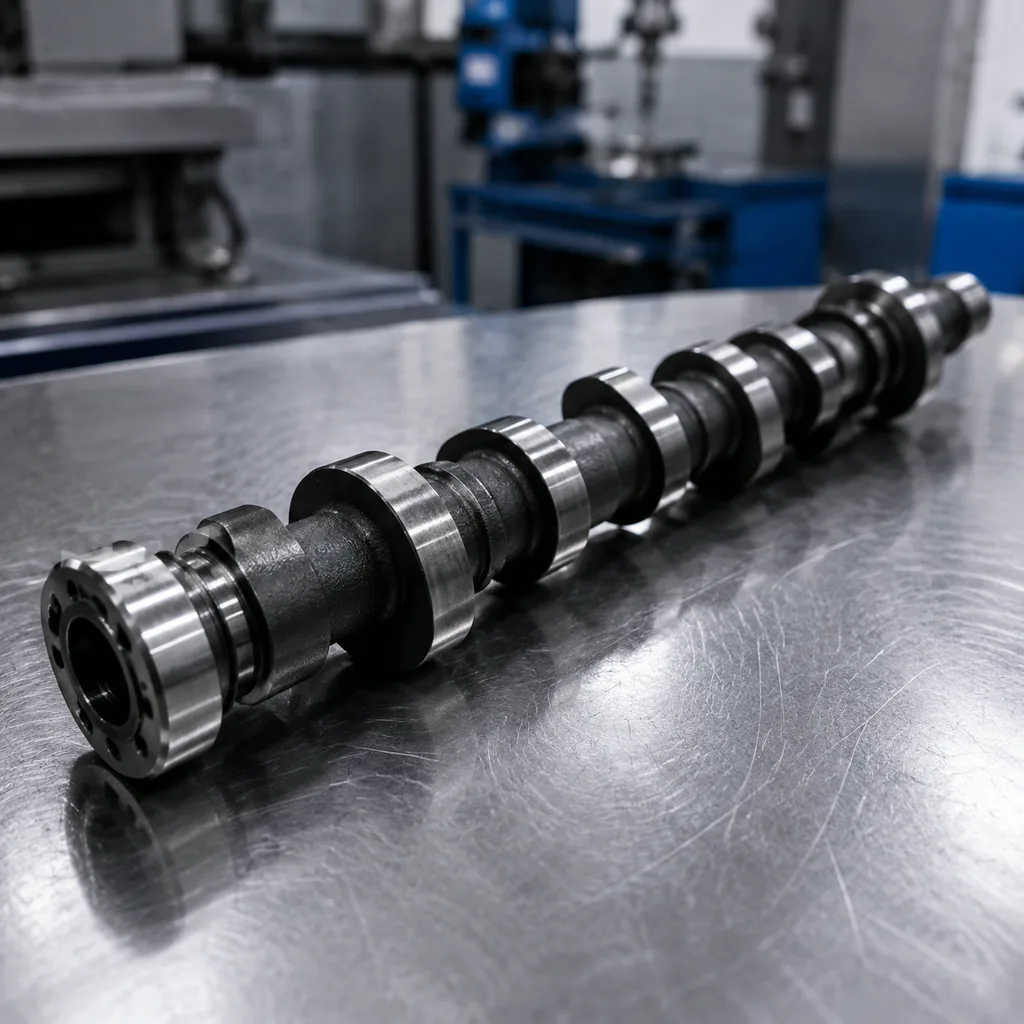
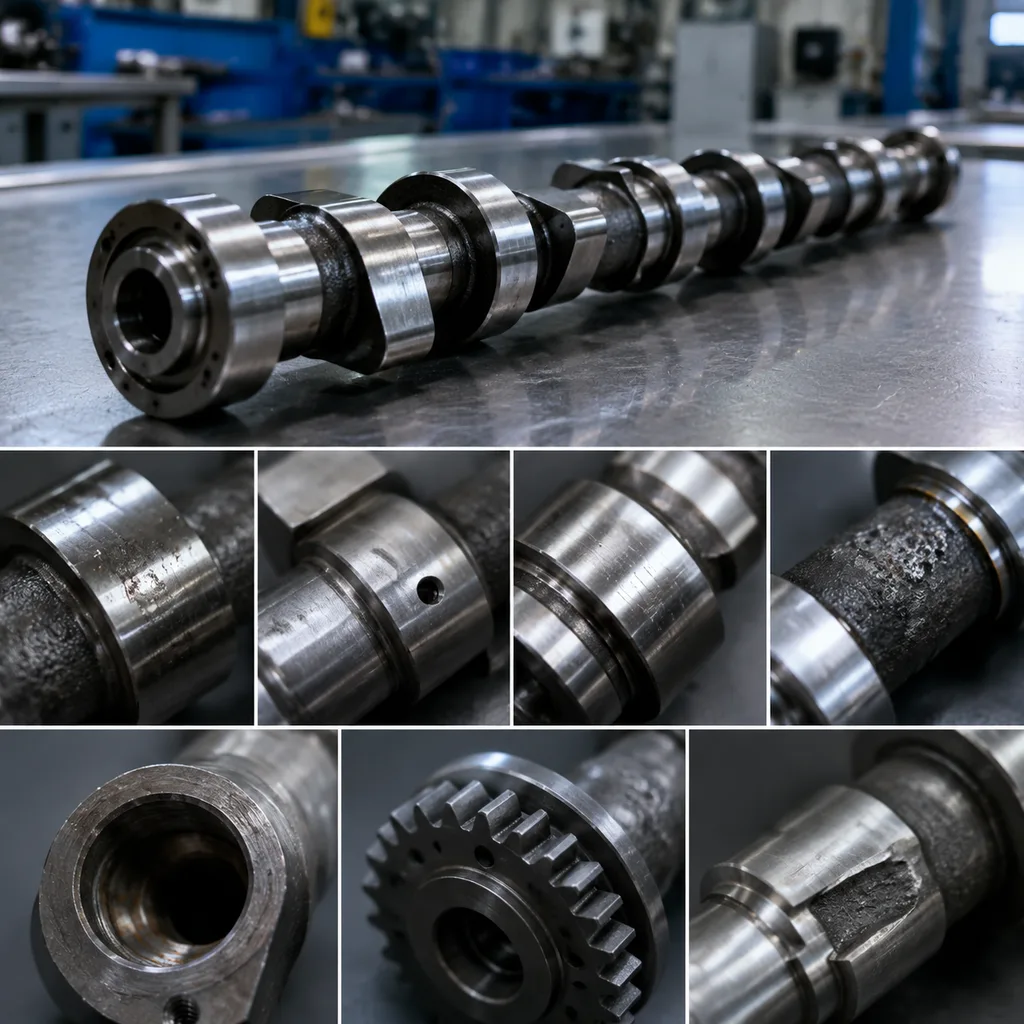
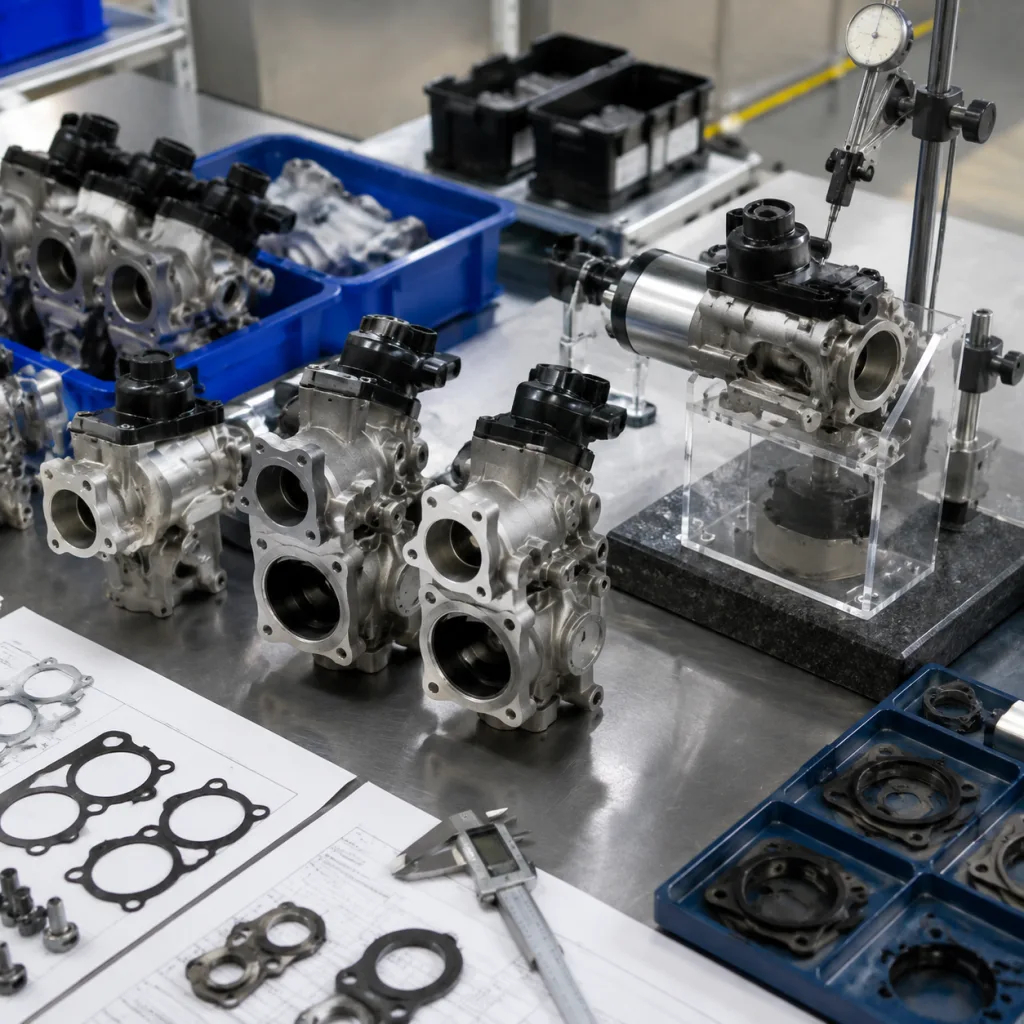
A camshaft for Lexus IS OE equivalent replacement is not proven by a catalogue match alone. It has to sit correctly in the cylinder head, hold valve timing, generate the correct sensor reference where used, and survive the first seconds of low-lubrication start-up. Small errors matter: 0.02-0.05 mm on a journal, 0.5-1.0° on lobe phasing, or a shifted trigger reference can become noise, fault codes, unstable idle, early wear, or expensive warranty claims.
Driventus manufactures engine components in Taizhou, Zhejiang, with process controls aligned to IATF 16949:2016 and ISO 9001:2015. For procurement teams, the useful question is not “does it look like the old camshaft?” but “what evidence proves this SKU will repeat across batches?” This article sets out the checks behind Lexus IS replacement camshaft sourcing: application confirmation, profile and trigger matching, metallurgy, surface hardening, validation, packaging, MOQ, lead-time planning, and change control.
Driventus is an independent aftermarket manufacturer; brand names are referenced for fitment only. We do not claim approval or endorsement by any vehicle manufacturer. For broader engine component coverage, buyers can review our catalog or the engine component category at /products/engine-components.html.
Start with a fitment decision, not a price comparison
OE-equivalent, in this product category, means the replacement camshaft is engineered to match the original part family’s functional geometry, installation interface, and operating requirements. It does not mean the part is supplied by, approved by, or endorsed by the vehicle manufacturer.
Before comparing quotations, close the fitment gate. A useful procurement specification should answer these points:
Engine application range, including displacement, fuel type, valve train layout, and production years
Engine code or market-specific application data, where available
Intake or exhaust position, plus bank location for V-type engines where relevant
Camshaft sensor trigger or reluctor configuration, including tooth count and reference angle
Journal diameter, journal width, and journal spacing, usually controlled in the 0.01-0.03 mm range depending on the design
Cam lobe lift, base circle, lobe separation, and phasing features, with lobe phase typically checked to within about ±0.5-1.0° against the approved master
Oil feed holes, oil grooves, thrust control features, and end-face geometry
Heat-treatment route and target hardness range, such as HRC or HV values by zone
Surface finish requirements for lobes and journals, commonly controlled by Ra limits rather than visual brightness
Packaging, corrosion protection, barcode label, and batch traceability
Treat any OE reference as a fitment cross-reference, not as proof of design. If a buyer uses an internal placeholder such as OE 06A… or OE 11251… in an RFQ, drawings, approved samples, VIN-derived application data, or measured originals should still confirm the final design. Lexus IS applications vary by market and production year. A model name on its own is too loose for dependable sourcing.
The first commercial filter should therefore be technical: engine family, year range, position, trigger design, and master-sample status. Once those are locked, price comparison becomes meaningful. Without that step, a low quotation can simply be the wrong camshaft quoted quickly.
The measurement table that prevents variant drift
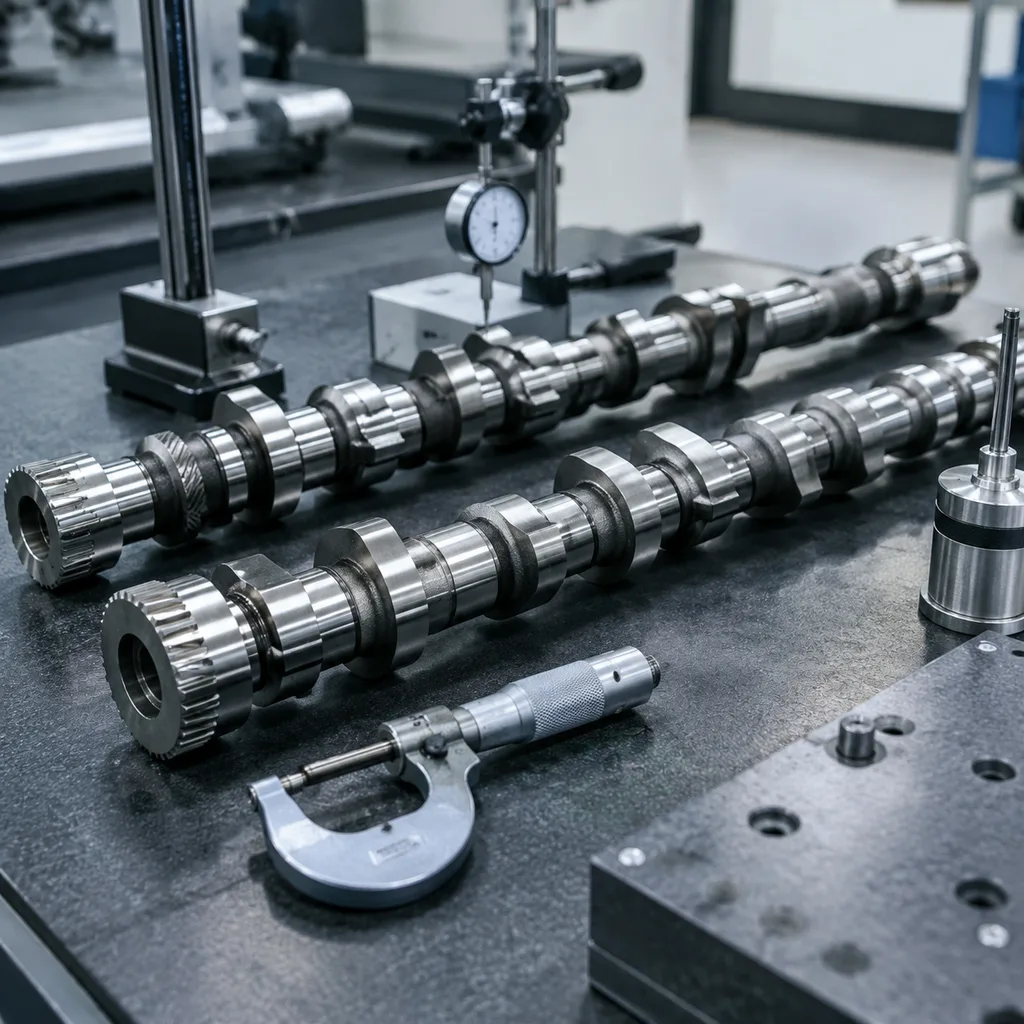
Camshafts are timing parts, not decorative machined bars. A visual match cannot confirm OE-equivalent supply. Driventus verifies critical dimensions by drawing, gauge, and sample comparison during development and production release, then uses defined inspection points to support repeatable production.
Check point
Procurement relevance
Typical verification method
Overall length and end-face features
Controls axial fit, thrust location, and sensor alignment
Height gauge, CMM, fixture gauge
Journal diameters
Affects oil clearance, oil pressure retention, and seizure risk
0.001 mm micrometer, air gauge, roundness inspection
Journal width and spacing
Ensures cylinder head bearing alignment
CMM or dedicated gauge
Cam lobe lift
Controls valve opening and engine breathing
Profile measurement, lift curve overlay
Base circle diameter
Affects valve lash or hydraulic adjuster position
Micrometer and profile scan
Lobe phase angle
Controls valve timing relative to the crankshaft
Cam profile analyser, angular fixture
Trigger wheel or reluctor geometry
Supports accurate camshaft position sensor signal
Optical or CMM inspection
Oil holes and grooves
Maintains lubrication flow to bearing and contact areas
Pin gauges, visual inspection, flow check
Runout and straightness
Reduces rotation resistance, noise, and bearing load
</tr></thead><tbody> </tbody></table>Acceptance bands should be agreed by drawing, not guessed from a sample photo. As practical reference points, journal diameter may be held within roughly ±0.01 mm on many machined designs, runout is often targeted below 0.03-0.05 mm depending on length, and lobe lift variation is normally controlled tightly enough to prevent visible lift-curve mismatch. These values are not universal specifications; they are starting points for the control plan and must be aligned to the exact Lexus IS application.
For aftermarket distribution, maintain an approved master sample for each Lexus IS application family. Incoming stock can then be checked against both the master and the latest drawing revision. This matters when one purchasing programme covers several engine variants, or when a distributor handles both intake and exhaust positions.
Do not consolidate camshafts by appearance alone. Intake and exhaust parts may share similar lengths yet differ in lobe phase, trigger features, thrust design, oil routing, or end-face machining. The wrong variant can pass a warehouse glance and still fail at installation or after first start-up.
Material choice is a wear-risk calculation
Material selection is not a contest to choose the strongest option on paper. It depends on engine design, valve spring load, lubrication conditions, contact stress, production economics, and the original design concept. Replacement camshafts are commonly produced from chilled cast iron, ductile iron, or forged steel, depending on the application. The target is the right combination of core properties, lobe durability, journal finish, and dimensional stability after heat treatment.
A serious sourcing file should define:
Material grade or equivalent metallurgical requirement
Chemical composition range and microstructure requirement, supported by a mill certificate or internal chemical analysis
Surface hardening method, such as induction hardening, carburising, nitriding, or chilled casting where applicable
Lobe and journal hardness targets, including acceptable tolerance range; examples may include hardened lobe surfaces in the HRC 50-60 or equivalent HV band, depending on material and design
Case depth requirement, when a hardened case is specified, often verified by section testing on development or batch samples
Surface roughness requirement for lobes and journals; buyers commonly specify Ra targets around 0.2-0.8 μm for running surfaces, subject to mating-part design
Straightness and runout limits before and after heat treatment
Magnetic particle inspection or other crack-detection requirement where specified
Cleaning standard to reduce abrasive residue and machining debris, including blocked-oil-hole checks
Anti-corrosion oil, VCI bag, sealed packaging, or export carton requirement
Surface finish is one of the fastest ways to separate controlled production from cosmetic finishing. Excessive roughness can accelerate follower wear and generate metal debris during early running. Over-polishing can also create problems if it changes intended geometry or reduces oil-retention characteristics. Bright is not the same as correct.
Hardness needs the same context. A soft lobe may wear under boundary lubrication; a brittle or poorly controlled hardened layer can crack, spall, or damage mating parts. Buyers should ask how the supplier controls heat-treatment parameters, verifies case depth, checks for cracks, and records batch-level results. A robust file should show furnace or induction parameters, quench control, hardness sampling frequency, crack-detection results, and disposition rules for nonconforming batches.
Driventus production controls use process documentation, inspection records, and batch traceability within our quality system. Our facilities operate under IATF 16949:2016 and ISO 9001:2015 frameworks, with control plans, incoming material checks, in-process inspections, and final release criteria.
A release sequence for private-label and export programmes
A camshaft for Lexus IS OE equivalent programme should be validated before bulk release, especially when the part will be distributed across several countries, sold under a private label, or installed by a repair-chain network. The validation plan does not need to duplicate an OEM development programme. It does need to catch the aftermarket failure modes that create claims: wrong variant, inaccurate timing, poor lubrication interface, insufficient hardness, corrosion, and handling damage.
Use a staged release sequence:
1. Dimensional PPAP-style review: full layout report against drawing data, reverse-engineered master data, or an approved reference sample, normally with at least 3-5 initial samples measured. 2. Material confirmation: chemical composition, hardness, case depth, and microstructure checks against the sourcing specification. 3. Runout and straightness testing: confirmation before and after heat treatment to identify distortion risk. 4. Surface integrity checks: crack inspection and roughness measurement at lobes, journals, thrust faces, and sensor-related features. 5. Assembly trial: installation in a representative cylinder head to confirm journal fit, thrust clearance, sensor alignment, oil hole location, and rotation torque. 6. Functional timing check: comparison of lobe phasing and trigger position against the approved sample or master data, with angular results recorded rather than judged visually. 7. Cleaning and contamination review: inspection for machining debris, abrasive residue, blocked oil holes, or unsuitable protective oil. 8. Packaging trial: drop, vibration, stacking, and corrosion-risk review for export handling and long sea freight, including carton compression and VCI effectiveness where required.
For larger distributors, Driventus can support sampling, batch approval, and application-specific documentation through custom manufacturing. This can include customer drawings, private-label packaging, inspection reports, material certificates, and agreed acceptance criteria. A typical sample process uses 2-4 weeks for drawing/sample confirmation and 4-8 weeks for first article production depending on tooling, heat-treatment route, and current capacity.
Repeat orders should not bypass the approval logic. Keep batch traceability, controlled change management, and retained inspection records in place after launch. Packaging and restricted-substance requirements also need review where parts are sold into the EU or UK. REACH (EC) No 1907/2006 is relevant to substances in articles and packaging declarations, and buyers may also need internal material disclosure formats depending on the customer channel.
Seven failure modes buyers can remove early
Most camshaft sourcing problems are preventable when the RFQ contains technical data instead of only a vehicle model name. Variant control, dimensional evidence, and installation guidance reduce both purchasing risk and warranty cost.
Risk
Likely cause
Mitigation for buyers
Incorrect valve timing
Wrong intake/exhaust position, bank, or lobe phase
Require profile data, position marking, and application table
Sensor fault code after installation
Trigger geometry or angular position mismatch
Verify reluctor profile, tooth form, and reference angle
Noisy operation
Journal clearance, lobe finish, follower condition, or oil pressure issue
Check diameters, roughness, application notes, and installation requirements
Premature lobe wear
Incorrect hardness, poor lubrication, contaminated oil, or worn followers
Specify hardness, surface finish, cleaning standard, and installation guidance
Tight rotation during assembly
Runout, journal misalignment, or cylinder head compatibility issue
Use assembly trial and straightness inspection before release
Installer returns
Mixed engine variants in one SKU or unclear catalogue data
Use VIN/application mapping, position marking, and sample comparison
Corrosion on arrival
Long sea freight, humidity, or inadequate packaging
Require VCI protection, sealed cartons, and corrosion-resistant packing process
</tr></thead><tbody> </tbody></table>Fitment data management is as important as production quality. Lexus IS models can include multiple engine families across regions and years. A broad aftermarket description may be convenient for catalogue entry, but it is risky for purchasing. Ask for a clear application table and confirm whether the camshaft is for intake, exhaust, left bank, right bank, or a specific valve train configuration.
Some warranty claims start at installation, not in manufacturing. A new camshaft installed with worn followers, blocked oil passages, contaminated oil, insufficient assembly lubricant, or an incorrect timing procedure may fail even when the part is dimensionally correct. Repair-chain customers should receive a short installation note covering oil-passage cleaning, mating-component inspection, timing procedure, assembly lubricant, and fresh oil and filter after major valve train work.
Define claim evidence before launch: photos of markings and failure surface, mileage at failure, oil/filter change record where available, installation date, fault codes, mating-part condition, and return quantity by batch. With that information, a supplier can separate product defects from installation, catalogue, or service-condition issues within 5-10 working days instead of leaving claims open-ended.
Build the RFQ around repeat supply
A camshaft supplier should not be selected on unit price alone. Stable metallurgy, controlled heat treatment, accurate profiles, clean machining, and protected packaging all affect landed cost. A cheaper offer without inspection data can become more expensive through returns, labour claims, catalogue corrections, emergency rework, and stock write-offs.
A practical RFQ package for Lexus IS replacement camshafts should include:
Target application and engine code information, where available
Model year range and destination market, because fitment can vary by region
Intake or exhaust position and bank location
OE cross-reference format if used, such as OE 06A… only as a reference
Drawing, measured sample, 3D scan data, or master sample status
Annual forecast, initial order quantity, and preferred shipment schedule
Required packaging: neutral, private label, or distributor brand
Required documents: inspection report, material certificate, PPAP elements, or IMDS-style material disclosure if needed
Destination market requirements, including EU, UK, US, Canada, Australia, or Brazil
Labelling requirements, barcode format, carton strength, and palletisation rules
Warranty handling, defect-analysis expectations, and response time requirements
Separate development MOQ from repeat-order MOQ. A new or modified camshaft carries higher initial cost because tooling, fixtures, sample inspection, and heat-treatment validation are front-loaded. Typical aftermarket logic is: sample order for approval, pilot lot to confirm repeatability, then container or consolidated shipment for stable landed cost. Depending on design and packaging, buyers should expect MOQ to be negotiated by SKU and process route; common B2B planning ranges are 50-100 pieces for stocked repeat items and 200-500 pieces for new or low-volume private-label programmes.
Unit price usually improves when several Lexus IS or related engine SKUs are batched together, because setup, inspection, packaging printing, and export documentation costs are spread across more parts. Driventus supplies aftermarket distributors, wholesalers, OEM/Tier-1 sourcing teams, and multi-location repair chains. Our export experience covers more than 60 countries, with B2B documentation, packaging control, and repeat-batch traceability.
For sample comparison, use a two-stage approval: dimensional and material review first, then assembly and functional confirmation before production release. As a planning guide, repeat production commonly requires 30-45 days after order confirmation for available-process items, while new tooling or special validation can extend lead time to 60-90 days. Ocean freight, customs clearance, and destination warehousing should be added separately to avoid unrealistic launch dates.
Stable supply depends on change control. If material source, heat-treatment route, machining process, packaging method, or marking format changes, the buyer should be notified before shipment when the change can affect fit, function, durability, compliance, or warehouse handling. That discipline keeps a camshaft for Lexus IS OE equivalent programme consistent across repeat orders and helps distributors protect their brand reputation in the aftermarket.
Frequently asked questions
No. OE-equivalent means the replacement is engineered to match the required fit, function, and performance characteristics for the application. It is not supplied, approved, or endorsed by the vehicle manufacturer. Driventus is an independent aftermarket manufacturer; brand names are referenced for fitment only.
Provide engine application, model year range, engine code if available, intake or exhaust position, bank location where relevant, sample photos, drawings if available, target quantity, packaging requirement, and any OE-format cross-reference. VIN-derived application data or an approved sample helps prevent variant mix-ups.
Yes. For qualified B2B programmes, Driventus can support neutral or private-label packaging, inspection reports, batch traceability, and application-specific documentation. Requirements should be confirmed during sampling and quotation.
If you are building a Lexus IS camshaft replacement programme, share your application list, sample requirements, drawings or reference parts, and target volumes. To review feasibility and pricing, [request a quote](/contact.html).