Camshaft for Nissan Sentra OE Equivalent: Sourcing Notes
Buyers sourcing a camshaft for Nissan Sentra OE equivalent need more than a catalogue match. They need the right lobe profile, journal sizes, timing-drive geometry, surface finish, and hardness to keep installation and engine behavior close to original. For procurement teams, the biggest risk is not the part name; it is variation in lift, base circle, phasing, and heat treatment that can change valve timing or shorten service life. Driventus supplies engine components from Taizhou, Zhejiang, for aftermarket and B2B channels across more than 60 export markets. We are certified to IATF 16949:2016 and ISO 9001:2015, and Driventus is an independent aftermarket manufacturer; brand names are referenced for fitment only. This article explains how to evaluate OE-equivalent replacement camshafts for Nissan Sentra applications, what to verify before purchase, and which documents to request from the supplier.
How to decide if a Sentra camshaft is truly OE-equivalent
For a Nissan Sentra application, OE-equivalent means the replacement camshaft matches the original part’s fit, function, and operating behavior closely enough that installation and engine performance stay within the intended engine family. That definition is narrower than a catalogue cross-reference. It requires confirmation of lobe profile, lift, duration, base circle, journal diameter, overall length, drive-end configuration, and any sensor or timing-interface features.
A practical buying rule is to tie acceptance to the OE reference, not to a generic Sentra listing. Ask for the engine code, model year range, and valve-train variant first. Then compare the specification set. A small change in phasing or base-circle size can shift valve timing, alter idle quality, increase emissions risk, or accelerate wear. If the supplier cannot state the measurement method and reference point, the part is not ready for production sourcing.
For buyer-side tolerance control, request dimensional variation no greater than ±0.02 mm on journal diameter, ±0.10 mm on overall length, and ±0.05 mm on critical runout unless your drawing requires tighter limits. Use those numbers as a screen, then validate against the OE sample or engineering print. The goal is not to claim OEM status. The goal is to preserve the original installation envelope and engine response.
Driventus is an independent aftermarket manufacturer; brand names are referenced for fitment only.
Specification checklist: the numbers that matter
The strongest sourcing programs start with hard specifications, not photos. Before placing a production order, request dimensional evidence for the candidate camshaft and compare it with the OE sample, engineering drawing, or validated cross-reference record.
Ask for confirmation of:
- Journal diameter and bearing surface finish, with diameter tolerance and measurement points clearly stated
- Overall shaft length and end-face geometry, including allowable axial variation
- Lobe height, lift, and lobe separation data, referenced to the same measurement method as the OE part
- Base-circle dimensions and phasing, with intake/exhaust timing angles called out
- Drive-end keyway, sprocket interface, or gear features, including key width and spline or taper details if used
- Sensor target geometry, where applicable, including tooth count, window width, or trigger offset
- Runout, straightness, and surface concentricity, measured after final grinding and finishing
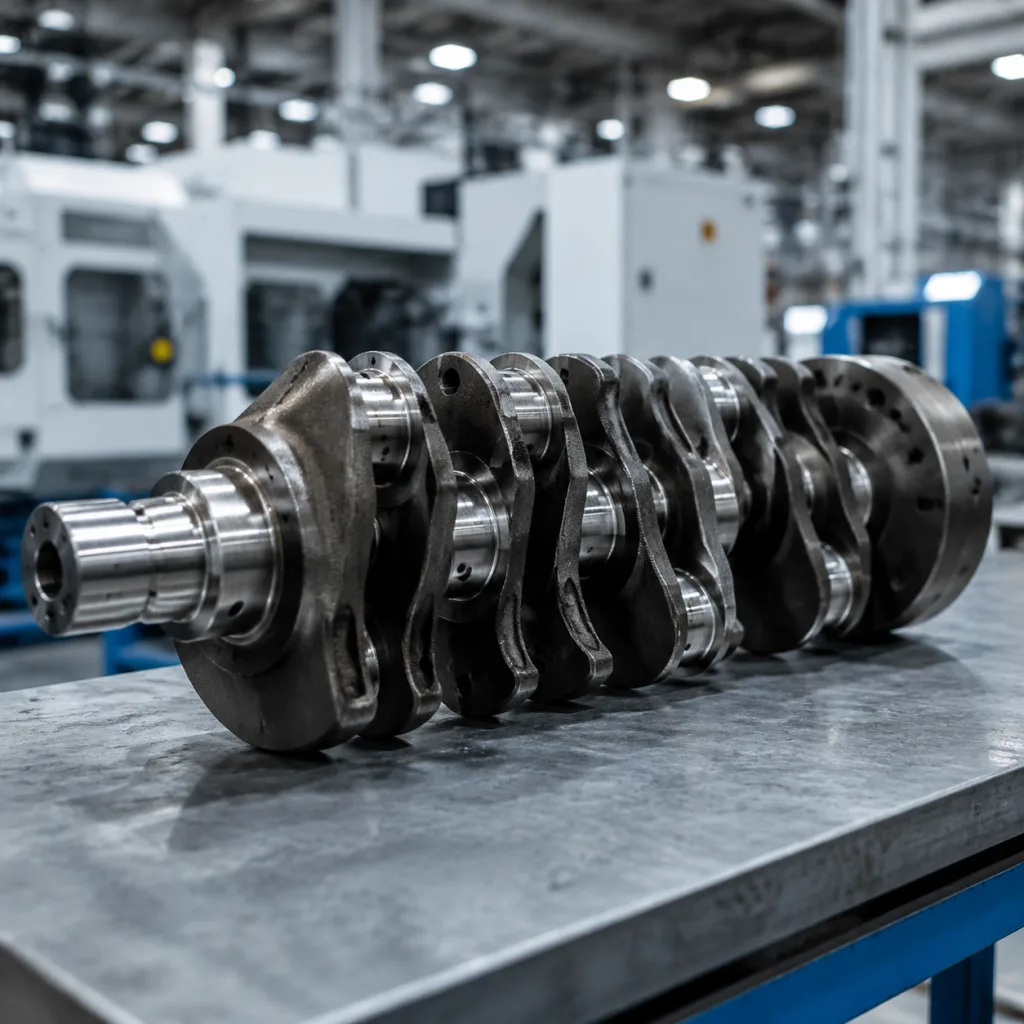
Material and heat treatment matter just as much as geometry. Request the alloy specification, hardening method, case depth or hardness range, and any post-machining finishing process used on the lobes and journals. For a replacement camshaft, a practical target is Rockwell hardness in the HRC 50-60 range on wear surfaces, with case depth or hardened layer documented in microns or millimeters depending on the base material and process. A camshaft that measures correctly but lacks stable heat treatment can still create premature wear, noise, or timing drift in service.
If you are comparing multiple suppliers, standardize the inspection method. Use the same gauge list, datum points, and master sample across all evaluations. That prevents false mismatches caused by different measurement routines rather than real product variation.
Step-by-step validation before mass order release
A replacement program is stronger when it is validated in layers instead of by appearance alone. Start with incoming inspection, then add functional checks that reflect how the part behaves in the engine.
A practical sequence is:
- Confirm the dimensional match against the approved reference
- Verify hardness on lobes and journals
- Check the base material and heat treatment route
- Measure surface roughness on wear-critical areas
- Inspect runout and concentricity after finishing
- Confirm fitment in the designated engine assembly
For buyer-side specification control, request surface roughness targets of Ra 0.2 to 0.8 μm on lobe and journal contact areas unless the OE sample shows a different benchmark. Also ask for 100% visual inspection for scoring, burrs, and finish defects, plus AQL-based sampling for dimensional checkpoints on production lots. If the supplier uses induction hardening or carburizing, request the process window, soak time, quench method, and post-heat-treatment grind allowance so you can confirm the part is stable enough for repeat production.
For higher-volume programs, add endurance or bench testing that simulates operating load, lubrication, and thermal cycling. A useful threshold is at least one endurance validation build before launch, with the test run matching the intended application profile in hours, RPM band, and oiling conditions. That matters most when the part will serve a broad aftermarket base with mixed service conditions. If the supplier can share control plans, inspection records, and sample test reports, specification lock becomes much easier.
A simple procurement test applies here: if the part cannot be described, measured, and tested against a fixed reference, it is not ready for repeatable sourcing.
Failure modes buyers should watch for
Most camshaft sourcing problems show up after installation, not at the purchase-order stage. The common failure modes are predictable.
One risk is geometry drift. If lift, phasing, or base-circle dimensions deviate from the reference, the engine may still run, but idle quality, emissions behavior, and fuel economy can move in the wrong direction. Another risk is surface and hardness inconsistency. A shaft that looks correct but lacks stable heat treatment can wear prematurely or generate abnormal noise under load.
Misread fitment data is another frequent issue. A Sentra listing may look correct on the surface while the actual engine code, timing-drive setup, or sensor interface differs. That is why the check should start with application data, not with the vehicle name alone. The same model can carry different valve-train variants across years and markets.
Watch for incomplete inspection records too. If the supplier cannot show runout data, hardness results, or a clear sample-approval trail, the commercial risk rises quickly. In replacement programs, incomplete documentation is often the first sign that repeat orders will be inconsistent.
The best defense is to force every claim back to a measurement, a drawing, or a validated sample. Anything else is just a description.
Commercial comparison: what to compare beyond price
Commercial decisions should support technical control, not override it. The lowest unit price is rarely the best outcome if the supplier cannot hold dimension, material, and traceability standards across multiple lots.
Compare the following before you award the business:
- MOQ, lead time, and replenishment capacity
- Packaging standard and corrosion protection for transit
- Batch traceability, including lot coding and inspection records
- Sample approval process before mass production
- Warranty terms and claim handling for B2B accounts
- Export documentation and compliance support for the target market
For planning, a typical factory MOQ for a camshaft program is often 50-100 pieces for a standard aftermarket spec, while custom packaging, unique phasing, or special finishing can raise the MOQ to 200-300 pieces depending on tooling and setup cost. Lead time is usually 15-25 days for in-stock or repeat-run parts and 30-45 days for newly opened orders that require raw-material reservation, heat treatment, and final inspection. Tie the promised ship date to an approved sample date, not just the purchase order date.
When comparing prices, ask for an EXW price at MOQ, a second price tier at 200+ units, and a quote that separates part cost from packaging and freight. That makes it easier to see whether the supplier is controlling cost through process efficiency or simply lowering specification. It also helps to align the sourcing package with the sales channel. A warehouse customer, distributor, and repair-network buyer may all need the same camshaft, but they may require different labeling, carton quantity, and document formats. Clarifying those requirements early reduces rework and avoids shipment delays.
For multinational programs, request written confirmation that the supplier can maintain the same specification across repeat orders. That continuity matters more than a one-time sample.
Where Driventus fits in the replacement chain
Driventus supports B2B buyers who need replacement engine components backed by controlled manufacturing, documented inspection, and cross-reference support. Our role in the supply chain is to help procurement teams move from OE reference to production-ready aftermarket part with fewer fitment surprises and clearer quality controls.
We work from Taizhou, Zhejiang, and supply customers across more than 60 export markets. Because Driventus is an independent aftermarket manufacturer, our focus is on specification alignment, stable production, and practical sourcing support rather than OEM branding. For camshaft programs, that means helping buyers confirm the right application details, review samples, and define the inspection points needed for repeat orders. When buyers send a sample request, we typically ask for the OE number, engine code, production year range, photos of the drive end and lobe face, target annual volume, and any known tolerance limits so we can quote accurately and avoid retooling surprises.
If you are building a replacement program for a Nissan Sentra application, the most efficient next step is to send the OE reference, engine code, and any sample or drawing you already have. That allows the supplier to verify fitment details, confirm the specification set, and determine whether the part is suitable for OE-equivalent sourcing.
Frequently asked questions
No. OE-equivalent means the part is designed to match the original fit and function closely, but it is not an OEM-branded or manufacturer-approved item.
Confirm engine code, journal dimensions, overall length, lobe profile, drive-end features, and any sensor target or timing interface details against the OE sample or drawing. Also ask for hardness, runout, and surface finish data so the part can be validated before mass order release.
Yes. We support B2B cross-reference sourcing and can align part specifications to drawings, samples, or OE references for fitment only.
If you are building a replacement program or need a sample review, send the OE reference and application details through /contact.html.
Request a Quote