Camshaft for Mitsubishi Pajero Aftermarket Replacement Guide
Choosing a camshaft for Mitsubishi Pajero aftermarket replacement is a fitment decision, not a branding decision. The part has to reproduce the OE valve timing profile, journal geometry, drive interface, and surface condition closely enough to survive real engine load, not just pass a visual check. Driventus supplies aftermarket camshafts for engine rebuild and remanufacturing channels, with production controlled under IATF 16949:2016 and ISO 9001:2015. Driventus is an independent aftermarket manufacturer; brand names are referenced for fitment only. If you are sourcing against a Pajero program, the safest path is to anchor the order to engine code, OE reference, and measured sample data rather than vehicle name alone.
Start with the fitment risk, not the part photo
A Mitsubishi Pajero can carry different engines, lifter setups, timing drives, and sensor layouts across model years. That means two camshafts that look close can still fail at installation or during the first hour of running.
Use this as the first filter:
- Engine code, not just model name
- Intake or exhaust position
- Timing drive type: belt, chain, or gear
- Cam sensor trigger geometry
- Hydraulic or mechanical lifter setup
If any of those are unclear, ask for the removed part before placing volume. A sample-based check is faster than reworking a shipment after the fact.
What must match on an OE-equivalent replacement
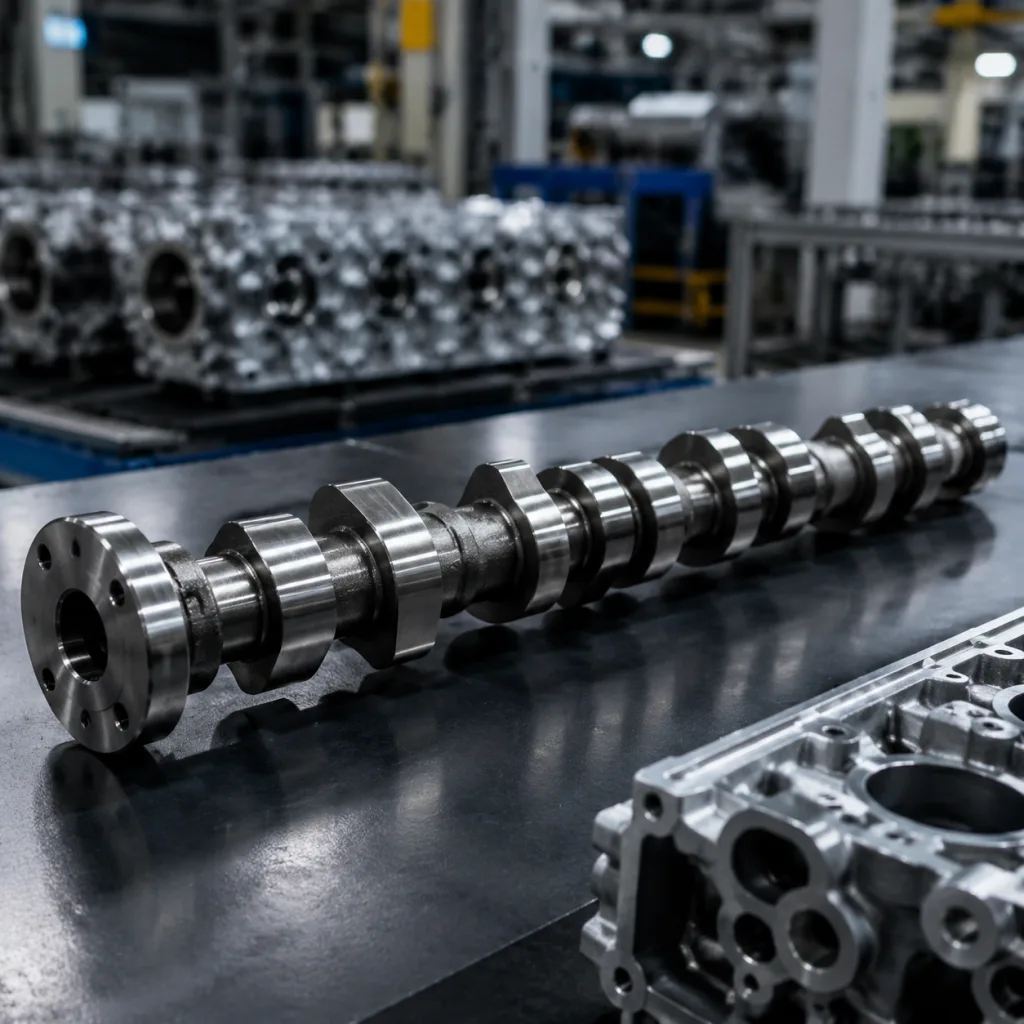
An OE-equivalent camshaft is defined by measurable geometry and surface condition. For the camshaft for Mitsubishi Pajero aftermarket replacement program, buyers should ask suppliers to match the OE sample or drawing on the following points:
- Base circle diameter and lobe lift
- Journal diameter, width, and spacing
- Overall length and thrust face position
- Keyways, flats, dowels, and trigger features
- Heat treatment, hardness, and surface finish
Set numeric tolerances in the RFQ. Typical buyer-side targets for an OE-equivalent program are journal diameter within ±0.01 mm, overall length within ±0.10 mm, lobe lift within ±0.03 mm, and runout no greater than 0.03 mm TIR unless the engine drawing calls for tighter limits. Journals are often specified at Ra 0.2–0.4 μm and lobes at Ra 0.4–0.8 μm, but the OE sample should always take priority.
The practical test is repeatability. One perfect sample is useful; a stable lot is what keeps rebuild output moving.
Failure modes that show up after installation
Most camshaft complaints are not mysterious. They trace back to a few predictable misses in sourcing or approval.
Common failure modes include:
- Wrong engine family or cylinder-head variant
- Sensor trigger mismatch that confuses the ECU
- Incorrect journal spacing or thrust position
- Surface hardness that is too low for the load
- Poor runout control that raises noise and wear
- Packaging damage that scars journals before installation
If the engine starts but idles badly, check sensor geometry first. If wear appears quickly on the lobes, check surface hardness, finish, and oil clearance. If the part will not seat cleanly, compare thrust face position and journal spacing against the OE sample before blaming the installer.
Material and hardness: the spec details buyers should ask for
A camshaft runs in boundary-lubrication conditions, so material and surface integrity matter more than most buyers expect. Depending on engine design and duty cycle, aftermarket production usually uses chilled cast iron or alloy steel.
Request these control points:
- Base material declaration
- Lobe and journal hardness by batch
- Case depth where carburising or induction hardening is used
- Nitriding or phosphate treatment, if applicable
- Corrosion protection for storage and freight
For alloy-steel designs, a practical working-surface hardness target is often HRC 50–60, unless the OE drawing states otherwise. For chilled-cast designs, ask for the OE-equivalent case depth and the actual test method. If the supplier offers nitriding, request case-depth data in the 0.20–0.60 mm range or the drawing requirement, plus microhardness profile data where available.
Surface protection matters too. If the part arrives with staining or freight corrosion, the rest of the inspection is already compromised.
Step-by-step: how to approve a supplier lot
Treat approval as a controlled sequence, not a one-time promise.
1. Identify the engine code, cam position, and OE reference. 2. Compare the supplier sample against a physical OE part or drawing. 3. Verify critical dimensions: journals, length, lift, runout, and trigger features. 4. Review material, hardness, and surface finish data by heat lot. 5. Confirm packaging, labeling, and corrosion protection. 6. Release only after the sample matches both geometry and production documents.
For production buys, ask for first-article approval on 5–10 pcs, dimensional sampling on every lot, and hardness confirmation on 1–3 pcs per heat lot. If the program is higher risk, request PPAP-style records: drawing ballooning, control plan, process flow, measurement report, and signed approval summary. That gives procurement a paper trail instead of a verbal assurance.
Sourcing scenarios: stocked item, custom run, or private label
The right sourcing path depends on how stable your demand is.
- Stocked export item: best for urgent repair demand and smaller replenishment orders
- Made-to-order replacement part: better when you need controlled fitment and recurring volume
- Private-label or drawing-based program: best when you want your own part identity and repeatable supply
Driventus manufactures in Taizhou, Zhejiang, and supplies B2B customers across export markets with documented quality control under our quality system. Buyers can review our catalog for adjacent engine components and related rebuild items when consolidating purchasing.
For forecastable programs, ask for tiered quotes at 100/300/500 pcs so you can see price breakpoints clearly. Also confirm whether the quote includes inner and outer carton labeling, corrosion protection, and export packing, because those items can move landed cost more than the piece price alone. If you need broader BOM support, engine components can be quoted together to reduce supplier count and simplify inbound inspection.
What to include in the RFQ so quotes are comparable
A vague RFQ creates vague pricing. To compare suppliers on the same basis, include:
- Engine code and camshaft position: intake or exhaust
- OE reference or sample part for comparison
- Annual volume and forecast split
- Required tolerances and inspection level
- Label format, barcode needs, and packaging spec
If the buyer only has a vehicle description, request the old part for dimensional comparison before ordering volume. If the program is tied to an OE reference, quote against that reference first and use the sample as the backup control point. This is the fastest way to keep fitment, pricing, and lead time aligned without rework later.
Frequently asked questions
Confirm the engine code first, then check OE reference, valve count, and whether the part is intake or exhaust. If the OE number is not available, compare the old camshaft by journal size, length, sensor features, drive interface, and measured runout before ordering volume.
Yes, if the manufacturer controls the critical dimensions, hardness, straightness, and lobe profile against an OE sample or drawing. The key is documented validation, not appearance, and the buyer should set numeric tolerances in the purchase specification.
Ask for dimensional inspection data, hardness results, material declaration, batch traceability, and packaging verification. For regulated supply chains, request confirmation of IATF 16949:2016 and ISO 9001:2015 controls, plus first-article or PPAP-style records when the program requires them.
If you need a verified replacement programme or a sample check against your OE reference, send the part details to Driventus and we will review the fitment data with you: /contact.html
Request a Quote