Crankshaft Pulley Subaru Wholesale: Sourcing Guide
When buyers source crankshaft pulley Subaru wholesale programs, price matters only after fit, durability, and repeatable supply are proven. The pulley drives the accessory belt system and, in some designs, also helps manage torsional vibration through a bonded damper or controlled mass. Small errors in bore size, offset, groove geometry, or balance can trigger belt noise, premature wear, vibration, or warranty claims. So the real job is to verify the OE cross-reference, application range, groove profile, hub runout, surface finish, material specification, and balancing method before volume purchase.
Driventus manufactures engine and powertrain components in Taizhou, Zhejiang, under IATF 16949:2016 and ISO 9001:2015 quality systems, supplying aftermarket, OEM, and repair-network customers in more than 60 countries. Driventus is an independent aftermarket manufacturer; Subaru and other brand names are referenced only to identify fitment. This guide focuses on how to avoid sourcing mistakes, compare suppliers, validate parts before release, and prepare the documents import, quality, and warehouse teams usually need.
Fitment first: what can go wrong
A pulley can look correct in a catalog and still fail in service. The common mistakes are simple: the belt track is right, but the offset is wrong; the OD matches, but the groove profile does not; the part fits the shaft, but the balance is off.
Before asking for a quote, confirm the items below:
- OE cross-reference: verify the reference number, engine code, model-year range, and market application.
- Bore and shaft interface: check bore size, keyway or locating feature, retention method, and tightening requirements.
- Outside diameter and groove count: confirm the belt path, accessory speed ratio, and pulley alignment.
- Runout and balance: request measured values from production samples, not only catalog claims.
- Material and construction: confirm whether the part is solid metal, multi-piece, or rubber-bonded.
- Surface treatment: verify corrosion resistance, coating thickness, and storage protection.
If you are building a broader order, start with our catalog and the engine components range.
Spec deep-dive: what a supplier should control
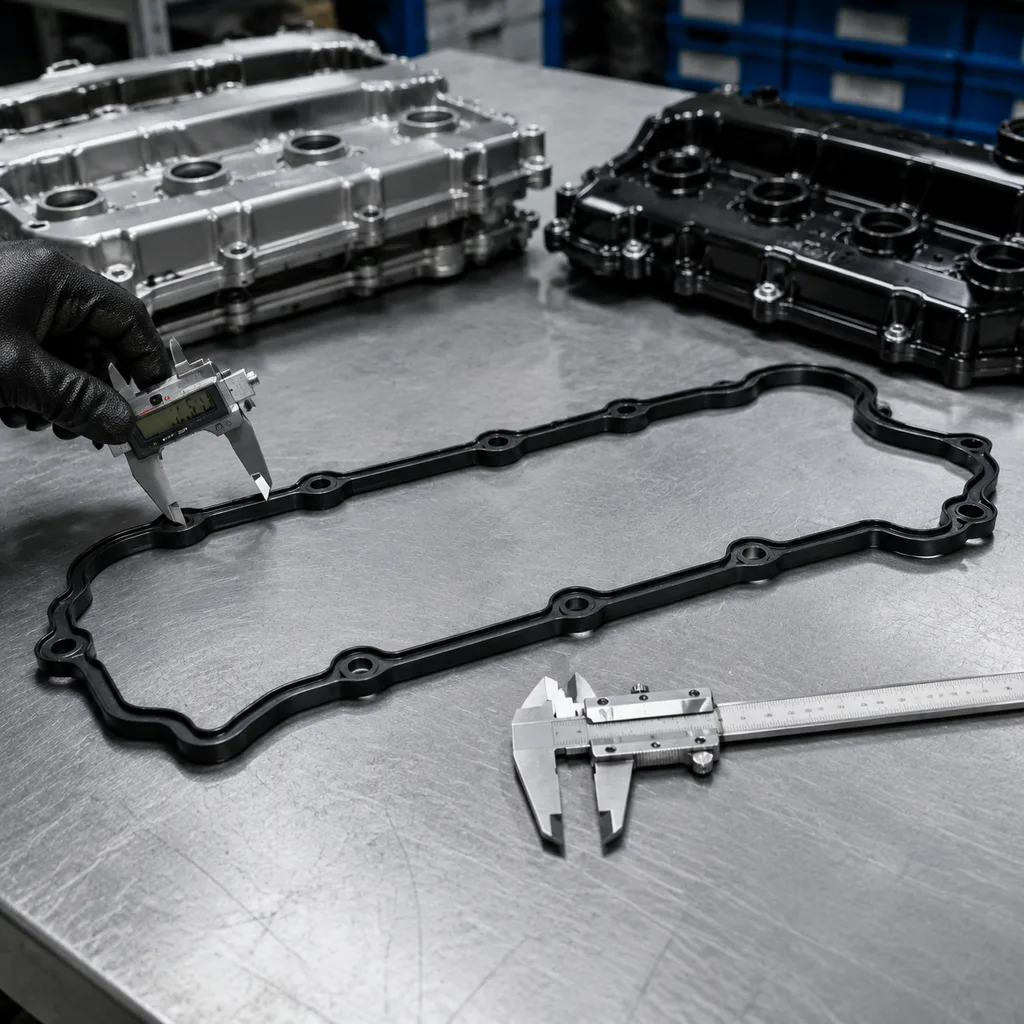
A reliable supplier should treat the pulley as a controlled engine component, not a simple machined ring. That means traceability from blank or raw material to machining lot, balancing record, final inspection, and packing batch. If the design includes a rubber damper, bond quality and rubber specification become part of the control plan too.
| Control item | Typical buyer check | Why it matters |
|---|---|---|
| Material specification | Ductile iron, steel, aluminium alloy, or rubber-bonded construction by application | Affects inertia, strength, damping, and service life |
| Dimensional tolerance | Bore, offset, groove profile, face width, and mounting features | Prevents belt tracking errors and installation issues |
| Radial and face runout | Measured with calibrated gauges on approved samples and production lots | Limits vibration, belt flutter, and accessory bearing load |
| Dynamic balance | Verified after machining and before release | Reduces noise, vibration, and crankshaft/accessory stress |
| Damper bond control | Rubber hardness, bond integrity, and visual inspection where applicable | Helps prevent separation, cracking, or damping loss |
| Corrosion protection | Phosphate, coating, anodic finish, or oil protection by material | Extends storage life and improves field durability |