Camshaft for BMW X3 OE Equivalent Sourcing Guide
Replacement camshafts for BMW X3 applications need more than a visual match. For distributors, repair-chain buyers, and import managers, the risk sits in dimensional accuracy, surface durability, valve-train compatibility, and traceable production control. A camshaft for BMW X3 OE equivalent program should be checked against engine-code coverage, lobe profile repeatability, journal concentricity, hardness depth, packaging protection, and batch documentation. Driventus supplies engine and powertrain components from Taizhou, Zhejiang, with exports to more than 60 countries and production controls aligned with IATF 16949:2016 and ISO 9001:2015. This article lays out the sourcing decisions that help buyers qualify OE-equivalent camshafts for aftermarket replacement, without implying vehicle-maker approval. Driventus is an independent aftermarket manufacturer; brand names are referenced for fitment only.
Start With Fitment Risk, Not the Part Picture
For professional sourcing, OE-equivalent does not mean a cosmetic copy. It means the replacement camshaft matches the functional geometry, material performance, and installation interface required by the specified engine family.
BMW X3 coverage is where many programs go wrong. The same model badge can hide petrol and diesel variants, different engine codes, intake and exhaust differences, and regional build changes. Before price discussions, lock down the engine code, chassis year range, displacement, timing-trigger features, bearing journal count, and any variable valve timing interface. If the file is incomplete, ask for VIN-based fitment data or a sample part before quotation.
A usable RFQ should include:
- Engine code, chassis year range, and displacement
- Intake or exhaust position, or a complete pair if sold as a set
- Original part number or internal cross-reference number
- Quantity forecast for trial order, 90-day demand, and annual demand
- Required packaging format, label language, and pallet standard
- Whether phaser, gear, or trigger wheel is included or excluded
Buyer checks usually start here:
- Correct intake or exhaust camshaft configuration
- Matching cam lobe sequence and timing reference features
- Journal diameter and thrust-face position within drawing tolerance
- Compatible gear, sprocket, phaser, or sensor interface
- Surface hardness suitable for follower or tappet contact
- Clean oil-feed holes and deburred edges
- Packaging that prevents bending, corrosion, and impact damage
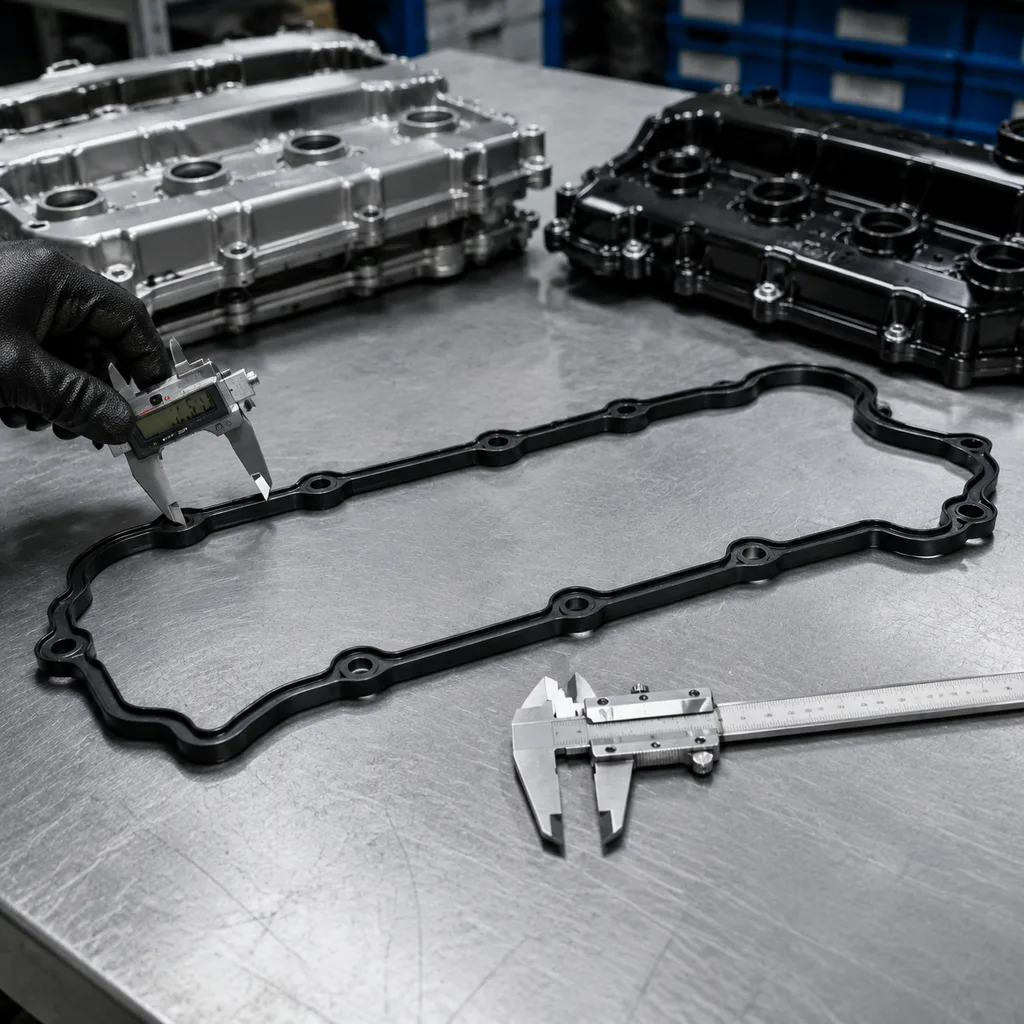
For the first sample round, a practical acceptance target is journal diameter within ±0.01 mm of drawing, runout not exceeding 0.03 mm across the full shaft length, and lobe lift within ±0.05 mm unless the engine file calls for tighter limits. For high-volume repair programs, freeze those values against a master sample and keep them in the control plan.
Driventus can support fitment review through our catalog and engine-component coverage at /products/engine-components.html. Where standard catalog coverage is not enough, custom manufacturing can be assessed from drawings, samples, or buyer-controlled specifications.
What the Specs Need to Say
Camshafts live under repeated sliding and rolling contact. Small shifts in lobe lift, base circle, runout, or surface finish can lead to valve noise, low compression, poor idle, diagnostic fault codes, or early follower wear. That is why procurement specs need measurable limits, not just an application list.
For buyers writing a purchase specification, the following are practical starting points for OE-equivalent replacement programs, subject to engine-code review and final drawing approval:
| Check item | Why it matters | Typical verification method | |
|---|---|---|---|
| Overall length and thrust location | Controls axial fit and timing alignment | Vernier, height gauge, CMM | |
| Journal diameter and roundness | Affects oil film and bearing clearance | Micrometer, roundness tester | |
| Lobe lift and base circle | Controls valve opening and engine breathing | Cam profile measuring equipment | |
| Runout | Prevents vibration and uneven bearing load | V-block and dial indicator | |
| Surface hardness | Reduces lobe and follower wear | Rockwell or Vickers hardness test | |
| Case depth or hardened layer | Supports durability beyond surface reading | Metallographic inspection | |
| Oil-hole cleanliness | Prevents lubrication failure | Visual inspection, air-flow check |
| Sourcing route | Best fit | Advantages | Buyer responsibilities |
|---|---|---|---|
| Catalog OE-equivalent part | Standard aftermarket replacement demand | Faster sampling, lower development cost, existing process data | Confirm engine application and local market fitment |
| Sample-based reverse engineering | Discontinued or hard-to-source applications | Useful when drawings are unavailable | Provide clean samples and define acceptance limits |
| Drawing-controlled production | Distributor private label, repair-chain program, Tier-1 service channel | Strongest dimensional control and change management | Release drawing, revision control, and forecast plan |
| Custom material or process | High-mileage, severe-duty, or regional fuel/oil conditions | Can target specific durability requirement | Approve validation plan and commercial MOQ |