Camshaft for BMW X5 OE Equivalent: Sourcing Guide
A camshaft for BMW X5 OE equivalent has to be matched to the exact engine application, not just the vehicle name. BMW X5 platforms have used multiple petrol and diesel engines across generations and markets, with different intake and exhaust camshafts, variable valve timing interfaces, reluctor features, bearing journal layouts, thrust faces, and oil-feed details. Even a part that installs cleanly can cause timing deviation, noise, unstable idle, emissions faults, or premature wear if the lobe profile, journal dimensions, phasing features, surface finish, or hardness fall outside the required window.
For procurement teams, the sourcing process should start with the OE number, engine code, camshaft position, production range, and timing-system type. The replacement can then be verified through OE cross-reference, sample comparison, dimensional inspection, and batch-level traceability before approval for repeat supply. Driventus is an independent aftermarket manufacturer; vehicle and brand names are used only to identify fitment. We manufacture engine and powertrain components under IATF 16949:2016 and ISO 9001:2015 processes, with validation focused on dimensional control, hardness, runout, surface integrity, and repeatability for distributor and import programs.
What OE-equivalent means for BMW X5 camshafts
For a BMW X5 camshaft, OE-equivalent means the replacement is engineered as a functional substitute for the original part in a defined engine application. A similar-looking blank, casting, or machined profile is not enough. The camshaft must match the geometry that governs valve lift, duration, timing synchronization, lubrication, and bearing support.
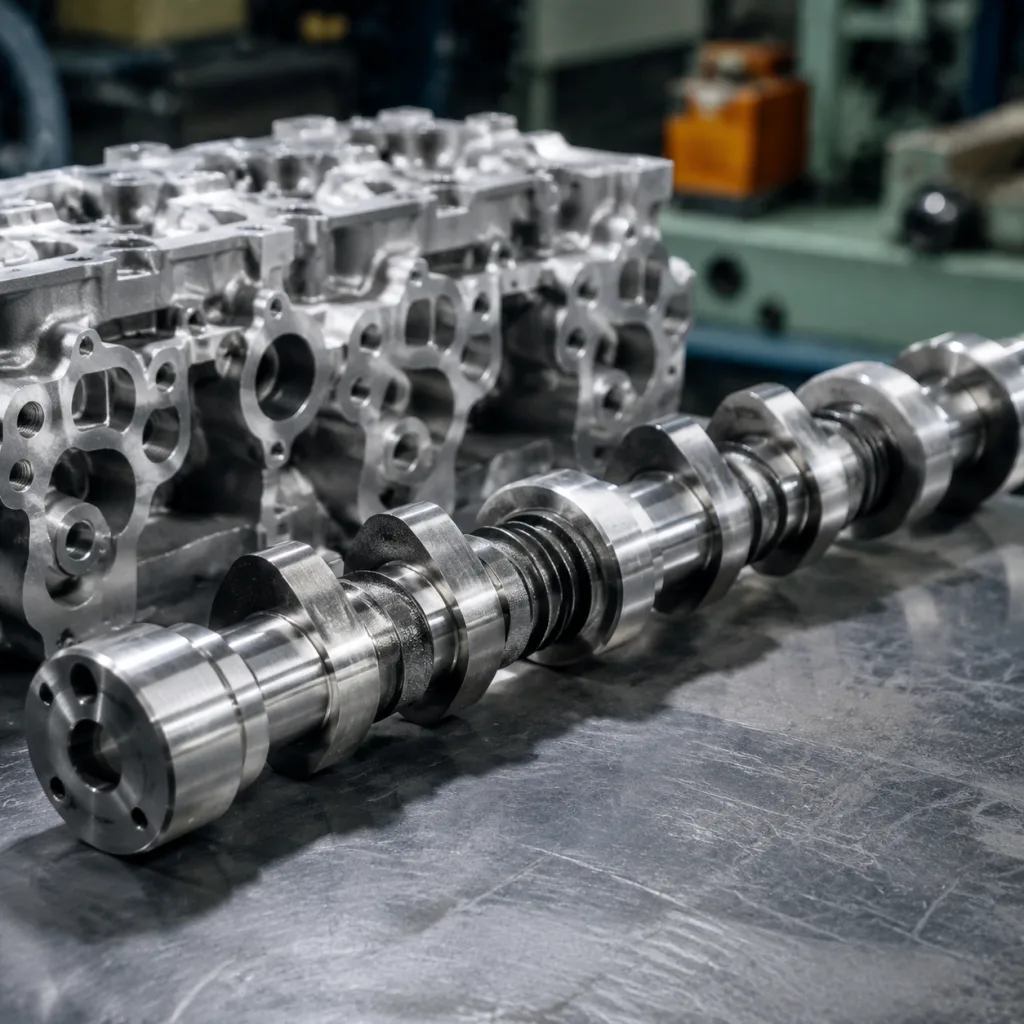
The main matching points include the OE reference number, engine code, intake or exhaust position, lobe count, lobe lift, base-circle diameter, journal diameters, journal spacing, thrust-face location, timing-drive interface, sensor trigger features, and oil-passage details where applicable. On variable valve timing engines, the actuator interface and phasing geometry deserve particular attention, because small deviations can shift commanded timing and trigger engine-management faults.
In practice, approval should compare the proposed camshaft with published OE data, a verified removed sample, and label data from the original part. For multi-market BMW X5 applications, importers should also check production-date splits, emissions specification, left-hand or right-hand market restrictions, and any superseded OE numbers. Driventus supplies OE-style replacements only after part-level verification, so the commercial offer is tied to a confirmed application rather than a broad model description.
Core validation checks before you approve a substitute
Before approving a camshaft for BMW X5 OE equivalent supply, procurement teams should ask for evidence that the part has been checked against the dimensions and functional features that matter in service. A useful validation package normally includes dimensional inspection, material confirmation, heat-treatment control, surface-finish review, and batch traceability.
Dimensional checks should cover all bearing journals, lobe lift, base circle, total runout, straightness, thrust width, end features, timing-interface dimensions, and sensor-related geometry. For engine components of this type, runout is typically assessed in hundredths of a millimeter, and journal fit should be verified against the engine builder's required clearance rather than a generic aftermarket target. Surface and hardness checks help reduce the risk of lobe scuffing, journal wear, and noise complaints after installation. Depending on the specification, a supplier may use hardness testing, roughness measurement, metallographic review, magnetic particle inspection, or other non-destructive checks to verify production quality.
Fitment validation should also cover the parts that work with the camshaft, including cam followers or rocker arms, camshaft adjusters, sprockets, chains, bearings, seals, and position sensors. If these interfaces are overlooked, a correct-looking camshaft can still create warranty exposure.
If your target market includes the EU or UK, verify material and chemical compliance for the supply chain as part of the approval file. Where relevant, component declarations should align with REACH (EC) No 1907/2006 and your customer’s restricted-substance policy. For larger programs, keep the first-article inspection report, control plan, and batch records linked to the purchase order so future claims can be traced quickly.
BMW X5 replacement factors that affect fit and service life
BMW X5 camshaft selection depends on engine family, fuel type, production period, intake or exhaust location, and the design of the valve-timing system. A sourcing team should not approve a camshaft from the vehicle name alone, because the X5 range includes several engine architectures with different valve-train layouts and timing controls.
Important fitment factors include the engine code, OE number, cylinder-head design, camshaft adjuster type, reluctor or trigger pattern, oil-feed configuration, and whether the required part is for the intake side or exhaust side. Some engines also have production splits or superseded numbers that look close in catalog data but are not interchangeable without confirming the full application. In practice, a one-digit difference in the OE reference can mean a different sensor window, a different thrust arrangement, or a different phasing range.
Service life is shaped by more than the camshaft itself. Lubrication quality, oil-change interval, follower condition, timing-chain condition, installation cleanliness, torque procedure, and correct engine-oil specification all influence wear. When a camshaft is replaced after a failure, the surrounding valve-train parts should be inspected, because worn followers, contaminated oil passages, or damaged adjusters can cause the replacement part to fail prematurely.
For distributors, catalog data needs to be precise and easy to audit. Each SKU should identify the OE references, engine codes, camshaft position, applicable production ranges, and installation notes that reduce returns. If the program needs a special profile, revised metallurgy, or a customer-specific tolerance package, our custom manufacturing process can be used to align the part to the target sample and customer drawing.
Manufacturing and quality controls used in supply
A reliable camshaft supply program depends on controlled manufacturing, not final sorting alone. Driventus applies IATF 16949:2016 and ISO 9001:2015 quality-management processes to engine and powertrain component production, with attention to batch-to-batch repeatability and traceability from raw material to shipment.
Manufacturing control for camshafts typically covers material selection, forming or casting control where applicable, machining of journals and lobes, heat treatment, grinding, polishing, cleaning, anti-corrosion protection, and final packaging. Critical characteristics such as lobe geometry, bearing-journal diameter, runout, surface roughness, hardness, and timing-interface accuracy require stable process control, because even small variation can affect valve timing, wear pattern, or noise. In many programs, journal surface roughness targets are specified in Ra, and the acceptable window is defined by the OE drawing or sample rather than a universal aftermarket standard.
Inspection can include incoming material checks, in-process measurement, final dimensional reports, hardness verification, visual inspection, surface-finish measurement, and lot identification. For repeat programs, control plans and sampling methods should be agreed before purchase orders are placed, especially when private-label packaging, destination-market labeling, or customer-specific documentation is required.
Packaging is also part of quality control for camshafts. The part must be protected against corrosion, impact, and handling damage during international transport. For importers and distributors, clear carton labeling, OE cross-reference data, batch coding, and consistent packing quantities make warehouse receiving and claims handling easier. If you need a broader engine-component programme beyond camshafts, review our catalog or the focused engine components page for related parts.
Commercial considerations for import managers and distributors
When sourcing a camshaft for BMW X5 OE equivalent supply, the commercial decision should account for fitment accuracy, documentation, minimum order quantity, lead time, packaging, and aftersales support. A low unit price can become expensive if the part leads to returns, installation disputes, or catalog confusion across different BMW X5 engine variants.
Before requesting a quotation, prepare the OE number, engine code, intake or exhaust position, sample photos if available, target market, packaging requirements, annual volume, and any private-label expectations. If the part is intended for a distributor catalog, include the required cross-reference format and whether you need barcode labels, neutral packaging, branded packaging, or customer-specific carton data.
For new programs, a staged approval process is usually the better route. Start with fitment confirmation and sample review, then move to first-article inspection, pilot order, market feedback, and repeat supply. This reduces risk when the application has superseded OE numbers, market-specific variants, or limited historical sales data.
Import managers should also review landed cost rather than unit cost alone. Freight mode, packing density, duty classification, payment terms, inspection requirements, and claim-handling procedure all affect margin. If you need a sourcing review, sample comparison, or private-label supply plan, use the request a quote form and share the OE number, engine code, target annual volume, destination market, and required documentation.
Frequently asked questions
Match the OE number, engine code, intake or exhaust position, production range, and timing hardware. Do not rely on model year alone, because BMW X5 engines vary by market, generation, fuel type, and emissions specification.
It should match the critical dimensions, lobe geometry, base circle, journal layout, surface finish, hardness, timing interface, and sensor-related features. Batch inspection records, traceability, and compliance documentation are also important for repeat orders.
Yes. Driventus can review samples, drawings, OE cross-references, packaging requirements, and target volumes for private-label or custom manufacturing programmes. Share your requirements through /contact.html for a quotation.
If you are sourcing a camshaft for BMW X5 OE equivalent, send the OE reference, engine code, camshaft position, destination market, and volume target for review. We will confirm fitment, validation requirements, and commercial options at /contact.html
Request a Quote