Dual Mass Flywheel vs TRW Alternative: Sourcing View
For importers, gearbox kit distributors and repair-chain procurement teams, a dual mass flywheel decision is never just a price comparison. Buyers have to evaluate torsional damping, ring gear accuracy, clutch interface geometry, balance, traceability, packaging, warranty evidence and continuity of supply. TRW is a recognised aftermarket reference across many product groups, so it is often used as a commercial or catalogue benchmark. At the same time, many buyers qualify independent alternatives to improve cost control, lead time, private-label flexibility and range coverage.
This article compares dual mass flywheel vs TRW alternative sourcing from a technical and purchasing perspective. It does not imply approval, endorsement or authorisation by any vehicle manufacturer or by TRW. The focus is on what to check before listing an alternative part number, how to structure validation, and which supplier documents should be available before shipment. Driventus is an independent aftermarket manufacturer; brand names are referenced for fitment and purchasing context only.
What a dual mass flywheel must control
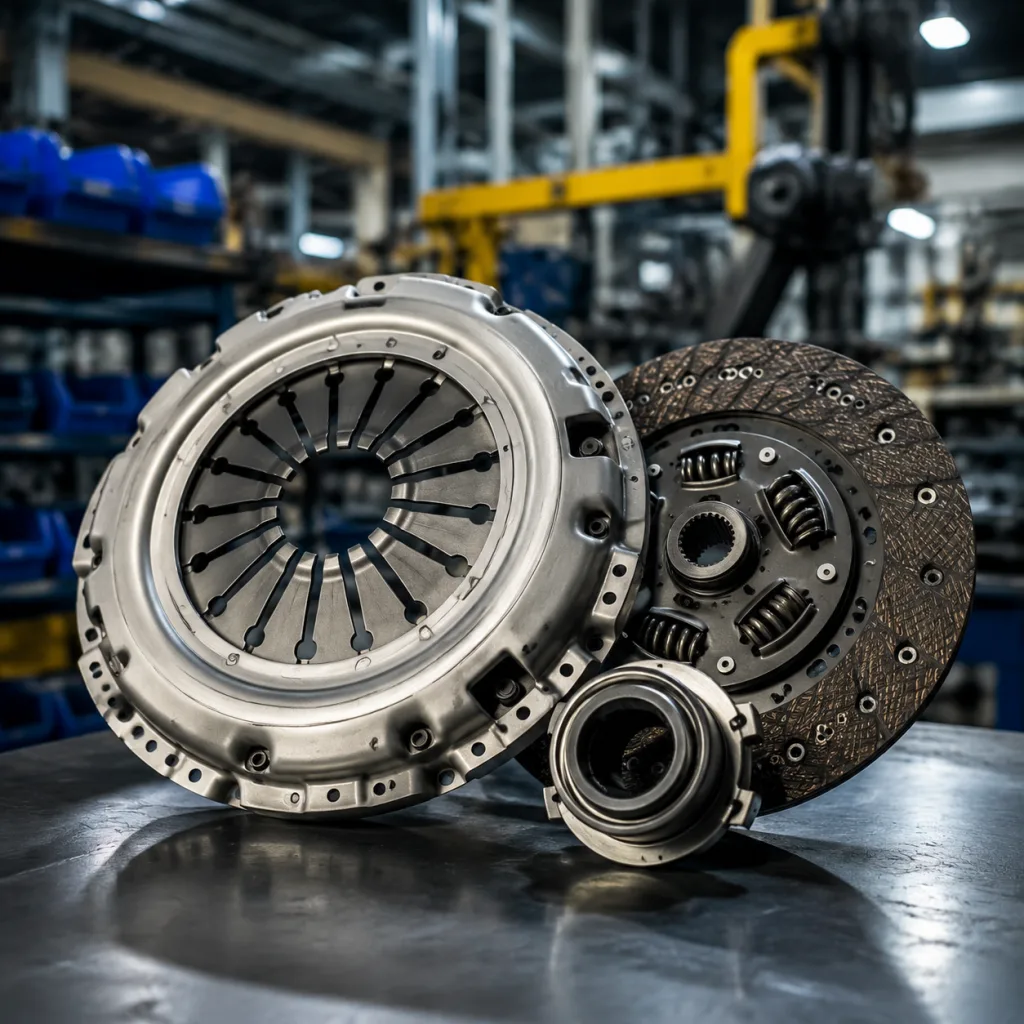
A dual mass flywheel, or DMF, sits between the crankshaft and clutch assembly. Its purpose is to reduce torsional vibration from the engine before that vibration reaches the gearbox. This is especially important on modern diesel engines, turbocharged petrol engines and downsized powertrains that produce high torque at low engine speed.
For sourcing teams, the important point is that a DMF is not a simple rotating disc. It is a calibrated spring, friction and mass system. If the damping rate, axial runout, angular displacement, balance or ring gear position is wrong, the vehicle may suffer clutch judder, gear rattle, starter engagement noise, difficult shifting or premature bearing and gearbox wear.
Typical DMF purchasing checks include:
Primary and secondary mass material grade, hardness and machining quality
Spring set specification, angular displacement range and stop position
Friction washer material, grease specification and thermal stability
Crankshaft bolt pattern, pilot diameter and mounting face flatness
Clutch cover bolt pattern, dowel position and release system compatibility
Ring gear tooth count, pitch, chamfer direction and induction hardening depth
Axial and radial runout after assembly
Sealing integrity and resistance to grease leakage under operating temperature
Dynamic balance grade, measurement method and traceability record
Marking, batch code and installation instruction accuracy
The comparison should therefore be based on measured fit and validated function, not only on visual similarity, catalogue interchange or a matching cross-reference.
Dual mass flywheel vs TRW alternative: comparison factors
A TRW-referenced aftermarket part may be used by buyers as a benchmark for catalogue coverage, packaging expectations, distributor price positioning or market acceptance. An independent alternative should be assessed against the same technical and commercial criteria. The table below summarises common evaluation points for B2B sourcing teams.
Evaluation area
TRW-referenced aftermarket option
Independent DMF alternative
Buyer verification method
Catalogue coverage
Often broad in mature European applications
Can be broad, platform-focused or developed around buyer demand
Check TecDoc-style attributes, engine codes, gearbox codes and production dates
Dimensional fit
Must match OE application data
Must match OE application data
CMM report, gauge inspection, drawing review and installation trial
Damping behaviour
Application-specific
Must be tuned and validated per application
Torsional test curve, angular displacement data and NVH comparison
Ring gear accuracy
Critical for starter engagement
Critical for starter engagement
Tooth count, pitch, chamfer, hardness depth and runout report
Balance and runout
Required for smooth operation
Must be controlled by process and final inspection
Dynamic balance certificate and axial/radial runout records
Batch traceability
Expected by professional buyers
Should be equivalent
Lot code, material heat number, production date and process record
Supply flexibility
Depends on distribution channel and stock policy
Can support private label, planned builds and range gaps
MOQ, lead time, forecast agreement and safety-stock plan
Documentation
Varies by channel
Should be requested before approval
PPAP-style file, inspection plan, test evidence and warranty analysis
Branding
Established aftermarket brand position
Buyer brand or supplier brand may be possible
Packaging artwork control, barcode check and label approval
</tr></thead><tbody> </tbody></table>For procurement teams, the practical question is not whether one label is always better. The question is whether the alternative can prove dimensional conformity, damping performance, durability and process consistency before it enters saleable inventory.
Validation data buyers should request before listing
A DMF alternative should be qualified with objective test data before it is listed, stocked or installed at scale. For high-volume programmes, Driventus recommends a document package similar to what buyers use for clutch, crankshaft and other rotating assembly components.
A practical approval file may include:
2D drawing with critical-to-quality dimensions clearly marked
Material certificate for cast iron, steel masses and other major components
Spring, friction washer, grease and sealing component specification
First article inspection report with actual measured dimensions
CMM report for crank interface, clutch interface and ring gear datum
Axial and radial runout report after assembly
Dynamic balance report, with the acceptance criteria stated
Torsional stiffness and angular displacement curve for the target application
Endurance test summary, including cycle count, temperature condition and failure criteria
Ring gear hardness and tooth geometry report
Salt spray or surface protection report where relevant, using ISO 9227 when specified by the buyer
Packaging drop or transport validation for export cartons
Full traceability format, including batch code, production date and shipment link
For manufacturing system control, buyers should ask whether production is managed under IATF 16949:2016 and ISO 9001:2015. These standards do not make a part automatically suitable for a specific vehicle, but they define expectations for process control, corrective action, risk management, calibration, internal audit and continuous improvement.
Where material compliance is relevant to the destination market, buyers may also require declarations aligned with REACH (EC) No 1907/2006. DMF assemblies are mechanical products, but grease, coatings, labels and packaging materials can still create compliance questions during import review.
Commercial trade-offs for distributors and repair chains
The strongest reason to consider an independent DMF supplier is often range control. A distributor may need stable access to slower-moving applications, private-label packaging, kit bundling or planned container shipments. A repair chain may need predictable warranty handling, national availability and consistent installation information. These requirements are not always solved by buying only from the most visible aftermarket label.
Main trade-offs to evaluate include:
Price versus evidence: A lower unit cost is only useful if the alternative includes test records, traceability and warranty support.
Stock breadth versus depth: Some buyers need 200 low-volume references; others need deep stock on 20 fast movers.
Lead time versus MOQ: Factory-direct supply can reduce unit cost, but forecast discipline and launch planning are needed.
Private label versus branded resale: Custom packaging improves channel control, but it requires artwork approval, barcode accuracy and version control.
Application risk: High-torque diesel, taxi, fleet and light commercial applications need more conservative validation because field loads are severe.
Warranty process versus sales speed: Rapid range expansion can create revenue, but returns become expensive if diagnosis rules and evidence requirements are unclear.
For a first sourcing project, many buyers start with a controlled list of high-volume DMF references, compare field return data for 6 to 12 months, and then expand the range. This approach reduces launch risk, gives the supplier measurable feedback and helps procurement defend the switch internally with data rather than assumption.
How Driventus supports alternative DMF programmes
Driventus manufactures and sources engine and powertrain components for aftermarket distributors, OEM service channels, Tier-1 customers and multi-location repair groups. For dual mass flywheel projects, our team can support dimensional benchmarking, application confirmation, packaging planning and batch documentation.
Buyers can review related product categories in our catalog, including engine and powertrain components for export programmes. Production and inspection activities are managed through our documented quality system, with controls aligned to IATF 16949:2016 and ISO 9001:2015.
For customers that need more than catalogue supply, Driventus can discuss custom manufacturing. This may include buyer-specified packaging, defined inspection frequency, application-specific drawing control, scheduled container shipments, supplier consolidation or dedicated development of a DMF reference where annual demand justifies tooling and validation.
Driventus is an independent aftermarket manufacturer; brand names are referenced for fitment only. We do not claim approval, endorsement or authorisation by any vehicle manufacturer or aftermarket brand owner. Cross-references are used to identify fitment and purchasing context only.
Procurement checklist before switching supplier
Before replacing an existing TRW-referenced or other aftermarket DMF source with an alternative, procurement and quality teams should complete a formal check. The list below is suitable for importers and repair networks that want a repeatable approval process.
Confirm vehicle application, engine code, gearbox code, clutch type and production year range.
Compare all critical dimensions against the existing approved part and OE fitment data.
Check ring gear tooth count, tooth profile, chamfer direction, pitch and heat treatment.
Verify bolt-hole position, dowel location, crankshaft pilot fit and mounting face flatness.
Request torsional performance data, angular displacement data and endurance test evidence.
Review balance grade, axial runout and radial runout results from the supplier.
Inspect packaging strength, corrosion protection, labels and installation note accuracy.
Confirm torque-to-yield bolt inclusion policy if the application requires new bolts.
Require batch traceability on the product, carton and shipment documents.
Define warranty evidence requirements, claim response time and failure analysis process before the first shipment.
Place an initial controlled order before national, platform-wide or multi-warehouse rollout.
This process helps separate a viable alternative from a visually similar part that has not been properly validated. For buyers comparing dual mass flywheel vs TRW alternative options, the checklist also creates a documented basis for internal approval, supplier scorecards and future range expansion.
Frequently asked questions
Yes, if it is validated for the same application and meets the required dimensions, damping behaviour, ring gear specification, balance and durability targets. Buyers should request inspection and test data before listing or installing the alternative.
Request drawings or critical dimensions, first article inspection, CMM data, balance results, torsional test data, endurance summary, material certificates, packaging specification and traceability format. Certification to IATF 16949:2016 and ISO 9001:2015 should also be reviewed.
Driventus can discuss private-label and custom manufacturing programmes where volume, application data and validation requirements are clear. Packaging, inspection plans and batch documentation can be agreed during quotation.
If you are comparing dual mass flywheel sources for a distributor, repair-chain or import programme, share your application list and target volumes. To start a technical and commercial review, [request a quote](/contact.html).