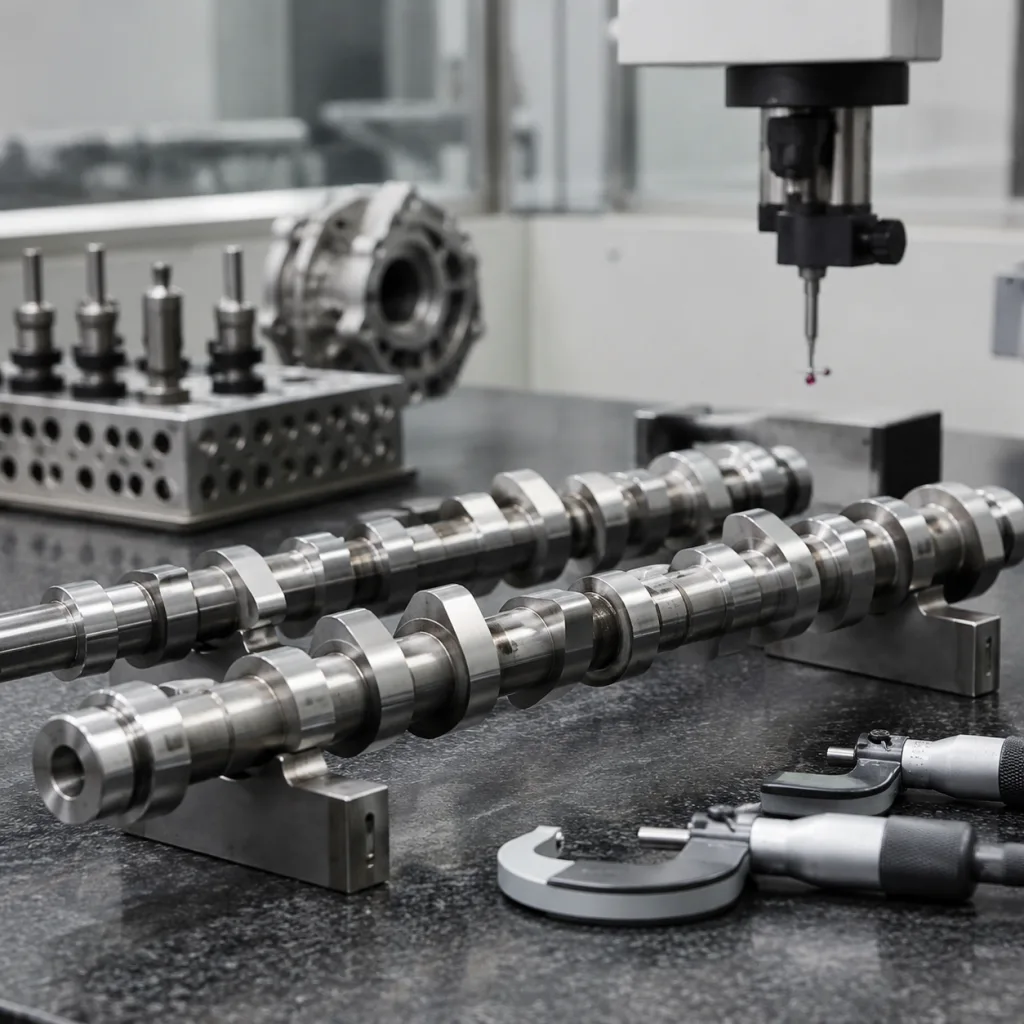
camshaft · 2026-06-05

Camshaft Honda Replacement: OE-Match Controls for B2B Sourcing

When procurement teams source a camshaft Honda replacement, the catalogue image is only a starting point. The replacement shaft must match the target Honda engine family by engine code, OE cross-reference, cam position, lobe count, journal layout, thrust location, timing reference, and any VTEC, i-VTEC, VVT/phaser, distributor-drive, fuel-pump-drive, or cam-position-sensor interface. Key characteristics usually include lobe lift and phase, base-circle diameter, journal diameter and roundness, axial end-play control, oil-hole position, runout, surface hardness, case depth where applicable, and ground surface finish.

Driventus is an independent aftermarket manufacturer; Honda and related brand names are referenced for fitment only. We supply camshafts for B2B buyers that need repeatable dimensional control, documented inspection, batch traceability, export-safe packaging, and stable replenishment for aftermarket distribution, engine rebuilding, fleet maintenance, and service-parts channels. This article explains what to verify before purchase order release, how OE-equivalent camshafts are validated, which manufacturing controls affect durability, and when a custom build is the better route than a standard catalogue replacement.

What buyers should verify before ordering

Specify a camshaft replacement by engine code, displacement, cylinder count, valve-train layout, OE/interchange reference, and production date range. For Honda applications, the same vehicle model name may carry different engine families depending on market, emissions specification, model year, and trim level. The purchasing file should state whether the shaft is for an SOHC or DOHC engine, whether it is intake or exhaust, and whether the engine uses VTEC, i-VTEC, VVT phasing, a distributor drive, a cam position trigger, a mechanical fuel-pump drive, or another application-specific interface.

Before approval, confirm the technical application rather than relying on a catalogue image. On a camshaft Honda replacement, differences of less than 1 mm in thrust-face width, trigger feature position, dowel-pin location, oil-hole position, or journal diameter can stop installation or lead to noise, low oil pressure, cam sensor errors, or accelerated bearing wear. Buyers should also check superseded OE references, regional part-number variations, and front-bank/rear-bank differences on V-type engines.

Check these items before approval:

  • OE reference, interchange number, or supersession path where a published cross-reference exists
  • Engine code, displacement, cylinder count, fuel system, emission market, and production year range
  • SOHC/DOHC layout and intake, exhaust, front-bank, or rear-bank cam designation
  • Number of lobes, journal count, bearing sequence, trigger features, and oil-feed details
  • Overall length, journal diameters, journal widths, thrust-surface location, and end-play control surface
  • Sensor drive, distributor drive, fuel-pump drive, VTEC oil-control feature, or VVT/phaser interface, if applicable
  • Lobe arrangement, base circle, nominal lift, and timing relationship to keyways, dowel pins, gears, or trigger wheels
  • Heat-treatment route, surface hardness range, and case-depth requirement where applicable
  • Journal and lobe surface-finish targets, normally specified as Ra and verified after final grinding or polishing
  • Anti-corrosion protection, individual sleeve or VCI wrapping, and export carton strength
  • Packaging quantity, barcode, label format, batch code, and pallet requirements for warehouse receipt

For replacement sourcing, the goal is dimensional match and functional equivalence for the stated engine application. If the buyer needs a verified alternative to an original part, request inspection records covering lobe profile, journal diameter, roundness, runout, straightness, surface finish, hardness, and timing-reference position. For first orders, a pre-shipment sample or PPAP-style sample file can include photos of the camshaft, label, carton, protective sleeve, and critical dimensions. Our our catalog lists part families for engine and powertrain applications, including camshafts and related components.

OE-equivalence is a dimensional and functional claim

For procurement, OE-equivalent means the replacement camshaft is manufactured to match the critical dimensions and operating function required for the stated application. It does not mean vehicle-maker approval, endorsement, or supply through the original equipment channel. Driventus is an independent aftermarket manufacturer; brand names are referenced for fitment only.

That claim should rest on measurable characteristics. A camshaft controls valve timing, valve lift, valve acceleration, and follower contact conditions, so a visual match is not enough. The supplier should identify which dimensions are controlled by engineering drawing, which are validated against an approved master sample, and which are checked during production. For a camshaft Honda replacement, this matters most where similar engines use different VTEC oil passages, VVT phaser interfaces, cam sensor trigger patterns, distributor-drive ends, or dowel-pin positions.

Typical control points for a replacement camshaft include:

</tr></thead><tbody> </tbody></table>A credible supplier should state which characteristics are controlled in process and which are checked at final inspection. In-process controls normally include raw casting or forging inspection, machining datums, rough grinding, heat-treatment response, straightening, finish grinding, washing, and rust prevention. Final inspection should confirm that the finished shaft meets the agreed tolerance plan and that packaging protects journals, lobes, keyways, and trigger features from contact damage. Under IATF 16949:2016 and ISO 9001:2015, traceability, nonconforming-product control, gauge calibration, and corrective-action records are part of a defensible quality system. To review our controls, see the quality system page.

Materials, heat treatment, and finish

Camshaft durability depends on the base material, production route, hardening process, and final surface finish. Common routes include chilled cast iron, ductile iron, induction-hardened cast iron, carburised or nitrided steel, and forged or machined steel. The correct choice depends on follower type, valve-spring load, lobe stress, lubrication conditions, and programme volume. For B2B sourcing, the material name alone is less important than documented material traceability, hardness range, hardened-layer depth where applicable, microstructure control, and batch-to-batch repeatability.

Aftermarket replacement programmes have to tolerate mixed service conditions: short-trip operation, varied lubricant quality, extended warehouse storage, and installation by different repair networks. A shaft may be dimensionally correct, but if it is under-hardened, it can develop lobe-nose wear, pitting, or scuffing. If it is too hard or has unsuitable microstructure, edges or oil holes may become brittle. Excessive roughness on journals or lobes can accelerate follower wear and disturb the oil film. Poor rust prevention can cause staining or pitting during sea freight, leading to warehouse rejection before the part ever reaches an engine.

A practical specification checklist:

  • Material declaration with heat number, melt reference, casting batch, or bar-stock batch code
  • Defined production route, such as chilled cast, ductile iron, induction hardened, carburised, nitrided, or forged steel, as applicable
  • Surface-hardness target and allowable range for lobes, journals, thrust faces, and drive features
  • Case-depth or hardened-layer requirement where induction hardening, carburising, or nitriding is used
  • Core strength, microstructure, or nodularity control where required by the design
  • Lobe-grinding specification covering lift, base circle, flank/ramp geometry, nose radius, and profile tolerance
  • Journal diameter, roundness/cylindricity, and roughness targets, typically expressed with Ra and drawing tolerances
  • Deburring requirements around oil holes, keyways, dowel holes, slots, gear seats, and trigger features
  • Washing and cleanliness control to remove grinding swarf, abrasive residue, and machining chips
  • Phosphate, rust-preventive oil, VCI paper, plastic sleeve, end caps, or other corrosion protection before packaging
  • Dimensional inspection plan covering 100% of safety/fitment-critical features or an agreed AQL for routine features

Surface finish deserves close attention for fleets, rebuilders, and warranty-sensitive distribution programmes. Journals need a finish that supports stable hydrodynamic lubrication, while lobe finish must suit the follower system. Roller-follower, flat-tappet, rocker-arm, and direct-acting bucket systems impose different contact stresses and break-in requirements. The camshaft should also be compatible with the intended follower material and lubrication recommendation. If the application calls for a revised material route, tighter hardness band, discontinued profile, or non-standard geometry, our custom manufacturing service is available for drawing-based, sample-based, and contract builds.

Validation testing for replacement parts

A replacement camshaft should be validated before volume shipment, especially when the programme will support multiple distributors, fleet contracts, or private-label service channels. Validation confirms more than the accuracy of one sample. It shows whether the manufacturing route can repeat the same geometry, hardness, and finish across batches. For buyers, the release package should distinguish first-article approval from routine production inspection.

Published quality standards can support the control plan, even when the final OE reference differs by engine code. In most camshaft programmes, the validation package combines dimensional inspection, material verification, hardness checks, lobe-profile measurement, runout review, cleanliness control, and packaging verification. For a camshaft Honda replacement with VTEC, i-VTEC, VVT, a cam sensor, or a distributor interface, the validation file should also confirm timing-reference angle, phaser mounting face, dowel-pin position, oil-feed passages, trigger pattern, and end-feature geometry.

Common validation items include:

  • First-article dimensional inspection against drawing, OE reference data, or approved master sample
  • Cam-profile verification for lobe lift, base circle, flank/ramp geometry, nose form, and angular timing
  • Keyway, dowel, gear seat, trigger wheel, distributor drive, and phaser-interface position checks
  • Journal diameter, journal width, roundness/cylindricity, and bearing-surface finish measurement
  • Runout and straightness checks after heat treatment, straightening, and final grinding
  • Hardness mapping across lobe nose, lobe flank, journals, thrust faces, and drive features where required
  • Case-depth, microstructure, chill-depth, or metallurgical review when required by the material route
  • Oil-hole position, diameter, edge break, deburring, and cleanliness inspection
  • Corrosion-protection screening based on storage period, sea-freight route, and warehouse conditions
  • Packaging drop, vibration, compression, carton-strength, and pallet-stability checks for export shipments
  • Label, barcode, batch code, country-of-origin marking, and traceability review before warehouse release

Where relevant, buyers may also request compliance screening for REACH (EC) No 1907/2006 for restricted substances in packaging, coatings, or corrosion inhibitors. Application-specific durability testing may be added when the buyer provides a defined test requirement, such as engine bench running, rig testing, or post-test wear measurement. For emission-related fitment discussions, confirm the exact engine application and calibration market from the technical file instead of assuming compatibility across model names. Driventus supports procurement reviews with inspection reports, batch records, pre-shipment photos, packaging data, sample approval records, and agreed control-plan documentation when requested.

When to choose stock replacement versus custom build

Standard stock is appropriate when the engine family is stable, the OE cross-reference is clear, the camshaft is already in regular production, and annual demand supports routine replenishment. Custom manufacturing fits better when the buyer needs a superseded profile, a limited-run market variant, a controlled engineering revision, or a private-label programme with fixed packaging, labelling, and documentation. The decision should weigh technical risk, launch timing, minimum order quantity, inventory carrying cost, and the potential cost of a mismatch claim after installation.

Choose stock if:

  • The OE number, interchange reference, and engine code are confirmed
  • The production year range and target market have no visible design variation
  • The camshaft does not require a unique VTEC, VVT/phaser, trigger, distributor, fuel-pump, or oil-feed feature
  • The required intake/exhaust or bank position is already separated in the catalogue and warehouse system
  • Lead time and availability matter more than programme-specific packaging
  • The part will move through standard aftermarket distribution channels
  • Standard inspection reports, standard carton labels, and standard batch coding are sufficient
  • The forecast supports regular replenishment rather than a one-time controlled release

Choose custom manufacturing if:

  • The camshaft has a rare, discontinued, superseded, or market-specific profile
  • You need a drawing-controlled revision or sample-controlled duplication
  • The application has a special trigger pattern, phaser interface, oil-feed passage, thrust arrangement, or end-drive feature
  • You require customer-specific carton artwork, barcode structure, pallet format, or label content
  • You need private-label supply with controlled brand artwork and warehouse identification
  • You want pilot quantities, sample approval, or first-article inspection before volume release
  • You need additional material certificates, hardness maps, profile reports, or packaging documentation for a programme file

For distributors and repair networks, the main risk is mismatch at the engine-code or cam-position level. A verified sample review is usually faster and less expensive than an installed-part claim involving labour, gaskets, oil, and customer downtime. For private-label buyers, define the documentation package before issuing the purchase order. Inspection-report format, label fields, carton quantity, batch coding, photo requirements, and change-notification rules should be agreed early. If your team needs a quotation for a specific part family, use request a quote.

Frequently asked questions

Match the engine code, OE cross-reference, intake/exhaust or bank position, journal dimensions, lobe profile, timing reference, and any VTEC, VVT/phaser, distributor, oil-feed, fuel-pump, or cam-sensor features. Ask for inspection data and application confirmation, not only catalogue photos.

No. OE-equivalent means the replacement is built to match the required dimensions and function for the stated application. It does not mean vehicle-maker approval, endorsement, or supply through the original equipment channel. Driventus is an independent aftermarket manufacturer; brand names are referenced for fitment only.

Request dimensional inspection records, cam-profile or critical-feature checks, hardness results, material or batch traceability, packaging details, label confirmation, and a quality-system summary referencing IATF 16949:2016 or ISO 9001:2015 controls where applicable.

If you need a verified camshaft replacement for a Honda application, send the OE reference, engine code, cam position, target market, packaging requirement, and target quantity. We will confirm fitment and supply options via /contact.html

Request a Quote
Control item What is checked Why it matters
Journal diameterMicrometre or air-gauge measurement against drawingMaintains bearing oil clearance and load distribution
Journal roundness/cylindricityRoundness tester or multi-point diameter checkReduces oil leakage, noise, and uneven bearing wear
Lobe lift and base circleCam profile measurement or master-profile comparisonPreserves valve lift, duration, and engine response
Lobe phase/timingAngular measurement from keyway, dowel, gear, or trigger referencePrevents valve timing error and misfire or sensor faults
Timing referenceKeyway, dowel, trigger wheel, gear, or phaser datum checkEnsures correct assembly and ECU signal correlation
RunoutDial-gauge measurement between centres or on V-blocksHelps prevent binding, vibration, and abnormal journal loading
StraightnessShaft alignment check after heat treatment and final grindingSupports free rotation in the cylinder head or cam carrier
Surface hardnessRockwell, Vickers, or equivalent method by material/processProtects lobes, journals, and thrust faces from premature wear
Case depthMetallurgical or hardness-depth verification where induction hardening, nitriding, or carburising is usedConfirms adequate hardened layer below the working surface
Surface roughnessRa measurement on journals and lobe contact facesSupports lubrication film, break-in, and follower compatibility
Thrust faceAxial position, width, flatness, and finishControls end play and axial movement
Oil holes and groovesPosition, diameter, deburring, and cleanliness checkEnsures oil reaches journals, VTEC/VVT features, and contact surfaces