Procurement teams looking for a camshaft Fiat supplier are usually balancing three priorities: accurate geometry, consistent metallurgy, and delivery performance that supports either production schedules or aftermarket replenishment. Driventus supplies camshafts for Fiat applications to distributors, repair networks, private-label brands, and industrial buyers that need repeatable fitment backed by documented quality controls.
Our manufacturing base is in Taizhou, Zhejiang, where machining, heat treatment, finishing, and inspection are managed through controlled production workflows. Our programs are aligned with IATF 16949:2016 and ISO 9001:2015, and material or process routes can be adapted for OE-equivalent replacement, private-label distribution, or customer-specific supply.
Driventus is an independent aftermarket manufacturer. Fiat and other brand names are referenced only to identify vehicle fitment and application compatibility. When qualifying a new source, buyers should focus on lobe geometry, journal runout, surface hardness, material consistency, export packaging, and traceable lot records. The guide below outlines what to confirm before placing volume orders and where Driventus can support validation, documentation, and custom manufacturing.
What buyers should expect from a Fiat camshaft supplier
A reliable camshaft Fiat supplier should do more than confirm that a part number appears in a catalogue. For B2B sourcing, the supplier needs to support application matching, stable production, and quality evidence that can be reviewed by procurement, engineering, and warehouse teams.
Typical sourcing checks
Application cross-reference by OE number where available, including references such as OE 06A107065 when the programme requires it
Engine code, model year, market, and vehicle application confirmation
Material declaration and heat-treatment route
Journal diameter, lobe lift, base circle, phase angle, and overall length verification
Surface hardness, surface finish, and wear-resistance data
Packaging suitable for sea freight, air freight, export warehousing, and onward distribution
Lot traceability connected to batch records and inspection reports
Buyers managing several markets should also confirm whether the camshaft is intended for OE-equivalent replacement, private-label distribution, or custom specification work. That distinction affects the approval route. A replacement programme may focus on fitment, hardness, and dimensional match, while a private-label or contract programme may also require label control, packaging artwork, incoming inspection standards, and a defined change-notification process.
Dimensional control and production capability
Camshafts are highly sensitive to machining accuracy. Small changes in lobe profile, journal diameter, or surface finish can affect valve timing, oil film stability, noise, and long-term wear. For procurement teams, the important question is not only whether the sample fits. It is whether the supplier can hold the same standard across repeat production batches.
Key technical points to verify
Item
Buyer check
Why it matters
Journal diameter
Measured against approved drawing or master sample
Controls bearing fit and oil film stability
Lobe lift and phase
Verified against master data
Affects valve timing, combustion efficiency, and engine output
Runout
Checked on the finished shaft
Reduces vibration, noise, and uneven bearing or lobe wear
Surface finish
Confirmed after grinding and polishing
Supports low friction and improves wear performance
Hardness
Reported by lot after heat treatment
Indicates process consistency and resistance to premature wear
Concentricity
Inspected on critical features
Supports reliable assembly and stable rotation
End features
Checked for position, thread, slot, or drive-interface accuracy where applicable
Prevents installation issues and timing-related failures
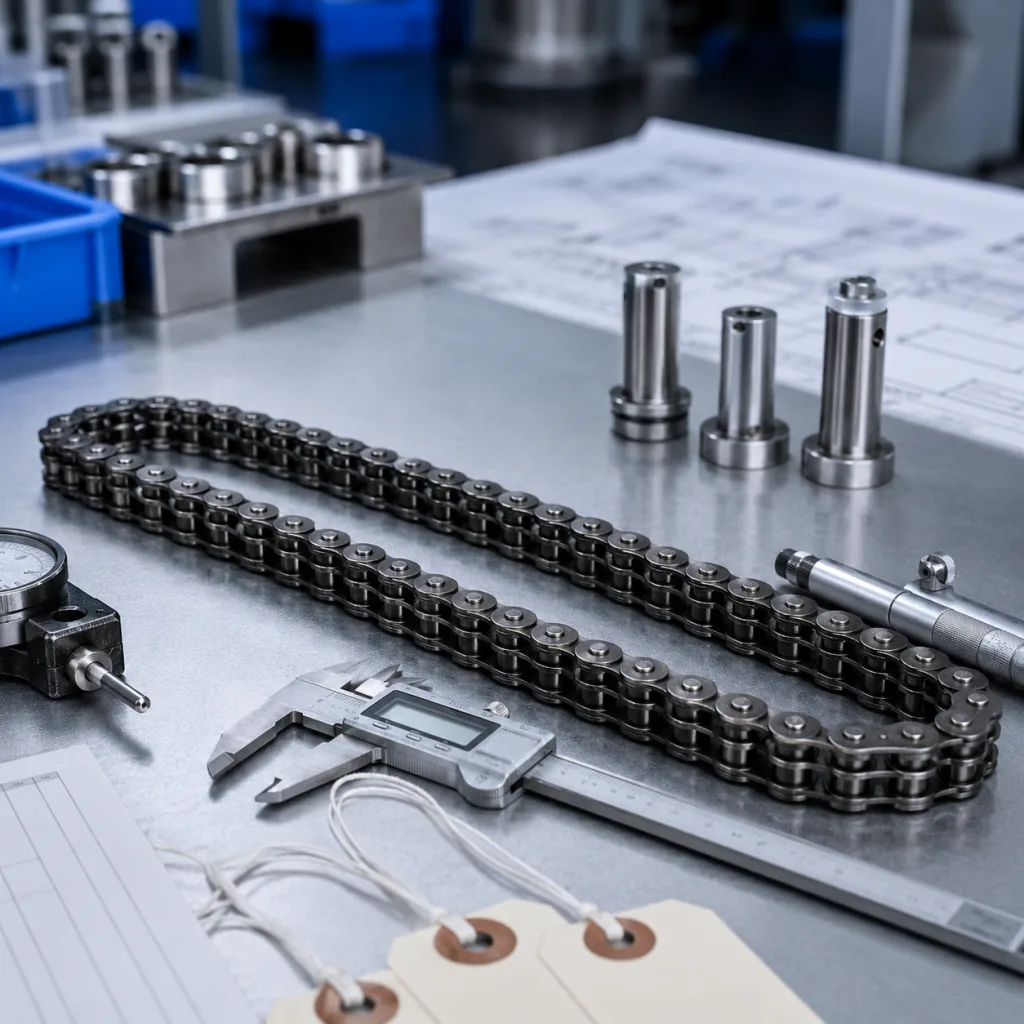
</tr></thead><tbody> </tbody></table>Driventus uses controlled machining, heat treatment, grinding, and inspection steps for camshaft production. We can support programmes that require OE-style dimensional matching, reverse review from a supplied sample, or custom development based on buyer specifications. For buyers who need broader engine component supply, see our catalog and engine components.
Quality documentation, audits, and compliance
For cross-border sourcing, quality documentation is as important as sample approval. A serious supplier should be able to provide a clear quality pack that helps the buyer complete internal review, customs preparation, warehouse intake, and customer approval.
Driventus operates under IATF 16949:2016 and ISO 9001:2015. These systems support process control, inspection planning, traceability, corrective action, and continuous improvement across production. For export programmes, buyers may also request material and chemical compliance support aligned with REACH (EC) No 1907/2006. If the camshaft is supplied into a regulated or customer-controlled vehicle programme, the buyer may require additional evidence linked to customer specifications, validation plans, or related test methods.
Common documents requested by buyers
Dimensional inspection report with critical characteristics identified
Heat-treatment record and hardness result
Material certificate or chemistry summary
Surface finish or runout data when specified
Packaging specification and carton or pallet details
Sample approval record or first article inspection file
Lot traceability sheet linked to batch and production date
Corrective action record if the programme has previous field or incoming issues
You can review our quality system for the controls used across production, inspection, and traceability. For programmes that need a non-standard lobe profile, material change, special marking, private-label packaging, or dedicated inspection format, custom manufacturing is available.
MOQ, lead time, and supply planning
B2B buyers usually compare suppliers on more than unit price. Minimum order quantity, tooling status, stock availability, and replenishment lead time can determine whether a programme is practical. A low quote is not useful if the delivery window, packaging method, or approval process does not match the buyer’s channel.
Driventus supports export supply for distributors, OEM and Tier-1 programmes, and multi-location repair chains. Typical planning considerations include:
MOQ alignment: suitable for pilot orders, annual contracts, consolidated shipments, or mixed engine-component orders
Lead time: influenced by stock status, tooling readiness, machining sequence, heat treatment, grinding, inspection, and packing requirements
Packing format: single-piece box, inner carton, bulk export carton, palletised shipment, or buyer-specified private-label format
Forecast support: useful for recurring Fiat applications with predictable aftermarket demand
Change control: important when drawings, markings, labels, or packaging are locked by the customer
Logistics planning: needed for sea freight, air freight, bonded warehouse delivery, or regional distribution hubs
Where buyers want to reduce inventory risk, the best approach is to qualify one reference sample, confirm the dimensional match, complete a controlled trial order, and then scale to scheduled replenishment. This route gives procurement teams evidence before committing to annual volume and helps both sides agree on inspection criteria, packaging standards, and lead-time expectations.
Validation testing for replacement and export programmes
Camshaft validation should reflect the end use. An aftermarket replacement part does not usually follow the same sign-off route as an OE production programme, but it still needs evidence that it will install correctly and perform under realistic operating conditions. The validation plan should therefore match the buyer’s risk level, market, and customer requirements.
Common validation items
Visual inspection for surface defects, burrs, corrosion, handling marks, and coating issues where applicable
Dimensional check against drawing, OE-style reference data, or an approved sample
Rotation and fit verification in the target engine family or fixture
Journal, lobe, and end-feature inspection against agreed tolerances
Hardness and microstructure review after heat treatment
Surface finish review on journals and lobes when specified
Packaging drop, vibration, and transit checks for export routes
Marking, label, and barcode confirmation for warehouse intake or private-label programmes
For buyers in the EU, UK, US, Canada, Australia, Brazil, and other export markets, documentation should be sufficient for customs clearance, incoming quality review, and downstream customer communication. If your team needs a controlled part-change process, a sample approval file, or a private-label supply route, our engineering and production teams can support sample review, validation planning, and production scheduling under a documented approval workflow.
How to qualify Driventus for Fiat camshaft supply
A clear sourcing process reduces back-and-forth sample revisions and helps both teams confirm feasibility early. Procurement teams typically move fastest when they share complete application and commercial information at the start of the enquiry.
Please include:
1. OE reference number or existing supplier part number 2. Engine code, vehicle model, model year, and target market 3. Required annual volume and first-order quantity 4. Target packaging format, including private-label needs if applicable 5. Inspection, compliance, or validation documents required 6. Any branding, marking, barcode, or label instructions 7. Current sample, drawing, or measurement report if available
If the requirement is based on an existing OE reference such as OE 06A107065, include the current sample and any measurement report your team can share. That allows Driventus to compare the shaft against production capability, confirm critical dimensions, and recommend whether the project should follow an OE-equivalent replacement route, a custom manufacturing route, or a contract supply model.
For a straightforward sourcing discussion, request a quote with your application data, target volume, and packaging requirements.
Frequently asked questions
Yes. We support aftermarket distributors, wholesalers, private-label brands, and repair chains with application-matched camshafts. Buyers can request sample review, dimensional data, packaging options, and production planning before committing to volume.
Driventus operates under IATF 16949:2016 and ISO 9001:2015. We can also support documentation requests related to REACH (EC) No 1907/2006 and customer-specific inspection or traceability requirements.
Yes, where application data and a reference sample are available. We can assess fitment, confirm critical dimensions, review material and heat-treatment needs, and discuss custom manufacturing when the programme requires a non-standard specification.
If you are qualifying a new camshaft source for Fiat applications, send your OE reference, engine code, target volume, and packaging needs. Our team will review the specification and reply with supply options at /contact.html.