timing chain · 2026-06-07

How to Verify Timing Chain Quality Before Sourcing

Timing chain quality is best verified before purchase, not after installation. For procurement teams, the goal is to confirm that the chain matches the required pitch, width, link count, heat treatment, fatigue life, wear resistance, and corrosion protection for the target engine family. The review should also prove that the supplier can repeat the same result across batches, with traceability and packaging that protect the chain during storage and export transit. Driventus is an independent aftermarket manufacturer; brand names and OE numbers are referenced for fitment identification only. This guide explains how to verify timing chain quality when sourcing from China or any other market, using a practical process for distributors, wholesalers, repair networks, and OEM supply teams. It covers application data, dimensional inspection, material and process confirmation, test evidence, packaging control, and supplier documentation. The same process applies when comparing samples, approving a new source, or qualifying a replacement part against an OE reference such as OE 06A109229 or similar cross-reference data used for fitment only.

Start with the application and OE cross-reference

Before inspecting the chain, define the application clearly. A timing chain is not a generic commodity part. It has to match the engine family, sprocket geometry, guide layout, tensioner range, lubrication environment, and expected service interval.

Use the OE cross-reference as a fitment reference only, not as a claim of OE approval. Record the engine code, number of links, pitch, roller or link design, and any associated components supplied in the kit. This baseline prevents a common sourcing problem: approving a sample that looks similar but does not match the working geometry of the engine.

Minimum data to collect

  • Engine displacement and engine code
  • Chain type: single-row, double-row, silent chain, or roller/link chain
  • Pitch, width, pin diameter, and plate thickness
  • Number of links and overall length
  • Roller, bushing, or tooth engagement design where applicable
  • Associated tensioner, guide, sprocket, and seal part numbers
  • Packaging label, batch code, and traceability format

If the supplier cannot provide dimensional data for the exact application, the sample is not ready for approval. A catalog listing or OE number match is useful for screening, but it is not a substitute for a drawing, specification sheet, and inspection record. For broader sourcing, compare the part against our catalog and related assemblies in engine components.

Check materials, heat treatment, and surface finish

The first technical proof of chain quality is the build specification. In service, timing chains usually fail through elongation, pin and bushing wear, plate fatigue, abnormal noise, or corrosion-related seizure. These problems are often linked to weak material control, inconsistent heat treatment, poor edge finishing, or inadequate rust prevention.

Ask the supplier to state the base steel grade, the process route for plates, pins, bushings, rollers, or silent-chain links, and the hardening method used where applicable. Carburising, carbonitriding, induction hardening, and through-hardening are not interchangeable; the correct process depends on the chain design and wear surfaces. The supplier should also be able to state target hardness ranges and show that those ranges are monitored by batch.

</tr></thead><tbody> </tbody></table>Request evidence of testing to relevant published standards where applicable. IATF 16949:2016 and ISO 9001:2015 are management-system standards for process control, not direct product performance guarantees, so they should be reviewed together with inspection records and test reports. For EU-market restricted-substance compliance, REACH (EC) No 1907/2006 may be relevant. For salt spray or corrosion data, confirm the exact test method, exposure time, acceptance criteria, and sample condition before comparing one supplier with another.

Measure key dimensions against drawing tolerance

Dimensional verification should be performed against the supplier’s drawing or an approved buyer drawing, not by visual comparison alone. A timing chain may look correct beside a reference sample and still fail if pitch accumulation, side clearance, pin fit, or total length sits outside tolerance.

Focus on the dimensions that affect valve timing, sprocket engagement, tensioner travel, and long-term wear.

Critical measurements

1. Pitch consistency across multiple links 2. Accumulated pitch over a defined number of links 3. Plate thickness, plate profile, and side-plate alignment 4. Roller diameter, bushing diameter, and concentricity where applicable 5. Pin diameter, pin projection, and press-fit stability 6. Chain width, side clearance, and articulation smoothness 7. Total length, link count, and master reference position if applicable

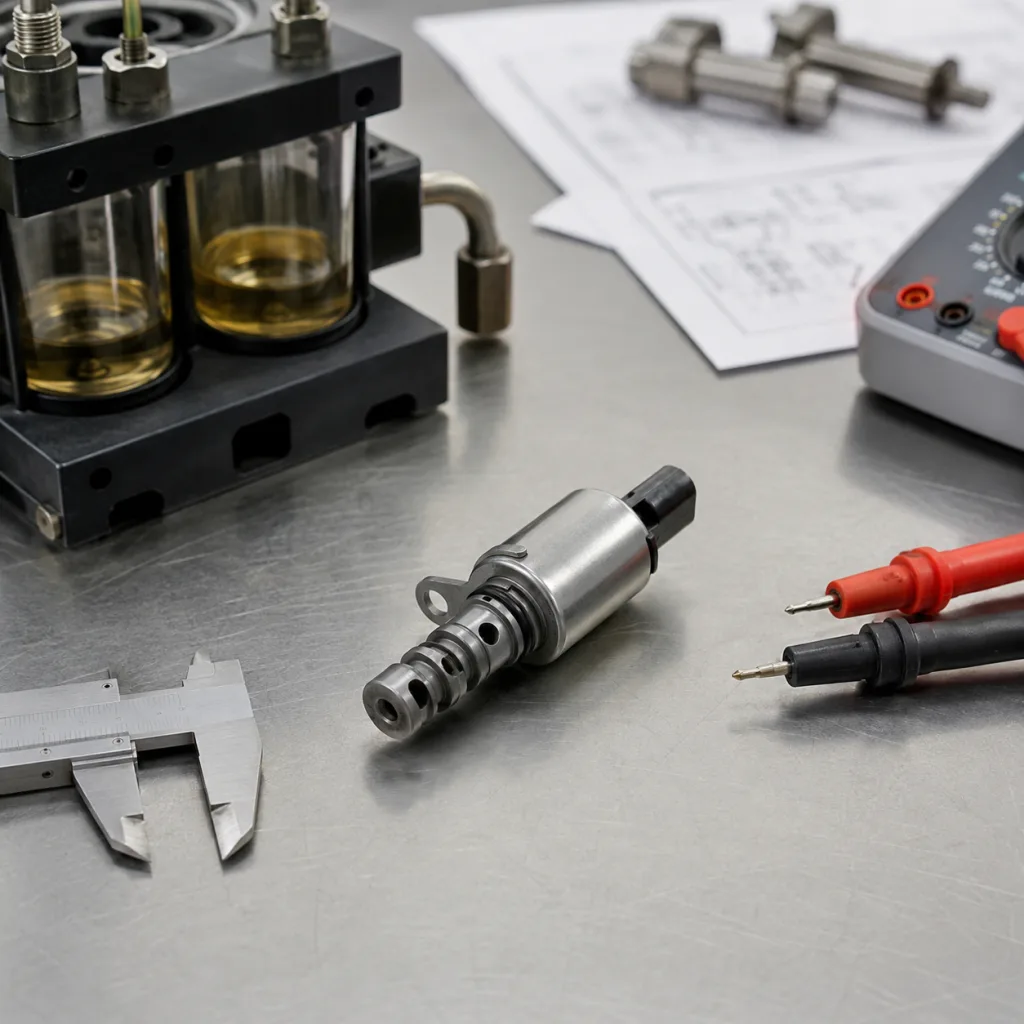
Use calibrated measuring tools such as micrometers, pin gauges, vernier calipers, hardness testers, and a chain measuring fixture. For incoming samples, measure at least three chains from different cartons or sample packs. For pilot lots, increase the sample size and record measurements by carton, batch code, and inspection date.

Variation between cartons is a warning sign. It can indicate mixed lots, unstable assembly tooling, poor in-process checks, or uncontrolled subcontracted components. A capable supplier should be able to show the inspection method, accepted tolerance band, gauge calibration status, and production control plan. If the chain is supplied as part of a kit, also verify tensioner travel, guide clearance, sprocket compatibility, and any fasteners or seals included in the package. This is especially important on engines where the chain path is long, the start-stop load is high, or the tensioner has limited compensation range.

Review test evidence, not just certificates

Certificates are useful, but they do not prove that the timing chain in front of you will perform correctly. To verify timing chain quality, review test records for the actual part family and the current production batch. The evidence should connect the supplier’s quality system to the specific product being purchased.

For automotive buyers, useful evidence includes:

  • Fatigue or endurance test results for the chain design
  • Wear or elongation data after cycle testing
  • Hardness inspection records for pins, bushings, plates, and rollers
  • Corrosion test results for coating, oiling, or packaging validation
  • Incoming inspection records for raw material lots
  • In-process inspection records for assembly and press-fit operations
  • Final inspection records for the shipment batch
  • Non-conformance and corrective-action history for the part family

Ask for the test method, sample size, acceptance criteria, equipment used, test date, and report number. A statement such as “tested for quality” is not enough. The report should identify the part number, production lot, test conditions, and result. If the supplier provides only a generic certificate, request supporting data before approving the order.

Where the broader powertrain or vehicle programme requires emissions or durability validation, ask whether the chain has been assessed within the relevant assembly-level test programme. Standards or procedures such as ECE R-83 may apply in the wider vehicle context, but they do not replace product-level chain testing. For a controlled supplier review, our quality system explains the documentation and traceability structure used for export programmes.

Inspect packaging, traceability, and logistics control

A well-made chain can still arrive unsuitable for sale if packaging is weak. Timing chains are vulnerable to impact, contamination, moisture, and corrosion during export handling. Packaging quality is therefore part of product quality, especially for distributors holding stock across multiple warehouses.

Check the following before approving shipment:

  • Individual oiling or rust-inhibitor protection
  • Sealed inner bag, barrier film, or equivalent moisture protection
  • Carton strength suitable for export stacking and pallet handling
  • Part number, quantity, and batch code on each unit pack
  • Traceability from unit pack to carton, pallet, and production lot
  • Clear storage instructions for warehouse and branch teams
  • Protection against mixed parts in kits or multi-part shipments

Traceability matters most when a field issue appears. You need enough batch-level information to isolate affected stock quickly, identify the production date and line, and connect the goods to inspection records. Without that link, one small quality concern can become a wider inventory hold.

For private-label orders, confirm that the label, barcode, carton mark, country-of-origin statement, and internal batch code do not conflict with the buyer’s warehouse system. If the project requires a non-standard size, special coating, revised kit content, or private-label pack, use custom manufacturing to define drawing, testing, inspection, and packaging requirements before tooling or mass production begins.

Use a supplier scorecard before placing the order

A supplier scorecard gives procurement teams a consistent way to compare quotations, samples, pilot lots, and repeat orders. It also keeps the decision focused on evidence rather than price alone. The scorecard does not need to be complex, but the same pass/fail rules should be applied to every supplier under review.

Verification item What to confirm Why it matters
Plate materialSteel grade, thickness, profile, and burr controlSupports fatigue strength and chain stability
Pin and bushing hardnessTarget hardness range and batch consistencyControls wear, elongation, and joint durability
Roller or link finishDiameter, contact surface quality, and coating conditionReduces friction and abnormal running noise
Surface finishNo sharp edges, rust, cracks, or coating defectsProtects guides, sprockets, and oil film stability
Lubrication retentionOil-compatible finish or pre-lubrication methodReduces start-up wear before full oil circulation
Rust preventionAnti-corrosion treatment, sealed packing, and storage limitsProtects the product during export and warehousing

</tr></thead><tbody> </tbody></table>If a supplier cannot provide these items, pause the purchase decision until the gaps are closed. For high-volume programmes, use a staged approval path: first article inspection, pilot lot, then production release. This reduces the risk of mixed batches, unclear accountability, and inconsistent repeat supply.

For procurement teams comparing multiple part families, the same method can be applied to chains, sprockets, guides, gaskets, water pumps, and related parts in our catalog. A disciplined sourcing process takes more work at the start, but it gives buyers stronger control over fitment accuracy, warranty exposure, and long-term supplier performance.

Frequently asked questions

The first check is dimensional match to the target engine application, including pitch, width, link count, chain type, and total length. After that, confirm material grade, heat treatment, wear resistance, corrosion protection, and batch traceability. A sample can look correct and still fail if pitch accumulation or side clearance is out of tolerance.

No. Certificates such as IATF 16949:2016 or ISO 9001:2015 show management-system control, but they do not prove the performance of a specific chain batch. You still need drawings, inspection data, material records, and test reports for the exact part number and production lot.

Use OE numbers only as fitment references. Confirm the actual dimensions, chain type, kit contents, and application data, then verify that the supplier can produce to the approved drawing, inspection method, and batch traceability requirements.

If you need a reviewed sample, batch documentation, or a sourcing comparison for your application, please [request a quote](/contact.html).

Request a Quote
Scorecard area Pass criteria
Fitment dataOE cross-reference used only for identification; target application confirmed
Drawing controlSupplier drawing or buyer drawing available for the exact part number
Dimensional controlMeasurements within approved tolerance and recorded by batch
Material controlSteel grade, hardness range, and process route declared
Test evidencePart-family and batch-specific reports available
TraceabilityLot code visible on product pack, cartons, and inspection records
PackagingCorrosion protection and export-ready packing validated
ComplianceIATF 16949:2016, ISO 9001:2015, REACH, or other market requirements aligned where relevant
Corrective actionSupplier can document non-conformance handling and improvement actions