Camshaft for Citroen Jumper OE Equivalent Sourcing
A camshaft for Citroen Jumper OE equivalent replacement has to do more than fit the cylinder head. For distributors, repair-chain buyers and import managers, the part must reproduce the original valve timing geometry, bearing journal dimensions, lobe hardness, oil feed design and traceability expected in commercial van service. Jumper applications can overlap with related light commercial platforms, while engine families vary by market, model year and emissions configuration. That makes engine-code validation and disciplined catalogue control essential before a purchase order is released. Driventus manufactures engine and powertrain components in Taizhou, Zhejiang, under IATF 16949:2016 and ISO 9001:2015 systems covering machining, heat treatment validation, inspection and batch documentation. This guide sets out the practical checks procurement teams should use when sourcing OE-equivalent camshafts for replacement programmes, from dimensional confirmation and material review to testing, cross-reference handling and supplier documentation.
What OE Equivalent Means for Jumper Camshafts
For replacement sourcing, OE equivalent means the camshaft is engineered to match the functional requirements of the original part, without implying vehicle manufacturer approval, sponsorship or endorsement. The buyer should verify fitment by engine code, production year, fuel system, valve train layout and the OE cross-reference format supplied in the enquiry. Cross-reference examples such as OE 06A... or OE 11251... should be used only when that numbering convention is already present in the sourcing brief or customer file.
A correct camshaft must preserve valve lift, opening and closing events, base-circle geometry, journal alignment and timing reference features within controlled tolerance bands. Even small deviations can affect idle stability, emissions performance, turbocharger response, noise and valve train wear. For commercial vans such as the Citroen Jumper, those technical differences quickly become business issues: vehicle downtime, repeat repair labour, wrong-part returns and warranty claims.
Driventus is an independent aftermarket manufacturer, and brand names are referenced for fitment identification only. Buyers can review related engine parts in our catalog and the engine-component range at /products/engine-components.html.
Dimensional and Material Checks Before Ordering
A procurement file for a camshaft for Citroen Jumper OE equivalent supply should include a drawing or sample-based specification, along with the inspection method used to confirm each critical feature. Where the buyer cannot share proprietary drawings, Driventus can work from sample parts, approved reference dimensions and agreed critical-to-quality characteristics through custom manufacturing.
Checkpoint
Procurement requirement
Why it matters
Bearing journal diameter
Match agreed reference tolerance
Controls oil film stability and cylinder-head fit
Cam lobe lift
Confirm by CMM, profile gauge or approved fixture
Maintains valve motion and engine breathing
Base circle runout
Controlled across all lobes
Reduces tappet noise, timing variation and uneven wear
Surface hardness
Verified after heat treatment or surface hardening
Helps prevent lobe scuffing under boundary lubrication
Oil feed holes and grooves
Position, chamfer and burr control checked
Protects journals during cold start and low-speed operation
End-face geometry
Confirmed against thrust control design
Limits axial movement in service
Timing reference feature
Matched to sensor or drive layout where applicable
Prevents synchronization errors and installation delays
</tr></thead><tbody> </tbody></table>Material selection depends on the engine application, load profile and production route. Common options include chilled cast iron, alloy cast iron and forged steel, selected according to wear requirements, surface treatment and order volume. The purchasing specification should state the required material grade or agreed equivalent, heat treatment process, hardness range, surface roughness targets and metallurgical acceptance criteria. If the original part is supplied as a sample, the sample should be treated as a reference for measurement and validation, not as a substitute for a locked production specification.
Validation Testing for Replacement Programmes
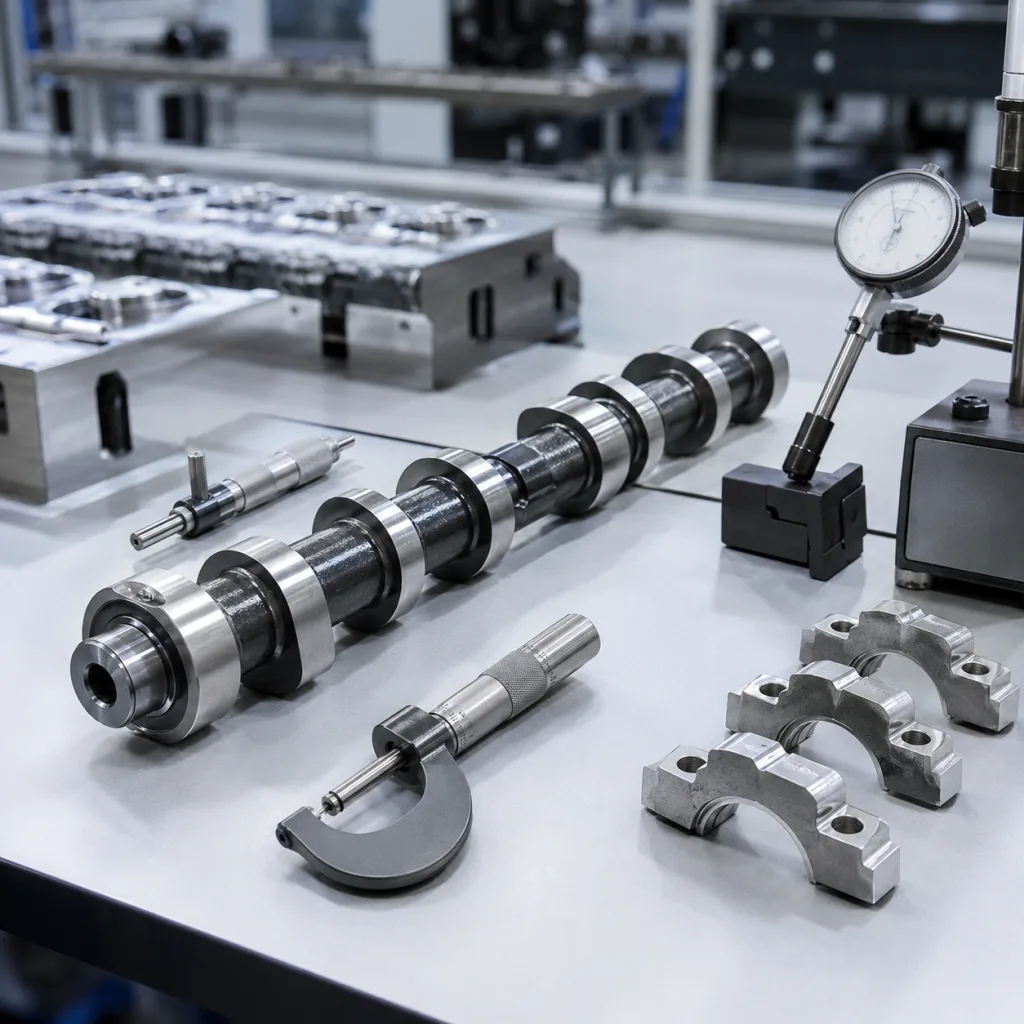
Replacement parts for commercial vehicles need validation that is practical, repeatable and auditable. For a camshaft, buyers should look for evidence beyond a visual report or catalogue match. The most useful records are dimensional inspection reports, hardness readings, microstructure checks where applicable, surface roughness data, crack-detection results when specified and packaging traceability.
A typical Driventus validation package can include:
First article inspection report covering critical journals, lobes, oilways, timing features and end geometry.
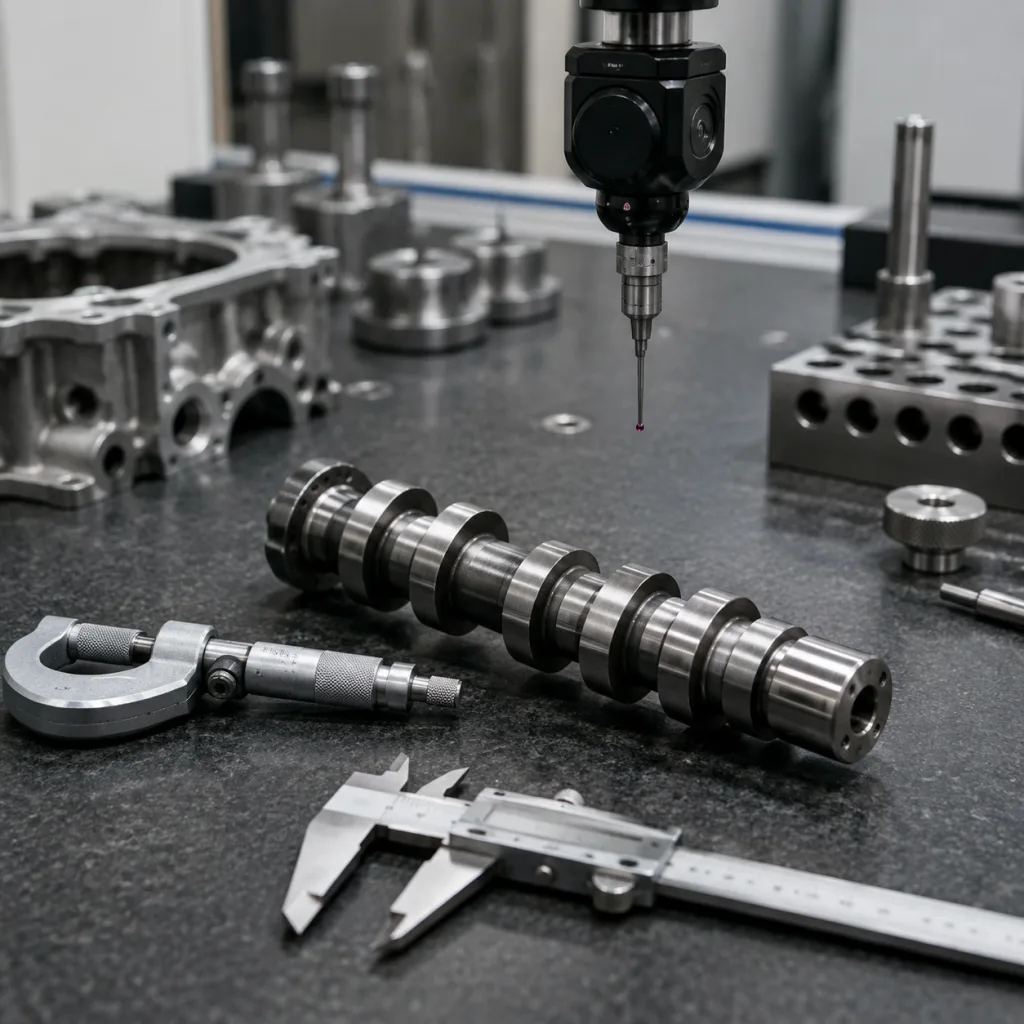
Coordinate measuring machine data for selected profile, datum and alignment points.
Hardness test records after heat treatment or surface hardening.
Surface roughness checks on bearing journals, thrust faces and cam lobes.
Magnetic particle inspection or other crack-detection checks where specified.
Batch traceability linking raw material, machining, heat treatment, inspection, packing and shipment.
Sample retention plan for repeat orders, claim investigation and revision comparison.
The quality management framework should also be transparent. Driventus operates under IATF 16949:2016 and ISO 9001:2015; buyers can review the quality system before qualification. These standards do not replace part-level validation, but they define the process discipline expected for automotive production, corrective action, document control and manufacturing control plans.
Fitment Cross-Reference and Catalogue Control
Camshaft misidentification is a common sourcing risk because one vehicle name can cover multiple engine families, market variants and production periods. The Citroen Jumper has been sold across different regions and model years, often sharing powertrain architecture with other light commercial vehicles. A single catalogue description is therefore not enough for high-volume purchasing or repair-chain replenishment.
Buyers should confirm:
Vehicle model and production year range.
Engine displacement, fuel type and engine code.
Emissions generation or market variant where it affects the engine specification.
Cylinder head type and valve train layout.
Intake or exhaust camshaft position where separate shafts are used.
Sensor trigger wheel, timing slot, keyway or drive-end reference design.
OE cross-reference format supplied by the customer, such as OE 06A... or OE 11251... only when already present in the enquiry.
Packaging label language, barcode format and customer part number mapping.
A disciplined cross-reference process protects both the distributor and the manufacturer. It reduces mixed shipments, prevents wrong-part returns and keeps repair-chain inventories cleaner. For importers consolidating several engine families in one shipment, part-number mapping should be locked before production release, with any supersession, replacement or private-label number recorded in the order file.
Standards, Compliance and Export Documentation
A camshaft is not usually certified to an emissions regulation as a standalone part, but it must support correct engine operation after installation. Buyers serving the EU, UK, US, Canada, Australia, Brazil and other export markets should therefore separate product conformity, material compliance, customs documentation and quality-system evidence.
Relevant documentation may include supplier declarations for REACH (EC) No 1907/2006 where applicable to materials and supplied articles, ISO 9001:2015 certification, IATF 16949:2016 certification, inspection records and packing lists aligned with customs requirements. For brake components, standards such as SAE J2527 may be relevant, but they are not camshaft validation standards and should not be misapplied. Emissions regulations such as ECE R-83 relate to vehicle emissions approval rather than standalone aftermarket camshaft approval.
For B2B replacement programmes, the most useful evidence is controlled manufacturing data: batch records, material certificates where agreed, hardness logs, dimensional reports, packaging records and a clear claim-handling process. This is especially important for multi-location repair chains that need consistent fitment, predictable replacement labour time and fast resolution if a field issue is reported.
Sourcing Terms for Distributors and Repair Chains
When sourcing a camshaft for Citroen Jumper OE equivalent programmes, buyers should align commercial terms with technical approval stages. A sample order should not be treated as a production release. First samples should be used to confirm fitment, measurement repeatability, packaging, labelling, installation feedback and any market-specific documentation before broader inventory placement.
Typical sourcing sequence:
1. Buyer provides target application, engine code, sample or cross-reference data. 2. Driventus confirms feasibility, tooling status, MOQ and estimated lead time. 3. Samples are produced or selected from existing validated stock. 4. Buyer reviews dimensional report, fitment result, packaging specification and label format. 5. Production order is released with locked part number, revision level and inspection criteria. 6. Shipment documents and batch traceability records are issued with the order.
This approach suits aftermarket distributors, OEM or Tier-1 service-part projects and repair-chain replenishment. For active quotations, buyers can request a quote with target annual volume, destination market, packaging needs, label requirements and any available sample, OE reference or technical file.
Frequently asked questions
Yes, but engine code, model year, photos, sample measurements or a physical sample are needed. A vehicle name alone is not enough for reliable fitment confirmation across different Jumper engine families and market variants.
No. OE equivalent means the part is designed to match functional fit and performance requirements for replacement use. Driventus is an independent aftermarket manufacturer; brand names are referenced for fitment identification only.
Depending on the order and agreement, documents may include inspection reports, batch traceability, material information, packing lists, quality management system certificates and agreed compliance declarations.
For Citroen Jumper camshaft sourcing, share the engine code, target volume, destination market and any sample or reference data. Driventus can review fitment and quotation requirements at /contact.html