Broken Timing Belt Repair Cost and Timing Chain Kit Sourcing
A broken belt or stretched chain is not just a parts replacement. For distributors, repair chains, and fleet service networks, the exposure sits in four places: engine damage, labour hours, downtime, and repeat-repair risk. The cheapest kit is rarely cheap if it leaves a bay blocked for another teardown.
The repair route depends on engine design, interference clearance, mileage, oil-service history, and kit completeness. A belt-only repair may be approved the same day. An interference-engine failure with bent valves can absorb head-gasket parts, bolts, machining, fluids, filters, and several days of workflow.
This guide reframes broken timing belt repair cost timing chain kit sourcing as a decision problem, not a generic maintenance checklist. It covers cost triage, failure patterns, kit specification, approval testing, warranty controls, and quotation logic for B2B aftermarket and service-channel supply. Driventus is an independent aftermarket manufacturer; brand names are referenced for fitment only.
Start With the Cost Fork: Timing Job or Engine Repair?
The first cost fork is simple: did the pistons and valves meet? In an interference engine, lost synchronisation can bend valves, damage guides, mark pistons, crack rocker arms, or break camshaft caps. In a non-interference engine, the repair may stay within the timing system: belt or chain, guide, tensioner, seal, gasket, water pump where applicable, and fluids.
That distinction controls the quote. It also controls warranty exposure. A repair chain that approves a kit before checking compression may end up arguing over labour, not parts. Procurement teams should separate two questions: what caused the failure, and whether the replacement kit is complete enough to prevent a comeback.
Use these cost drivers before committing the order:
- Engine layout: transverse four-cylinder engines may need 3.5–6.0 labour hours for front timing service; V6, V8, or rear timing-chain layouts can reach 8–18 hours before cylinder-head work.
- Damage level: compression loss, valve leakage, broken rockers, or metal debris can add valves, stem seals, head bolts, head gasket, machining, coolant, oil, and filters.
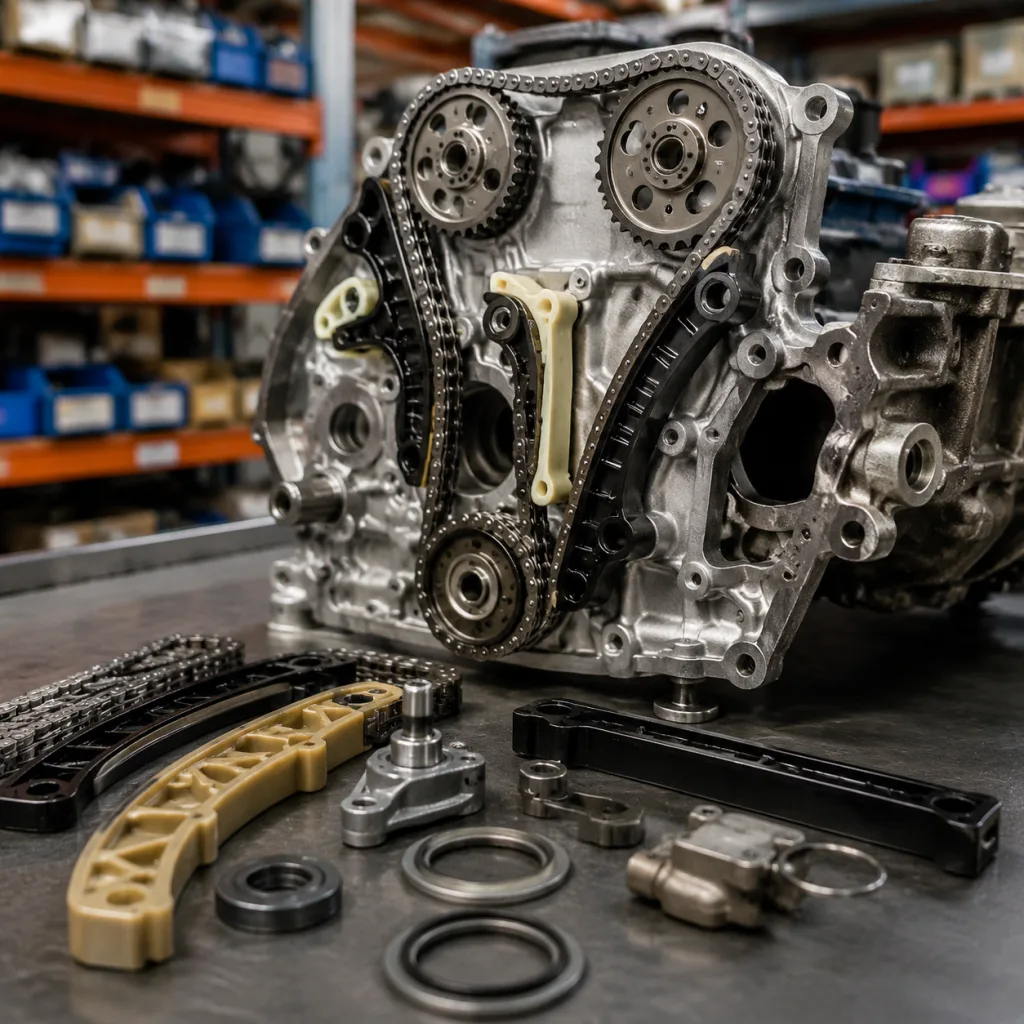
- Kit scope: chains, guides, tensioners, sprockets, VVT actuator bolts, seals, and gaskets must work as a matched set; one missing seal can hold the vehicle.
- Labour market: workshop rates commonly range from about USD 40–180 per hour depending on region and service channel.
- Downtime: towing, loan vehicles, bay occupation, parts waiting time, customer compensation, and repeat diagnostics may outweigh the kit price.
A practical broken timing belt repair cost model separates parts, labour, secondary damage, and downtime. A no-damage four-cylinder belt repair may use 4–6 hours plus a belt kit and water pump. A jumped chain with bent valves may require 12–25 total hours including diagnosis, cylinder-head removal, machining coordination, timing-set installation, oil flush, scan verification, and road testing.
For sourcing, judge a timing chain kit as a system. Chain pitch accuracy, guide wear resistance, tensioner response, sprocket tooth profile, and seal quality affect noise, start-up rattle, leakage, and cam/crank correlation. One repeat teardown can erase the gross margin on dozens of kits.
Failure Patterns: What the Vehicle Is Telling You
A snapped belt and a worn chain usually fail differently. Belts often stop suddenly after age degradation, oil contamination, seized idler failure, or water-pump lock-up. Chains more often warn first: cold-start rattle, correlation codes, guide debris, or phaser noise. But a collapsed tensioner or broken guide can still create an abrupt timing jump.
| Symptom | Likely cause | Inspection action | Replacement implication |
|---|---|---|---|
| No-start with fast cranking | Broken belt or chain jump | Remove cover, verify cam movement, record cranking RPM | Inspect the full timing set before quoting |
| Rattle at cold start for 1–3 seconds | Tensioner leak-down or guide wear | Check oil-pressure history, oil viscosity, and chain slack | Replace chain, tensioner, guides, and seals |
| Cam/crank correlation code | Chain elongation or slipped timing | Scan live data, check timing marks, compare commanded vs actual cam angle | Confirm kit dimensional match |
| Misfire after timing loss | Bent valves or low compression | Perform compression and leak-down testing | Cylinder-head repair may be required |
| Oil leak at cover | Seal or gasket hardening | Inspect timing cover, crank seal, and mating surfaces | Include gasket set in the repair bundle |
| Check item | Typical method | Procurement reason |
|---|---|---|
| Chain length over defined links | Gauge fixture or calibrated measurement at 20°C | Controls cam timing accuracy |
| Guide mounting-hole position | CMM or fixture check against drawing datum | Prevents misalignment and rubbing |
| Tensioner extension force | Bench test at defined stroke and oil condition | Reduces rattle and jump risk |
| Tensioner leak-down | Timed plunger drop or pressure-retention test | Controls cold-start noise |
| Sprocket tooth profile | Profile projector or go/no-go gauge | Confirms chain mesh stability |
| Seal hardness | Shore A durometer, commonly checked around 70±5 Shore A when specified | Supports leak prevention |
| Packaging traceability | Batch, date-code, label, and carton-drop review | Enables field-claim containment |