By Vincent Xi, Editorial Author
350 Small Block Engine Rebuild Kit Sourcing Guide
A 350 small block engine rebuild kit should be sourced from a controlled specification, not from the product title alone. In wholesale buying, the same keyword can point to a light gasket-and-bearing set, a broader master kit, a rotating-assembly-oriented package, or a private-label box with different internal parts. That difference affects fitment evidence, returns exposure and quote comparability. Public service information from Power Solutions, Inc. gives useful context: its 5.0 L and 5.7 L manual scope ties assembly work to fastener strategy, component context and revision-controlled service data. Chevrolet Performance material adds a second boundary: CT350 can refer to a documented CT350 (602) 350 HP circle-track engine assembly, but that does not approve or define every aftermarket kit. For procurement teams, the practical sequence is fitment boundary, signed BOM, dimensional and material evidence, sample inspection, packaging control, then landed-cost comparison.
Start With Kit Scope, Not Price
Before requesting prices, define what the supplier is quoting. A 350 small block engine rebuild kit may be a gasket-and-bearing kit, a master rebuild kit, a rotating-assembly-oriented kit, or a private-label program. Those are different commercial products even when the application headline is similar.
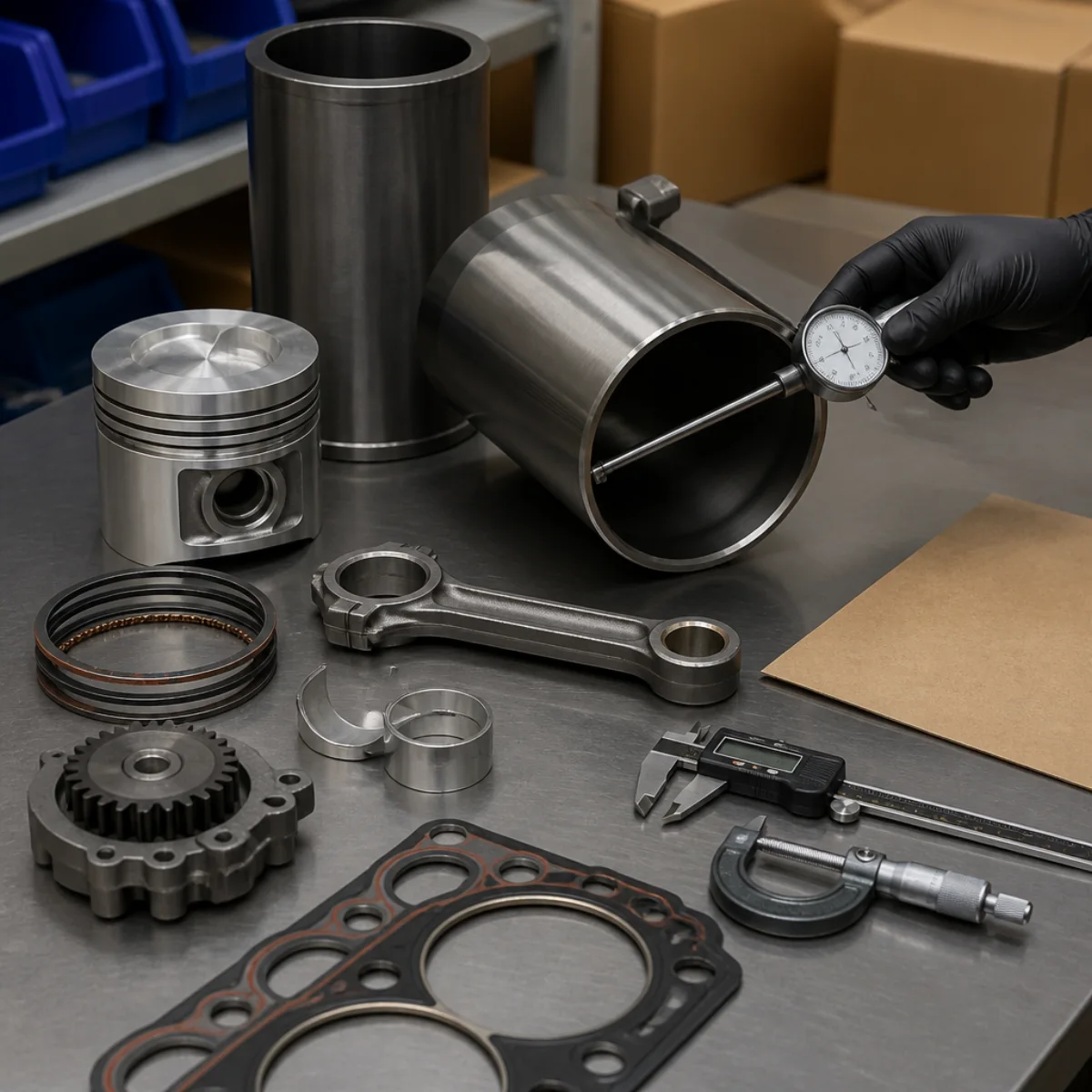
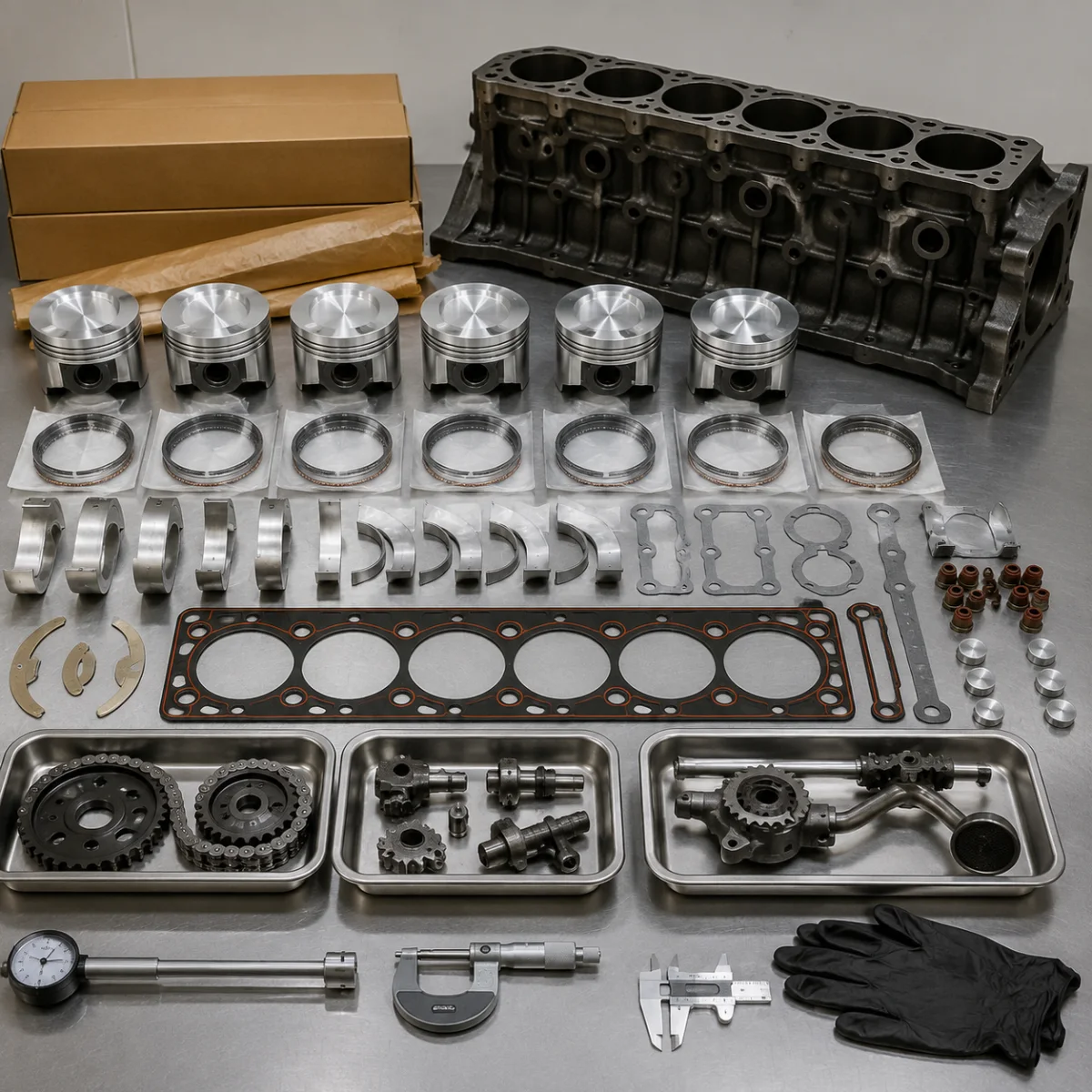
The RFQ should separate required parts from optional parts. Depending on the kit tier, required lines may include piston rings, main bearings, rod bearings, cam bearings, a full gasket set, timing components, oil pump and expansion plugs. Tier-dependent lines may include pistons, lifters, push rods, valve train parts, fasteners or rotating-assembly components.
The procurement rule is direct: do not compare unit price until every supplier has quoted the same line-item BOM. If one offer includes pistons and timing components while another covers only gaskets and bearings, the lower number may be missing scope rather than showing better value.
Use engine components and our catalog as product-family starting points, then issue a controlled line-item specification for the exact kit tier, packaging form and inspection documents required for your channel. The RFQ should ask the supplier to identify each part by description, quantity, material or construction description where available, allowed substitution rule and the inspection evidence that will be supplied with the quote or sample.
Keep Fitment Evidence Separate From Brand References
OE and performance names can help frame the application discussion, but they should not be treated as supplier approval. Chevrolet, Chevrolet Performance, GM-style naming and CT350 references may identify an engine family, reference package or catalog cross-reference. They do not prove that an aftermarket supplier has manufacturer endorsement.
The Chevrolet Performance CT350 and CT400 technical manual, revised February 2023 and retrieved for this article on 2026-07-15, lists a CT350 package as a CT350 (602) 350 HP engine assembly. That figure supports only a narrow statement about that documented engine package. It does not define every rebuild kit sold for small block applications, and it does not validate any private-label supplier.
For quotations, require the supplier to state the target engine architecture, casting or reference family where used, included and excluded parts, and whether reference numbers are used only for cross-reference. RFQ language should also state that brand names, OE references and performance-package names are for fitment identification only and do not imply approval, endorsement or certification.
Before order release, ask for fitment evidence tied to the quoted BOM: dimensional sheets, cross-reference notes, sample measurements and application exclusions. This evidence is more useful than broad catalog wording when a distributor has to handle returns, substitutions or warranty discussions.
Specify The Matched Parts That Drive Returns
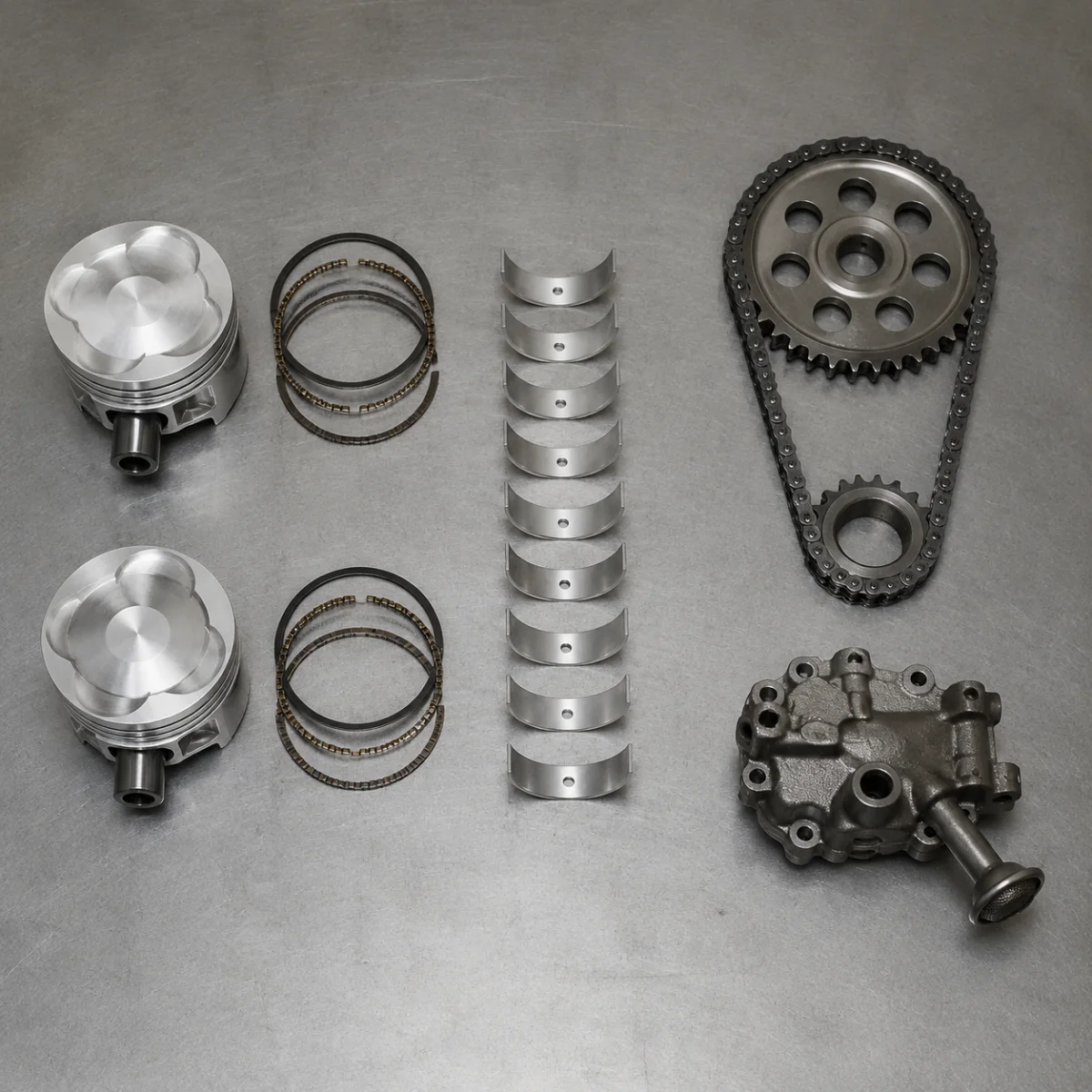
Return risk often concentrates where parts must work together. Pistons, rings, pins, bearings, gaskets, oil pump parts and timing components should be managed as a controlled set, not as a loose bundle of aftermarket items.
For each quoted kit tier, ask suppliers to confirm:
- Piston style, pin arrangement, ring set compatibility and any oversize choices offered.
- Ring pack description, ring material or coating description where the supplier claims it, and packaging method that keeps rings separated and identifiable.
- Main, rod and cam bearing construction, coating or overlay description where applicable.
- Gasket material type for head, intake, oil pan and valve cover positions.
- Timing set type and whether the chain and sprockets are supplied as a matched set.
- Oil pump inclusion, pickup compatibility and packaging protection.
- Fastener inclusion or exclusion, because torque procedures can depend on fastener design, lubricant condition and whether fasteners are new or reused.
- Substitution rules if a component becomes unavailable during production.
Dimensional evidence belongs in the quotation file. Ask which points will be measured on the sample kit, such as bearing shell identification, piston and ring compatibility, gasket opening alignment, timing component fit, oil pump interface and carton protection. Do not add tolerance numbers unless they appear in supplier drawings or verified service data for the exact application.
Then turn the specification into a sample plan. Each sample kit should be unpacked against the same BOM that will govern bulk packing. Record part count, markings, component packaging, obvious material differences, carton protection and any supplier substitutions. If the supplier quotes an equivalent component, require an updated drawing, material statement or dimensional comparison before approval.
Use Service Data As A Purchasing Checkpoint
Service-manual values should not be copied into a supplier process sheet without engineering review. They are still useful purchasing checkpoints because they reveal where a kit must support assembly conditions that cannot be judged from a photo or carton label.
In the Power Solutions, Inc. service manual excerpt retrieved on 2026-07-15, the manual scope includes 5.0 L and 5.7 L engine service information. Within that service context, the fastener tightening table lists the crankshaft balancer bolt at 95 N·m and the connecting rod nut first pass at 27 N·m before the angle stage. The same excerpted manual shows revision control with revision level 3 released on 12/11/2024. These are service data points from the cited manual, not a claim about Driventus manufacturing practice.
Use those values to shape supplier questions. Ask how the quoted bearings, fasteners, pistons, rings and gasket materials are selected for the intended assembly environment. Confirm whether the kit includes instructions, whether those instructions match the actual parts supplied, and whether the supplier identifies lubricant assumptions, fastener reuse assumptions, angle-tightening requirements or engine-variant exclusions.
The procurement decision is whether the supplier can connect quoted parts to assembly evidence. If the answer is only a product photo or a generic catalog line, hold the order until sample inspection records and technical documents are available.
Write The RFQ So Weak Quotes Expose Themselves
A useful RFQ gives suppliers enough structure to quote the same product and gives buyers enough evidence to reject unclear submissions. It should read less like a catalog inquiry and more like a purchasing control document.
Buyer checklist:
- Application boundary: engine family, target market, reference numbers and exclusions.
- Kit level: gasket kit, master rebuild kit, rotating assembly kit or private-label program.
- BOM: every included part, quantity, material description and allowed substitute rule.
- Dimensional control: drawings, sample measurement points and acceptable inspection format.
- Material control: bearing construction, gasket material, ring description, piston description and finish notes where applicable.
- Testing and inspection: sample inspection report, visual checks, dimensional checks, packaging checks and any functional checks the supplier can document for the quoted kit.
- Packaging: inner protection, carton structure, label content and pallet requirements.
- Documentation: quote validity, inspection report, material statement and any certificate scope claimed by the supplier.
- Sample plan: sample quantity, approval criteria, destructive checks if required and packaging review.
- Commercial terms: minimum order quantity, lead-time basis, incoterm, tooling charges and change-control process.
For non-catalog variations, route the discussion through custom manufacturing. For inspection and document expectations, align the RFQ with the buyer-facing quality system page, while still asking for current supplier documents for the exact quoted part.
The RFQ should also define post-approval control. Require written change control for component substitutions, carton artwork changes, label revisions and supplier-side material changes. A rebuild kit can look identical at retail while its internal parts, packaging protection or document file have changed.
Normalize Stocking Options Before Landed Cost
Distributors often compare offers that are not equivalent. A lower unit price may reflect fewer included parts, lighter packaging or a kit intended for a different customer segment. Use a comparison table before commercial review.
| Stocking option | Suitable buyer use | Main sourcing risk | RFQ control | |
|---|---|---|---|---|
| Gasket-and-bearing kit | Repair-channel replenishment where pistons and timing parts are sourced separately | Buyer assumes missing parts are included | Lock the BOM and carton label wording | |
| Master rebuild kit | Wholesale programs that need a broader single-box offer | Mixed component grades or undocumented substitutions | Require sample inspection against a signed BOM | |
| Rotating-assembly-oriented kit | Engine builder or machine-shop channel | Fitment depends heavily on machining and balancing choices | Require drawings, material notes and assembly assumptions | |
| Private-label kit | Distributor brand program | Packaging claims may outrun the evidence file | Approve artwork only after technical document review |
| Data point | Value | Scope | As of | Evidence |
|---|---|---|---|---|
| PSI 5.7 L manual scope | 5.7 L | Power Solutions, Inc. service manual scope covering engine service information for the 5.7 L designation; used as compatibility context, not universal aftermarket fitment | Revision control release 12/11/2024; source retrieved 2026-07-15 | The title and table of contents identify 5.7 L coverage; the article uses this to justify controlled fitment confirmation for 350 small block sourcing. Source |
| PSI 5.0 L manual scope | 5.0 L | Power Solutions, Inc. service manual scope covering engine service information for the 5.0 L designation; used as adjacent manual-scope context, not universal aftermarket fitment | Revision control release 12/11/2024; source retrieved 2026-07-15 | The manual title identifies 5.0 L and 5.7 L coverage; the article uses this to keep service data bounded to the cited manual scope. Source |
| Crankshaft balancer bolt torque | 95 N·m | Power Solutions, Inc. service manual fastener tightening specification for the crankshaft balancer bolt in the cited engine service context | Revision control release 12/11/2024; source retrieved 2026-07-15 | The fastener table lists Crankshaft Balancer Bolt at 95 N·m; the article uses it as a service-context verification gate. Source |
| Connecting rod nut first pass | 27 N·m | Power Solutions, Inc. service manual fastener tightening specification for connecting rod nut first pass before the angle stage | Revision control release 12/11/2024; source retrieved 2026-07-15 | The fastener table lists Connecting Rod Nut First Pass at 27 N·m; the article uses it to show why kit evidence must match assembly conditions. Source |
| CT350 package output | 350 HP | Chevrolet Performance CT350 (602) circle track racing engine package listing in the CT350 and CT400 technical manual | Manual states revised February 2023; source retrieved 2026-07-15 | The contents excerpt lists CT350 (602) 350 HP Engine Assembly; the article uses it only to limit CT350 references to that documented package context. Source |
| PSI service-manual revision note | 12/11/2024 release date | Power Solutions, Inc. revision control table entry for revision level 3 of the cited 5.0 L and 5.7 L service manual | Source retrieved 2026-07-15 | The revision control excerpt lists release date 12/11/2024 and notes an update related to spark plug gap; the article uses the date only as document context. Source |
Methodology
Public source pages were retrieved on 2026-07-15 for a 2026-07-16 publication draft. Source selection prioritized manufacturer or service-manual material visible in the evidence excerpts, plus a government rebuilding-practice context source. Numeric values were extracted only where the excerpt showed the figure, unit, product or service scope and source context. Horsepower package data, displacement scope, torque values and document dates were not charted because they measure different things and do not share one comparison boundary.
Limitations and what to verify
- The excerpts do not provide complete aftermarket kit drawings, bore choices, material grades or packaging specifications; buyers must verify current drawings, sample measurements, material declarations and carton samples before approval.
- Service-manual torque entries support assembly verification context only; buyers must confirm the actual engine variant, fastener design, lubricant condition and quoted supplier instructions before using values in production or warranty documents.
- Chevrolet Performance CT350 references are not supplier endorsements or universal fitment claims; buyers must validate fitment against target applications, casting references and applicable emissions or competition rules.
- No supplied evidence establishes Driventus certifications, facility operation, export markets, annual capacity, defect rate or customer outcomes; buyers should request current supplier documentation and inspection records for the exact quoted program.
Sources used
- CT350 & CT400 — chevrolet.com. Supports the limited CT350 package reference and the caution that performance-package data is not a universal aftermarket kit approval.
- 5.0L & 5.7L Service Manual — psiengines.com. Supports the 5.0 L and 5.7 L service-context discussion, the manual revision context and the selected torque values used as procurement verification examples.
- Heavy-Duty Engine Rebuilding Practices — nepis.epa.gov. Reviewed for rebuilding-practice context and source-bound limitations, not used as a 350 small block kit specification.
Frequently asked questions
Include the target application boundary, exact BOM, kit tier, oversize options, packaging requirements, sample approval plan, substitution rules and required documents. Ask suppliers to identify which references are fitment aids only and which specifications are controlled in their quotation.
No. A CT350 reference can help identify a documented Chevrolet Performance package, but it should not be treated as universal fitment or manufacturer approval. Require the supplier to confirm the actual target engine family, included components and exclusions.
Ask for drawings or dimensional sheets, BOM confirmation, sample inspection report, material statements where relevant, packaging specification, quotation validity and any current certificate scope the supplier claims. Treat sales-page wording as secondary to controlled documents.
Inspect each sample against the same BOM and approval checklist. Compare part markings, gasket materials, bearing appearance, ring packaging, carton protection, document completeness and substitution notes. Do not compare price until the kit scope is confirmed as equivalent.
For a sourcing discussion, send the BOM, fitment boundary and sample requirements with your request a quote
Request a Quote