By Vincent Xi, Editorial Author
Engine Rebuild Kit for 350 Chevy: Procurement Guide
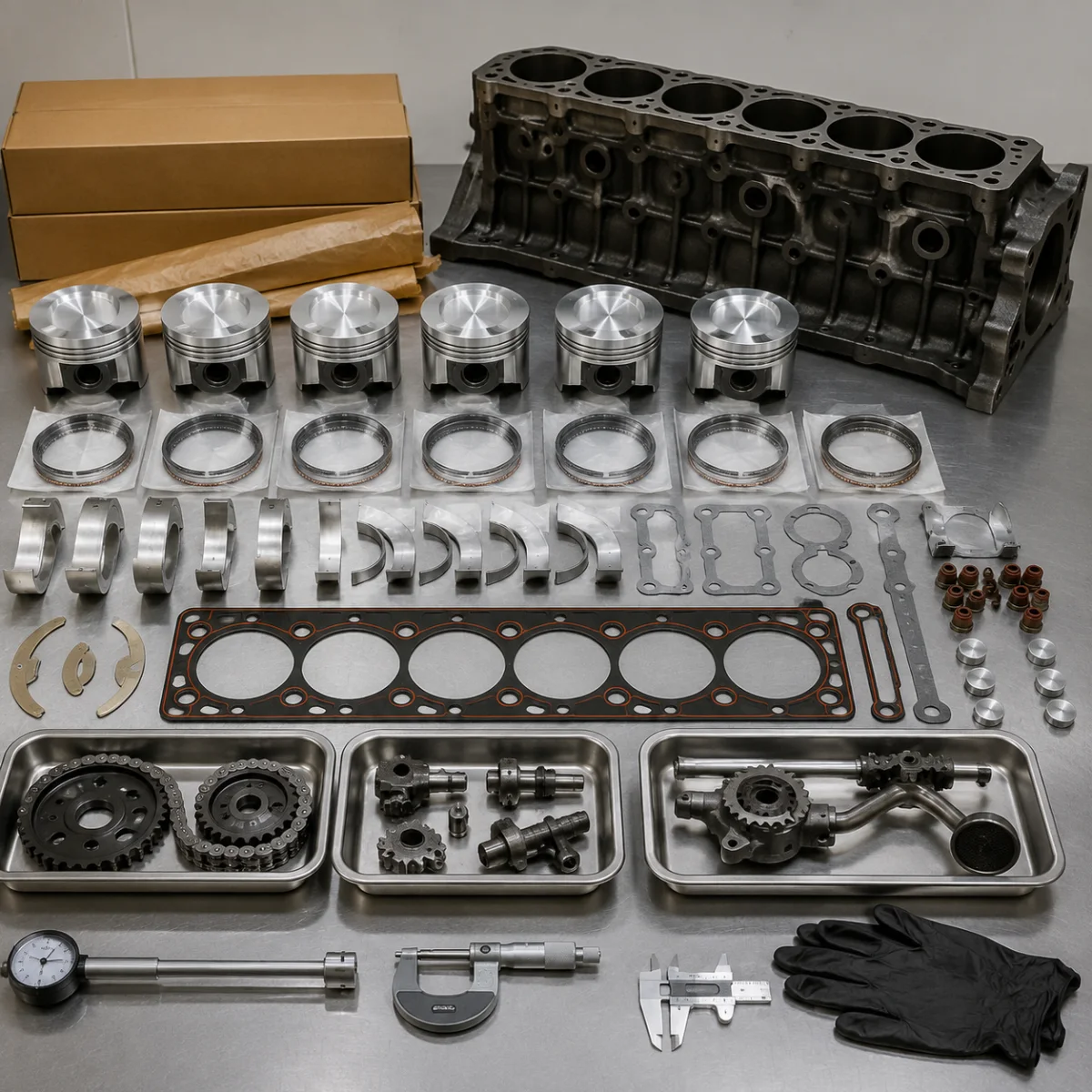
Buying an engine rebuild kit for 350 Chevy applications starts with a narrow definition, not a broad catalogue name. The same phrase can describe a light gasket-and-bearing package, a more complete overhaul kit, or a buyer-specified assortment with pistons, rings, bearings, gaskets, oil pump, timing set, plugs, seals and selected fasteners. Hot Rod uses the familiar 350-inch Gen I small-block Chevy wording, while the PSI manual works within a 5.7 L service-manual scope. Those references help frame the buying conversation; they do not prove that one aftermarket kit fits every block, rear-main seal style, crankshaft grind, head package or duty cycle. For distributors and import managers, the real work is to lock down fitment, machining assumptions, included lines, substitutions, packaging and inspection records before comparing price.
Start with the kit boundary
A supplier quoting an engine rebuild kit for 350 Chevy may be pricing a narrow ring-and-bearing set, a gasket-heavy service kit, a master overhaul kit or a private bundle assembled to the buyer's bill of materials. Those are different products. The RFQ should make the boundary visible before the first quotation is evaluated.
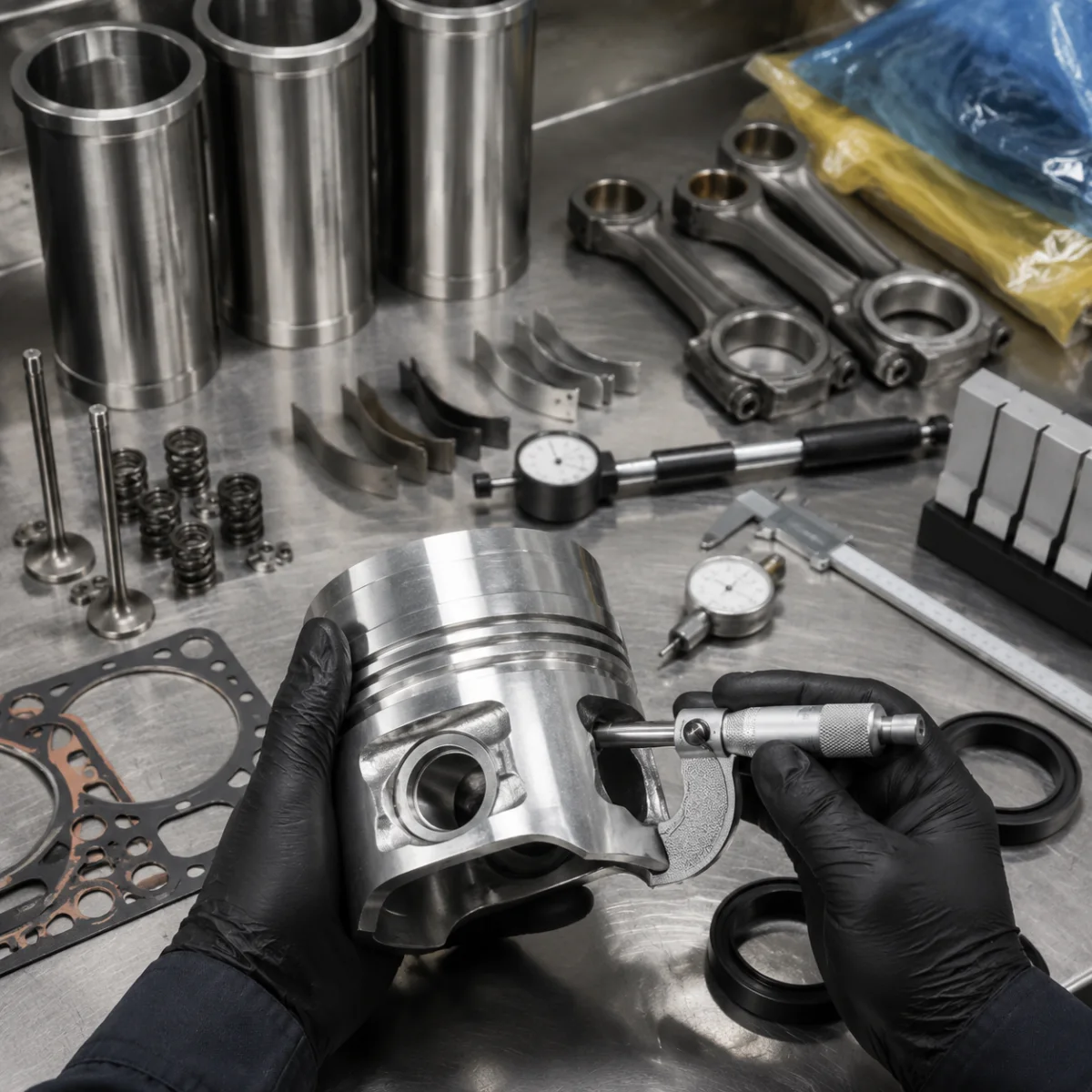
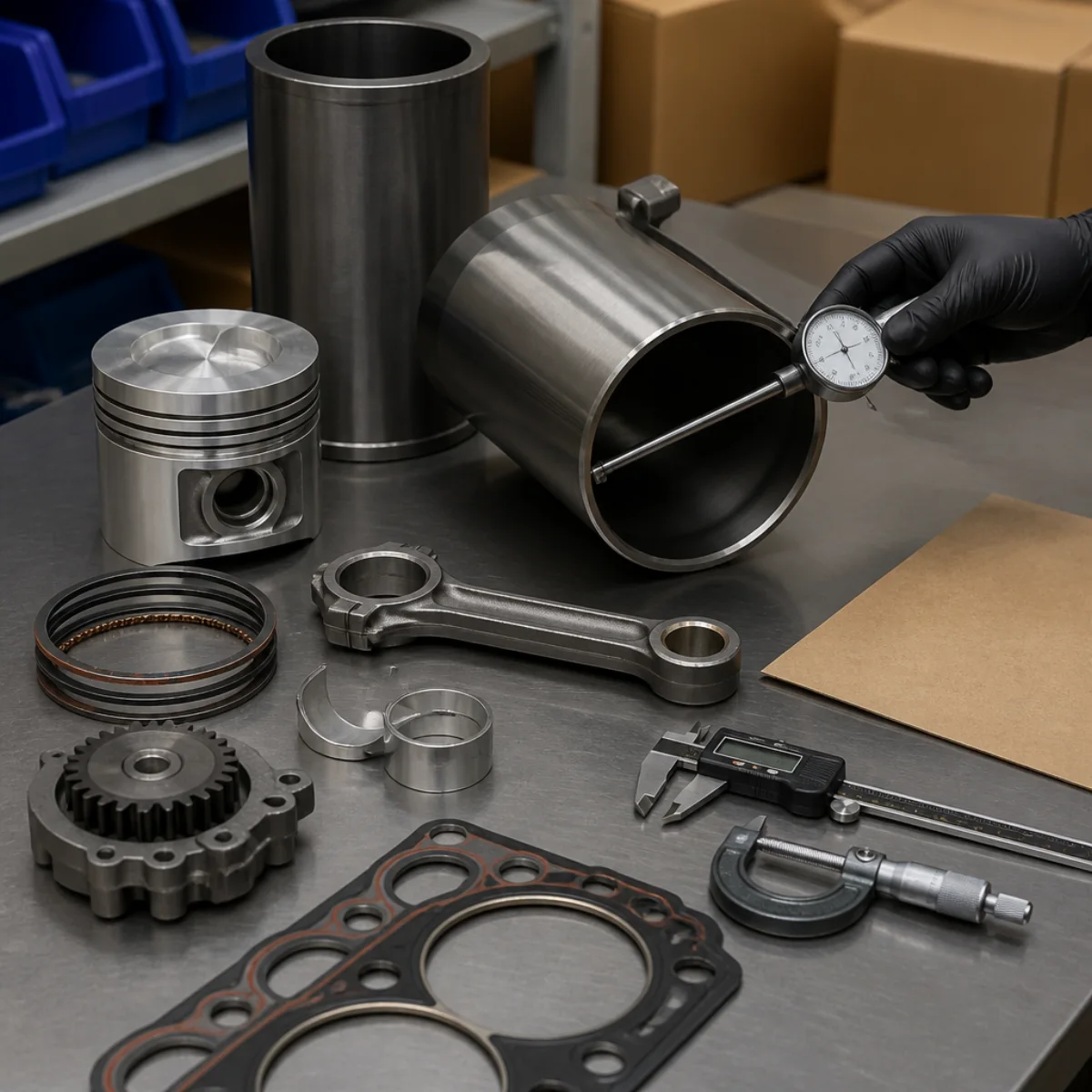
List each required line: pistons, piston rings, main bearings, connecting rod bearings, cam bearings, full gasket set, oil pump, timing set, freeze plugs, valve stem seals, head bolts, pan bolts and any other hardware only when it belongs in the program. Also list exclusions. If pistons depend on final bore size, make them conditional. If crankshaft inspection determines bearing undersize, do not let the supplier quote one fixed bearing set as the default.
For resale, decide whether the product will be one master SKU, a kitted set with visible internal line items, or a warehouse-assembled bundle. For remanufacturing, connect each line to the machining route and receiving inspection file. Chevrolet, GM, CT350 and CT400 language may help describe context, but it should not be treated as approval, endorsement or interchange evidence.
Separate the engine name from the engine evidence
The label "350 Chevy" is not enough for procurement release. Before selecting rings, bearings, gaskets or fasteners, verify block casting family, rear-main seal style, crankshaft condition, cylinder bore plan, head and intake combination, oil pan arrangement, fuel pump provision and intended service environment. A stock-style street rebuild, an industrial replacement and a race-oriented service engine can require different kit decisions.
The PSI manual is useful because it places 5.7 L information inside a defined service-document scope. It does not make every 5.7 L or 350-labeled aftermarket kit interchangeable. The Chevrolet Performance CT350 and CT400 manual is similarly specific: its contents separate CT350 350 HP and CT400 400 HP engine assemblies, installation information, engine specifications, torque specifications and technical inspection procedures. That structure is a procurement lesson. Keep the evidence tied to the exact engine program, not just to the nameplate.
Before price comparison, ask four questions: which engine version is covered, which machining dimensions are assumed, which variants are excluded, and what evidence shows the supplier selected the correct component group. Category teams can keep naming aligned through our catalog and the engine components category before moving the detail into supplier quotation files.
Build an RFQ that exposes non-comparable offers
A useful RFQ makes weak quotations obvious. It should force suppliers to declare fitment basis, material assumptions, kit contents, documentation, packaging and substitution rules in a format the buyer can compare line by line.
| RFQ input | Procurement question | Evidence to request | ||
|---|---|---|---|---|
| Engine identity and application | Is this a defined application or a generic small-block assortment? | Interchange basis, application notes and excluded variants | ||
| Bore and crank machining state | Which piston, ring, main bearing and rod bearing sizes are being quoted? | Oversize or undersize callouts, drawing references and inspection plan | ||
| Piston, ring and bearing material notes | Are the materials buyer-approved or only catalogue defaults? | Material declaration, coating note if any, marking photos and sample inspection record | ||
| Required kit contents | Are all required lines included without hidden substitutions? | Bill of materials with line-level descriptions and quantities | ||
| Gasket and sealing requirements | Do the gaskets and seals match the engine configuration? | Gasket construction notes, seal list and packaging protection method | ||
| Fastener inclusion policy | Are fasteners supplied, excluded or left to service reuse? | Fastener list, grade or specification basis, finish and installation notes | ||
| Packaging and barcode format | Will receiving, storage and resale work without repacking? | Plain-pack, private-label or buyer-specified packaging proposal | ||
| Documentation package | Can the sample be audited later against production supply? | Dimensional report, batch traceability and change-control statement |
| Data point | Value | Scope | As of | Evidence |
|---|---|---|---|---|
| Gen I displacement reference | 350 inch | Hot Rod article describing a Gen I small-block Chevy budget build as a 350-inch engine | Published 2024-05-03; retrieved 2026-07-15 | Used to support the article's wording that buyers commonly reference a 350-inch Gen I small-block Chevy. Source |
| Service manual displacement scope | 5.7 L | PSI service manual title and table of contents covering engine mechanical specifications for 5.7 L engines | Revision 3 dated 12/11/2024; retrieved 2026-07-15 | Used to anchor the sourcing discussion to a documented 5.7 L service-manual scope rather than a generic kit name. Source |
| CT350 assembly rating reference | 350 HP | Chevrolet Performance CT350 and CT400 technical manual table of contents listing CT350 (602) 350 HP Engine Assembly | Revised February 2023; retrieved 2026-07-15 | Used only to show application-specific Chevrolet Performance context, not aftermarket kit approval or interchange. Source |
| CT400 assembly rating reference | 400 HP | Chevrolet Performance CT350 and CT400 technical manual table of contents listing CT400 (604) 400 HP Engine Assembly | Revised February 2023; retrieved 2026-07-15 | Used only to show that named engine packages have distinct application context and should not be generalized to every rebuild kit. Source |
| Connecting rod nut first pass | 27 N·m | PSI fastener tightening specification for connecting rod nut first pass in its service manual | Revision 3 dated 12/11/2024; retrieved 2026-07-15 | Used as a document-control example showing that rebuild-kit fasteners depend on defined service procedures. Source |
| Connecting rod nut final angle | 70 degrees | PSI fastener tightening specification for connecting rod nut final pass in its service manual | Revision 3 dated 12/11/2024; retrieved 2026-07-15 | Used to show that some controlled fastener procedures include angle steps rather than torque alone. Source |
| Crankshaft balancer bolt torque | 95 N·m | PSI fastener tightening specification for crankshaft balancer bolt in its service manual | Revision 3 dated 12/11/2024; retrieved 2026-07-15 | Used as a second torque-document example supporting the need to verify service data for included fasteners. Source |
| Belt idler pulley bolt torque | 50 N·m | PSI fastener tightening specification for belt idler pulley bolt in its service manual | Revision 3 dated 12/11/2024; retrieved 2026-07-15 | Used as an additional example showing why service-data scope must be identified before quoting or installing related components. Source |
| Camshaft sprocket bolt torque range | 30-40 N·m | PSI fastener tightening specification for camshaft sprocket bolt in its service manual | Revision 3 dated 12/11/2024; retrieved 2026-07-15 | Used as a range example from a service table, not as a universal aftermarket assembly instruction. Source |
Methodology
Public source excerpts and metadata were reviewed for application scope, service-document context and visible numeric specifications. Primary use was given to publisher-identifiable sources with direct relevance to small-block Chevy rebuild terminology or 5.7 L service procedures. Numeric points were extracted only where the excerpt visibly showed the value and unit. No chart was prepared because the cited values cover different scopes and units rather than one directly comparable measurement set.
Limitations and what to verify
- The evidence does not include a current Driventus supplier quote, drawing pack or sample inspection report, so buyers must verify kit contents, materials, dimensions and substitutions against their own RFQ.
- The public service-manual excerpts support document-control examples, not universal assembly instructions, so buyers and builders must verify the latest applicable service information for the exact engine and fastener set.
- The Chevrolet Performance source is application-specific material, so buyers must not treat CT350 or CT400 references as proof of approval, endorsement or interchange for an aftermarket rebuild kit.
- The research pack does not provide current prices, lead times, minimum order quantities, production capacity, shipment markets, supplier certifications, defect rates or Driventus operating data.
Sources used
- Budget 350-Inch Small-Block Chevy Engine Rebuild and ... — hotrod.com. Supports the common 350-inch Gen I small-block Chevy reference used to frame buyer terminology.
- 5.0L & 5.7L Service Manual — psiengines.com. Supports the 5.7 L service-manual scope and specific fastener tightening examples used for document-control guidance.
- CT350 & CT400 — chevrolet.com. Supports the caution that official Chevrolet Performance material can be application-specific and supplemental rather than a universal parts catalogue.
Frequently asked questions
No. The name is too broad for purchasing control. Confirm block family, rear-main seal style, crankshaft condition, piston and ring requirements, bearing selection, head and intake gaskets, oil pan details and intended duty before approving a kit.
Confirm the kit boundary, engine identity, machining state, included and excluded components, substitution policy, inspection documents, packaging format and service-data assumptions. Otherwise two suppliers may quote different products under the same kit name.
Request a bill of materials, dimensional inspection report, material notes where available, packaging evidence, batch or lot traceability and a change-control statement. Current certificates or test reports should be supplied separately when the buyer requires them.
Only after confirming the exact engine, fastener, lubricant, sequence and current service document. Published values are evidence for document control, not a substitute for builder verification or the latest applicable repair information.
For a controlled kit bill-of-material review, send engine identity, machining state, required contents, packaging target and sample-document requirements through request a quote
Request a Quote