By Vincent Xi, Editorial Author
Caterpillar Diesel Engine Parts Sourcing Guide
Buying Caterpillar diesel engine parts in the aftermarket starts with proof of fitment, not a price list. A distributor, wholesaler or import manager needs to know which engine build is being served, what evidence supports the proposed reference, and what records will remain available if a claim appears months later. Cat and Caterpillar names are used here as fitment and reference terms only; they do not imply approval, endorsement or supply by the trademark owner. A practical sourcing file should connect the engine model, serial range, arrangement number, failed or existing sample, drawing revision, material statement, inspection record and quotation scope. Use [engine components](/products/engine-components.html) and [our catalog](/products.html) to frame the product family, then make the supplier prove how the proposed part fits the exact application.
Start With the Engine Build, Then Discuss the Part
A request for a piston kit, cylinder liner, bearing set, oil pump, gasket kit or valve-train component is still incomplete until the engine build is identified. Similar commercial names can conceal different ring grooves, oil passages, bolt patterns, cooling features, mating diameters or kit contents.
For Caterpillar diesel engine parts, open the enquiry with the engine model, serial prefix or serial range, arrangement number, machine or generator application, emission configuration where relevant, and the failed or existing part reference. Ask the supplier to repeat those details in the quotation or cross-reference sheet. That repetition is useful: it shows whether the supplier is pricing the same application the buyer is trying to support.
The buying purpose also changes the evidence threshold. A service replacement order needs immediate fitment proof and clear exclusions. Rebuild stock needs consistent kit contents and repeatable inspection records. A private-label programme adds drawing stability, label control, packaging rules and change-notification expectations.
Treat Cross-Reference as a Controlled Procurement Record
Cross-reference work should leave an audit trail. The file should link the original reference, supplier reference, engine model, supported serial range, arrangement or application notes, kit contents, drawing basis, material note and evidence status. It should also list what is not included, such as seals, fasteners, thrust washers, dowels, O-rings or installation consumables.
Ask the supplier to define the interchange type. A direct dimensional replacement is not the same risk as a superseded reference, a service-kit consolidation or a functional replacement that needs buyer approval. Mark that distinction in the sourcing file so procurement, warehouse and warranty teams are not forced to interpret it later.
For import programmes, align the technical record with the commercial record. Country-of-origin documentation, unit-pack and master-carton configuration, label fields, pallet rules, catalogue naming and private-label requirements should refer to the same part identity. Inconsistent names across the drawing, invoice, label and packing list make stock reconciliation and claim review harder.
Match Evidence Requirements to the Component Risk
The RFQ should tell the supplier what proof is required before price comparison begins. For hard engine components, that normally means a controlled drawing or buyer-approved sample, material grade, heat-treatment or coating requirements where applicable, and a measurement report for critical characteristics.
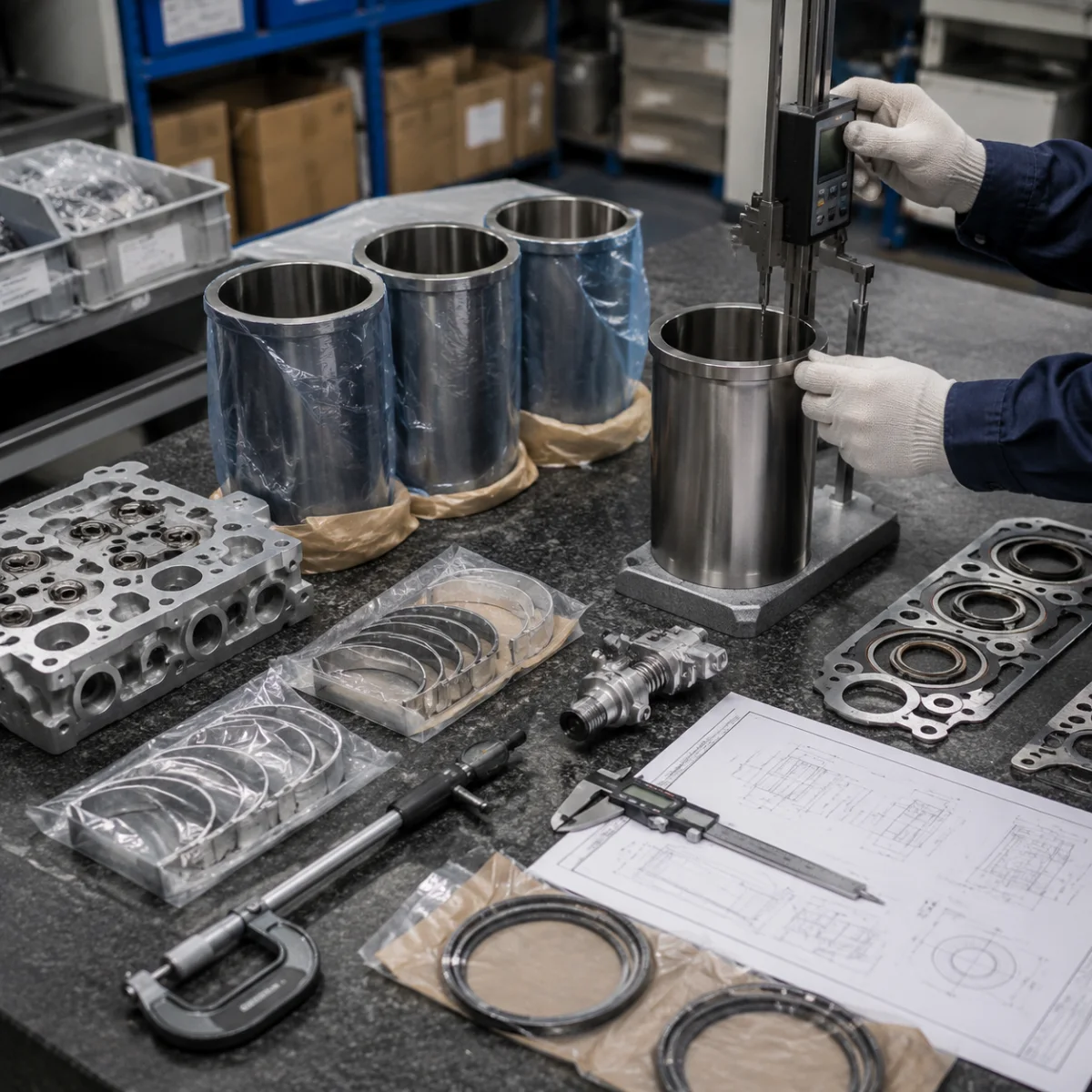
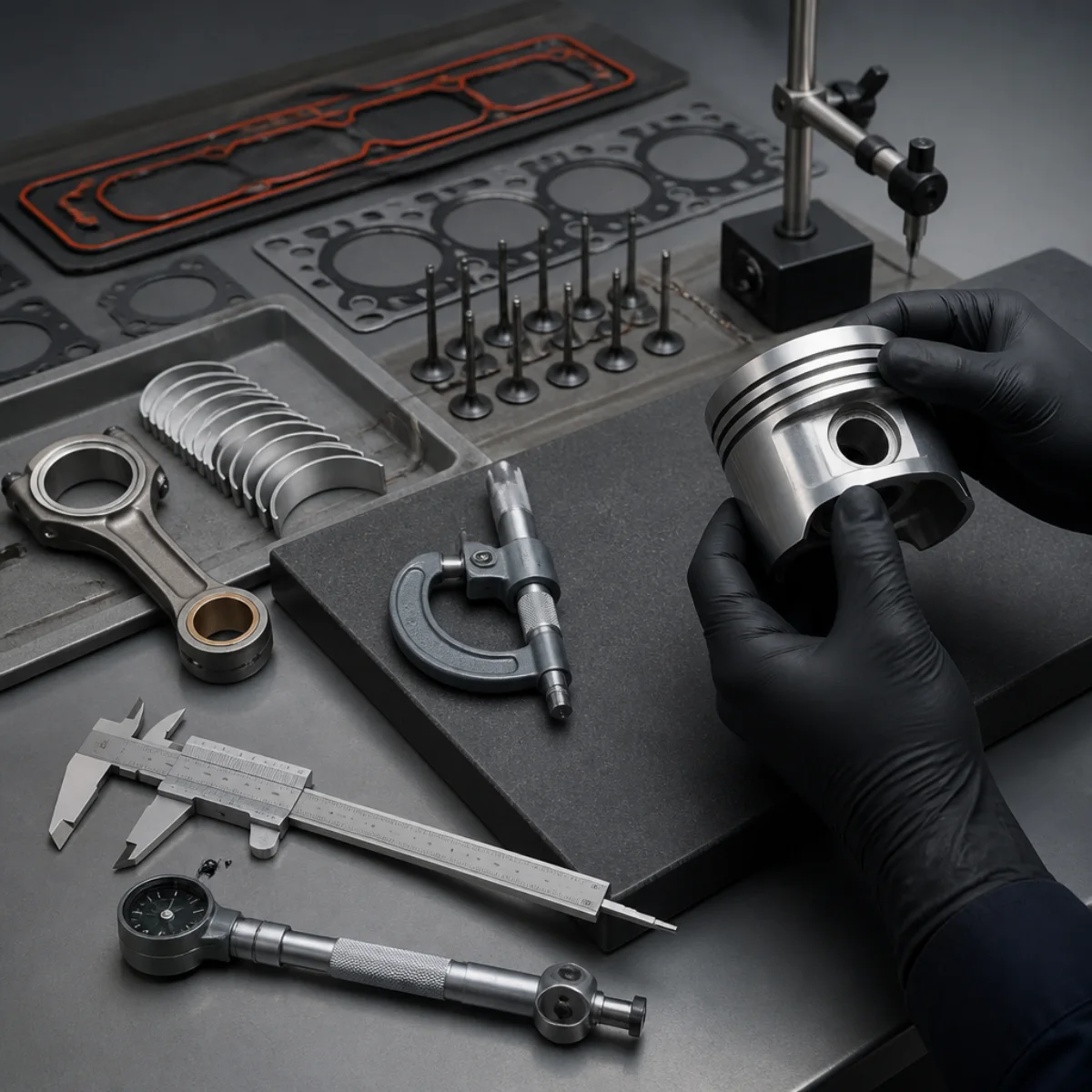
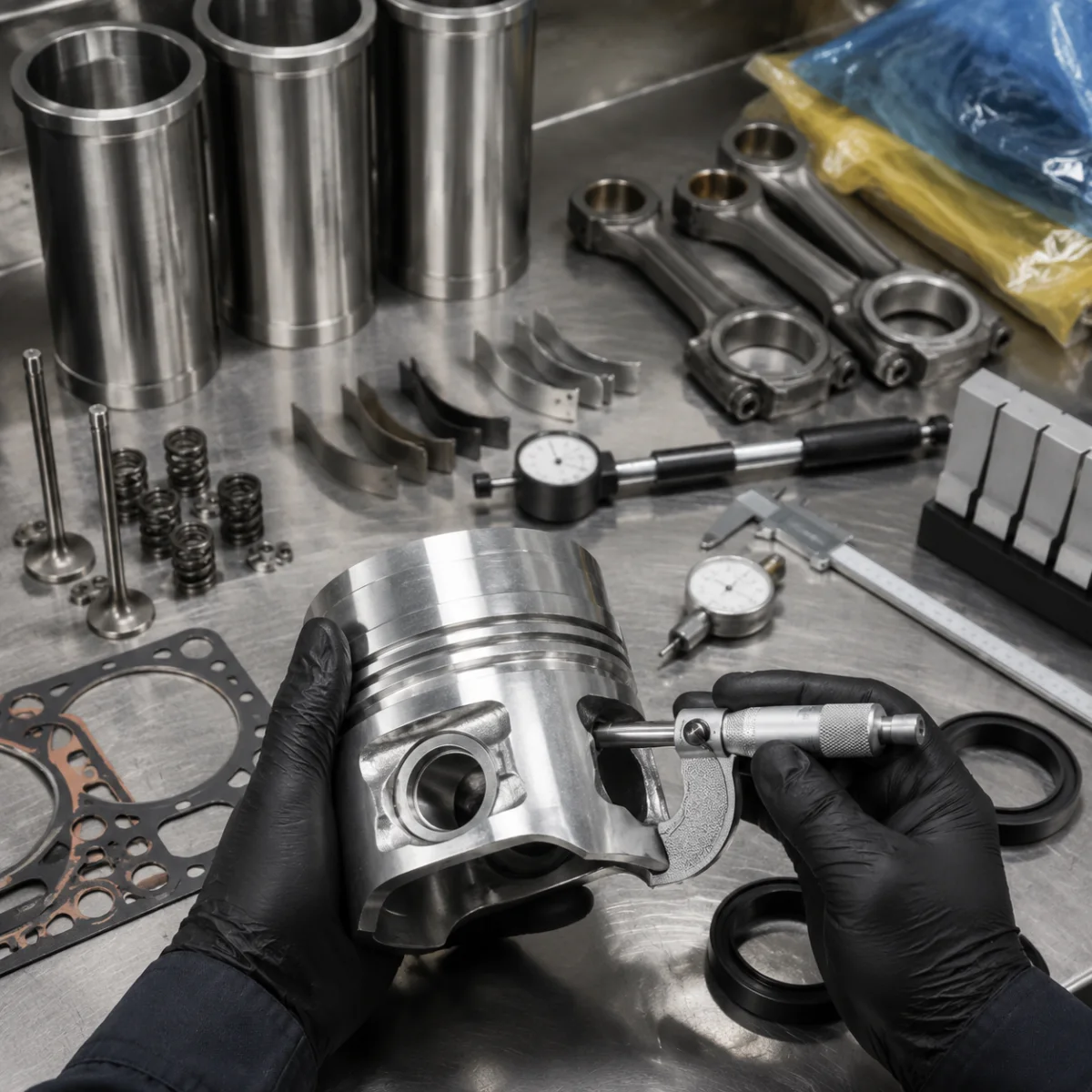
The function of the part determines the inspection focus. Pistons, liners, rings, bushings, bearings, valves and gasket sets should be reviewed around their working features: sealing faces, ring grooves, bearing crush areas, oil holes, dowel locations, fire-ring contact surfaces, bolt holes and mating diameters. The drawing or inspection plan should separate mandatory characteristics from reference dimensions.
Rubber, composite, coated and sealing parts need a different question set. Shape is not enough. Request the base material, coating system where relevant, hardness range, temperature and fluid exposure assumptions, plus shelf-life or storage requirements when applicable. A generic material family is weak evidence unless it is tied to the quoted part, production batch or inspection record.
Use Published Specifications as Boundary Checks Only
Published engine specifications can catch obvious category errors, but they are not purchase drawings. The supplied generator-set specification excerpt describes one Caterpillar 16CM32C configuration with 16 cylinders in Vee form, a 320 mm bore, 420 mm stroke, 33.8 l/Cyl. swept volume, 480 kW output/cyl. and 720 rpm revolutions. Those figures help identify the scale and duty context of that configuration; they are not universal dimensions for all Cat engine parts.
The same excerpt lists 23.7 bar BMEP and 10.1 m/s mean piston speed for the referenced configuration. It also describes material context, including a 1-piece dry engine block made of nodular cast iron, centrifugally cast liners, composite pistons with steel crown and nodular cast iron skirt, and piston rings with chromium-plated surfaces. In procurement terms, these details point to the type of material and dimensional evidence a buyer should request. They do not replace the current component drawing, controlled tolerance table, supplier inspection record or buyer-approved sample.
The reviewed Caterpillar on-highway fluids publication identifies SEBU6385-08 as November 2009 and places Fuel Specifications on page 25 and Cooling System Specifications on page 54. The excerpt also warns that specifications, torques, pressures, measurements and adjustments can change. Record the exact manual, drawing revision or approved sample used for the sourcing decision.
Where a standard appears in a source document or drawing, keep the standard claim separate from the supplier claim. The generator-set excerpt references ISO 3046/1 for reference conditions and overload context and ISO 8528/5 for load increment context. Those references do not prove that any aftermarket supplier is certified, approved or working to the latest revision. Request current documentation before relying on any standards claim.
Make the Quotation Describe the Controlled Features
A useful quotation for Caterpillar diesel engine parts should make clear what is controlled, what is assumed and what will be documented. Ask the supplier to state the drawing or sample basis, controlled dimensions, tolerance source, material or coating note, inspection method and available records for the order.
For a liner, the quote may need bore-related dimensions, flange dimensions, sealing-land condition, surface finish requirement if specified by the drawing, material note, packaging protection and inspection points. For a piston, request evidence around crown and skirt material, ring-groove dimensions, pin-bore checks, coating notes where applicable and sample photos. For a bearing, focus on shell identification, material construction, crush or spread checks if specified, oil-hole location and batch traceability.
Tolerance language should be precise. If a drawing gives tolerances, cite the drawing revision in the RFQ and require a measurement report against those characteristics. If the buyer is working from a sample instead of a drawing, label the dimensions as sample-derived and ask the supplier to confirm manufacturing tolerance before tooling or batch approval. Any quote assumption should remain marked as an assumption to verify before purchase order release.
Set Inspection Evidence Before the Price Comparison
Inspection requirements belong in the commercial conversation before suppliers are ranked. Ask which characteristics will be measured, what instruments will be used, what sample size or inspection level applies, how nonconforming parts are segregated, and whether records are tied to the production batch or only to a pre-production sample.
Machined parts usually need dimensional reports for mating diameters, sealing faces, holes, grooves and datum-related features. Sealing parts need material and compatibility evidence for the quoted compound or composite. Kits need contents verification, part-count control, packing photos and a clear list of exclusions. Coated, heat-treated or surface-treated parts need records that connect the stated process to the quoted part or batch.
The Caterpillar fluids excerpts emphasize that service information can change and that current information should be obtained before work begins. Apply the same document-control discipline to parts sourcing. Keep the RFQ, drawing or sample basis, supplier cross-reference, material statement, inspection report, photos, packing specification and final quotation together so a fitment, leakage, wear or claim issue can be reconstructed.
Build an RFQ Package That Can Be Audited Later
For custom manufacturing or recurring aftermarket supply, a short price email is too thin. The RFQ should define the technical basis, approval evidence, commercial scope and change-control expectations.
| RFQ input | Buyer request | Evidence to retain | ||
|---|---|---|---|---|
| Fitment basis | Engine model, serial range, arrangement number and reference part | Cross-reference sheet and supplier application statement | ||
| Drawing basis | Buyer drawing, supplier drawing or approved sample | Revision record and critical-characteristic list | ||
| Material and process | Grade, treatment, coating, elastomer or composite specification | Material certificate or supplier declaration tied to the quoted part | ||
| Tolerance control | Critical dimensions, datum features and acceptance criteria | Measurement report against the drawing or approved sample basis | ||
| Sample approval | Inspection method, measured features and acceptance criteria | Sample report, photos and deviation list | ||
| Kit contents | Included and excluded parts for each set | Packing list, bill of materials or kit checklist | ||
| Packaging scope | Unit pack, kit pack, carton, pallet and label requirements | Approved packing specification and inspection photos | ||
| Quality records | Inspection level, traceability and nonconformance response | Records aligned with the buyer's quality system requirements |
| Data point | Value | Scope | As of | Evidence |
|---|---|---|---|---|
| Generator-set cylinder count | 16 cylinders | Number of cylinders stated for the Caterpillar 16CM32C diesel engine with GE generator packaging technical specification excerpt | Retrieved 2026-07-14; source document excerpt shows no publication date | Used to show that part sourcing must be tied to the exact engine configuration rather than a broad model name. Source |
| Generator-set bore | 320 mm | Bore stated in the Caterpillar 16CM32C diesel engine with GE generator packaging technical specification excerpt for the referenced engine configuration | Retrieved 2026-07-14; source document excerpt shows no publication date | Used to show why bore-level geometry must be governed by drawings before substituting engine components. Source |
| Generator-set stroke | 420 mm | Stroke stated in the Caterpillar 16CM32C diesel engine with GE generator packaging technical specification excerpt for the referenced engine configuration | Retrieved 2026-07-14; source document excerpt shows no publication date | Used with the bore figure to illustrate that published engine geometry is configuration-specific, not universal. Source |
| Generator-set swept volume | 33.8 l/Cyl. | Swept volume per cylinder listed in the Caterpillar 16CM32C diesel engine with GE generator packaging technical specification excerpt for the referenced engine configuration | Retrieved 2026-07-14; source document excerpt shows no publication date | Used to reinforce that published technical values describe a specific configuration and should not be generalized to all replacement parts. Source |
| Generator-set output per cylinder | 480 kW | Output per cylinder listed in the Caterpillar 16CM32C diesel engine with GE generator packaging technical specification excerpt for the referenced engine configuration | Retrieved 2026-07-14; source document excerpt shows no publication date | Used to connect component sourcing to duty context and configuration-specific performance data. Source |
| Generator-set BMEP | 23.7 bar | BMEP listed in the Caterpillar 16CM32C diesel engine with GE generator packaging technical specification excerpt for the referenced engine configuration | Retrieved 2026-07-14; source document excerpt shows no publication date | Used as duty-context evidence, not as an approval value for any aftermarket component. Source |
| Generator-set revolutions | 720 rpm | Revolutions listed in the Caterpillar 16CM32C diesel engine with GE generator packaging technical specification excerpt for the referenced engine configuration | Retrieved 2026-07-14; source document excerpt shows no publication date | Used to connect part sourcing to duty context rather than treating a component reference as standalone proof. Source |
| Mean piston speed | 10.1 m/s | Mean piston speed listed in the Caterpillar 16CM32C diesel engine with GE generator packaging technical specification excerpt for the referenced engine configuration | Retrieved 2026-07-14; source document excerpt shows no publication date | Used to show why operating context and current component evidence matter in procurement review. Source |
| Fuel specifications location | 25 page | Table-of-contents location for Fuel Specifications in the Caterpillar On-Highway Diesel Engine Fluids Recommendations excerpt | Source excerpt identifies SEBU6385-08 as November 2009; retrieved 2026-07-14 | Used to support the article's point that service-fluid requirements belong in current document control. Source |
| Cooling system specifications location | 54 page | Table-of-contents location for Cooling System Specifications in the Caterpillar On-Highway Diesel Engine Fluids Recommendations excerpt | Source excerpt identifies SEBU6385-08 as November 2009; retrieved 2026-07-14 | Used as document-control context for service-related sourcing review. Source |
Methodology
Source excerpts were retrieved from the supplied research pack and filtered for visible, attributable claims. The generator-set specification was used only as one configuration example for dimensional, material and duty-context discussion. Caterpillar fluid guidance was used for document-control context. Numeric values were extracted only where a value, unit and scope were visible in the supplied excerpts; mixed-unit values were not combined into a chart.
Limitations and what to verify
- The generator-set specification describes a particular Caterpillar 16CM32C engine configuration, so buyers must verify the actual model, arrangement, serial range and drawing revision before applying any dimension to a sourced part.
- Fluid and service publications can change, and the excerpts are partial. Buyers must obtain current manuals, drawings, material certificates, sample reports, inspection records and quotation terms before approving supply.
- The article does not verify any Driventus certification, manufacturing capacity, export scope, defect rate or Caterpillar endorsement. Buyers should request current supplier documents for their own audit file.
- Published values such as bore, stroke, BMEP, speed and material descriptions are boundary checks only. They are not purchase tolerances, inspection limits or acceptance criteria unless repeated in the current drawing or buyer-approved specification.
Sources used
- TECHNICAL SPECIFICATIONS — f.machineryhost.com. Supported the configuration-specific cylinder count, bore, stroke, swept volume, output, BMEP, revolutions, mean piston speed and material-context examples used to explain engine geometry and sourcing evidence.
- Caterpillar On-Highway Diesel Engine Fluids Recommendations — caterpillar.scene7.com. Supported document-control guidance around fuel specifications, cooling system specifications and the need to obtain current service information.
- Cat Commercial Diesel Engine Fluids Recommendations — allmand.com. Supported parallel document-control context for Caterpillar commercial diesel engine fluid guidance and the warning that current information should be obtained.
- Diesel Engine Parts Cross Reference Guide: OEM to Aftermarket ... — heavydutyjournal.com. Used only as context for common aftermarket cross-reference themes, including dimensional tolerance mismatches and material or chemical compatibility, not as a source of technical numeric claims.
Frequently asked questions
They can be sourced when the buyer verifies fitment, material, dimensions, sample evidence and documentation for the exact engine application. Cat and Caterpillar references should be treated only as fitment and cross-reference terms. They do not imply approval, endorsement or supply by the trademark owner.
Send the engine model, serial range, arrangement number, existing part reference, failed-sample photos, required kit contents, drawing or sample basis, material requirements, packaging rules, tolerance expectations, inspection records and document expectations. State whether the order is for stock replacement, rebuild use, private-label supply or a custom programme.
Ask whether the cross-reference is direct interchange, supersession, kit consolidation or functional replacement. Require the supplier to identify covered applications, exclusions, drawing basis, material statement and approval evidence. Keep the cross-reference, inspection report and quotation in the same sourcing file.
No. Published specifications help define context, but purchase approval should rely on the current manual or drawing, buyer-approved sample, supplier measurement report, material evidence and quotation terms. Treat general literature as a boundary check, not as a manufacturing release.
Request records that match the part risk: dimensional reports for machined features, material or coating evidence for treated parts, compatibility notes for sealing materials, kit-content checks for sets, packing photos for export orders and traceability that links the records to the quoted part, sample or production batch.
Share the engine model, arrangement data, OE reference, sample photos and document requirements. Start a controlled sourcing discussion with Driventus: request a quote. Review related product scope at engine components.
Request a Quote