By Vincent Xi, Editorial Author
Engine Rebuild Kit for Jeep 4.0: B2B Buying Guide
An engine rebuild kit for Jeep 4.0 applications should be purchased from measurements and documents, not from a broad fitment label alone. In trade sourcing, the same phrase may refer to a gasket refresh pack, a piston-and-ring set, a lower-end kit, or a master rebuild kit with timing and oiling parts. The supplied specification excerpt identifies the Jeep 4.0L Power Tech engine as a cast-iron inline 6-cylinder engine with a standard bore and stroke of 98.4 mm x 87.4 mm. The same excerpt states an 11.4 L cooling-system capacity and a 1-5-3-6-2-4 firing order. A Wrangler Forum thread dated Jun. 23, 2014 reports a more granular standard-bore range of 3.8759 in to 3.8775 in, attributed in the post to Mopar Performance Parts; treat that forum value as secondary screening evidence until it is checked against current service data, supplier drawings and the machine shop's measurements. This guide turns the available public evidence into a procurement workflow for [engine components](/products/engine-components.html): define the build, lock the bill of materials, verify size options, approve samples and request current supplier records. Jeep and Mopar references are used only for fitment and dimensional context; they do not imply approval or endorsement.
Define The Build Before Asking For Price
Start with the engine, not the vehicle badge. The supplied specification excerpt describes the Jeep 4.0L Power Tech as a cast-iron inline 6-cylinder design. It also states that cylinders are numbered 1 through 6 from front to rear, the firing order is 1-5-3-6-2-4, the crankshaft rotates clockwise when viewed from the front of the engine, the crankshaft runs within 7 main bearings and the camshaft runs within 4 bearings. Those details give buyers a useful fitment frame, but they still do not define the condition of the block or the parts needed for a specific rebuild.
A practical RFQ should separate application identity from machining status. Ask whether the kit is intended for standard bore, oversize bore, standard crank journals or undersize bearings. A distributor buying inventory may need several size variants under one program. A remanufacturing buyer may need one matched kit after the block and crank have been measured.
The purchase specification should capture the target application range, engine family, kit level, bore status, crankshaft journal status, gasket scope, timing scope and packaging requirement. Our catalog can support product-family discussion, but final selection still needs the buyer's current application data, machine-shop measurements and inspection criteria.
Make Kit Scope Comparable
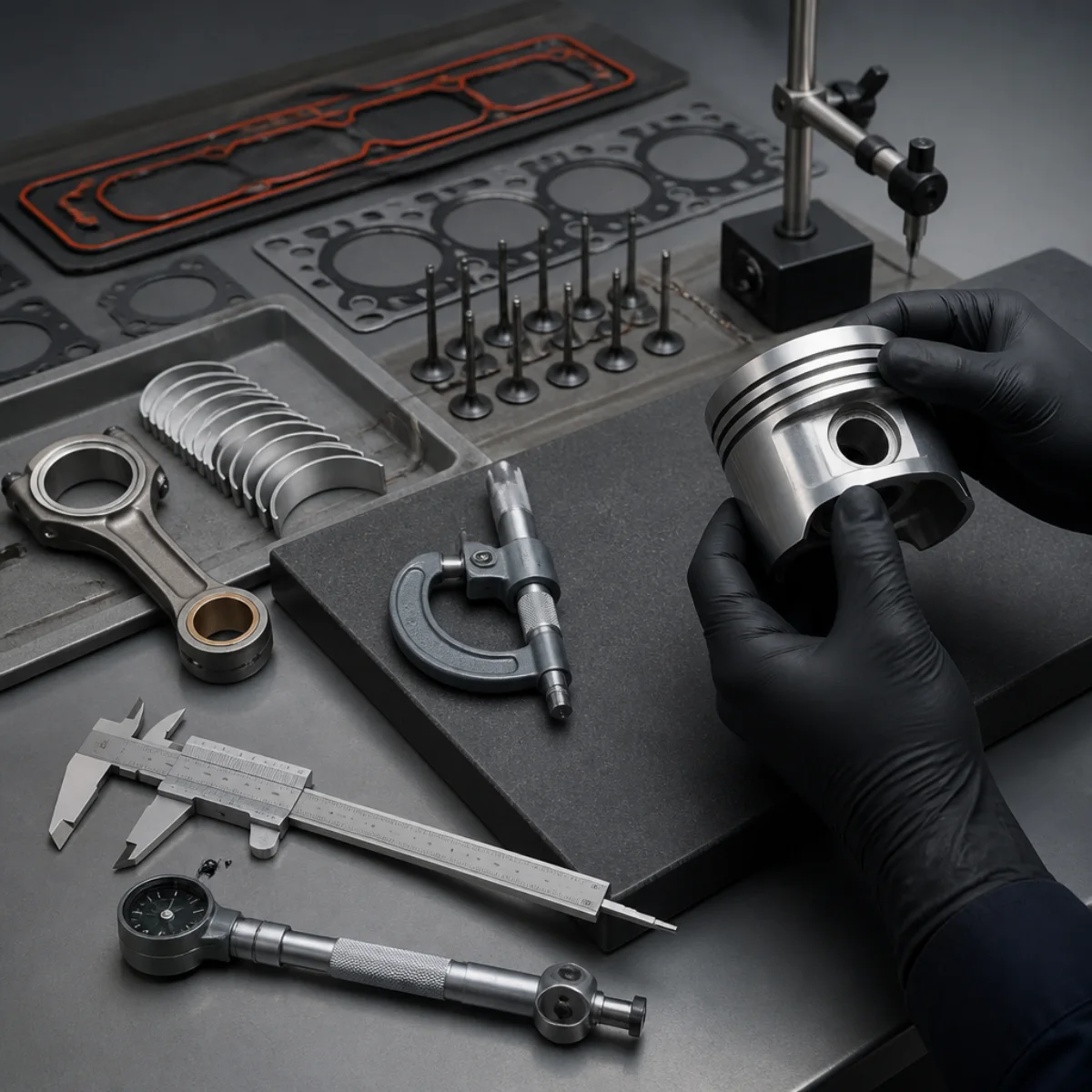
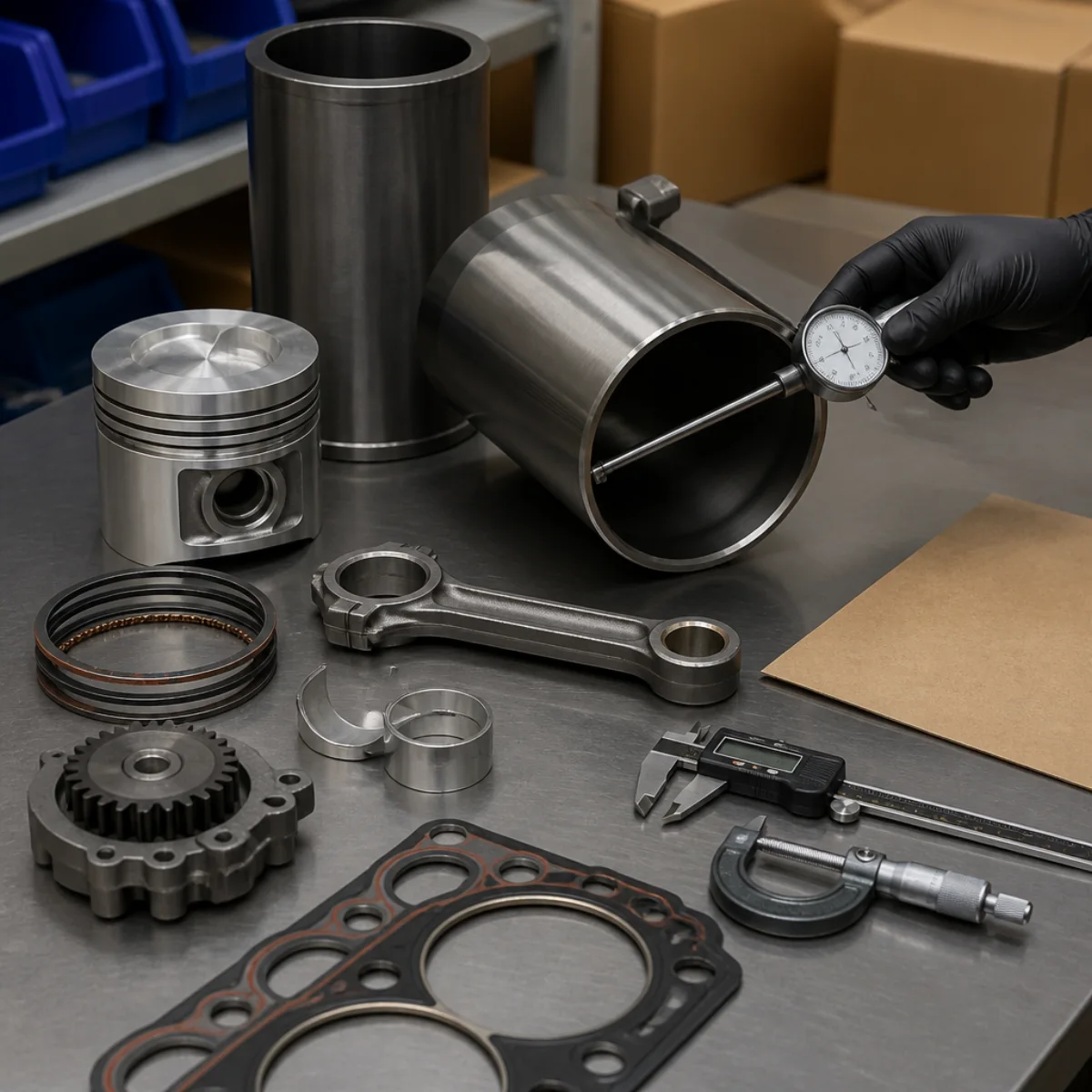
Price comparison is useful only after every supplier is quoting the same package. A gasket-heavy overhaul kit and a machining-ready master kit can both be marketed as an engine rebuild kit for Jeep 4.0, while the cartons may contain very different parts. The RFQ should state whether the required package includes pistons, piston rings, main bearings, rod bearings, thrust components, a full gasket set, valve stem seals, timing set, freeze plugs, oil pump and small hardware.
Exclusions deserve the same attention as inclusions. If cam bearings, lifters, pushrods, head bolts, harmonic balancer parts, core plugs or oiling components are not included, the quotation should say so before sample approval. That prevents a low unit price from hiding missing parts that customers expect for the rebuild route.
Use a kit matrix rather than a short product name. Put one component on each row and record quantity per engine, size option, declared material or coating, disclosed brand or manufacturer, substitution rule, package position and label requirement. For private-label or distributor packaging, align carton layout and internal protection through custom manufacturing discussions before sample packing. Packaging is part of the commercial product because it controls identification, protection and receiving accuracy.
Use Bore And Stroke As Size Gates
The research pack supports a limited set of dimensional anchors. The supplied specification excerpt states that the Jeep 4.0L Power Tech engine has a standard bore of 98.4 mm and a standard stroke of 87.4 mm. It also states a cooling-system capacity of 11.4 L. Cooling capacity is not a piston-sizing dimension, but it helps keep gasket and cooling-related discussions tied to the same engine context.
The Wrangler Forum thread gives a reported standard-bore range of 3.8759 in to 3.8775 in, attributed by the forum participant to Mopar Performance Parts. Because this is user-posted secondary evidence from Jun. 23, 2014, it should not be used by itself to order pistons or rings. Use it to sharpen the questions: what finished bore will the machine shop deliver, what piston clearance does the supplier specify for the quoted part number, what ring set matches that bore, and how are standard, oversize and undersize components separated in stock?
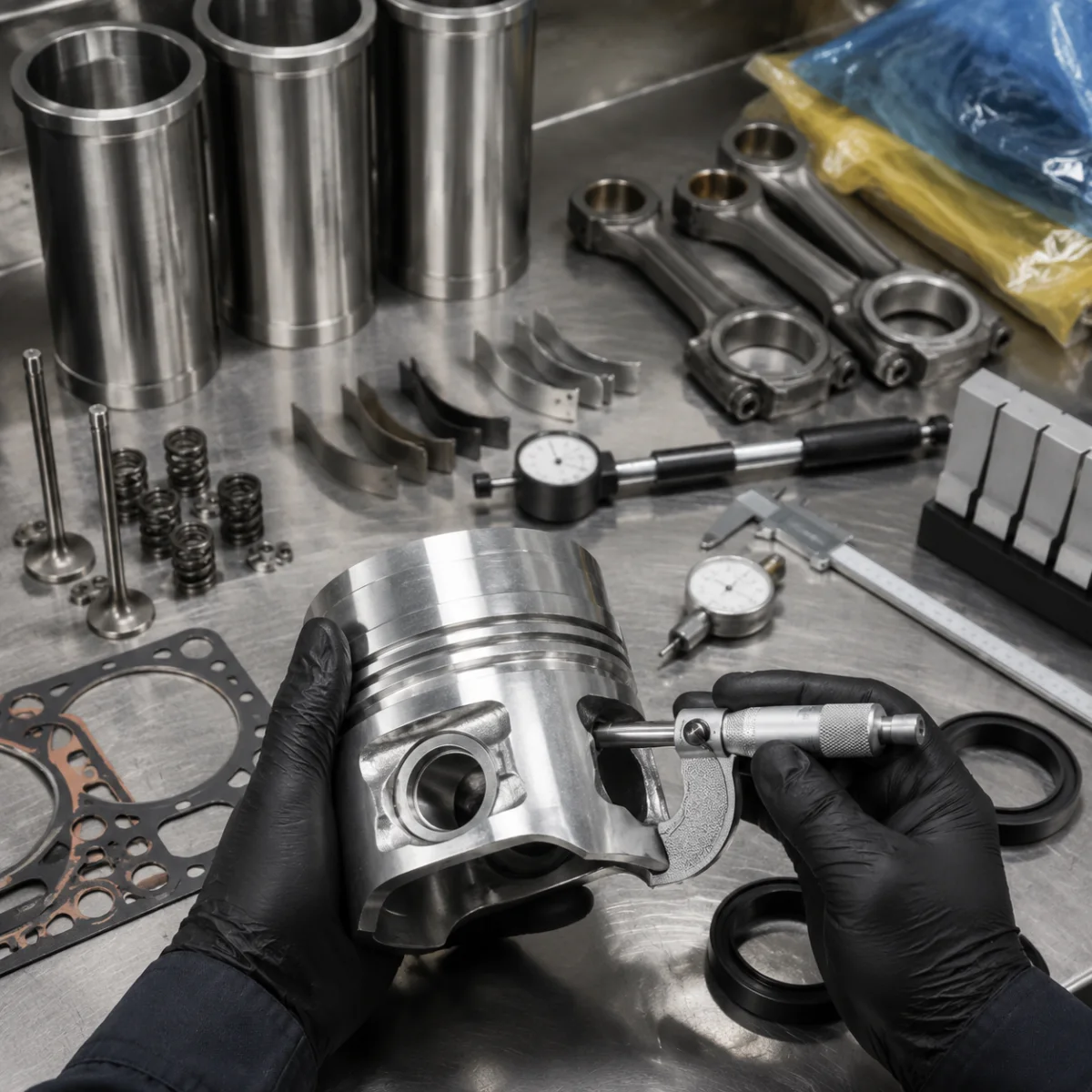
Turn those questions into procurement gates. Confirm the engine family and block identity first. Measure each cylinder before choosing standard or oversize piston and ring variants. Measure crank journals before selecting main and rod bearings. Request supplier drawings or inspection records for the piston, ring and bearing sizes being quoted. Finally, check that labels, cartons and batch records match the selected size variant. Many avoidable returns begin with a nominally correct application and the wrong machining size.
Ask For Part Evidence, Not Generic Claims
A Jeep 4.0 rebuild-kit RFQ should convert public dimensions into part-specific evidence requests. For pistons, ask for the quoted diameter class, oversize option, pin-bore control, ring-groove inspection points, visible coating or surface-treatment description if offered, and the supplier's recommended piston-to-bore clearance for the exact part number. For rings, ask for bore size, ring position, ring width, end-gap guidance, face material or coating if declared, and pack identification. For bearings, require main and rod bearing size class, undersize options, shell marking method, thrust-bearing treatment and journal-size compatibility evidence.
For gaskets and seals, avoid a quotation line that only says "full gasket set." Ask for a count and material description: head gasket construction, intake and exhaust gasket material, oil-pan gasket material, valve-cover gasket material, seal material where disclosed, and packing method for flat gaskets. If material details are not disclosed, the quotation should still identify included items, excluded items and items subject to substitution.
Tolerance language needs discipline. Do not publish a tolerance unless it appears in current service literature, supplier drawings or inspection records for the quoted parts. Instead, require the supplier to state inspection dimensions, measurement method, sampling basis, gauge type and pass/fail criteria for the lot being shipped. That gives the buyer reviewable evidence without turning an unverified catalogue phrase into a technical claim.
Send One RFQ Format To Every Supplier
A structured RFQ makes supplier answers comparable. Send the same fields to each candidate and treat missing information as a commercial risk, especially when a counteroffer does not disclose kit contents, dimensional options or substitution rules.
| RFQ field | What to request | Buyer decision it supports | ||
|---|---|---|---|---|
| Application scope | Engine family, vehicle application range and excluded variants | Confirms the quote is not relying on a loose fitment label | ||
| Rebuild route | Standard bore, oversize bore, standard crank or undersize bearing options | Matches the kit to measured machining outcomes | ||
| Bill of materials | Component list with quantities per engine and excluded items | Separates master kits from partial kits | ||
| Critical dimensions | Supplier drawings or inspection points for pistons, rings, bearings and gaskets | Allows engineering review before price selection | ||
| Material declarations | Declared materials, coatings or surface treatments for pistons, rings, bearings, gaskets and seals where available | Separates documented part construction from marketing descriptions | ||
| Test and inspection evidence | Dimensional reports, gasket checks, bearing-size verification, packing inspection and batch traceability | Shows how the quoted lot will be verified | ||
| Substitution rule | Written approval process for brand, material, coating or source changes | Prevents production shipments from drifting after sample approval | ||
| Sample pack | 1 complete kit packed as a commercial shipment, with size labels and internal separation | Tests labels, corrosion protection, separation and carton logic | ||
| Quality records | Batch traceability, incoming or final inspection records and material declarations | Supports buyer verification without implying certification | ||
| Quotation basis | MOQ, lead-time basis, packaging charges, validity and Incoterms if quoted | Keeps commercial comparison consistent |
| Data point | Value | Scope | As of | Evidence |
|---|---|---|---|---|
| 4.0L engine family | 4.0 L | Jeep Power Tech inline engine family identified in the specification excerpt used for rebuild-kit fitment context | Retrieved 2026-07-15; source excerpt did not state a publication date | Used to identify the engine family discussed throughout the sourcing article. Source |
| Cylinder count | 6 cylinders | Inline cylinder count stated for the Jeep 4.0L Power Tech engine in the supplied specification excerpt | Retrieved 2026-07-15; source excerpt did not state a publication date | Used to explain why kit contents and gasket layout must match the inline-6 engine family. Source |
| Standard bore metric | 98.4 mm | Standard bore stated for the Jeep 4.0L Power Tech engine block in the supplied specification excerpt | Retrieved 2026-07-15; source excerpt did not state a publication date | Used as a procurement gate for piston, ring and machining discussions. Source |
| Standard stroke metric | 87.4 mm | Standard stroke stated with the bore for the Jeep 4.0L Power Tech engine block in the supplied specification excerpt | Retrieved 2026-07-15; source excerpt did not state a publication date | Used to frame engine identity and avoid treating the kit as a generic vehicle-badge item. Source |
| Cooling capacity reference | 11.4 L | Cooling-system capacity stated for the Jeep 4.0L Power Tech engine in the same specification excerpt | Retrieved 2026-07-15; source excerpt did not state a publication date | Used only as ancillary context for checking gasket and cooling-related kit discussions. Source |
| Firing-order sequence | 1-5-3-6-2-4 sequence | Firing order stated for the Jeep 4.0L Power Tech engine in the supplied specification excerpt | Retrieved 2026-07-15; source excerpt did not state a publication date | Used as engine-identity context, not as a rebuild-kit performance claim. Source |
| Main bearing count | 7 main bearings | Crankshaft support count stated for the Jeep 4.0L Power Tech engine in the supplied specification excerpt | Retrieved 2026-07-15; source excerpt did not state a publication date | Used to reinforce why bearing quantity and size class must be checked in the kit bill of materials. Source |
| Camshaft bearing count | 4 camshaft bearings | Camshaft bearing count stated for the Jeep 4.0L Power Tech engine in the supplied specification excerpt | Retrieved 2026-07-15; source excerpt did not state a publication date | Used as an inspection and bill-of-materials check when cam bearings are included or excluded. Source |
| Forum lower bore limit | 3.8759 in | Wrangler Forum participant's reported lower standard-bore figure for a Jeep 4.0 cylinder, attributed in the post to Mopar Performance Parts | Thread post dated Jun. 23, 2014; retrieved 2026-07-15 | Used as secondary screening evidence, not as controlling service literature. Source |
| Forum upper bore limit | 3.8775 in | Wrangler Forum participant's reported upper standard-bore figure for a Jeep 4.0 cylinder, attributed in the post to Mopar Performance Parts | Thread post dated Jun. 23, 2014; retrieved 2026-07-15 | Used to explain why buyers should confirm current data and actual bore measurements. Source |
Methodology
Public source excerpts were reviewed for engine-family identity, dimensional values and sourcing relevance. Claims were limited to figures visible in the supplied excerpts, while forum material was downgraded to secondary screening context. The buyer workflow was derived from those limited data points plus neutral procurement controls: RFQ comparison, sample approval, size verification, material declaration review, inspection-record review and document control. Values were not charted because bore, stroke, cooling capacity, bearing counts and forum-reported bore limits do not share one exact unit and scope.
Limitations and what to verify
- The specification excerpt does not prove current service-manual status or supplier compatibility; buyers should verify current drawings, OE service data, finished bore size, crank journal measurements and sample reports before ordering.
- The forum bore range is secondary user-posted evidence, even though it attributes the figures to Mopar Performance Parts; buyers should confirm the numbers against current technical documentation and machine-shop measurements.
- No supplier certification, production capacity, defect rate, lead time, export capability, facility operation or customer outcome is established by the cited sources; buyers should request current certificates, inspection records, quotations and packaging samples from each supplier.
Sources used
- Jeep 4.0L Engine Specifications Guide | PDF — scribd.com. Supported the Jeep 4.0L engine family context, cast-iron inline 6-cylinder description, standard bore, standard stroke, cooling-capacity reference, firing order and bearing-count context.
- Stock 4.0 Cylinder Dimensions — wranglerforum.com. Provided secondary standard-bore figures used as buyer-screening prompts, with caution about verification.
Frequently asked questions
The buyer should define the kit by bill of materials. Common scope may include pistons, rings, main bearings, rod bearings, gaskets, seals, timing parts and oiling items, but suppliers vary. Ask for quantities, size options, exclusions and substitution rules before comparing quotations.
They should be used only as a starting point. The evidence includes a 98.4 mm standard bore from a public specification excerpt and a forum-reported 3.8759 in to 3.8775 in range from a Jun. 23, 2014 thread. Final piston and ring selection should follow measured finished bore, current service data and the supplier's documented piston and ring specifications.
Request dimensional inspection records for pistons, rings and bearings; gasket and seal material information where available; batch traceability; packing inspection records; carton-label examples; and any current certificate the supplier chooses to claim. Check the records against the exact part numbers, size classes and lot being quoted.
Use the same RFQ pack for every supplier: application scope, rebuild route, kit contents, drawings, size options, material declarations, sample pack, inspection records, packaging requirements and quotation terms. Reject vague complete-kit descriptions unless the supplier provides a clear component list and documented size control.
No. In sourcing copy, those names should be used only for fitment and reference context. They do not imply approval, certification or endorsement. Buyers should verify application, measurements, samples and documents before publishing catalogue claims or placing bulk orders.
For a defined Jeep 4.0 rebuild kit RFQ, prepare your application range, target kit contents, machining size options and document requirements, then request a quote.
Request a Quote