White Smoke From Exhaust: Exhaust Manifold Gasket Checks
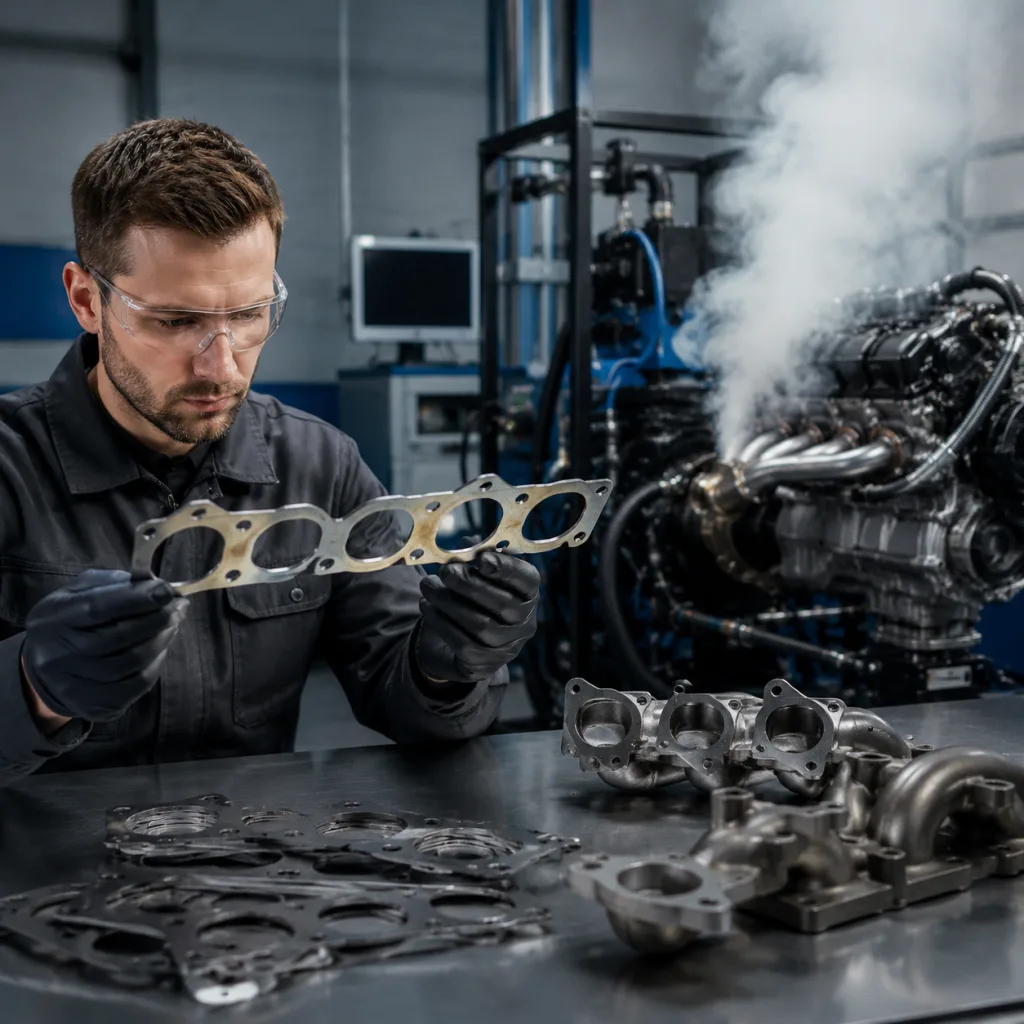
White smoke from exhaust usually points first to coolant entering the combustion chamber, but an exhaust manifold gasket can still be part of the fault chain. On engines with a nearby cooling leak, a cracked manifold, warped flange, or failed gasket can leave hot spots, misfire, and visible vapour that is easy to misread. For procurement teams and workshop buyers, the practical question is whether the gasket is sealing to OE dimensions, the mating faces are flat, and the replacement part has been validated for the engine family. Driventus is an independent aftermarket manufacturer; brand names are referenced for fitment only. We supply exhaust sealing components built under IATF 16949:2016 and ISO 9001:2015 controls, with material and dimensional checks that support repeatable fitment across export markets.
What white smoke usually means
White exhaust smoke is commonly described as steam. In a service environment, the first checks are coolant level, oil condition, misfire data, and whether the smoke appears only at cold start or continues after warm-up.
Typical diagnostic pattern:
Observation
Likely direction
Sweet smell, coolant loss
Coolant ingress
Persistent smoke after warm-up
More serious internal leak
Smoke with rough idle
Possible misfire or sealing issue
Smoke near manifold area
External leak, gasket, or crack
</tr></thead><tbody> </tbody></table>In practice, a technician should separate normal condensation from a fault condition using temperature and time. Steam that clears within 30–90 seconds of a cold start and does not return after a fully warm engine is usually condensation. By contrast, white smoke that continues after 5–10 minutes of running, especially with coolant loss above 50–100 ml per 100 km, points toward coolant intrusion or combustion sealing failure. An exhaust manifold gasket is not the usual root cause of white smoke, but it can coexist with a coolant leak, warped manifold, or a cylinder head issue. That is why diagnosis should separate combustion symptoms from exhaust sealing defects before replacement decisions are made.
How the exhaust manifold gasket fits the fault chain
The exhaust manifold gasket seals the joint between the cylinder head and manifold. If the seal fails, hot exhaust can escape at the flange, oxygen can enter the system, and the engine control unit may see abnormal oxygen readings downstream.
A failed gasket can produce:
Ticking or chuffing noise on cold start
Soot marks around the port area
Slow oxygen sensor response
Localised overheating near the flange
Reduced turbo spool on turbocharged applications
A practical check is to verify the leak point before replacement. Manifold-side leakage often shows a soot halo within 5–20 mm of the flange edge, while coolant-related white smoke usually leaves evidence in the cooling system or combustion chamber. A gasket leak alone does not create coolant vapour, but it can add enough noise, smell, and visible haze at the engine bay to hide the real root cause. For procurement and repair chains, the key is to stock the correct gasket thickness, port spacing, and heat resistance for the engine code, not only the vehicle model.
Inspection steps before replacement
Use a structured inspection sequence before ordering parts.
1. Check coolant level and pressure test the cooling system to the cap rating, typically 0.9–1.4 bar depending on the vehicle. 2. Inspect the manifold face for cracks, warping, or erosion. 3. Confirm whether smoke exits the tailpipe or only the engine bay. 4. Look for black soot trails around the gasket perimeter. 5. Measure flange flatness and bolt-hole alignment. 6. Verify bolt torque history and fastener stretch if applicable.
For a flatness check, use a straightedge and feeler gauge across the sealing face. As a working shop tolerance, many buyers target no more than 0.05–0.10 mm deviation across the flange length, while anything beyond 0.20 mm should trigger resurfacing or component replacement, subject to OE service data. Fasteners should also be assessed: reusable bolts must stay within length and yield limits specified by the platform, and torque-to-yield hardware should not be reused once stretched.
If the engine has repeated gasket failure, inspect the mating surfaces and adjacent components. A gasket should not be blamed for a distorted manifold or a head face outside tolerance. In our catalog, buyers often pair the gasket with bolts, studs, and related sealing parts to reduce comeback risk. Where a platform requires a broader sealing package, our quality system documents dimensional control, inspection points, and traceability practices.
Replacement criteria for procurement teams
For replacement buying, the decision should be based on fitment data and material performance rather than vehicle description alone. Important specifications include compressed thickness, port geometry, reinforcement layers, and coating type.
Compare these points before purchase:
OE cross-reference and engine code match
Number of ports and bolt pattern
Material type: multilayer steel, graphite, or composite
Heat cycling resistance for the duty cycle
Surface finish and embossing quality
Packaging traceability and batch identification
Typical buyer acceptance targets include compressed thickness within ±0.05 mm of the approved sample, port location within ±0.20 mm, and bolt-hole positional accuracy within ±0.15 mm, unless the OE drawing specifies tighter limits. For high-temperature applications, buyers often request materials rated for continuous exhaust exposure above 450°C and short-term peaks closer to 700–900°C, depending on engine layout and turbo proximity.
Driventus supports custom manufacturing when a platform needs a special thickness, coating, or port configuration. For buyers handling mixed fleets, the safest approach is to validate against the engine family first, then confirm the OE cross-reference such as `OE 06A107065` where applicable.
Testing and compliance expectations
For B2B buyers, gasket quality should be verified by measurable controls. Relevant references include IATF 16949:2016 for automotive process discipline, ISO 9001:2015 for quality management, and REACH (EC) No 1907/2006 for chemical compliance in the EU.
Useful validation checks include:
Thickness after compression
Recovery after heat cycling
Leak integrity under exhaust temperature load
Bolt-load retention after thermal soak
Corrosion resistance of coatings and inserts
A practical incoming-sample plan is to inspect the first 5–10 units from each batch, then measure thickness, port alignment, and visual finish against the approved master. Many buyers also specify zero visible delamination, no coating flake larger than 0.5 mm, and no post-cycle leak under a pressure or flow test defined by the application. Where products are used in broader exhaust or emissions-related assemblies, the application may also require alignment with customer specifications for thermal durability. For sourcing teams, published test data is more useful than general claims. That is especially true when a white smoke complaint is being investigated alongside manifold sealing loss and sensor faults.
What to stock for service reliability
Repair chains and distributors should carry parts that reduce diagnostic uncertainty and installation error.
Recommended stocking approach:
Engine-code-specific exhaust manifold gaskets
Matched fastener kits where required
Mating seals for adjacent exhaust joints
Service notes for torque sequence and re-torque limits
Batch-controlled inventory for warranty tracking
A practical stocking rule is to hold 4–8 weeks of sell-through for fast-moving engine families and 1–2 months of cover for heavier-duty or low-volume applications. MOQ should be reviewed against lane velocity: for standard catalogue items, buyers often prefer cartons of 25–100 units, while custom or platform-specific parts may require 300–1,000 units depending on tooling, packaging, and material setup. On pricing, request tiered breaks by 100/500/1,000 pieces and confirm whether quoted prices include inner-box labels, palletisation, and test reports, because those details materially affect landed cost.
If you are consolidating procurement across platforms, start with our catalog and, where needed, the broader engine components range. Buyers looking for high-volume supply can also use request a quote to confirm lead time, MOQ, and packaging requirements before release order planning.
Frequently asked questions
Usually no. White smoke normally indicates coolant or condensation. A failed gasket can still contribute indirectly by creating exhaust leaks, masking the real fault, or occurring alongside a coolant-side issue.
Check coolant level, perform a pressure test, inspect the manifold face for soot, and confirm whether the smoke comes from the tailpipe or the engine bay. That separates internal and external faults.
Yes. Use engine code and OE reference together, such as `OE 06A107065` where applicable. Driventus is an independent aftermarket manufacturer; brand names are referenced for fitment only.
If you need a fit-checked replacement or a sourcing review for a specific engine family, use our contact form and we will confirm the correct specification for your market: /contact.html