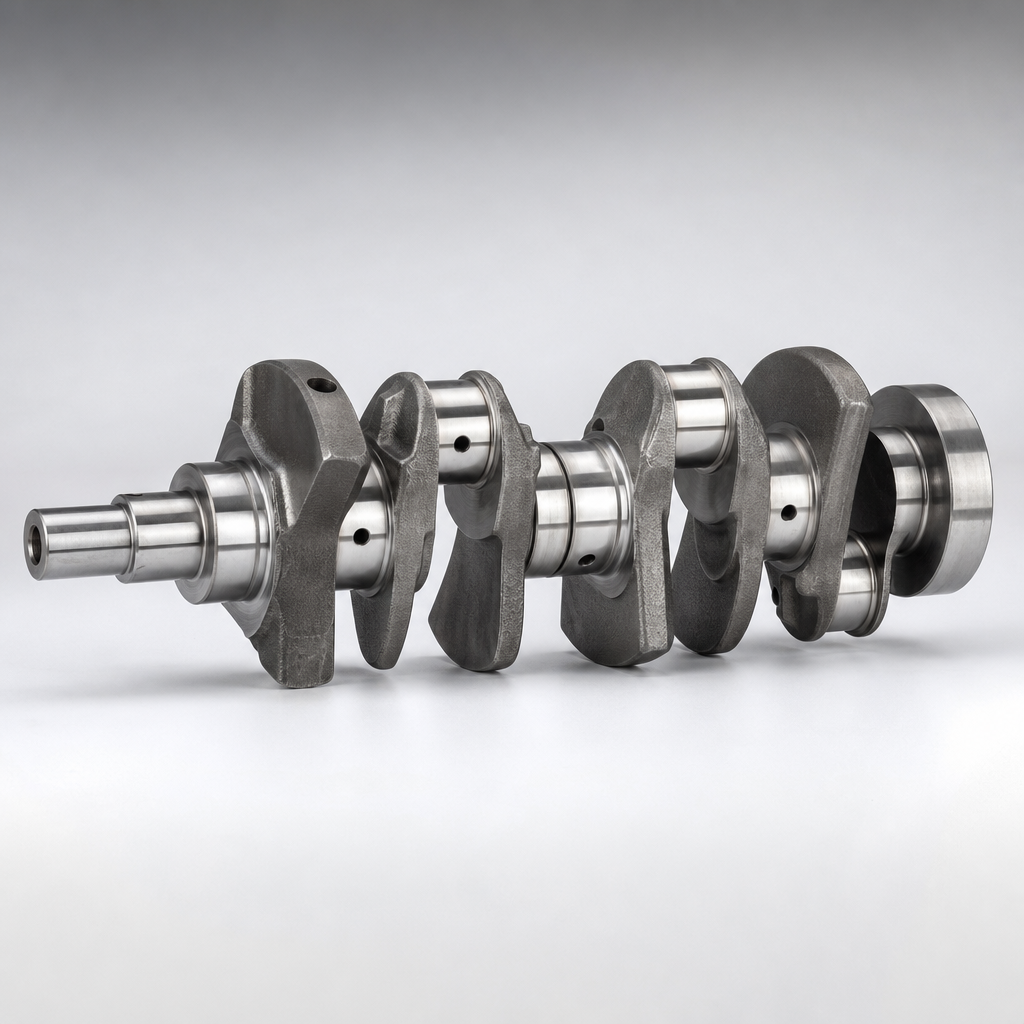
Buying a camshaft for Jaguar applications is a sourcing exercise, not a catalogue exercise. Procurement teams need dimensional consistency, traceable metallurgy, repeatable heat treatment, and stable supply terms across every purchase order. That matters more when the part must align with engine-family requirements, valvetrain geometry, and the inspection controls used by downstream assemblers or remanufacturers. Driventus is an independent aftermarket manufacturer; brand names are referenced for fitment only. We manufacture camshafts in a vertically integrated plant in Taizhou, Zhejiang, and export to 60+ countries under IATF 16949:2016 and ISO 9001:2015 controls. For buyers comparing suppliers, the key question is not whether a part looks similar. It is whether the supplier can hold profile accuracy, journal finish, and hardness consistency across production lots, with documentation that stands up to incoming inspection and audit review. For a typical Jaguar camshaft programme, buyers should expect controlled production against a signed drawing, a defined sample-approval route, and lot-level traceability back to the heat number and furnace run.
What to confirm before you request a quote
For Jaguar camshaft sourcing, start with the controls that affect fit and durability, not the sales description.
OE cross-reference or confirmed application mapping
Base material and blank route
Heat-treatment method and case or core hardness targets
Journal diameter, lobe lift, and phase timing tolerances
Surface finish on journals and lobes
Packaging, preservation oil, and corrosion protection
Traceability to heat number and batch record
Approved drawing revision and inspection standard
A buyer should request the dimensional target set before quoting, not after. For a production-ready part, the minimum technical file should include journal diameter tolerance, total indicated runout, lobe lift, base circle size, lobe-to-lobe indexing, and the target roughness on the bearing surfaces. Typical control values for a precision aftermarket camshaft programme are runout within 0.02-0.05 mm, journal diameter within +/-0.01 to +/-0.02 mm depending on the application, and surface roughness around Ra 0.2-0.4 um on critical journals after grinding. Those limits vary by engine family, but a supplier should be able to state the actual target rather than speak only in generalities.
Typical buyer questions include MOQ, sample policy, and lead time. Those are valid, but they do not come before the technical file. A supplier should be able to show dimensional inspection records, hardness data, and the revision state of the drawing or control plan. For Jaguar applications with variable valve timing, the validation package should also show that the part matches the intended engine variant and phaser interface. If you are building a sourcing shortlist, start with our catalog and filter by engine family rather than by vehicle badge alone.
Where certification removes supply risk
Camshaft supply is a process control problem. The part spends its life under cyclic loading, so small deviations in profile or hardness can become noise, misfire, wear, or oiling complaints downstream.
Driventus operates under IATF 16949:2016 and ISO 9001:2015. For buyers, that means the manufacturing system is built around documented controls, not ad hoc final inspection. The records that matter most are:
Control point
Why it matters
Incoming material verification
Confirms alloy grade and traceability
CNC turning and grinding control
Protects journal geometry and concentricity
Heat-treatment records
Supports hardness stability and wear resistance
Final metrology
Confirms lift, base circle, and lobe indexing
Packaging inspection
Reduces transit damage and rust risk
</tr></thead><tbody> </tbody></table>For export markets, ask whether the supplier can support REACH (EC) No 1907/2006 documentation where applicable, and whether any surface coatings or oils are declared. If the part is destined for regulated applications, request the control plan and inspection format before first order release. Buyers using supplier scorecards should also review the quality system rather than relying on verbal assurance. In practical terms, a buyer should expect hardness confirmation in the 50-60 HRC range for many hardened camshaft programs, with the exact target tied to the alloy and heat-treatment route. Ask for both the target and the allowable spread, because a hardness number without a tolerance is not enough to manage incoming inspection.
Jaguar fitment is a timing problem, not a badge problem
Jaguar engine programmes often involve closely related variants, and that is where sourcing mistakes happen. A camshaft may fit physically but still fail to match timing, lobe separation, or sensor phasing requirements.
When we receive an enquiry, we map the request against engine code, displacement, valve-train layout, and OE cross-reference. We do not claim OEM approval or endorsement, and we do not treat badge similarity as proof of interchangeability. Driventus is an independent aftermarket manufacturer; brand names are referenced for fitment only.
What we validate before production:
1. Engine family and model-year range 2. Intake or exhaust position 3. Sensor and phaser interface details 4. Journal and lobe dimensional targets 5. Surface hardness and runout limits 6. Packaging and labelling requirements 7. Any note on VVT phasing angle, keyway position, or trigger wheel geometry
For a release package, the buyer should provide the OE number, VIN or engine code, and the measured sample if the part is being reverse-matched. A good supplier will then confirm the critical features back in writing. That should include the nominal lobe lift, lobe centerline or timing window if available, and the acceptable deviation from the reference part. Where a program uses variable cam timing, the interface check must include the phaser bolt pattern, trigger position, and installed timing relationship. For related engine parts, see our engine components.
Lead time and MOQ depend on part status
Sourcing managers usually need three numbers before they can move a project forward: MOQ, sample lead time, and production lead time. Those numbers depend on whether the camshaft is a stocked item, a semi-custom item, or a fully custom programme.
Stocked catalogue item: shortest lead time, lowest setup cost
Semi-custom item: requires drawing review and tooling confirmation
Custom manufacturing: requires process validation and approval of first samples
For planning purposes, a stocked camshaft can often ship in 7-15 days after order confirmation if inventory is available. Semi-custom orders usually need 20-35 days, and fully custom programs commonly run 30-45 days for first samples and 35-60 days for production after approval, depending on tooling readiness and heat-treatment capacity. These are working ranges, not promises, and the actual commitment should be tied to the exact part status and order quantity.
MOQ depends on process route and packaging requirement. For many aftermarket camshaft programs, trial orders can start at 20-50 pieces when the item is already tooled and validated, while a new production run may require 100-300 pieces to make the setup economical. If the part is private-label or needs special cartons, barcode labels, or serialized lot tracking, the MOQ may increase because the packaging line becomes part of the setup cost.
Commercially, buyers should ask for three separate price states: sample price, production unit price at the target annual volume, and a forecast price for 6-12 months if the program is replenished. That makes it easier to compare suppliers that quote only a low initial price but load the cost into tooling or packaging. For larger programmes, we can support phased supply so the buyer can qualify samples, run bench validation, and then release a production order. That structure reduces risk when a new supplier is being added to an approved vendor list. If your team needs private-label packaging, barcodes, or documented lot traceability, we can align the order flow accordingly. For commercial enquiries, use request a quote so the application data and volume assumptions stay attached to the record.
What an audit should prove on site
A factory audit for camshaft supply should focus on the operations that create variation. The cleanest audit report is not the most useful one unless it shows how parts are actually controlled.
Check the following on site or through a remote audit pack:
Material storage and heat number segregation
CNC programme control and revision management
Grinding wheel management and dressing records
Heat-treatment furnaces and calibration status
Measuring equipment calibration and gauge R&R where available
Final inspection criteria for runout, diameter, and lobe profile
Nonconforming product handling and corrective action records
First article inspection format and sign-off responsibility
Sampling frequency for in-process checks and final lot release
A serious audit should also confirm how the supplier handles rework, scrap, and deviation approval. Ask for examples of the actual inspection sheet, not a presentation slide. The buyer should see the measurement device used for lobe height, the gauge resolution, the calibration date, and the acceptance rule for each critical characteristic. For camshaft programs, a practical incoming check often includes journal diameter, total runout, overall length, and one or two functional dimensions taken from the reference drawing. If the supplier says “all parts inspected,” ask what that means in pieces per lot, because 100 percent visual inspection is not the same as dimensional control.
If your organisation requires supplier qualification evidence, we can provide documentation aligned to the order scope, including inspection records and export packing details. For customised engine programmes, see custom manufacturing.
Frequently asked questions
Yes. We work from OE cross-reference data, engine code, and application details. We verify dimensional targets and functional interfaces before release. Driventus is an independent aftermarket manufacturer; brand names are referenced for fitment only. For quoting, we normally need the OE number, engine code, quantity target, and whether the part is intake or exhaust.
Typical documents include material traceability, inspection records, packing list, and certification references tied to the order scope. Additional documents can be supplied based on customer audit requirements. For controlled shipments, we can also align documents to the lot number, heat number, and shipment date so the buyer can tie the shipment back to the inspection record.
Yes, depending on the part status and tooling condition. Trial orders are useful for fitment checks, bench testing, and qualification before a larger production release. Trial quantity is usually lower than production MOQ for an existing tool, but the exact minimum depends on whether the part is stocked, semi-custom, or fully custom.
Review the technical fitment data in [our catalog](/products.html), then send the application details and target volume through [request a quote](/contact.html) so we can confirm lead time, MOQ, inspection scope, and supply terms.